
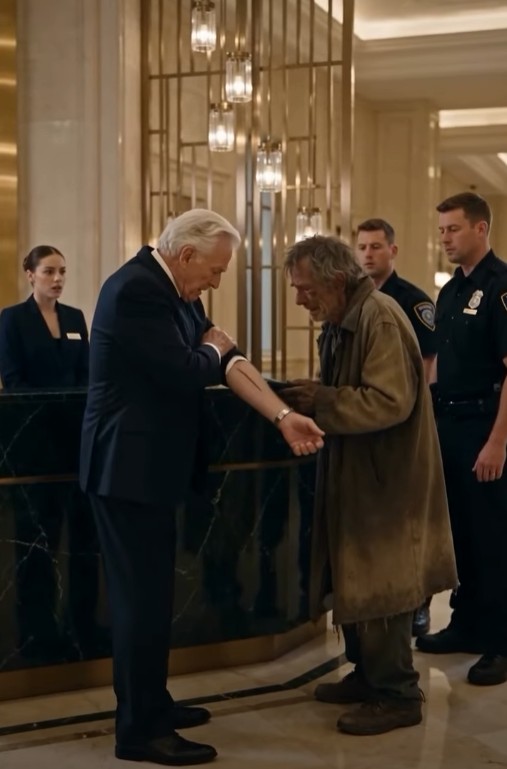
A homeless man walked into a five-star hotel to return a lost wallet.
And within seconds, security was being called.
The man’s name was Samuel.
He was in his late sixties.
His brown coat was torn at one sleeve.
His shoes were badly worn.
And he carried everything he owned in one faded backpack.
The marble lobby was filled with business travelers, expensive luggage and polished shoes.
Samuel looked painfully out of place.
The receptionist glanced at him.
“Sir, you can’t stay here.”
Samuel stopped.
“I’m not staying.”
“Then what do you need?”
He reached into his coat.
The receptionist immediately stiffened.
Samuel slowly placed a black leather wallet on the counter.
“I found this outside.”
She looked at it.
Then at him.
“I only came to return it.”
Before she could answer, another employee stepped closer.
“Should I call security?”
Samuel sighed.
“If you want.”
Then the elevator doors opened.
A tall elderly man stepped into the lobby surrounded by two assistants.
His name was Richard Hale.
He was seventy-two.
A businessman whose real-estate company had become one of the largest in the region.
Most people in the hotel knew who he was.
Samuel did not seem to care.
Richard took three steps.
Then stopped.
He stared at Samuel.
His face went pale.
One assistant asked:
“Mr. Hale?”
Richard did not answer.
His hands began trembling.
Then he whispered:
“Samuel?”
The homeless man slowly turned.
For several seconds, the two elderly men simply looked at each other.
Richard stepped closer.
“Samuel Carter?”
Samuel’s eyes narrowed.
“Do I know you?”
Richard looked as though he had forgotten how to breathe.
“It’s Richard.”
Samuel stared.
Then something changed in his expression.
“Richard Hale?”
Richard nodded.
The receptionist looked between them.
Nobody understood.
Richard stepped forward.
“Is it really you?”
Samuel gave a small, tired smile.
“Depends who’s asking.”
Richard’s eyes filled with tears.
He reached for Samuel’s hand.
Samuel hesitated.
Then let him take it.
Richard whispered:
“You saved my life.”
The entire lobby seemed to go silent.
Thirty years earlier, Richard Hale was not yet a billionaire.
He was a regional property developer trying to turn one successful project into a business.
One of those projects was a six-story commercial building under construction on the edge of the city.
Samuel worked there as a carpenter.
He was thirty-eight.
Strong.
Quiet.
Known mostly for arriving early and leaving exactly on time because he had two young children waiting at home.
Then, one afternoon, part of the unfinished building collapsed.
The cause was later traced to a combination of structural failure and unsafe temporary support.
Workers ran.
Dust filled the site.
People shouted.
Several men escaped through the ground floor.
Richard did not.
He had been meeting a contractor inside when the collapse happened.
A section of ceiling came down.
Richard was struck and trapped behind broken timber and debris.
He could hear people outside.
But he could not move properly.
Then the shouting grew farther away.
Richard believed everyone had left.
Until someone came back.
Samuel.
Richard remembered almost nothing clearly from the first few minutes.
Only Samuel’s voice.
“Stay awake.”
Then:
“I’m getting you out.”
Samuel should not have gone back inside.
Emergency crews had not yet declared the area safe.
Later, he admitted that.
He knew the risk.
But through an opening, he had seen Richard moving.
Samuel used a piece of timber as leverage.
Cleared smaller debris.
Then helped drag Richard through a narrow gap toward the stairwell.
By the time firefighters reached them, both men were covered in dust.
Richard had a fractured leg and several other injuries.
Samuel had badly injured his shoulder.
Both survived.
Richard spent weeks recovering.
When he returned to work, he asked about Samuel.
The construction company told him Samuel had left.
Richard assumed he had gone home to recover.
He sent a letter.
It came back.
He asked the site foreman.
No forwarding address.
He tried again months later.
Nothing.
Then the company handling Samuel’s employment shut down.
Records were poor.
People moved.
Years passed.
Richard never forgot him.
He paid for advertisements asking former workers from the site to contact him.
He spoke to labor offices.
Old subcontractors.
Former supervisors.
Nothing.
He even hired a private investigator years later.
Still nothing.
Richard’s business grew.
One project became ten.
Ten became dozens.
His name appeared on towers, hotels and commercial developments across the city.
But one unresolved story stayed with him.
The carpenter who had gone back into a collapsing building when everyone else was running out.
Now that man was standing in front of him.
Homeless.
Holding someone else’s lost wallet.
Richard looked overwhelmed.
“What happened to you?”
Samuel pulled his hand away gently.
“That’s a long story.”
Richard turned to the receptionist.
“Was he being asked to leave?”
Nobody answered.
Samuel did.
“I was returning a wallet.”
Richard looked at the black wallet.
Then toward the receptionist.
“Whose is it?”
She opened it carefully.
There was identification inside.
The wallet belonged to a hotel guest.
Cash was still there.
Cards.
Everything.
Samuel said:
“I found it near the taxi entrance.”
Richard looked at him.
“You could have kept the money.”
Samuel’s expression hardened.
“Why would I do that?”
Richard immediately regretted the question.
“I didn’t mean—”
“I know what I look like.”
The words landed harder than shouting would have.
Samuel continued.
“But being poor doesn’t make something mine.”
Richard looked down.
“You’re right.”
He turned to the hotel manager, who had now appeared.
“Find the owner.”
Then Richard looked back at Samuel.
“And bring us somewhere private.”
Samuel shook his head.
“No.”
Richard was confused.
“No?”
“I’m not here for charity.”
“I didn’t say charity.”
“You were about to.”
Richard knew him well enough, somehow even after thirty years, to stop pushing.
So instead he asked:
“Can I buy you breakfast?”
Samuel considered it.
“That depends.”
“On what?”
“Is the coffee here worth what you charge for it?”
Richard laughed.
For the first time, Samuel did too.
They sat in a quiet corner of the hotel restaurant.
Samuel ate slowly.
Richard barely touched his food.
He wanted answers.
Samuel gave them gradually.
After the construction accident, his shoulder never fully recovered.
He could still work, but heavy carpentry became difficult.
The subcontractor that employed him disputed part of his compensation.
There were months of paperwork.
Bills.
Missed work.
Then Samuel’s wife became ill.
Most of what savings they had disappeared.
Richard interrupted.
“Why didn’t you contact me?”
Samuel looked at him.
“I tried once.”
Richard froze.
“When?”
“About a year after the accident.”
Samuel had called Richard’s company.
It was still small then.
He left a message.
No response came.
Richard shook his head.
“I never got it.”
“I figured.”
“Why didn’t you try again?”
Samuel shrugged.
“Pride.”
That answer hurt.
His wife died several years later.
Samuel raised their two children as best he could.
For a while, life stabilized.
He worked maintenance jobs.
Then as a building superintendent.
His children grew up.
One moved abroad.
The other became estranged after years of arguments Samuel did not want to discuss.
Then the apartment building where he worked was sold.
His job disappeared.
His housing had been tied to employment.
Within months, Samuel had nowhere permanent to live.
He stayed with friends.
Then shelters.
Then occasionally on the street.
Richard stared at him.
“For how long?”
“On and off? Three years.”
Richard looked devastated.
Samuel noticed.
“Don’t do that.”
“Do what?”
“Look at me like my whole life was one long tragedy.”
Richard said nothing.
Samuel continued.
“I had thirty years after that building.”
“I raised two children.”
“I was married.”
“I worked.”
“I had good years.”
“I had bad years.”
“Now I’m having a very bad chapter.”
“That is not the same as having a worthless life.”
Richard nodded slowly.
“You’re right.”
Samuel took another drink of coffee.
Then Richard asked:
“What can I do?”
Samuel immediately answered:
“Nothing dramatic.”
Richard almost smiled.
“You remember me.”
“I remember rich people.”
Richard laughed despite himself.
Samuel continued.
“I don’t want a mansion.”
“I don’t want cameras.”
“I don’t want to become some story about the billionaire who saved the homeless man.”
Richard became quiet.
Samuel leaned forward.
“Because you didn’t save me.”
“I saved you once.”
“That doesn’t mean you owe me thirty years of my life.”
Richard looked at him for a long time.
Then said:
“No.”
“But I do owe you the chance to decide what help you’ll accept.”
Samuel did not answer.
That was different.
Richard did not offer cash across the table.
He did not announce that Samuel would never be homeless again.
Instead, he asked practical questions.
Did Samuel have identification?
Yes.
Did he receive any retirement benefits?
A small amount.
Did he have a bank account?
No.
Medical care?
Occasionally through community services.
Did he want permanent housing?
“Yes.”
That answer came immediately.
Richard nodded.
“Then let’s start there.”
Samuel agreed to speak with a housing counselor.
Not Richard’s personal staff.
A professional from a local nonprofit that worked with older adults experiencing homelessness.
Richard paid nothing secretly.
He asked what could legally and responsibly be done.
Samuel was eligible for several programs he had never completed applications for.
He lacked one document.
Then another.
He had missed a housing appointment months earlier because he had no reliable phone.
The process took weeks.
Not one emotional breakfast.
Richard offered to rent Samuel an apartment immediately.
Samuel refused.
“You’ll turn me into a dependent.”
Richard said:
“I could just pay a year.”
“No.”
“Six months?”
“No.”
“Three?”
Samuel smiled.
“You negotiate for a living, don’t you?”
Eventually, they reached an agreement Samuel could live with.
Richard funded a housing-assistance program through the nonprofit.
Not for Samuel alone.
For older adults leaving homelessness.
Samuel went through the same eligibility process as everyone else.
No luxury apartment.
No penthouse.
A small one-bedroom unit in a quiet building.
Affordable rent based on his income.
Support with benefits and medical appointments.
Samuel accepted.
Richard helped with one thing personally.
Furniture.
Samuel protested.
Richard said:
“I’m buying a bed.”
“No.”
“You carried me out of a building.”
“That was thirty years ago.”
“I’ve waited thirty years to win one argument.”
Samuel gave up.
The bed arrived.
So did a table.
Two chairs.
A kettle.
Nothing extravagant.
Samuel chose everything himself.
Then the hotel called.
The owner of the wallet had been found.
He was a visiting architect.
The wallet contained several thousand dollars in cash because he had been preparing to pay a private contractor.
Nothing was missing.
He asked to meet Samuel.
Samuel declined.
Then the man offered a reward.
Samuel declined that too.
Finally, the guest wrote a letter.
Samuel accepted the letter.
It said:
You returned more than a wallet. You reminded me how quickly people judge someone before knowing anything about them.
Samuel read it.
Then folded it.
“That’s a little dramatic.”
Richard laughed.
“Coming from you?”
Samuel looked offended.
Richard reminded him who had once run into a collapsing building.
“That was different.”
“Of course.”
The receptionist also apologized.
Not because she had been wrong to protect the hotel.
Security mattered.
But because she had decided what Samuel intended before hearing him.
Samuel accepted the apology.
He did not demand anyone lose a job.
“Just ask people what they need before deciding who they are.”
That sentence spread through the hotel staff.
But Richard was not finished with his own questions.
There was one thing he still wanted to know.
“Why did you go back into that building?”
Samuel stared at him.
“You’ve asked me that three times.”
“I know.”
“And?”
“I still don’t understand.”
Samuel thought.
Then shrugged.
“I heard you.”
“That’s it?”
“You were shouting.”
“Everyone else was leaving.”
“Yes.”
“You knew it could collapse again.”
“Yes.”
“You had children.”
Samuel’s face changed slightly.
“That’s exactly why.”
Richard frowned.
Samuel explained.
His oldest child had been eight at the time.
The youngest five.
When Samuel heard Richard yelling beneath the debris, he thought:
That man may have children too.
Samuel did not know whether Richard had children.
He simply could not walk away from a voice asking for help.
“That was the whole heroic decision?”
Richard asked.
Samuel smiled.
“Sorry to disappoint you.”
Richard cried anyway.
Months later, Samuel visited the old construction site.
The original damaged building had been demolished decades earlier.
A new office tower stood there now.
Richard’s company no longer owned it.
They stood across the street.
Samuel looked up.
“I barely recognize the place.”
Richard asked:
“Do you remember carrying me out?”
“Mostly I remember you complaining.”
“I had a broken leg.”
“You were still complaining.”
They laughed.
Then Richard gave Samuel something.
Not money.
A small framed photograph.
It had been taken the day after the accident.
A local newspaper photographer captured the damaged building.
Near the edge of the image, two men were being helped by firefighters.
One was Richard.
The other was Samuel.
Neither man knew the photo existed until Richard found it in an archive years later.
Samuel stared at it.
“I looked young.”
“You were.”
“So did you.”
Richard smiled.
“I was.”
Samuel pointed to Richard’s clothes.
“You still wore terrible suits.”
Richard laughed.
Samuel kept the photograph.
It went on the wall of his new apartment.
But he refused to make his life revolve around what happened thirty years earlier.
He joined a woodworking program at a community center.
His shoulder limited what he could do.
So he built smaller things.
Boxes.
Birdhouses.
Frames.
He liked teaching younger people basic carpentry.
Eventually, he began volunteering twice a week.
Richard visited sometimes.
Never with cameras.
Never with assistants if he could avoid it.
The two men became friends in a way they had never had the chance to become before.
Not billionaire and homeless man.
Not rescuer and rescued.
Just Richard and Samuel.
Two older men who argued constantly about coffee.
Richard’s housing fund grew.
Other donors joined.
Within several years, it had helped dozens of older adults secure stable housing.
Richard wanted to name it after Samuel.
Samuel refused.
Again.
“What is it with rich people naming things?”
Richard asked:
“What should we call it?”
Samuel thought for a moment.
“The Second Door.”
Richard looked confused.
“Why?”
Samuel explained.
Sometimes a person reaches one door and it closes.
A job.
A home.
A marriage.
Health.
Pride.
What matters is whether there is another door afterward.
Richard liked it.
So the Second Door Housing Fund became permanent.
Samuel served on its advisory board.
He insisted people with lived experience of homelessness be included in decision-making.
“Otherwise you’ll build something that looks good in a brochure and makes no sense in real life.”
Nobody argued.
Years later, the story of the hotel lobby was still told.
It changed slightly depending on who repeated it.
Some versions claimed Richard immediately gave Samuel millions.
False.
Others said Samuel became a company executive.
Also false.
One version said Richard bought him a mansion.
Samuel laughed hardest at that.
“I can barely clean one bedroom.”
The truth was quieter.
And better.
A man with almost nothing found a wallet containing something valuable.
He returned it.
A wealthy man happened to walk into the lobby.
Recognized the face of someone he had searched for decades earlier.
And finally found the person who once carried him out of a collapsing building.
Richard could not repay Samuel for saving his life.
Samuel did not want repayment.
What he wanted was dignity.
Stability.
And the right to decide what came next.
That was what Richard eventually learned to offer.
Not rescue.
Opportunity.
The old photograph remained on Samuel’s wall.
Beside it, eventually, went another.
Two elderly men sitting at a small kitchen table.
Samuel holding coffee.
Richard complaining that it was terrible.
On the back, Samuel had written:
Found again after thirty years.
Then underneath:
Still talks too much.
Richard loved it.
Because the greatest thing Samuel gave him had never been that one heroic act decades earlier.
It was the lesson he gave him twice.
The first time:
When someone needs help, do not walk away.
The second:
When you help them, do not take away their dignity.
And that was why the morning in the five-star hotel became unforgettable.
Not because a billionaire found a homeless man.
But because two lives, separated for thirty years, crossed again over something as simple as a lost wallet.
And this time, neither man walked away.