
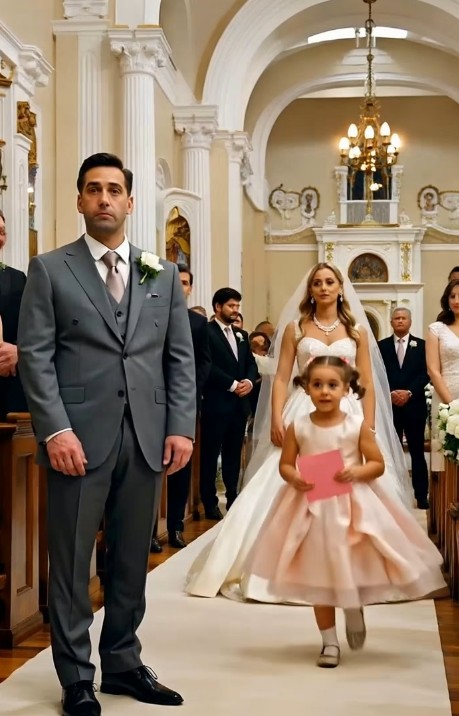
The bride was seconds away from saying “I do” when a little girl ran down the aisle screaming:
“Daddy! Don’t marry her!”
The entire church froze.
Six-year-old Lily stood halfway down the aisle, clutching a pink envelope.
Her father, Thomas, stepped away from the altar.
“Lily?”
“What are you doing here?”
The bride, Claire, turned slowly.
Her smile disappeared.
Someone near the back whispered:
“Who let her in?”
Lily ignored everyone.
She kept walking toward her father.
“Grandma said you have to open this before you marry her.”
Thomas frowned.
“My mother?”
Lily nodded.
Then held out the envelope.
Claire forced a nervous laugh.
“Thomas, this is ridiculous.”
“Someone please take her outside.”
Lily immediately stepped closer to her father.
“No.”
Thomas looked at Claire.
Then at his daughter.
Something about Lily’s face stopped him.
She was not throwing a tantrum.
She looked frightened.
He took the envelope.
Inside was a photograph.
Thomas stared.
It showed a silver necklace laid across a dark wooden box.
A small oval pendant hung from the chain.
He knew it instantly.
His late wife, Anna, had worn that necklace almost every day.
Her mother gave it to her when she turned eighteen.
After Anna died, Thomas placed it inside a keepsake box in his bedroom.
Then, months later, it disappeared.
He searched everywhere.
Drawers.
Closets.
Storage boxes.
Nothing.
Eventually, he assumed he had misplaced it during the chaos after Anna’s death.
Now he looked toward Claire.
The necklace was around her neck.
Same oval pendant.
Same tiny scratch near the clasp.
Thomas’s expression changed.
“Where did you get that?”
Claire touched it instinctively.
“This?”
“Yes.”
She hesitated.
“It was a gift.”
“From who?”
“A jeweler.”
Thomas stared at her.
“That isn’t an answer.”
Claire looked toward the guests.
“Can we please not do this here?”
Then Lily whispered:
“Daddy… I saw her take it from Mommy’s special box.”
Thomas looked down at his daughter.
“When?”
Lily pointed toward Claire.
“Before she moved in.”
The room went silent.
Claire stepped forward.
“She’s six.”
“She doesn’t understand what she saw.”
Lily’s face tightened.
“I do.”
Thomas lowered the wedding rings.
His hands were already shaking.
Then he noticed something else inside the pink envelope.
A second folded paper.
He pulled it out.
It was a photocopy of a legal document.
At first, Thomas did not understand what he was looking at.
Then he saw his own name.
A signature appeared at the bottom.
Thomas Hale.
He stared.
“That’s not my signature.”
Claire went pale.
The priest looked from Thomas to Claire.
Nobody moved.
Thomas read the heading again.
It appeared to be an authorization connected to a property transfer.
His house.
The house he had bought with Anna twelve years earlier.
The same house where Lily lived.
According to the paper, Thomas had agreed to grant Claire broad authority to act regarding the property.
But Thomas had never signed anything like it.
He turned to Claire.
“What is this?”
She shook her head quickly.
“I’ve never seen that.”
Lily interrupted.
“Grandma has the original.”
Thomas looked toward the back of the church.
Then he saw his mother, Margaret, standing near the doors.
She had not been seated with the family.
She had arrived late.
And she looked terrified.
Thomas walked toward her.
“Mom?”
Margaret stepped forward.
“I’m sorry.”
“For what?”
“I should have told you yesterday.”
“Told me what?”
Margaret looked at Claire.
Then back at her son.
“I found paperwork in your study.”
Thomas stared.
“What paperwork?”
Margaret took another envelope from her handbag.
Claire immediately said:
“This is insane.”
Margaret ignored her.
She handed the papers to Thomas.
There were several documents.
A copy of his identification.
A property valuation.
Bank account information.
A draft power-of-attorney form.
And an unsigned mortgage application.
Thomas’s stomach dropped.
“What is all this?”
Margaret answered carefully.
“I don’t know exactly.”
“But I know you didn’t prepare it.”
Claire stepped toward them.
“You had no right to go through private documents.”
Margaret turned.
“They were in my son’s house.”
Claire snapped:
“Our house.”
Thomas looked at her.
“No.”
The single word stopped everyone.
“It is not your house.”
Claire’s face changed.
Thomas looked at the priest.
“I’m sorry.”
Then he looked toward the guests.
“The wedding is not continuing.”
Whispers filled the church.
Claire grabbed his arm.
“Thomas, you’re humiliating me.”
He pulled away.
“I’m trying to understand why my late wife’s necklace is around your neck.”
“And why someone copied my signature onto a document involving my house.”
Claire’s voice rose.
“I told you, I don’t know anything about that.”
Thomas looked at Lily.
“Come here.”
She ran into his arms.
He lifted her.
Lily buried her face against his shoulder.
Then Thomas walked away from the altar.
Not dramatically.
Not angrily.
Just finished.
Outside the church, Margaret finally explained everything.
The story had started three days earlier.
She had been at Thomas’s house helping prepare for the wedding.
Thomas was out collecting his suit.
Claire was meeting the florist.
Lily was coloring at the kitchen table.
Margaret went upstairs looking for an old family photograph Thomas wanted displayed at the reception.
She entered the study.
A folder was sitting partly open on the desk.
Margaret saw her son’s name.
Then the address of the house.
She almost ignored it.
Then she saw the signature.
Something looked wrong.
Thomas always signed his surname with a long upward stroke through the H.
This signature did not.
Margaret had spent thirty-five years seeing her son’s handwriting.
She knew.
So she photographed the document.
She did not take it.
She did not want to accuse anyone without understanding what she had found.
Then Lily came upstairs.
Margaret asked if she had seen the silver necklace Claire had begun wearing recently.
Lily nodded.
“That was Mommy’s.”
Margaret froze.
“What?”
“Claire took it.”
“When?”
Lily explained.
Months earlier, before Claire officially moved into the house, Lily had gone into Thomas’s bedroom looking for a stuffed rabbit.
She saw Claire opening Anna’s keepsake box.
Claire removed the necklace.
When Lily asked what she was doing, Claire said:
“Your daddy said I could borrow it.”
Lily believed her.
Margaret did not.
Because Thomas had once told Margaret that Anna’s jewelry would eventually go to Lily.
He had specifically said he did not want anyone else wearing the necklace.
Margaret asked Thomas indirectly the next day.
“Did you ever give Claire Anna’s necklace?”
Thomas said:
“No.”
Then the wedding preparations interrupted them.
Guests arrived.
Phones rang.
Everything moved too quickly.
Margaret became afraid she would destroy her son’s wedding over something she had misunderstood.
So she did something more sensible.
She called a lawyer.
Not to accuse Claire.
To ask what the document meant.
The lawyer told her something important.
A photocopy did not prove that any valid legal transfer had occurred.
Signatures could be disputed.
Documents might be drafts.
Nothing should be assumed.
But if Thomas genuinely had not signed the paper, he needed to know immediately.
Margaret printed the photograph of Anna’s necklace.
Then copied the suspicious document.
She put both inside the pink envelope.
She planned to speak with Thomas before the ceremony.
But Claire had arranged for Thomas to arrive through a separate entrance.
Margaret could not reach him privately.
Lily saw the envelope.
“What’s that?”
Margaret told her:
“Something your dad needs before he gets married.”
Then Margaret was pulled aside by another relative.
When she turned back, Lily had taken the envelope.
And run.
Thomas listened to all of this in the church parking lot.
Then asked the question everyone was avoiding.
“Why would Claire want paperwork involving the house?”
Margaret shook her head.
“I don’t know.”
That answer mattered.
No one had proof of motive.
No one yet knew whether Claire had actually forged anything.
Thomas did not call the police and accuse her of crimes based only on suspicion.
Instead, he called his attorney.
Then he contacted his bank.
Then the county property office.
Within hours, he learned something disturbing.
Two weeks earlier, someone had requested certified copies of documents related to the property.
The request used Thomas’s personal information.
A lender had also received a preliminary inquiry about borrowing against the house.
No loan had been approved.
No ownership had changed.
But someone had clearly been gathering information.
Thomas’s attorney advised him to freeze any pending property-related activity and formally dispute any document carrying an unauthorized signature.
Then the attorney asked:
“Who had access to your records?”
Thomas closed his eyes.
Claire.
But also other people.
Contractors.
Family.
A cleaner.
Anyone with access to the study.
So he refused to jump to conclusions.
The investigation became slower.
And much more complicated.
Thomas found the original suspicious document in the house that evening.
Not in Claire’s belongings.
Inside a desk drawer.
The signature looked like his.
But not quite.
His attorney arranged for a forensic document examiner to review it.
Again, no instant conclusion.
The examiner compared known signatures.
Bank records.
Legal forms.
Old contracts.
The opinion was clear enough to raise serious concern.
The signature was inconsistent with Thomas’s normal writing and appeared to have been simulated.
Then came the email records.
Thomas reviewed a shared household tablet.
Claire had once used it to communicate with a property broker.
The messages did not show an actual completed transfer.
But they showed questions.
How much equity was in the property?
Could one partner borrow against a jointly occupied home?
What documents would a lender require?
One message said:
My fiancé is very busy and has already agreed. I’m helping organize everything.
Thomas had never agreed.
Claire denied writing some of the messages.
She said someone could have accessed the account.
That possibility had to be investigated too.
Then Thomas remembered something.
Several months earlier, Claire had suggested adding her name to the property.
Thomas refused.
The house was meant to remain Lily’s long-term security.
Claire became upset.
They argued.
Then she dropped the subject.
Or Thomas thought she had.
The silver necklace provided another clue.
Thomas asked Claire where she got it.
Her story changed.
First, she said it was a gift.
Then that she bought it from a vintage dealer.
Then that Anna’s jewelry box had already been open and she believed the necklace had been set aside.
Thomas produced an old photograph.
Anna wearing the necklace.
Then a close-up.
The tiny scratch on the clasp matched.
A jeweler examined it.
The conclusion was simple.
The necklace was almost certainly the same piece.
Claire finally admitted taking it.
But said she intended only to borrow it for the wedding.
Thomas stared at her.
“For months?”
She did not answer.
That confession destroyed what little trust remained.
The wedding was formally canceled.
Guests were informed.
Deposits were lost.
Embarrassing photographs circulated.
Thomas did not care.
His daughter mattered more.
So did the truth.
Then something unexpected happened.
The deeper review of the property documents revealed that Claire was not the only person involved.
A mortgage broker named Evan Ross had been communicating with her.
He was someone Claire knew before meeting Thomas.
The messages between them were more serious.
Claire had sent him property records.
He had prepared draft paperwork.
She repeatedly asked how quickly funds could be released if Thomas “signed.”
Evan responded with instructions about supporting documents.
But there was no message explicitly saying:
Forge his signature.
That distinction became important.
When questioned through attorneys, Claire claimed Evan told her the form was only preliminary and would require Thomas’s later confirmation.
Evan claimed Claire assured him Thomas had authorized everything.
Each blamed the other.
The matter was reported to the relevant authorities and lender fraud team.
Investigators reviewed metadata, email records, document versions, and access history.
Eventually they established that the disputed signature had been inserted into a digital draft created from a scan of an older document containing Thomas’s genuine signature.
The scan had been stored on Claire’s laptop.
That was much harder to explain.
Claire’s attorney advised her not to make further statements.
The attempted transaction had never been completed.
No money was released.
No house changed hands.
But investigators still examined possible fraud and forgery offenses.
Thomas stayed out of public arguments.
His attorney told him:
“Let evidence do the talking.”
So he did.
Months later, Claire entered into a legal resolution connected to the attempted use of falsified documents.
The details were less dramatic than gossip suggested.
There was no million-dollar theft.
No secret deed transferring Thomas’s entire life overnight.
The system had actually stopped before money moved because additional verification would have been required.
But the intent behind the documents was serious enough.
For Thomas, however, the legal outcome was not the hardest part.
Lily was.
She had liked Claire.
That was what people forgot.
Children can warn adults about something and still grieve when the relationship falls apart.
Lily asked:
“Is Claire bad?”
Thomas thought carefully.
He did not want to teach his daughter that people are divided neatly into good and evil.
So he said:
“She did some things that were wrong.”
“Very wrong.”
“And we have to keep ourselves safe.”
Lily asked:
“Did she love us?”
Thomas swallowed.
“I don’t know what she felt.”
“But love doesn’t make it okay to lie or take things.”
Lily nodded.
Then asked for the necklace.
Thomas looked at her.
“You want it?”
“It was Mommy’s.”
He had the clasp repaired.
Then placed the necklace back into Anna’s keepsake box.
This time, he gave Lily the small key.
“Not to wear yet.”
Lily nodded seriously.
“Keep it safe.”
“I will.”
Margaret laughed.
“That sounds familiar.”
Thomas asked:
“What?”
“Nothing.”
A year passed.
Life became ordinary again.
That was the greatest relief.
School.
Work.
Breakfast.
Homework.
No attorneys calling every morning.
No wedding plans.
No cameras.
No dramatic revelations.
Thomas became much more careful with personal documents.
He enabled alerts on financial accounts.
Locked important records away.
Reviewed property filings.
And taught Lily something age-appropriate about privacy.
“If something feels wrong, tell me.”
She answered:
“Even if you’re getting married?”
Thomas laughed.
“Especially then.”
He never forgot the church.
The moment Lily appeared in the aisle.
The pink envelope.
The entire room holding its breath.
People later told the story as if the necklace alone proved everything.
It didn’t.
A child’s statement needed to be checked.
A photograph needed context.
A document needed examination.
Property records needed verification.
No responsible person should decide guilt from one dramatic moment.
But Lily’s interruption did something essential.
It stopped Thomas from making a permanent decision before important questions were answered.
That was enough.
Years later, Lily asked her father whether she had “saved” him.
Thomas shook his head.
“You told me something I needed to know.”
“That’s different.”
She frowned.
“But if I didn’t run into the church…”
Thomas looked at her.
“Yes.”
“That mattered.”
He hugged her.
“But you weren’t responsible for fixing the adults.”
That mattered too.
Lily had carried an envelope.
The adults had to handle everything after that.
Lawyers.
Banks.
Investigators.
Evidence.
Consequences.
The little girl did not solve a crime.
She simply refused to stay quiet when she saw something that did not make sense.
And on the day her father was about to promise his future to someone else, she ran down the aisle carrying two pieces of the past.
Her mother’s missing necklace.
And a signature her father had never written.
Thomas never said “I do” that afternoon.
Months later, he realized something.
The most important words spoken in that church had not come from the bride.
Or the groom.
Or even the priest.
They came from a six-year-old girl holding a pink envelope.
“Daddy.”
“Please look.”