
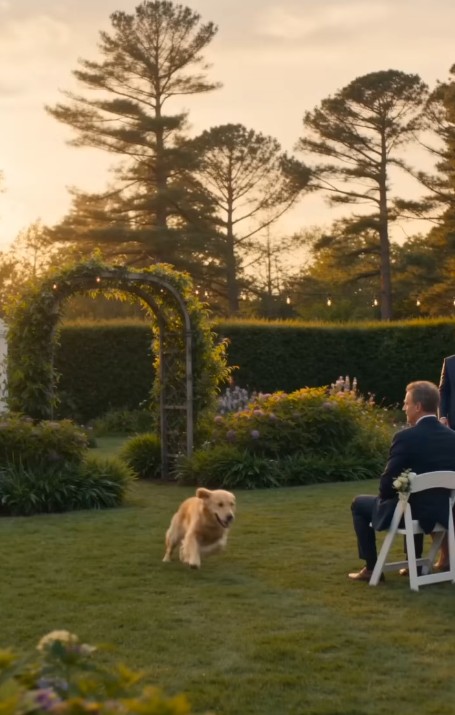
A Golden Retriever suddenly ran through a wedding ceremony carrying a muddy white glove.
Guests gasped.
The bride stepped backward.
Her mother stood up immediately.
“Someone get that dog out!”
But the dog ignored everyone.
He ran past the flower arrangements.
Past the first row.
Past the bride and groom.
Then stopped in front of an elderly woman sitting alone near the back.
The dog dropped the glove at her feet.
The woman looked down.
Her face changed.
Her hands began trembling.
“That belongs to my husband.”
The groom, Matthew, stepped closer.
“What?”
The elderly woman picked up the glove.
Her name was Eleanor.
She and her husband, George, lived less than a mile from the wedding venue.
George had left home early that morning for his usual walk near the woods.
He was supposed to be gone for forty minutes.
He never returned.
At first, Eleanor assumed he had stopped to talk with someone.
Then an hour passed.
Then two.
She called him.
No answer.
George sometimes forgot to charge his phone, so she tried not to panic.
But by late morning, she had called their daughter.
Then the police.
Officers began checking the walking trails.
Because the wedding venue sat near the edge of the same wooded area, Eleanor’s daughter had brought her there temporarily while police searched nearby.
Eleanor had planned to stay only a few minutes.
Then the Golden Retriever appeared.
No one at the wedding recognized him.
He wore an old brown collar.
His fur was damp around the legs.
Mud covered his paws.
The dog looked toward Eleanor.
Barked twice.
Then turned and ran toward the garden gate.
Stopped.
Looked back.
Matthew understood before anyone said it.
“I’m following him.”
The bride, Grace, grabbed his arm.
“Go.”
Matthew ran.
One of the venue workers followed.
The dog crossed the garden.
Went through an open side gate.
Then headed toward a narrow gravel path beside the woods.
Matthew shouted:
“Slow down!”
The Retriever stopped every few seconds.
Waited.
Then continued.
Whether the dog was deliberately leading them or simply returning to a place he had recently been, Matthew could not know.
But the glove had belonged to George.
That alone was enough reason to follow.
The dog left the main trail.
Moved through wet grass.
Then stopped beside an old greenhouse behind an abandoned cottage.
The greenhouse had not been used for years.
Several panes were cracked.
Vines climbed over one side.
The entrance was partly hidden behind overgrown bushes.
The dog barked.
Matthew approached.
Then heard something.
“Hello?”
A weak voice answered.
“Here.”
Matthew moved toward the glass.
Inside, sitting on the floor near a wooden bench, was George.
Alive.
Conscious.
Exhausted.
“George?”
The elderly man lifted one hand.
“I can’t get the door open.”
Matthew tried the handle.
Jammed.
The frame had shifted.
He told George to stay back.
Then called emergency services.
A venue worker found another entrance panel, but it was also stuck.
They did not smash the glass immediately because they did not want to send broken pieces toward George.
Firefighters arrived within minutes.
They forced the warped door open safely.
George was helped outside.
Eleanor reached the greenhouse shortly afterward with a police officer.
The moment she saw her husband, she began crying.
George smiled weakly.
“I’m fine.”
Eleanor answered:
“You are never allowed to say that sentence again.”
Paramedics checked him.
He was dehydrated.
His blood sugar was low.
And he had bruised one knee after falling.
But he was otherwise stable.
Then Eleanor noticed the dog.
He stood quietly near the greenhouse.
She walked toward him.
“Was it you?”
The Retriever wagged his tail.
Then something caught the sunlight.
A small silver object hanging from the dog’s collar.
Eleanor stared.
“Wait.”
She leaned closer.
Attached beside the old identification loop was a tiny silver key.
Her expression changed completely.
George noticed it too.
He stopped smiling.
“That can’t be.”
Matthew looked between them.
“What is it?”
George reached toward the collar.
The dog allowed him to touch the key.
George turned it over.
On one side were three tiny scratched initials.
G.E.W.
George.
Eleanor.
And their daughter’s childhood initial.
Eleanor covered her mouth.
“We lost that fifteen years ago.”
The wedding guests who had followed at a distance were confused.
George explained.
The key once belonged to a small wooden keepsake box he and Eleanor kept at home.
Inside were family letters, photographs and a few pieces of jewelry.
Fifteen years earlier, during a picnic beside the same woods, the key disappeared.
George had carried it on a small chain.
He remembered reaching into his pocket when they returned home.
Gone.
They searched the picnic area the next morning.
Nothing.
Eventually, they replaced the lock on the box.
The missing silver key became a family joke.
George was famous for losing things.
But now it was hanging from the collar of a dog nobody recognized.
Matthew asked the obvious question.
“How did he get it?”
George shook his head.
“No idea.”
Police scanned the Retriever for a microchip.
There was one.
His registered name was Cooper.
The contact information belonged to a man named David Miller.
Officers called him.
David arrived twenty minutes later, out of breath and embarrassed.
“There you are.”
Cooper immediately ran toward him.
David apologized repeatedly.
A section of his backyard fence had been damaged during heavy rain the night before.
Cooper had escaped that morning.
David had spent hours searching.
When Eleanor showed him the silver key, he became confused.
“That’s been on his collar since I adopted him.”
“When was that?” George asked.
“About six years ago.”
“Where did you get him?”
“A rescue.”
That answer only deepened the mystery.
David pulled out his phone.
He showed them an old photograph from Cooper’s adoption day.
Same brown collar.
Same silver key hanging from it.
The key had been there from the beginning.
The shelter staff apparently assumed it was simply an old charm left by the previous owner.
They never removed it.
Now the search shifted backward.
Who owned Cooper before David?
The rescue still had records.
Cooper had been surrendered by an elderly man named Harold Pierce who had moved into assisted living.
Harold had owned the dog for several years.
Before that, Cooper’s history was incomplete.
George heard the name.
“Harold Pierce?”
Eleanor looked at him.
“You know him?”
George nodded.
Harold had once lived near the old cottage beside the greenhouse.
Fifteen years earlier.
Exactly when the key disappeared.
That afternoon, after George was medically cleared, the family contacted Harold’s assisted-living facility.
With his permission, they spoke by phone.
George explained the silver key.
Harold laughed.
“You finally found that thing?”
George sat upright.
“You knew about it?”
Harold remembered.
Years earlier, he had been walking a much younger Cooper—or possibly the dog’s predecessor, because his memory of the timeline was uncertain—near the picnic area.
He found a small silver key in the grass.
He picked it up.
There were initials scratched into it.
He meant to ask around.
Then forgot.
Eventually, he attached it to a dog collar so he would not lose it.
Harold could not remember exactly when it moved from one collar to another.
When he later surrendered Cooper to the rescue, the key went with him.
No magic.
No impossible coincidence requiring the dog to remember an object for fifteen years.
Just an old man finding something in the grass.
Keeping it.
Then accidentally passing it along with a dog years later.
George laughed.
“That sounds exactly like something Harold would do.”
Eleanor looked at the key.
“So it traveled all this time?”
Apparently.
And now Cooper had wandered back toward the same woods.
Still wearing it.
But the more important mystery was how Cooper found George.
George finally explained what happened.
That morning, he followed his normal trail.
Near the abandoned cottage, he heard an animal moving through the brush.
Cooper appeared.
The dog was muddy and wet.
George tried reading the tag on his collar, but the current phone number was partly obscured by mud.
Then George felt dizzy.
His blood sugar had dropped faster than expected.
He carried medication, but realized he had left it at home.
He decided to take a shortcut toward the road.
The old greenhouse seemed like an easy landmark.
Then rain started.
George went inside to sit for a minute.
The door slammed behind him.
When he tried opening it, the warped wood would not move.
He shouted.
No one answered.
Cooper remained outside for a while.
Then disappeared.
George assumed the dog had left.
At some point, one of George’s gloves came off near the greenhouse entrance.
Cooper apparently picked it up.
What happened after that could only be partly reconstructed.
The dog traveled through the woods.
Reached the wedding venue.
Ran inside.
And dropped the glove in front of Eleanor.
Did Cooper recognize that the glove belonged to George?
Probably by scent.
Did he know Eleanor was George’s wife?
Nobody could establish that.
It was possible Cooper had encountered Eleanor earlier around the search activity.
Possible he was simply drawn toward a crowd.
Possible the glove drop happened near her by chance.
But once the glove was recognized and Cooper ran toward the gate, Matthew followed.
That sequence led directly back to the greenhouse.
George called it a rescue.
The police officer called it a fortunate chain of behavior.
David called Cooper:
“A professional troublemaker.”
All three descriptions seemed fair.
The wedding had been delayed by nearly an hour.
When everyone finally returned to the venue, Grace was still wearing her dress.
Matthew apologized.
She stared at him.
“For what?”
“For disappearing in the middle of our wedding.”
“You found somebody’s missing husband.”
“That sounds bad when you phrase it like that.”
Grace laughed.
Eleanor and George remained long enough to see the ceremony restart.
George sat with his leg elevated.
Cooper sat outside with David.
The bride’s mother, who had originally demanded the dog be removed, brought him a bowl of water.
David teased her.
“I thought you wanted him gone.”
She replied:
“That was before he started rescuing guests.”
The ceremony resumed.
No dogs interrupted it this time.
Afterward, Grace asked Eleanor if she wanted the silver key back.
David had already removed it from Cooper’s collar.
Eleanor looked at George.
Then at the dog.
She shook her head.
“No.”
David looked surprised.
“It belongs to you.”
Eleanor smiled.
“It did.”
She asked only that David replace the old metal loop securing it so it would not fall off.
George agreed.
“He carried it longer than we ever did.”
So the key remained on Cooper’s collar.
But David added a proper identification tag beside it.
Clear name.
Current phone number.
No mystery required.
Several weeks later, George and Eleanor invited David and Cooper to their home.
Cooper immediately investigated every room.
He attempted to steal a sandwich.
Then fell asleep beneath the dining table.
George brought out the old keepsake box.
The replacement key opened it.
Inside were photographs from the picnic where the original had vanished.
One showed George and Eleanor sitting in the grass.
Behind them, barely visible, was the old cottage.
And beyond it, the greenhouse.
George laughed.
“The key almost made it home.”
Eleanor answered:
“It took the scenic route.”
The photograph was framed.
Beside it, George placed a new picture.
Cooper standing outside the greenhouse.
Silver key on his collar.
Muddy white glove near his paws.
George wrote the date underneath.
Then added:
THE DAY SOMETHING WE LOST CAME BACK WITH HELP.
David liked the sentence.
Matthew preferred something more dramatic.
“The Wedding Dog Who Saved George.”
Grace rejected it.
“You’re making yourself sound important.”
“I followed him.”
“Exactly.”
The story became a favorite among wedding guests.
Every retelling exaggerated something.
Cooper broke through the church doors.
False.
George had been trapped for days.
False.
The dog deliberately searched for Eleanor.
Unknown.
The silver key somehow guided Cooper to George.
Definitely not.
The truth was already strange enough.
A dog escaped through a damaged fence.
An elderly man encountered him in the woods.
The man became trapped in an old greenhouse.
The dog picked up his glove.
Then appeared at a nearby wedding carrying it.
A woman recognized the glove.
The groom followed the dog.
And George was found.
The key was simply an older coincidence threaded through the same landscape.
Lost fifteen years earlier.
Found by someone else.
Attached to a collar.
Passed from one owner to another.
Then carried back into the lives of the people who had lost it.
Months later, George began walking again.
But he changed his habits.
Phone charged.
Medical supplies carried.
Family told his route.
No entering abandoned greenhouses.
Eleanor insisted on the last rule.
Cooper visited occasionally.
Whenever he did, George gave him one white gardening glove to carry around the yard.
David objected.
“You’re encouraging theft.”
George answered:
“I owe him one.”
Nobody ever proved what Cooper understood that morning.
Maybe very little.
Maybe he was simply following scent, movement and familiar human cues.
But everyone agreed on one thing.
When the Golden Retriever ran into that wedding carrying a muddy white glove, the ceremony stopped.
And because it stopped, people paid attention.
Sometimes that is all it takes for an ordinary object to become the beginning of a rescue.