
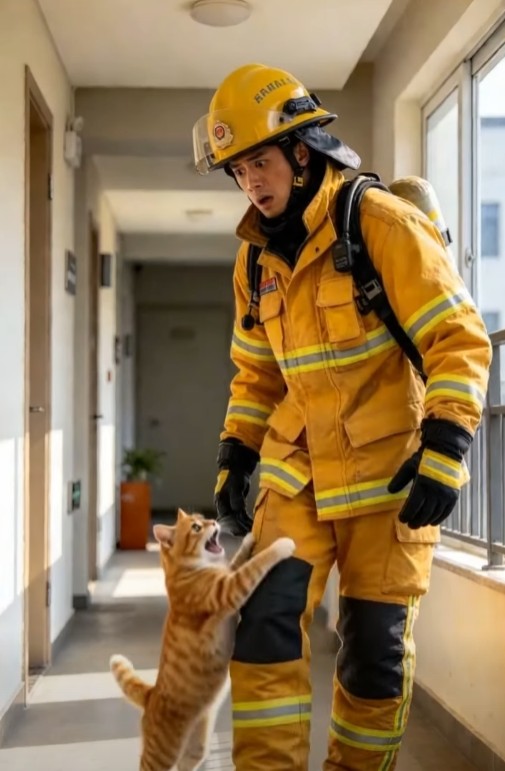
A firefighter was finishing a routine building inspection when a small orange cat suddenly grabbed his trouser leg.
He gently moved the cat aside.
But it came back.
Again.
And again.
“What’s your problem, little guy?” he asked.
The cat released his leg and ran down the hallway.
Then stopped in front of a locked apartment door.
It scratched once.
Then twice.
Then began clawing at the bottom of the door.
The firefighter, Marcus, stopped smiling.
Something about the animal’s behavior felt too focused to ignore.
He walked closer.
“Hey.”
The cat looked at him.
Then scratched again.
Marcus leaned toward the door.
At first, he heard nothing.
Then:
Tap.
Tap.
Tap.
He froze.
“Hello?”
Silence.
Marcus knocked.
“Fire department. Is someone inside?”
Another faint tapping sound came from the apartment.
Three knocks.
Then nothing.
Marcus immediately radioed the situation and contacted the building manager.
The manager, Elena, hurried upstairs carrying the master key.
“Who lives here?”
“Mrs. Bennett,” she said. “She’s seventy-nine.”
“When did you last see her?”
“Yesterday afternoon.”
Marcus tried the handle.
Locked.
Elena inserted the key.
The orange cat sat directly behind them.
The moment the door opened, it rushed forward.
Marcus stopped it with one foot until he knew the apartment was safe.
“Stay there.”
He stepped inside.
“Mrs. Bennett?”
A faint voice answered from the living room.
“Here.”
Marcus found the elderly woman on the floor beside an armchair.
Her name was Margaret.
She was conscious.
But pale.
A walking cane lay several feet away.
Her phone was on a table she could not reach.
Marcus knelt beside her.
“Don’t try to move yet.”
Margaret looked embarrassed.
“I fell last night.”
“You’ve been here all night?”
She nodded.
“I kept thinking someone would hear me.”
Marcus called for medical assistance.
Margaret had managed to drag herself a short distance after falling, but pain in her hip stopped her from moving farther.
She had tried shouting.
Nobody heard.
Eventually she found a wooden walking stick beneath the chair and began tapping it against the floor whenever she heard footsteps outside.
Marcus now understood the three knocks.
But the cat still did not make sense.
The animal entered the apartment once Marcus allowed it.
It jumped onto the sofa.
Then sat there quietly, watching Margaret.
She turned her head.
Her expression changed.
“That cat…”
Marcus looked over.
“You know him?”
Margaret began crying.
“No.”
The firefighter frowned.
“He isn’t yours?”
“I’ve never seen him before.”
The cat blinked at her.
Then curled its tail around its paws.
Marcus looked at Elena.
The building manager shook her head.
“I don’t recognize him either.”
That was when Marcus noticed the collar.
It was old.
Blue fabric.
A small metal tag hung beneath the cat’s chin.
Marcus reached carefully toward it.
The cat allowed him to turn it.
One side read:
OLIVER.
The other side had an address.
Marcus stared at it.
Then looked toward Margaret’s apartment number.
The address was this building.
But not Margaret’s apartment.
Apartment 3B.
Margaret lived in 5D.
Elena’s expression changed.
“3B?”
Marcus looked at her.
“What?”
“Nobody lives there now.”
“How long has it been empty?”
Elena thought.
“Almost two years.”
Marcus looked again at the cat.
“Who lived there?”
The manager did not answer immediately.
Then she said:
“An elderly man named Walter Reed.”
Margaret suddenly spoke from the floor.
“Walter?”
Marcus turned.
“You knew him?”
Margaret looked toward the orange cat.
“Walter had a cat.”
Her voice became softer.
“But I thought it disappeared.”
The paramedics arrived.
As they assessed Margaret, Marcus stayed near the doorway with Elena.
He asked:
“What happened to Walter?”
The manager explained.
Walter had lived in Apartment 3B for nearly eighteen years.
Quiet man.
Retired electrician.
No close family nearby.
About two years earlier, he suffered a stroke and moved into a nursing facility.
His apartment was cleared.
Elena remembered seeing a cat occasionally before that.
But when Walter left, nobody could find it.
A neighbor said the cat had escaped during the confusion.
The building staff assumed someone eventually took it in.
Margaret, still listening, whispered:
“Oliver.”
Everyone turned.
She stared at the cat.
“That was the cat’s name.”
Marcus looked at the tag again.
Oliver.
So this was almost certainly Walter’s missing cat.
But that raised a much bigger question.
Where had Oliver been for two years?
And why had he appeared outside Margaret’s apartment that morning?
After Margaret was taken to the hospital, Elena called the number listed on Oliver’s old tag.
Disconnected.
Then she checked archived tenant records.
Walter’s emergency contact was a niece named Sarah.
She called.
Sarah answered.
At first, she thought Elena was calling about old paperwork.
Then Elena said:
“We think we found Oliver.”
There was a long silence.
“What?”
“Your uncle’s cat.”
Sarah almost laughed.
“That’s impossible.”
But she came to the building anyway.
The moment she saw the orange cat, she covered her mouth.
“Oh my God.”
She knelt.
“Oliver?”
The cat approached.
Sniffed her hand.
Then rubbed its head against her fingers.
Sarah started crying.
“That’s him.”
She showed them an old photograph.
Walter sitting in a chair.
A younger orange cat on his lap.
Same white patch beneath the chin.
Same torn edge on one ear.
Same blue collar.
There was little doubt.
Oliver had returned.
But nobody understood where he had been.
Sarah contacted the veterinarian Walter used years earlier.
Oliver had been microchipped.
The chip confirmed the identity.
Registered owner:
Walter Reed.
The contact information was outdated.
That likely explained why nobody had connected the cat back to him.
Sarah asked the veterinarian whether someone else might have cared for Oliver during the missing years.
Possible.
Very possible.
Cats sometimes survive through combinations of human feeding, scavenging, shelter and temporary homes.
So Sarah began asking around the neighborhood.
The answer came from a woman who owned a small laundromat three blocks away.
Her name was Patricia.
She recognized the photograph immediately.
“That’s Sunny.”
Sarah frowned.
“Sunny?”
Patricia explained.
An orange cat began appearing behind the laundromat nearly two years earlier.
Employees fed him.
Eventually he started sleeping in a storage room during cold weather.
He came and went.
Nobody considered him fully owned.
They called him Sunny.
Patricia had once noticed the microchip-shaped mark on his collar but never realized he actually had a chip.
“He seemed healthy,” she said.
“I thought he belonged to someone nearby.”
That explained most of Oliver’s missing time.
But not why he returned to his old building.
Patricia had another detail.
Three days earlier, construction started behind the laundromat.
Heavy machinery.
Noise.
Workers repeatedly opened the storage area.
Oliver disappeared.
Nobody saw him afterward.
He may simply have wandered away from the disturbance.
The old apartment building was less than half a mile away.
Perhaps familiar smells or surroundings drew him back.
Perhaps he had occasionally returned before without anyone noticing.
Nobody could know exactly.
Then Marcus asked the question that bothered him most.
Why Margaret’s door?
Why 5D?
Oliver’s old home was 3B.
The answer emerged when Margaret returned home from the hospital several days later.
Thankfully, she had not broken her hip.
Severe bruising.
Dehydration.
But she would recover.
Sarah brought Oliver to visit.
Margaret smiled when she saw him.
“So you’re Walter’s cat.”
Oliver immediately walked toward her living-room window.
Then jumped onto the same sofa.
Margaret watched.
“That’s interesting.”
“What?”
She pointed toward the window.
“I used to feed him.”
Sarah stared.
“What?”
Years earlier, when Walter still lived in the building, Oliver frequently wandered the hallways.
Margaret kept a small container of cat treats in her apartment.
Whenever she saw him, she gave him one.
Sometimes Oliver sat outside her door.
Sometimes Margaret let him inside for a few minutes.
Walter knew.
He joked that Oliver had a second apartment.
Margaret had forgotten much of that until seeing him again.
“It was years ago.”
Sarah asked:
“So he remembered her?”
A veterinarian later said that was possible, but nobody could prove precisely what Oliver recognized.
Cats can retain long-term associations with people, places, scents and routines.
The building itself may have been familiar.
Margaret’s hallway might have carried recognizable smells.
And Oliver had apparently visited her apartment repeatedly in the past.
But no one could say that Oliver returned specifically because he somehow knew Margaret had fallen.
That would go beyond the evidence.
What could be said was remarkable enough.
Oliver returned to a building he had once lived in.
He went to the apartment of a woman who used to feed him.
He repeatedly scratched at her door.
He attracted Marcus’s attention.
And because Marcus stopped to investigate, he heard Margaret tapping from inside.
That chain of events got her help.
Margaret liked the simpler version.
“He came looking for treats.”
Sarah laughed.
“After two years?”
“He always had excellent timing.”
The question then became what to do with Oliver.
Walter was still alive.
Sarah visited him in the nursing facility.
His health had declined significantly, but he remained mentally alert.
When Sarah told him Oliver had been found, Walter did not believe her.
So she showed him a photograph.
Walter stared at it for nearly a minute.
Then whispered:
“That old thief.”
Sarah laughed and cried at the same time.
With permission from the facility, Oliver was brought for a short supervised visit.
The cat entered the quiet room in a carrier.
Walter sat in a wheelchair.
Sarah opened the door.
Oliver hesitated.
Then walked out.
Walter called softly:
“Oliver.”
The cat stopped.
Looked toward him.
Then approached.
Nobody in the room tried to interpret exactly what the animal remembered.
There was no need.
Oliver rubbed against Walter’s shoes.
Then jumped carefully onto the blanket covering his knees.
Walter placed one trembling hand on his back.
“There you are.”
Sarah turned away because she was crying too hard.
Walter could not keep a pet in his current care setting.
So arrangements had to be made.
Sarah offered to take Oliver.
But Margaret surprised everyone.
“Can he stay with me?”
Her daughter objected at first.
“You just got out of the hospital.”
Margaret answered:
“That’s exactly why.”
She lived alone.
Her family visited often, but not every day.
After the fall, everyone agreed some things needed to change.
A medical alert device.
More regular check-ins.
Handrails.
A phone that could be reached from the floor.
But Margaret also wanted company.
Sarah asked Walter.
He smiled.
“Oliver already chose her years ago.”
So, after veterinary checks and with the family’s agreement, Oliver moved into Apartment 5D.
Back into the same building.
Two floors above where his story had begun.
Margaret bought him a new collar.
But she kept the old blue one in a drawer.
She also updated the microchip information immediately.
Marcus visited several weeks later.
Margaret opened the door using a cane.
Oliver sat behind her.
Marcus laughed.
“There’s my assistant.”
Margaret corrected him.
“Your supervisor.”
The cat ignored both of them.
Marcus asked how she was doing.
“Better.”
“And Oliver?”
“Expensive.”
Apparently the cat had developed very particular opinions about food.
Sarah said Walter had always spoiled him.
Margaret refused to continue the tradition.
She lasted four days.
The story spread through the fire station.
People exaggerated it.
The cat “rescued” an elderly woman.
The cat “heard her calling for help.”
The cat “knew exactly which firefighter to find.”
Marcus corrected those versions whenever he heard them.
They did not know what Oliver knew.
The cat’s behavior could be explained in much simpler ways.
A familiar building.
A familiar apartment.
An old feeding routine.
Scratching at a door he remembered.
Marcus just happened to be there.
But the firefighter also admitted something.
He nearly ignored the animal.
He had finished his inspection.
He was thinking about lunch.
The cat grabbing his trouser leg seemed like an annoyance.
Then Oliver came back.
Again.
And again.
That persistence made Marcus stop.
And stopping allowed him to hear the tapping.
Months later, the fire department added a small note to one of its community safety presentations.
Not about heroic cats.
About people living alone.
Keep a phone or alert device accessible.
Arrange regular check-ins.
Make sure building staff have emergency contacts.
Small precautions can turn hours waiting on the floor into minutes.
Margaret volunteered to speak once.
She stood in front of a room and said:
“My official advice is to have a telephone in every room.”
Then she pointed toward Oliver’s photograph.
“My unofficial advice is to have a very stubborn cat.”
Everyone laughed.
Walter died the following year.
Sarah brought Margaret a small box of his belongings.
Inside was an old photograph of Walter in Apartment 3B.
Oliver sat on the windowsill.
Someone had written on the back:
OLIVER — NEVER WHERE HE’S SUPPOSED TO BE.
Margaret framed it.
She placed it beside a newer photograph.
Oliver sitting on her sofa.
Same orange coat.
Older face.
Still exactly where he apparently wanted to be.
Nobody ever proved whether he recognized Margaret that day.
Nobody could explain what combination of memory, scent, routine and chance brought him back to that exact hallway after two years away.
Maybe Oliver simply returned to familiar territory.
Maybe he remembered the woman who used to give him treats.
Maybe he scratched because he expected the door to open.
But the door did not open.
So he kept trying.
Until a firefighter noticed.
Marcus had originally asked:
“What’s your problem, little guy?”
Later, he laughed whenever he remembered it.
Oliver had not been the problem.
There was a woman behind a locked door who needed help.
And for whatever reason, one stubborn orange cat refused to let the firefighter walk away.