
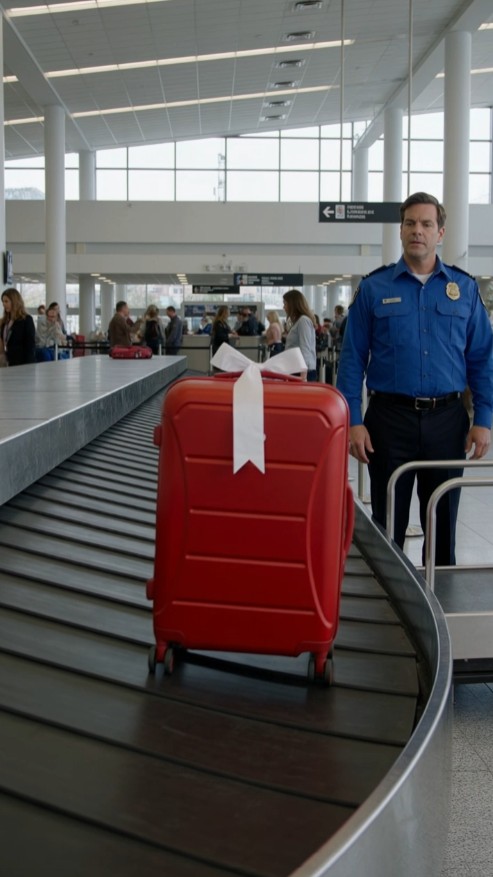
The same red suitcase kept appearing on the airport baggage carousel.
Again.
And again.
Nobody claimed it.
At first, baggage supervisor Marcus Reed assumed the passenger was simply running late.
It happened all the time.
Someone stopped at immigration.
Someone went to the restroom.
Someone misunderstood which carousel to use.
Nothing unusual.
But twenty minutes later, almost every other bag from the flight was gone.
The carousel continued turning.
And the bright red suitcase kept coming back.
A white ribbon was tied around its handle.
Marcus watched it pass for the fifth time.
Then the sixth.
Something bothered him.
Not the suitcase itself.
The labels.
There were too many of them.
He pressed the stop control.
The conveyor slowed.
Then stopped completely.
Marcus lifted the suitcase onto the inspection table.
He did not open it.
Airport staff could not simply search luggage because it looked unusual.
Instead, he examined the external tags.
One baggage label showed Rome.
Another showed Amsterdam.
A third showed Boston.
Underneath those was an older tag from Chicago.
Different dates.
Different airlines.
Different flights.
Marcus frowned.
“How did you manage that?”
He called another employee.
“Emma, come look at this.”
Emma worked at the airport’s baggage-services desk.
She turned the suitcase around.
Then stared at the labels.
“This bag has been traveling.”
“That’s what I thought.”
“Was it on tonight’s flight?”
“Apparently.”
Emma scanned the newest barcode.
The system returned an error.
She tried again.
Then entered the number manually.
The result made even less sense.
The luggage had been recorded as transferred from another airport.
Before that, it had been placed into a delayed-baggage system.
Before that, another carrier had marked it unidentified.
The electronic history stretched back weeks.
Emma looked at Marcus.
“This thing has been bouncing around airports.”
“How?”
“Probably one bad tag followed by another.”
They moved it to the lost-baggage counter while Emma contacted the airline.
That was when a woman standing nearby suddenly froze.
She had been speaking with another employee about a suitcase of her own.
Then she saw the red case.
And the white ribbon.
Her face went pale.
She stopped mid-sentence.
Marcus noticed.
“Ma’am?”
She walked toward the counter slowly.
Her eyes never left the suitcase.
“Where did you get that?”
“It came off Carousel Seven.”
The woman covered her mouth.
“No.”
Emma stepped closer.
“Do you recognize it?”
The woman nodded.
Tears immediately filled her eyes.
“That’s my mother’s suitcase.”
Marcus looked at the old labels.
“How long have you been looking for it?”
The woman took a deep breath.
“Almost seven months.”
Emma stared at her.
“Seven months?”
The woman nodded.
“My name is Julia Bennett.”
She touched the white ribbon.
“My mother tied this here herself.”
Marcus asked:
“Do you have anything that can confirm the bag is hers?”
Julia immediately opened her phone.
She found a photograph.
An elderly woman was standing beside an airport check-in desk.
Next to her was the same bright red suitcase.
Same scratched corner.
Same white ribbon.
The photograph had been taken eight months earlier.
Emma compared the image carefully.
“It certainly looks like the same case.”
Julia started crying.
Marcus expected her to ask whether the suitcase was damaged.
Or whether anything had been stolen.
Instead, she whispered:
“I thought it was gone forever.”
Then she said something that confused him.
“I don’t even care what’s inside.”
Marcus looked at her.
“Then why does the suitcase matter so much?”
Julia sat down.
For several seconds, she could not answer.
Then she explained.
Her mother’s name was Margaret.
Margaret had been seventy-one when she took the trip.
It was the first major journey she had taken alone in more than forty years.
For most of her adult life, Margaret rarely traveled without her husband, Henry.
They had married young.
Raised two children.
Worked ordinary jobs.
Saved carefully.
And promised each other that after retirement they would finally see some of the places they had spent decades talking about.
Italy was first.
Margaret wanted Florence.
Henry wanted Rome.
They joked for years about arguing over which city deserved more time.
Then Henry died before they ever made the trip.
Afterward, Margaret stopped talking about travel.
Her passport remained in a drawer.
The guidebooks disappeared into a cupboard.
When Julia suggested they travel together, Margaret always gave the same answer.
“Maybe next year.”
Next year came.
Then another.
Eventually Julia realized her mother was not waiting for the right time.
She was afraid of going without Henry.
So on Margaret’s seventieth birthday, Julia gave her an envelope.
Inside was a plane ticket.
Not a completed holiday.
Not an expensive tour.
Just a refundable ticket to Rome.
Margaret stared at it.
Then said:
“I can’t do this.”
Julia answered:
“Yes, you can.”
“I don’t speak Italian.”
“You barely speak English before coffee.”
Margaret laughed.
That was the beginning.
For months, they planned.
Julia offered to come.
Margaret surprised her.
“No.”
“You gave me the ticket because you think I can do this.”
“So I should try.”
Julia was nervous.
Margaret was more nervous.
But on the morning of departure, she arrived at the airport wearing a blue coat and pulling a bright red suitcase.
Julia hated the suitcase.
It was impossible to miss.
“That’s why I bought it,” Margaret said.
Then she tied a white ribbon around the handle.
Julia asked:
“Why?”
“Now nobody can mistake it for theirs.”
They both laughed.
Julia took the photograph.
The one she had just shown Emma.
Margaret flew to Rome.
She called that evening.
“I survived.”
Julia asked:
“How was the flight?”
“Terrible.”
“Rome?”
“Beautiful.”
Margaret stayed twelve days.
She visited Rome.
Florence.
A small town Henry had once circled in an old travel book.
She sent Julia photographs constantly.
Coffee.
Churches.
Train stations.
Food.
Selfies that showed mostly Margaret’s forehead.
Then, on the flight home, the red suitcase disappeared.
Margaret landed.
Waited at baggage claim.
Every other passenger left.
Her case never appeared.
The airline took a report.
Margaret described it.
Bright red.
White ribbon.
Small scratch near the lower corner.
Inside were clothes.
Souvenirs.
And several personal items.
The airline promised to search.
Days passed.
Nothing.
Then weeks.
A bag with a similar description was found in another country.
Not hers.
A tracking number showed the suitcase had possibly been transferred incorrectly.
Then the trail disappeared.
Eventually, the airline declared it lost.
Compensation was offered based on the documented contents.
Margaret accepted reluctantly.
But she was strangely upset.
Julia told her:
“Mom, it’s just luggage.”
Margaret answered:
“I know.”
But it was not only luggage.
Inside was a small notebook.
Every evening during the trip, Margaret had written one page to Henry.
She knew he would never read it.
That was not the point.
The first entry began:
Well, Henry. I finally went without you.
She wrote about getting lost near the hotel.
Ordering the wrong meal.
Crying when she saw a place they had once planned to visit together.
Laughing because Henry would have complained about the crowds.
She wrote about being afraid.
Then discovering she could still do things alone.
At the end of the trip, the notebook was almost full.
Margaret told Julia:
“It was the first time since your father died that I felt like I was moving somewhere instead of only moving away from him.”
That notebook was inside the suitcase.
So were Henry’s old sunglasses.
Margaret had carried them during the trip.
A ridiculous thing, she admitted.
But she liked having something of his with her.
When the luggage vanished, those objects vanished too.
Julia helped file every report she could.
They called.
Emailed.
Sent photographs.
Nothing.
Three months later, Margaret suffered a sudden medical emergency.
She died shortly afterward.
The missing suitcase became one of those unfinished things families sometimes inherit.
Julia kept the lost-baggage reference number.
She did not know why.
The airline case was effectively closed.
The compensation had been paid.
Her mother was gone.
There was no practical reason to keep searching.
Yet every few weeks, Julia checked.
No update.
Then eventually she stopped.
Seven months after the suitcase disappeared, Julia was back at the airport for an entirely unrelated trip.
Her own luggage had been delayed.
She was standing at the lost-baggage counter when she saw something red behind Marcus.
And the white ribbon.
Now Marcus understood the tears.
Emma became quiet.
“So the notebook might still be inside?”
Julia nodded.
“If the bag hasn’t been opened.”
The airport team contacted the airline and security staff.
Ownership had to be verified properly before the luggage could be released.
The old baggage report was located.
The serial details matched.
The physical description matched.
Julia had photographs.
She also knew several specific things supposedly inside.
A green sweater with a repaired sleeve.
A ceramic magnet shaped like a tiny yellow car.
A black notebook with an elastic band.
A pair of men’s sunglasses inside a brown case.
Once the required checks were completed, Julia was allowed to open the suitcase with staff present.
Her hands trembled as she pulled the zipper.
The case opened.
The clothes were wrinkled.
A few objects had shifted.
But the contents were there.
Julia moved quickly.
Green sweater.
Small toiletry bag.
Two scarves.
The yellow-car magnet.
Then she stopped.
Near the bottom was a black notebook.
She lifted it with both hands.
For a moment, nobody at the counter spoke.
Julia opened the first page.
She recognized her mother’s handwriting immediately.
WELL, HENRY. I FINALLY WENT WITHOUT YOU.
Julia closed her eyes.
Then pressed the notebook against her chest.
Marcus looked away to give her privacy.
Emma asked quietly:
“Is everything there?”
Julia searched again.
At the side of the suitcase was a brown glasses case.
She opened it.
Henry’s sunglasses.
Julia laughed through her tears.
“Yes.”
“The important things are.”
Later, baggage specialists reconstructed what had probably happened.
There was no elaborate mystery.
No person intentionally sending the suitcase around the world.
The original luggage tag had been damaged during Margaret’s return journey.
Part of the barcode became unreadable.
The bag was manually rerouted.
During that process, an old transfer label remained attached.
Then another temporary tag was added.
At some point, the case entered an unidentified-baggage network.
A series of imperfect matches caused it to be forwarded between airports while staff attempted to associate it with different delayed-bag records.
Each time, another label was added instead of all obsolete ones being removed.
The white ribbon survived everything.
Rome.
A transfer hub.
A storage facility.
Another airport.
Another flight.
Another baggage room.
Months of movement.
Eventually, a worker scanned the most recent temporary tag and sent it onto the flight that brought it to Marcus’s carousel.
It was an error.
But an error that happened to deliver the suitcase to the exact airport where Julia was standing.
Emma said:
“If it had arrived tomorrow, you probably wouldn’t have been here.”
Julia looked at the red suitcase.
“I know.”
She did not turn that coincidence into something supernatural.
Her mother had not sent the bag back.
The suitcase had been moving through an imperfect baggage system.
But Julia also did not pretend the timing meant nothing to her.
Sometimes a coincidence can be meaningful without needing a magical explanation.
She took the suitcase home.
For several weeks, she could not read the notebook.
She placed it on her kitchen table.
Walked past it.
Touched it occasionally.
Then put it down again.
Finally, one Sunday morning, she opened it.
Margaret had written almost every night.
Some entries were funny.
Henry, the hotel shower requires an engineering degree.
Another:
You would hate this coffee and pretend yours was better.
Another:
A man tried to sell me a hat today. You would have bought it, which is why you should not have been trusted with money on holidays.
Julia laughed until she cried.
Then the entries became more serious.
Margaret wrote about loneliness.
About guilt.
About feeling disloyal for enjoying something Henry would never experience.
Then one page changed everything.
She wrote:
I thought traveling without you would prove how alone I am.
Instead, I am starting to understand something.
Being able to continue is not the same as leaving you behind.
I can miss you and still see what comes next.
Julia read the paragraph repeatedly.
Near the end of the notebook, Margaret wrote about returning home.
She planned to take another trip.
Somewhere closer next time.
Maybe with Julia.
Then the final full entry ended:
I think I’m ready to stop saying “maybe next year.”
Julia sat at the kitchen table for a very long time.
Her mother never got another year.
But she had gotten those twelve days.
And the suitcase contained proof of what they meant.
Julia contacted Emma at the airport.
She wanted to thank the baggage team.
Not because they had performed a miracle.
Marcus and Emma had simply stopped an unclaimed suitcase and paid attention to inconsistent labels.
Still, attention mattered.
If Marcus had allowed the bag to continue circulating, it might have returned to the baggage system again.
Instead, he stopped it.
Julia later brought copies of a few notebook pages to show them.
Emma read the shower entry and laughed.
“She sounds funny.”
“She was.”
Marcus pointed toward the suitcase.
“What are you going to do with that thing?”
Julia looked at the battered red case.
One wheel barely worked.
The shell was scratched.
Labels covered almost the entire handle.
She smiled.
“I’m definitely not checking it onto another flight.”
The suitcase went into Julia’s spare room.
She removed most of the outdated baggage labels but kept the oldest one from Rome.
And the white ribbon.
That stayed exactly where Margaret had tied it.
Months later, Julia did something she had not planned.
She booked a trip.
Not to Italy.
A short journey somewhere she and her mother had talked about visiting together.
On the morning she left, Julia packed a smaller carry-on.
No checked luggage.
Before leaving home, she opened Margaret’s notebook.
At the back were several blank pages.
Julia hesitated.
Then wrote on the first empty one:
Okay, Mom.
My turn.
When she returned, she added another page.
Then another after the next trip.
The notebook slowly became something different.
Margaret’s words at the front.
Julia’s at the back.
Not because Julia believed her mother could read them.
Because she finally understood why Margaret had written to Henry.
Some conversations are really ways of carrying love forward.
Years later, the red suitcase remained scratched and impractical.
Julia never restored it.
She liked the damage.
Every mark represented the strange journey it had taken after its owner went home without it.
Visitors occasionally asked why she kept such an ugly old suitcase.
Julia usually smiled.
“It was my mother’s.”
That answer was enough.
But sometimes she told the whole story.
About the first trip Margaret had taken alone.
The white ribbon she tied around the handle so nobody could mistake the bag.
The notebook written to a husband who was no longer there.
The luggage that vanished.
The mother who died before it could be returned.
And one ordinary afternoon when Julia happened to be standing in an airport baggage office and looked across the room.
There it was.
Bright red.
Covered in labels from places it should never have visited.
Still carrying the same white ribbon.
The suitcase had spent months going almost everywhere except where it belonged.
Then somehow, through a chain of mistakes, it came back.
And inside was the message Julia had not known she still needed from her mother:
Continuing your journey does not mean leaving the people you love behind.