
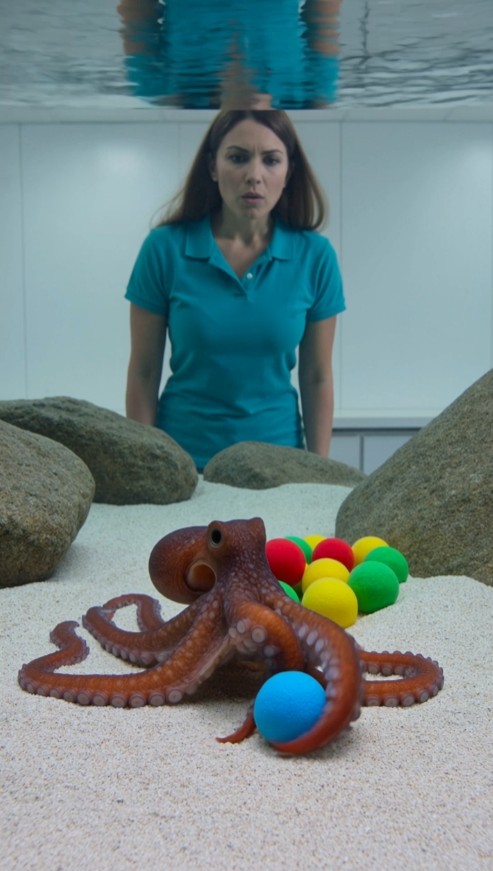
The researchers thought Echo was simply playing.
Every day, his keepers placed safe enrichment objects inside the aquarium.
Different shapes.
Different textures.
Different colors.
Some floated.
Some sank.
Some could be opened or moved.
Echo usually explored everything.
But after several weeks, one pattern became impossible to ignore.
Whenever blue objects appeared…
they disappeared.
A blue plastic ring.
Gone.
A smooth blue block.
Gone.
A blue cap from an enrichment container.
Gone.
Echo wrapped an arm around each one.
Pulled it across the tank.
Then vanished behind a large rock near his den.
At first, the staff laughed.
“He has a favorite color.”
But marine biologist Daniel was not convinced.
“That’s a very human way of describing it.”
His colleague Maya smiled.
“You have a better explanation?”
“Not yet.”
That was exactly why they decided to watch more carefully.
Echo lived in a marine research aquarium designed to study problem-solving and normal octopus behavior.
His tank contained rocks, sand, shelters and objects intended to encourage exploration.
Keepers changed the enrichment regularly so the environment would not become monotonous.
They already knew octopuses were capable of manipulating objects with impressive precision.
Echo could unscrew simple containers.
Move stones.
Pull food through openings.
And investigate unfamiliar objects for long periods.
But the blue-object habit was different.
He was not simply touching the objects.
He was transporting them.
Always toward the same place.
Maya placed a small underwater camera where it could see the entrance to Echo’s den without disturbing him.
Then the team waited.
The next morning, they introduced six objects.
Red ring.
Yellow block.
Clear tube.
Green disc.
Blue cap.
Blue rectangular tile.
Echo emerged.
He explored the clear tube first.
Then ignored it.
He touched the yellow block briefly.
Moved past the red ring.
Then reached the blue cap.
Within seconds, one arm wrapped around it.
Another arm anchored against the rock.
Echo pulled the cap toward himself.
Then carried it toward the den.
Daniel wrote down the time.
“Blue number one.”
Several minutes later, Echo returned.
He found the blue tile.
Same behavior.
“Blue number two.”
But what happened next was more interesting.
The camera showed Echo entering the den area.
He did not simply drop the objects inside.
He placed the blue cap near one side of the entrance.
Then adjusted it.
Moved it again.
The blue tile went beside another object already there.
Maya leaned toward the monitor.
“Wait.”
Around the entrance were several pieces they recognized.
Blue rings.
Blue blocks.
A pale-blue shell-shaped enrichment item.
All arranged among small rocks and fragments of shell.
Daniel replayed the footage.
“He’s been collecting them.”
That part was clear.
But why?
The team avoided jumping to conclusions.
An arrangement that looked decorative to a human observer might have an entirely different explanation.
Objects near a den could serve as barriers.
Cover.
Manipulable material.
Or simply items the animal repeatedly handled and abandoned in the same location.
So the researchers changed the experiment.
The following day, they provided similar objects in multiple colors.
Same size.
Same texture.
Same approximate weight.
Blue.
Red.
Green.
Yellow.
If Echo truly preferred blue, he should select it more often even when the physical properties were similar.
Over several sessions, he did.
Not perfectly.
Sometimes he moved a red object.
Sometimes he ignored every object.
Animal behavior rarely followed a clean pattern on command.
But blue items were transported toward the den more frequently than several alternatives.
Daniel became increasingly interested.
“Could he actually have a color preference?”
Maya answered:
“Maybe.”
But again, they were cautious.
Octopus vision is unusual.
Many species are believed to have limited conventional color vision compared with humans.
That did not mean Echo necessarily experienced “blue” the way people did.
Brightness.
Contrast.
Reflectance.
Texture.
Lighting.
All could affect how an object appeared underwater.
The team needed to separate human labels from what Echo might actually perceive.
So they changed the lighting.
Then tested different shades.
Dark blue.
Pale blue.
Gray objects with similar brightness.
Objects with similar texture but different colors.
The pattern became less simple.
Echo strongly preferred certain blue and blue-gray items.
But not every blue object.
That suggested color alone might not explain the behavior.
Then Maya noticed something else.
The preferred objects shared another characteristic.
They were flat.
Or partly curved.
And easy to position against the den entrance.
The objects Echo ignored were often rounder.
Larger.
Or more difficult to stabilize.
Daniel looked at the notes.
“So maybe we’ve been asking the wrong question.”
“What do you mean?”
“We keep asking why he likes blue.”
“What if he likes objects that work well here?”
He pointed toward the den.
The team reviewed the footage again.
Echo frequently manipulated the collected objects after placing them.
He rotated them.
Pushed them against stones.
Moved one object aside when leaving.
Then sometimes repositioned it afterward.
That looked less like random storage.
More like modification of the den entrance.
Still, the researchers did not call it “building” in the same way humans build structures.
They described it more carefully.
Echo appeared to be using movable objects around his shelter entrance.
That behavior itself was fascinating.
Wild octopuses have been observed interacting with shells, stones and other material around dens.
Some species may gather or reposition items near shelters.
In an aquarium, safe enrichment objects could become substitutes for material an octopus might manipulate in a natural environment.
The team decided to test that possibility.
For several days, they removed the colored enrichment pieces entirely.
Instead, they introduced flat shells, smooth stones and neutral-colored tiles.
Echo immediately began moving some of them toward his den.
Daniel smiled.
“There it is.”
But the story was not finished.
When blue objects were returned alongside equally useful neutral objects, Echo still often selected the blue ones first.
Maya laughed.
“So function and preference.”
“Possibly.”
Daniel emphasized the last word.
Possibly.
The team could not know whether Echo had what humans would call an aesthetic preference.
They could only describe the choices they observed.
Then came the most interesting week.
Keepers introduced several blue plastic discs containing small holes.
The discs were designed for another enrichment activity.
Echo ignored the food puzzle attached to them.
Instead, he detached one disc.
Carried it toward the den.
And positioned it almost vertically between two rocks.
A second disc followed.
Then a third.
The underwater camera showed something new.
The discs partially blocked direct visibility into the shelter.
Maya stared at the screen.
“Look at the angle.”
Daniel nodded.
The objects were not just clustered randomly.
Echo repeatedly adjusted them near the entrance.
When one fell flat, he repositioned it.
When a keeper moved one several centimeters away during routine cleaning, Echo later brought it back.
That observation changed the team’s working hypothesis.
Echo may have been using the objects to alter the structure or exposure of his hiding place.
Not necessarily because they were blue.
Not necessarily because he was “decorating.”
But because certain pieces could be manipulated effectively around the den.
The color preference remained a separate question.
The researchers began recording both variables.
Object color.
Shape.
Texture.
Weight.
Location.
Frequency moved.
Time spent manipulating.
The resulting chart was much more complicated than the original story:
OCTOPUS LOVES BLUE.
Daniel preferred the complicated version.
“Animals become more interesting when you stop forcing them into one explanation.”
Maya agreed.
A few days later, they noticed another behavior.
During feeding, Echo sometimes pulled one of the discs partly across the entrance before retreating inside.
After feeding, he moved it aside again.
Daniel wrote:
Possible temporary concealment behavior.
Not:
Echo closes his door.
That distinction mattered.
Calling the object a “door” would imply a purpose they had not demonstrated.
But the behavior was consistent enough to document.
The team contacted another cephalopod researcher for an outside opinion.
She reviewed the footage.
Her response was cautious.
The manipulation was interesting.
Den modification was plausible.
But aquarium enrichment behavior could be shaped by many factors.
Novelty.
Learned routines.
Handling ease.
Individual preference.
No single interpretation should be treated as proven from one animal.
The team agreed.
Echo was one octopus.
Not an entire species.
Still, individual behavior mattered.
The observation gave them a new way to design enrichment.
Instead of only asking:
Can the animal open this?
Can it solve this?
Can it get food from this?
They began asking:
Can the animal use this object in its own way?
That changed the tank.
Keepers provided more safe materials that could be moved, stacked or repositioned.
Smooth shell-like pieces.
Flat stones.
Flexible non-toxic strips.
Different shapes.
Some Echo ignored completely.
Others became part of the ever-changing area around his den.
The arrangement never stayed identical for long.
That was another important finding.
Echo was not creating one permanent structure.
He changed it.
Moved pieces.
Removed some.
Added others.
Sometimes scattered everything.
Then rebuilt a loose cluster days later.
The blue objects remained common.
But they were not sacred.
One morning, Maya found Echo sitting on top of a blue ring he had once kept near the den entrance.
Another day, he pushed it halfway across the tank and left it there.
Daniel laughed.
“There goes our perfect theory.”
Maya answered:
“That’s usually when science gets better.”
They continued observing.
Eventually they noticed that Echo seemed especially interested in blue objects only under one lighting condition.
Under a different aquarium light, the preference weakened.
That reinforced the possibility that brightness or contrast mattered as much as hue.
The team adjusted the wording of their notes again.
Apparent preference for certain blue/blue-gray objects under standard tank illumination.
Less exciting.
More accurate.
Then one afternoon, a visiting group of students watched Echo through the glass.
A child asked:
“Why does he like blue?”
Daniel smiled.
“We don’t actually know that he likes blue.”
The child pointed.
“But he keeps taking blue things.”
“He often chooses them.”
“That means he likes them.”
“Maybe.”
The child looked dissatisfied.
Daniel crouched beside the viewing window.
“Imagine I give you two boxes.”
“One is easy to carry.”
“One is hard to carry.”
“You keep picking the easy one.”
“Does that mean your favorite color is the color of the easy box?”
The child thought.
“No.”
“Exactly.”
Then Maya added:
“But if both boxes are equally easy and you still choose one more often, then we start asking another question.”
The child smiled.
“So you have to trick him?”
“No.”
Maya laughed.
“We have to trick ourselves into not assuming too much.”
That line stayed with Daniel.
The most interesting part of Echo’s behavior was not that he appeared to prefer blue.
It was how quickly humans wanted that to be the whole story.
A blue-loving octopus sounded charming.
Easy.
Shareable.
But Echo was doing something richer.
He was interacting with objects based on combinations of features.
Manipulating his environment.
Repeatedly returning material to one area.
Using certain shapes around the entrance of his den.
And displaying individual choices that changed with context.
Months later, the research team prepared a small internal presentation.
The first slide showed one of the earliest underwater images.
Echo inside his den.
Blue pieces scattered around the entrance.
The title read:
THE BLUE OBJECT PROBLEM.
The final slide read:
MAYBE IT WAS NEVER JUST ABOUT BLUE.
Daniel explained the observation.
The color pattern triggered their curiosity.
The camera revealed the collecting behavior.
Controlled comparisons showed that shape and handling mattered too.
Lighting affected apparent preference.
And repeated object positioning suggested den-related use.
No dramatic conclusion.
No claim that Echo was decorating his house.
No claim that he understood colors like a human.
Just a careful record of an animal using an artificial environment in a way his keepers had not anticipated.
That was enough.
Eventually, one of the blue objects became too worn for continued use.
Keepers removed it.
They replaced it with a nearly identical safe object.
Echo inspected the replacement.
Touched it.
Then left.
Maya laughed.
“He hates the new one.”
Daniel shook his head.
“You have learned nothing.”
The next morning, the replacement was beside the den.
Maya found Daniel.
“You were saying?”
He smiled.
“I withdraw my objection.”
Echo continued rearranging objects for months.
Some days, the den entrance looked almost bare.
Other days, several pieces surrounded it.
The underwater camera became one of the team’s favorite monitoring tools because it revealed behavior that was easy to miss from the viewing window.
Without it, they might have continued believing the objects simply disappeared behind the rock.
Instead, they discovered that Echo was moving them deliberately enough to produce a repeatable pattern.
That changed how they interpreted his enrichment.
The objects were not only toys given by humans.
Once inside the tank, they became materials Echo could incorporate into his own behavior.
One researcher eventually summarized it perfectly.
“We thought we were giving him objects to play with.”
“Maybe he was deciding what they were for.”
That sentence appeared in the team’s weekly notes.
Echo, of course, knew nothing about any of it.
He did not care about the researchers’ charts.
Or debates.
Or whether people called the behavior collecting, den modification, preference, or enrichment use.
He simply continued doing what interested him.
One arm around a flat object.
Another anchoring against the rock.
Pull.
Carry.
Reposition.
Sometimes blue.
Sometimes not.
But often enough that everyone noticed.
And that was why the observation became memorable.
The mystery began with a simple question:
Why does this octopus keep stealing the blue objects?
The answer turned out to be more interesting than:
Because blue is his favorite color.
The objects had features.
The den had a function.
The lighting mattered.
And Echo’s choices appeared to depend on more than one thing.
By the end of the week, the researchers still could not say exactly what Echo perceived.
But they had learned something more valuable.
When an animal repeatedly does something that seems strange, the best question is not always:
Why is it doing what we think it is doing?
Sometimes the better question is:
What have we failed to notice yet?