
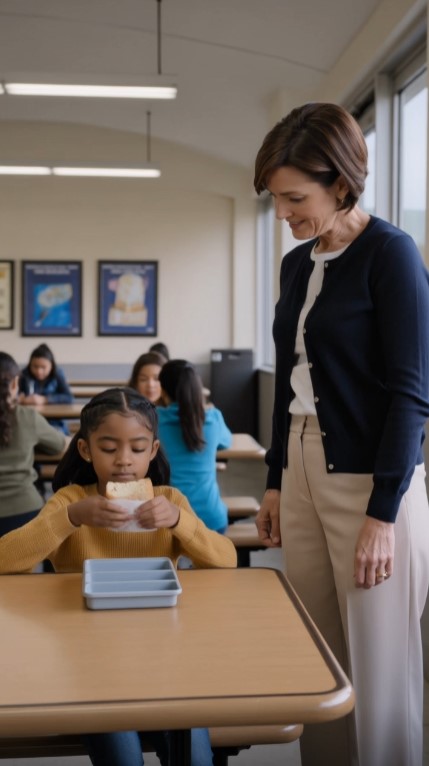
For three weeks, 10-year-old Mia barely touched her school lunch.
Her teacher, Mrs. Carter, became worried.
Every afternoon, Mia carefully wrapped everything back up…
put it in her backpack…
and hurried home.
One Friday, Mrs. Carter spoke with Mia’s mother and discovered something strange.
Mia always came home with an empty lunchbox.
So they quietly asked her why.
Mia started crying.
“There’s an old man at the bus stop who says he isn’t hungry.”
Every day, Mia had been giving him half her lunch.
Her mother went with her the next afternoon.
The elderly man was sitting alone on the same bench.
When Mia arrived, he smiled.
“You came back.”
Mia handed him a sandwich.
Her mother suddenly froze.
Around the man’s neck was an old wooden whistle.
She recognized it.
Her father had carved two identical whistles when she was a child.
One for himself.
And one for his younger brother…
who disappeared from the family more than forty years earlier.
She whispered:
“Where did you get that?”
The elderly man looked at her.
Then at Mia.
And quietly said:
“Your father gave it to me.”
Mia’s mother, Rachel, felt as if the ground had shifted beneath her.
She stepped closer.
“What did you say?”
The man touched the whistle.
“Your father gave me this.”
Rachel stared at him.
Her father’s name was Thomas.
He had died twelve years earlier.
But when Rachel was a child, Thomas had told her about a younger brother named Samuel.
Only once.
Then never again.
Samuel had disappeared from the family in his early twenties.
No one seemed to know why.
Rachel’s grandmother used to say:
“Some people leave because staying hurts too much.”
Thomas always changed the subject.
Rachel asked:
“Are you Samuel?”
The man looked down.
Then nodded.
“Yes.”
Mia stopped chewing.
“You’re Mom’s uncle?”
Samuel gave a weak smile.
“I suppose I am.”
Rachel sat beside him.
For several seconds, she said nothing.
Forty-three years.
That was how long Samuel had been gone.
She had grown up believing he was either dead or living somewhere far away.
Instead, he was sitting at a bus stop less than ten miles from her home.
Eating half of her daughter’s lunch.
Rachel whispered:
“Why didn’t you tell us?”
Samuel looked at the sandwich in his hands.
“Because I didn’t know how.”
That answer made Rachel angry.
“You had forty years.”
“I know.”
“My father died thinking you were gone.”
Samuel looked up sharply.
“No.”
Rachel frowned.
“What?”
“Thomas knew I was alive.”
She stared at him.
Samuel continued.
“He knew for years.”
Rachel felt another shock.
“You saw him?”
“Yes.”
“When?”
Samuel looked toward Mia.
“Not here.”
Rachel almost laughed.
“Apparently this family has been saying ‘not here’ for generations.”
Samuel smiled sadly.
Mia sat beside him.
“We can go somewhere else.”
That was how they ended up at Rachel’s kitchen table.
Samuel looked nervous inside the house.
He kept his coat on.
Mia placed a plate of sandwiches in front of him.
“You don’t have to share this time.”
Samuel laughed.
“Thank you.”
Rachel sat across from him.
“Start at the beginning.”
Samuel took off the whistle and placed it on the table.
Thomas had carved the pair when they were teenagers.
One for himself.
One for Samuel.
They used them while hiking near their family farm.
Two short blasts meant:
Where are you?
One long blast meant:
I’m here.
When Samuel was twenty-two, he got into trouble.
Not criminal trouble.
Debt.
Gambling.
Borrowing money.
He hid it from the family.
Then one night, money disappeared from their father’s business.
Everyone assumed Samuel took it.
Samuel denied it.
Thomas believed him at first.
Then evidence appeared.
A signed withdrawal slip.
A witness claiming Samuel had been seen near the office.
Their father confronted him.
Samuel became furious.
He shouted that the whole family had already decided who he was.
Then he left.
Rachel asked:
“Did you take the money?”
Samuel shook his head.
“No.”
Years later, the real person confessed.
A family employee named Robert.
He had taken it to cover his own debts.
Rachel stared.
“So Dad found out you were innocent?”
“Yes.”
“When?”
“About eight years after I left.”
Rachel’s frustration grew.
“And he still didn’t bring you home?”
Samuel smiled bitterly.
“He tried.”
Thomas found Samuel through an old friend.
They met at a diner.
Samuel expected an apology.
Thomas gave one.
But Samuel had spent eight years angry.
He didn’t know how to accept it.
He said cruel things.
Thomas said cruel things back.
They walked away again.
Then another ten years passed.
Mia frowned.
“That’s a lot of not talking.”
Samuel looked at her.
“Yes.”
“Why?”
Samuel sighed.
“Because adults can be very foolish for a very long time.”
Rachel almost smiled.
Then Samuel explained the whistle.
Twenty years after he first left, Thomas found him again.
This time Thomas did not ask him to come home.
He simply placed the wooden whistle on the table.
Samuel recognized it immediately.
Thomas had kept both.
One for himself.
One for Samuel.
He said:
“I don’t care who was wrong first anymore.”
Samuel cried.
So did Thomas.
That was the beginning of a quiet reconciliation.
They met a few times each year.
Always privately.
Rachel asked:
“Why privately?”
Samuel looked ashamed.
“Because your father didn’t know how to explain me.”
“He could have tried.”
“I told him that.”
Samuel nodded.
Thomas worried Rachel would be angry.
His wife was angry.
Other relatives still held old grudges.
Samuel was ashamed of the years he spent drinking and gambling after leaving.
Both brothers kept postponing the truth.
Then Thomas became ill.
Samuel visited him in the hospital.
Rachel froze.
“You were there?”
“Yes.”
“When?”
“The week before he died.”
Rachel covered her mouth.
She had been there every day.
“How did I not see you?”
“I came late.”
Samuel waited until visiting hours were almost over.
Thomas gave him the whistle.
The second one.
The one meant for Samuel.
He said:
“Keep this. I’ve carried your half long enough.”
Samuel looked down at it.
“That was the last time I saw him.”
Rachel started crying.
“You were in the same building as me.”
“I know.”
“You could have walked into the hallway.”
“I know.”
“You could have told me.”
“I know.”
Samuel didn’t defend himself.
That mattered.
Mia quietly slid a napkin toward her mother.
Rachel wiped her eyes.
Then asked:
“Why are you sitting at a bus stop now?”
Samuel looked embarrassed.
His life had not gone well recently.
He had worked most of his adult life as a mechanic.
He eventually stopped gambling.
Stopped drinking.
Built a small life.
Never married.
No children.
Then his landlord sold the building where he lived.
Samuel fell behind during the move.
He spent several weeks staying in cheap rooms.
Then ran out of money.
A local shelter had space at night, but during the day Samuel often sat at the bus stop.
He hated asking for help.
Mia found him.
The first day, she offered half a sandwich.
Samuel refused.
She left it anyway.
The next day she came back.
Then again.
Three weeks.
Rachel looked at Mia.
“You were giving him lunch every day?”
Mia nodded.
“He always said he wasn’t hungry.”
Samuel smiled.
“I was lying.”
Rachel gave him a look.
“Apparently that also runs in the family.”
Mia giggled.
Then Rachel noticed something.
The whistle had a tiny notch near the bottom.
Her father’s whistle had the same notch.
She remembered because she dropped it once as a child.
“Wait.”
She stood.
Went upstairs.
Returned with a small wooden box.
Inside were Thomas’s belongings.
Watch.
Wedding ring.
Photographs.
And another wooden whistle.
She placed it on the table beside Samuel’s.
Identical.
Samuel touched it.
For the first time, his composure completely disappeared.
“Tommy kept his.”
Rachel whispered:
“Until the end.”
Samuel picked up both whistles.
He held them together.
Two pieces of wood.
Four decades of silence.
Rachel sat beside him.
“My father talked about you once.”
Samuel looked at her.
“What did he say?”
“He said you were the funniest person he knew.”
Samuel laughed through tears.
“That sounds like a lie.”
“He also said you were impossible.”
“That sounds right.”
Then Mia asked:
“Did Grandpa miss him?”
Rachel looked at Samuel.
“Yes.”
Samuel nodded.
“Yes.”
That answer mattered more than all the others.
Over the next few days, Rachel helped Samuel get connected with housing support.
Not by simply moving him into her home immediately.
Samuel wanted independence.
Rachel respected that.
A social worker helped him secure temporary housing.
Then a small apartment.
Mia insisted on helping choose curtains.
Samuel hated every option she liked.
She chose bright yellow.
He complained for months.
Then never changed them.
Sunday lunch became routine.
At first, awkward.
Then normal.
Samuel told Rachel stories about Thomas.
Things she had never known.
Her father once fell into a pond trying to impress a girl.
Thomas hated pickles.
He secretly loved old western movies but pretended not to.
He once drove Samuel forty miles at midnight because Samuel’s dog was sick.
Rachel laughed.
“That sounds like Dad.”
Then Samuel told her something harder.
Thomas blamed himself for Samuel leaving.
Not for the accusation.
For what he said during the argument.
Thomas shouted:
“If you walk out, don’t come back.”
Samuel did.
Thomas regretted it almost immediately.
For years, he believed those words mattered more than they actually did.
Samuel said:
“I was already leaving.”
Rachel nodded.
“But Dad probably didn’t know that.”
“No.”
Mia listened quietly.
Then asked:
“Why do people say things they don’t mean?”
Samuel shrugged.
“Because sometimes anger gets to your mouth before love does.”
Rachel wrote that down later.
She didn’t know why.
Months passed.
Samuel got stronger.
He gained weight.
Started volunteering at a small repair shop.
The owner eventually offered him part-time work.
Samuel accepted.
He was good with his hands.
Mia loved visiting.
He taught her how to fix a bicycle chain.
Then how to check tire pressure.
Rachel complained:
“She’s ten.”
Samuel answered:
“Exactly. Old enough to stop calling every metal thing a ‘car part.’”
Mia loved him.
Then one afternoon, Samuel showed up carrying an envelope.
“This was Thomas’s.”
Rachel frowned.
“How?”
“He gave it to me in the hospital.”
“Why didn’t you give it to me?”
Samuel looked ashamed.
“I was scared.”
Rachel took a breath.
“Of course.”
Inside was a letter.
Addressed to Rachel.
Thomas had written it days before he died.
Rachel,
There is someone I should have introduced to you years ago.
Rachel stopped reading.
Samuel looked down.
Thomas explained everything.
The accusation.
The real thief.
The years of anger.
The reconciliation.
Then:
Samuel is not a good man because he never made mistakes.
He is a good man because eventually he stopped running from them.
Samuel covered his face.
Rachel continued.
I have been a coward about this.
I kept waiting for a perfect time to explain him to you.
There is no perfect time.
If he gives you this letter, it means he finally did what I was too afraid to do.
Rachel looked at Samuel.
“You waited twelve years.”
Samuel nodded.
“I know.”
She kept reading.
Please don’t punish him for my silence.
But don’t let him hide behind it either.
Rachel laughed through tears.
“That sounds exactly like Dad.”
Samuel smiled.
“Unfortunately.”
The letter ended:
If Mia is old enough to understand any of this someday, tell her Uncle Sam owes her a sandwich.
Rachel froze.
Mia had only been a baby when Thomas died.
Thomas had known Samuel might meet her someday.
Samuel whispered:
“I never saw that part.”
Rachel handed him the letter.
He read it.
Then laughed.
“He knew.”
Mia leaned over.
“What?”
Samuel looked at her.
“Apparently I owe you a sandwich.”
Mia smiled.
“You owe me about fifteen.”
Everyone laughed.
From then on, every birthday Samuel gave Mia one ridiculous sandwich.
Huge.
Overfilled.
Impossible to eat neatly.
He called it “interest.”
Years later, when Mia graduated from high school, Samuel sat in the front row beside Rachel.
He wore the whistle around his neck.
Mia walked across the stage.
Samuel clapped louder than anyone.
Afterward, Mia handed him a small box.
Inside was a new wooden whistle.
She had made it in shop class.
Not perfect.
A little crooked.
Samuel stared.
“For me?”
“No.”
She pointed to Rachel.
“This one is yours.”
Then she handed Rachel another.
Two matching whistles.
Just like Thomas had carved decades earlier.
Mia smiled.
“One long whistle means ‘I’m here.’ Right?”
Samuel’s eyes filled.
“Yes.”
Mia continued:
“So nobody disappears anymore.”
Rachel cried.
Samuel did too.
The whistles became a family joke.
If Samuel was late to dinner, Mia would blow hers.
If Rachel couldn’t find him at a park, she would use it.
One long blast.
Then somewhere nearby:
One long answer.
I’m here.
Samuel lived another nine years.
Not enough.
But enough to become part of the family.
He attended birthdays.
Graduations.
Holidays.
He argued about football.
Burned pancakes.
Fixed everything whether it needed fixing or not.
He became the uncle Rachel should have known all along.
When Samuel died peacefully, Mia was nineteen.
At his memorial, Rachel placed the original wooden whistle beside Thomas’s.
Two whistles.
Two brothers.
Together again.
Mia gave the eulogy.
She told the story of a ten-year-old girl who kept bringing half her lunch to an old man at a bus stop.
She said:
“I thought I was feeding somebody who was hungry.”
Then she smiled.
“I didn’t know I was bringing home part of my family.”
People cried.
Mia continued:
“He always told me I found him.”
“But that isn’t true.”
“He was sitting in the same place every day.”
“I just stopped long enough to notice.”
Rachel looked down.
That was the lesson she carried too.
Samuel had been alive for forty years.
Thomas had known for part of that time.
The family could have reunited sooner.
Much sooner.
But shame, anger, and fear kept winning.
Until a child ignored all of it.
Mia didn’t know Samuel’s mistakes.
She didn’t know the old accusation.
She didn’t know who owed whom an apology.
She simply saw an old man sitting alone.
And shared her sandwich.
One lunch became two.
Then three.
Then weeks.
Then a question.
A whistle.
A name.
And finally, a door back into the family.
Rachel kept Samuel’s original whistle.
Mia kept the one she made.
Years later, when Mia had a daughter of her own, the little girl once asked about the old whistle hanging beside a framed photograph.
Mia said:
“That belonged to Uncle Sam.”
“Who’s Uncle Sam?”
Mia smiled.
“Someone I met at a bus stop.”
That sounded too small.
So she told the whole story.
About Thomas.
Samuel.
The false accusation.
The lost years.
The hospital letter.
The sandwiches.
And the two whistles that meant:
Where are you?
And:
I’m here.
At the end, her daughter asked:
“Why didn’t they just talk?”
Mia laughed.
“That is exactly what I asked.”
Some family stories are complicated because something terrible happened.
Others become complicated because nobody speaks.
This one lasted more than forty years.
Then a ten-year-old girl opened her lunchbox…
split a sandwich in half…
and quietly changed everything.
Samuel had spent decades believing he no longer belonged anywhere.
Thomas died regretting that he had not brought his brother fully home.
Rachel grew up without knowing her uncle.
And Mia knew none of that.
She only knew the old man at the bus stop looked hungry.
Sometimes that is all kindness needs to know.