
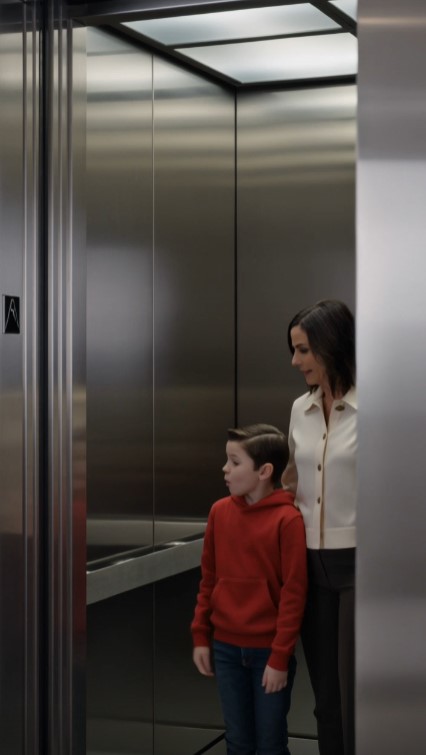
The elevator doors were closing…
When a 9-year-old boy suddenly shouted:
“WAIT!”
He held the open button.
His mother looked confused.
“Eli, nobody’s coming.”
“Yes, there is.”
Everyone looked down the empty hallway.
Nobody.
The doors started closing again.
Eli pressed the button.
“Not yet.”
Then…
An elderly woman appeared around the corner.
She slowly walked toward them.
The moment she entered the elevator…
She looked at Eli.
And dropped her handbag.
The boy’s mother apologized.
“I’m sorry. He insisted we wait for you.”
The woman stared at Eli.
“What’s your name?”
“Eli.”
Her face went pale.
Then she asked:
“What’s your father’s name?”
His mother immediately looked at her.
“Why?”
The woman didn’t answer.
Instead…
She reached into her handbag.
And removed a small key.
Eli’s mother froze.
She recognized it.
“That can’t be yours.”
The woman whispered:
“Then your husband never told you.”
“Told me WHAT?”
The elevator reached the lobby.
But nobody moved.
Because the elderly woman’s next sentence changed everything.
“I’ve been looking for your family for eleven years.”
Eli’s mother, Rachel Carter, stared at the tiny brass key.
It wasn’t an ordinary house key.
It was old.
Small.
With a round top and three shallow lines cut into one side.
Rachel had seen another key exactly like it.
Her husband Daniel kept it inside a wooden box in their bedroom.
He had never explained what it opened.
Whenever Rachel asked, he gave the same answer.
“It belonged to my father.”
Daniel’s father, Henry Carter, had died eleven years earlier.
Before Rachel ever met Daniel.
She looked at the elderly woman.
“Where did you get that?”
The woman picked up her handbag.
“My name is Margaret Wilson.”
“That doesn’t answer my question.”
“No.”
Margaret looked at Eli.
“But I think your husband should answer it with me.”
Rachel took out her phone.
Daniel was at work only fifteen minutes away.
He answered on the second ring.
“Hey.”
“Daniel, I need you to come to the Riverside Medical Building.”
“What happened? Is Eli okay?”
“We’re fine.”
“Then what’s wrong?”
Rachel looked at Margaret.
“There’s a woman here named Margaret Wilson.”
Silence.
Complete silence.
“Daniel?”
Nothing.
Then:
“Did you say Margaret Wilson?”
“Yes.”
Daniel’s voice changed.
“Stay there.”
“Do you know her?”
“Rachel, please. Just stay there.”
He hung up.
Rachel stared at her phone.
Eli looked between the two women.
“So Dad knows you?”
Margaret sat on a lobby chair.
“He knew my husband.”
Twenty minutes later, Daniel entered the building.
He was almost running.
Then he saw Margaret.
He stopped.
She stood.
For several seconds, neither spoke.
Finally Margaret said:
“You look like Henry.”
Daniel’s eyes filled.
“You’re Margaret?”
She nodded.
Daniel looked at the key in her hand.
Then he reached beneath his shirt.
Rachel had never noticed the thin cord he sometimes wore there.
Daniel pulled it out.
Attached to it was another small brass key.
Identical.
Margaret covered her mouth.
“You kept it.”
Daniel stared at her.
“My father gave it to me the night before he died.”
Rachel crossed her arms.
“Okay.”
Daniel looked at her.
“What?”
“I’ve spent ten minutes listening to people say things that apparently everybody understands except your wife and son.”
She pointed toward the keys.
“Start talking.”
Daniel sat down.
“My father had a brother.”
Rachel frowned.
“You told me your father was an only child.”
“I thought he was.”
Margaret shook her head.
“Not a brother by blood.”
Daniel looked at her.
“Thomas.”
Margaret nodded.
Thomas Wilson had been Margaret’s husband.
And Henry Carter’s closest friend.
They met when they were seventeen.
Worked together.
Served as best men at each other’s weddings.
Raised their families within a few streets of one another.
For more than thirty years, people joked that Henry and Thomas were brothers who happened to have different parents.
Then something happened.
A business failed.
Henry and Thomas had invested together in a small repair shop.
Money disappeared.
Bills accumulated.
Both men blamed the other.
The argument became personal.
Years of friendship collapsed in a single month.
Daniel was only fourteen.
He remembered Thomas vaguely.
Then suddenly Thomas stopped coming around.
“My father never talked about him afterward,” Daniel said.
Margaret nodded.
“Neither did mine.”
Rachel looked at her.
“Then what do these keys have to do with it?”
Margaret opened her handbag.
She removed an old photograph.
Two young men stood beside a green metal locker.
Henry Carter.
Thomas Wilson.
Both were laughing.
Between them was a small metal cash box.
On the back:
H + T — 1979
Daniel stared.
“What is that?”
“The reason I’ve been trying to find you.”
Margaret explained.
When Henry and Thomas opened their first workshop, they had almost no money.
They couldn’t afford proper office furniture.
So they bought an old steel cabinet from a closing factory.
Inside was a small locked compartment.
It came with two keys.
Henry kept one.
Thomas kept the other.
They jokingly called it their “retirement fund.”
Every Friday, each man put five dollars inside.
Sometimes ten.
Sometimes nothing.
Over the years, the box became less about money.
They put photographs inside.
Notes.
Receipts from their first profitable month.
A copy of their business license.
Letters to their children.
Then the partnership collapsed.
Thomas took the cabinet.
Henry kept his key.
Neither spoke to the other again.
“What happened to the money?” Eli asked.
Margaret smiled.
“There wasn’t much by then.”
“Why?”
“Your grandfather and Thomas kept taking it out whenever somebody needed something.”
One employee’s car broke down.
Another needed medicine for his daughter.
A neighbor’s furnace failed.
The “retirement fund” became an emergency box.
Eli smiled.
“So they were terrible at saving.”
Daniel laughed.
“Apparently.”
But Margaret hadn’t come looking for Daniel because of money.
She’d come because of what Thomas found inside that cabinet years later.
After the business closed, the steel cabinet sat in Thomas’s garage.
For decades.
He refused to open the locked compartment.
Margaret once asked why.
Thomas said:
“Because half of what’s in there belongs to a man who hates me.”
Then Henry died.
Thomas heard about it months later.
He didn’t attend the funeral.
He told Margaret he had no right.
“But he cried all night,” she said.
Daniel looked down.
Two years later, Thomas finally opened the compartment.
His key still worked.
Inside was an envelope.
Henry’s handwriting.
FOR THOMAS — IF WE’RE STILL TOO STUBBORN TO TALK
Daniel stared.
“My father wrote that?”
Margaret nodded.
“When?”
“Before their argument.”
The letter had apparently sat inside the cabinet for years before the friendship ended.
Thomas read it.
And everything changed.
Margaret handed Daniel a copy.
The original was stored safely.
Daniel began reading.
Tom,
If you’re reading this, one of two things happened.
Either we’re old men laughing about how young and stupid we used to be…
or we’re currently angry enough that neither one of us wants to admit the other exists.
Daniel laughed quietly.
“That sounds like Dad.”
He continued.
If it’s the second one, remember something.
We’ve survived bad jobs, bad cars, two weddings, three broken furnaces and the time you nearly burned down my garage trying to fix a toaster.
Margaret smiled.
“Thomas hated that part.”
Daniel continued.
Then the tone changed.
Money can be replaced.
Businesses can fail.
Pride can make both of us say things we don’t mean.
But if we ever stop speaking, one of us needs to be smart enough to knock on the other’s door.
It probably won’t be me.
I’m too stubborn.
So unfortunately, this responsibility falls to you.
Daniel stopped.
Margaret whispered:
“Thomas read that eleven years ago.”
Rachel understood.
“After Henry died.”
“Yes.”
Thomas had waited too long.
The man who wrote the letter was already gone.
“He never forgave himself,” Margaret said.
Thomas tried finding Daniel.
But Daniel had moved.
Changed jobs.
Then moved again.
Thomas had only an old address.
Letters were returned.
He contacted people from the former neighborhood.
No one knew where Daniel was.
Eventually, Thomas’s own health declined.
Before he died, he gave Margaret his key.
And a promise.
“Find Henry’s boy.”
Margaret had been trying ever since.
Daniel stared at her.
“Thomas died?”
“Six years ago.”
Daniel closed his eyes.
Rachel sat beside him.
Then Eli asked:
“What was inside the box?”
Margaret smiled.
“That’s the interesting part.”
The cabinet still existed.
Margaret had kept it in storage.
But she never opened the small compartment again.
“Why not?” Rachel asked.
“Because Thomas told me not to.”
“Why?”
“He said there were two keys for a reason.”
Margaret looked at Daniel’s key.
“He wanted Henry’s family there when it was opened.”
Daniel swallowed.
“And you’ve waited eleven years?”
“I promised.”
Two days later, Daniel, Rachel and Eli drove to Margaret’s house.
The old steel cabinet was in her garage.
Green paint.
Rust along the bottom.
One door slightly crooked.
Eli looked disappointed.
“That’s it?”
Daniel laughed.
“What were you expecting?”
“Something more secret.”
Margaret pointed toward a small locked compartment.
“There.”
Two keyholes.
Side by side.
Eli’s eyes widened.
“Both keys?”
Margaret nodded.
Thomas had modified the compartment years earlier so both locks had to be opened.
Daniel inserted Henry’s key.
Margaret inserted Thomas’s.
They turned them.
Click.
The compartment opened.
Inside were photographs.
Old documents.
A handful of coins.
Two five-dollar bills.
And three envelopes.
One was addressed:
DANIEL CARTER
Daniel froze.
“My name?”
Margaret shook her head.
“I’ve never seen that.”
Daniel opened it.
The letter was from Thomas.
Written shortly before his death.
Daniel,
If Margaret found you, she succeeded where I failed.
Daniel sat down.
Your father and I wasted years being angry over something neither of us could even explain properly by the end.
For a long time, I blamed Henry for the business failing.
He blamed me.
We were both partly right.
And both mostly wrong.
Thomas explained that years after the repair shop closed, he’d reviewed old financial records.
There had been no theft.
No secret betrayal.
No single person responsible.
The business had been failing for months.
A bookkeeping mistake made one account look worse.
A supplier dispute compounded it.
Henry assumed Thomas had hidden losses.
Thomas assumed Henry was trying to push him out.
Instead of sitting down and checking everything carefully…
they shouted.
Then stopped speaking.
We lost thirty years of friendship because two grown men were more interested in being right than understanding what had happened.
Daniel wiped his eyes.
The next line broke him.
Your father was my brother.
We just forgot that brothers can be angry without becoming strangers.
Inside the envelope was a photograph.
Henry holding Daniel as a baby.
Thomas stood beside him.
On the back Thomas had written:
TWO FOOLS AND ONE SMART KID — 1987
Eli laughed.
“Dad, you were bald.”
Daniel wiped his face.
“I was a baby.”
“You were still bald.”
Everyone laughed.
Then Rachel noticed the second envelope.
FOR WHOEVER COMES AFTER US
Eli pointed at himself.
“That’s me.”
Daniel smiled.
“Maybe.”
They opened it together.
Inside was a single sheet written by both Henry and Thomas decades earlier.
The handwriting alternated.
It was a list.
RULES FOR THE NEXT GENERATION
- Never start a business with someone whose handwriting you can’t read.
- Never lend Thomas tools unless you want to buy them back from him later.
- Never let Henry choose the radio station.
Eli was laughing.
Then the list became serious.
4. If somebody you love makes you angry, say why before silence starts doing the talking for you.
5. Money problems are problems. They are not proof that someone stopped loving you.
6. If you’re lucky enough to have a friend who becomes family, don’t treat that as something replaceable.
And finally:
7. If we ever forget these rules ourselves, remind us.
Daniel stared at the page.
“They wrote the warning.”
Margaret nodded.
“And then did exactly what they warned everyone else not to do.”
The third envelope contained something unexpected.
Not a letter.
A key.
Another key.
Newer.
Silver.
With a paper tag:
LOCKER 214 — RIVERSIDE MEDICAL BUILDING
Rachel stared.
“That’s where we met.”
Margaret’s eyes widened.
“I didn’t know that was in here.”
The coincidence suddenly seemed strange again.
Daniel called the building.
Locker 214 had once belonged to a small bank of rental storage lockers used by employees and long-term medical tenants.
Most had been removed during renovation.
But after checking archived records, building management found something.
Thomas Wilson had rented locker 214.
Eleven years earlier.
The year he’d begun searching for Daniel.
Margaret stared.
“He was treated there.”
“For what?”
“His heart.”
That explained why she had been in the building the day we met.
Margaret still saw a specialist there.
Thomas had apparently rented the locker while undergoing treatment.
With proper permission and verification, the building staff checked archived storage records.
The locker itself had been removed years earlier.
But unclaimed contents had been documented and transferred to secured storage before eventual disposition.
Against all odds, one small box associated with Thomas’s records remained.
After ownership was verified through the appropriate process, it was released to Margaret.
Inside was no fortune.
No hidden inheritance.
Just another photograph.
Henry and Thomas sitting on the hood of a broken-down truck.
And a cassette tape.
Daniel found someone who could safely digitize it.
Thomas’s voice filled the room.
Older.
Tired.
“Henry…”
A long pause.
“If somehow you’re hearing this, then I finally became less stubborn than you.”
Daniel covered his face.
Thomas continued.
“I found your letter.”
“I know I’m late.”
“That’s the problem with pride.”
“It always convinces you there’ll be more time.”
Then:
“I don’t care whose fault the shop was anymore.”
“I don’t care who said what.”
“I just miss my friend.”
The recording lasted four minutes.
At the end Thomas said:
“If Daniel ever hears this…”
Daniel looked up.
“…tell him his father talked about him constantly.”
“He was proud of you.”
“And tell him I’m sorry I disappeared from his life too.”
The tape clicked off.
Eli sat beside his father.
“Dad?”
“Yeah?”
“Are you okay?”
Daniel nodded.
“No.”
Then he smiled.
“But I will be.”
Margaret became part of our family after that.
Not because she replaced anyone.
Because she carried stories Daniel had never heard.
Stories about Henry before he became Dad.
Before he became Grandpa.
Stories about two teenage boys who repaired bicycles.
About the first workshop.
About terrible camping trips.
About Henry standing beside Thomas at his wedding.
And Thomas standing beside Henry when Daniel was born.
Eli loved those stories.
Especially the embarrassing ones.
One evening he asked Margaret:
“Why did you keep looking for us?”
She answered:
“Because Thomas asked me to.”
“Eleven years is a long time.”
“Yes.”
“You could’ve stopped.”
Margaret smiled.
“I could have.”
“Why didn’t you?”
She thought for a moment.
“Because your grandfather and my husband already wasted enough time.”
Eli remembered that.
Years later, when Daniel and Rachel renovated their garage, Eli asked for the old green cabinet.
“What are you going to do with it?” Daniel asked.
“Keep it.”
“Why?”
Eli shrugged.
“So nobody throws it away.”
Daniel smiled.
They restored it.
But they left the dents.
The rust marks.
The crooked door.
Inside, Daniel placed copies of the letters.
The two brass keys.
Thomas’s photograph.
And the seven rules.
On the outside, Eli added a small plaque:
DON’T LET SILENCE DO THE TALKING.
The original keys eventually stopped being important as keys.
They became reminders.
Two men had each carried one.
Each had possessed half the ability to open the same box.
But for decades, neither had been willing to cross the distance between them.
And none of us would have known the whole story if a nine-year-old boy hadn’t done something strange inside an elevator.
Years later, I asked Eli why he’d held the door that morning.
He shrugged.
“I saw her.”
I frowned.
“No, you didn’t. She hadn’t turned the corner yet.”
“I saw her shadow.”
That was it.
No supernatural feeling.
No mysterious voice.
The hallway lighting cast a moving shadow along the wall before Margaret became visible.
Eli noticed it.
The adults didn’t.
So he held the elevator.
A simple observation.
A few extra seconds.
Nothing magical.
But those few seconds brought Margaret Wilson into the same elevator as the family she’d been searching for during eleven long years.
She saw Eli.
Recognized Henry’s features in his face.
Asked his name.
Then his father’s.
And pulled a tiny brass key from her handbag.
Rachel recognized it.
Daniel arrived carrying its twin.
And a family discovered that decades earlier, two best friends had locked pieces of their lives inside a steel cabinet…
then allowed anger to lock them out of each other’s lives.
The most valuable thing inside wasn’t money.
It wasn’t the old photographs.
It wasn’t even Thomas’s recording.
It was a warning written by two young men before either of them realized they’d someday need it themselves:
If somebody you love makes you angry, say why before silence starts doing the talking for you.
Henry and Thomas learned that lesson too late.
Their children and grandchildren didn’t have to.