
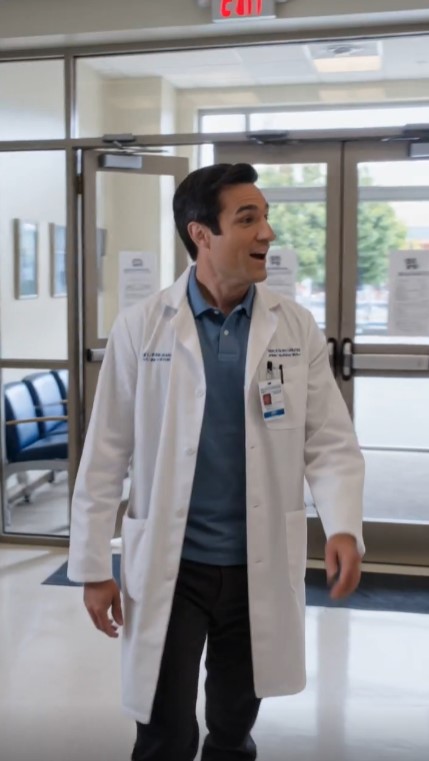
The doctor walked into the crowded waiting room and asked:
“Where’s the janitor?”
Everyone looked confused.
A cleaner at the end of the hallway slowly raised his hand.
“Me?”
The doctor walked straight toward him.
Then did something nobody expected.
He hugged him.
The cleaner froze.
“Doctor… what’s going on?”
The doctor stepped back.
“Do you remember a boy named Daniel?”
The cleaner thought for a moment.
Then his face changed.
“No…”
The doctor smiled.
“Yes.”
The cleaner looked at his coat.
Then at his face.
“You’re Daniel?”
The doctor nodded.
People nearby started watching.
The cleaner whispered:
“But I only gave you lunch.”
The doctor shook his head.
“No, sir.”
“You gave me much more than that.”
Then he reached into his pocket…
And showed the cleaner something he’d kept for twenty-six years.
The janitor covered his mouth.
It was a faded yellow meal ticket.
Almost torn in half.
Across the back, someone had written in blue ink:
DANIEL — LUNCH TOMORROW TOO. ASK FOR HENRY.
The janitor’s name was Henry Walker.
He was seventy-one now.
His hair had turned almost completely white.
His back hurt after long shifts.
But he’d worked in the same hospital for thirty-four years.
Twenty-six years earlier, Daniel Carter had been an eleven-year-old boy spending almost every afternoon there.
His mother, Rachel Carter, had been receiving treatment for a serious illness.
Daniel’s father had left years earlier.
Money was tight.
Very tight.
Rachel tried to hide that from her son.
Daniel tried to hide from his mother that he knew.
Every morning before school, Rachel gave him enough money for the bus and something small to eat.
Daniel usually saved it.
He worried they’d need it later.
So when he came to the hospital after school, he often sat in the waiting area without eating.
Henry noticed him.
At first, he didn’t know Daniel’s name.
He simply knew there was a skinny boy with an old backpack who appeared around three-thirty every afternoon.
Daniel always chose the same chair.
Always did his homework.
Always drank water from the fountain.
And every afternoon, when food carts passed nearby, Daniel watched them.
One Tuesday, Henry was cleaning beside him.
“You waiting for somebody?”
“My mom.”
“She work here?”
Daniel shook his head.
“She’s upstairs.”
Henry understood immediately.
“Have you eaten?”
“Yes.”
Daniel answered too quickly.
Henry looked at him.
“What?”
“I said yes.”
“What did you eat?”
Daniel hesitated.
“Stuff.”
Henry smiled.
“Stuff?”
“Yeah.”
“Good meal?”
“Pretty good.”
Henry didn’t embarrass him.
He simply nodded and continued cleaning.
Twenty minutes later, Henry returned carrying a paper bag.
He placed it beside Daniel.
“You forgot this.”
Daniel looked inside.
A turkey sandwich.
An apple.
A small carton of milk.
“This isn’t mine.”
Henry kept walking.
“Sure it is.”
“No, it’s not.”
Henry turned.
“Then I guess somebody made a mistake.”
Daniel looked suspicious.
“How much is it?”
“Already handled.”
“I don’t want charity.”
Henry stopped.
That word sounded strange coming from an eleven-year-old.
He walked back.
Then sat several feet away.
“This isn’t charity.”
“What is it?”
“Lunch.”
Daniel stared at him.
Henry pointed toward the sandwich.
“Food doesn’t care what you call it. Eat before your mother finds out you’ve been skipping meals.”
Daniel’s face changed.
“How do you know?”
Henry smiled.
“I clean floors.”
“What does that have to do with anything?”
“You learn to notice what people drop.”
He pointed toward Daniel’s backpack.
“And what they don’t.”
Daniel eventually ate.
The next afternoon, another bag appeared.
Then another.
Daniel finally confronted Henry.
“You can’t keep buying me food.”
“Why not?”
“Because it costs money.”
“Excellent observation.”
“I’m serious.”
“So am I.”
Daniel reached into his pocket.
Three coins.
“Here.”
Henry refused them.
Daniel became angry.
“I don’t want to owe you.”
Henry looked at him for a long moment.
Then he said something Daniel would remember for the rest of his life.
“Then don’t owe me.”
Daniel frowned.
“What?”
“Someday you’ll have enough.”
Henry pointed toward the crowded hospital corridor.
“When that happens, pay attention.”
“To what?”
“To the person who doesn’t.”
Daniel looked confused.
Henry stood.
“Then you’ll know what to do.”
The following week, Henry learned more about Daniel’s situation.
Not because he interrogated him.
Daniel gradually started talking.
His mother had been sick for months.
Daniel was terrified.
He didn’t understand most of what the doctors said.
He worried she’d die.
He worried they’d lose their apartment.
He worried somebody would decide his mother couldn’t take care of him because she was ill.
Henry listened.
He never promised Rachel would recover.
He never told Daniel everything would be fine.
Instead, he said:
“That’s a lot for an eleven-year-old to carry.”
Daniel looked down.
“I can handle it.”
“I know.”
Henry paused.
“But handling something doesn’t mean you have to carry every piece alone.”
Henry spoke with the appropriate hospital staff and, with Rachel’s knowledge, helped connect the family to existing patient-support resources.
Meal assistance.
Transportation information.
A social worker who knew about community programs.
Nothing magical.
Nothing outside the rules.
Just help the family hadn’t known how to find.
Rachel eventually discovered Henry had been feeding Daniel.
She confronted him near the elevators.
“You’ve been buying my son lunch?”
Henry looked embarrassed.
“Sometimes.”
“I’ll pay you back.”
“No.”
“Mr. Walker—”
“No.”
Rachel’s eyes filled.
“I don’t want people thinking I can’t feed my child.”
Henry immediately shook his head.
“I don’t think that.”
“You don’t?”
“I think you’re sick.”
Rachel stared.
“And I think your boy is trying so hard not to make your life harder that he’s pretending he isn’t hungry.”
Rachel covered her mouth.
Henry continued gently.
“You’ve got enough to fight right now.”
“Let somebody buy the kid a sandwich.”
Rachel started crying.
Henry looked away to give her privacy.
Then she hugged him.
Daniel saw the whole thing from the hallway.
That was the day he stopped being embarrassed by the lunches.
Months passed.
Rachel’s treatment continued.
Some weeks were better.
Others weren’t.
Daniel spent hundreds of hours in that hospital.
And Henry became part of his routine.
Sometimes they talked.
Sometimes Henry was too busy.
Sometimes Daniel followed him down the hallway while doing homework questions aloud.
“What’s twelve times eight?”
“Ninety-six.”
“What’s the capital of Montana?”
Henry stopped pushing his cleaning cart.
“Why would I know that?”
Daniel laughed.
“Helena.”
“Then why’d you ask me?”
“To see if you knew.”
Henry pointed his mop at him.
“Go do your homework.”
One afternoon, Daniel told Henry he wanted to become a doctor.
Henry raised an eyebrow.
“You do?”
“Yes.”
“Why?”
Daniel looked toward the elevators leading to his mother’s treatment floor.
“So people don’t have to be scared.”
Henry shook his head.
“Doctors can’t make everybody stop being scared.”
Daniel became quiet.
Henry added:
“But they can make sure people aren’t scared alone.”
Daniel never forgot that either.
Eventually, Rachel improved enough to spend less time at the hospital.
Daniel’s visits became less frequent.
Then one afternoon, Rachel came downstairs carrying a bag.
“We’re going home.”
Daniel smiled.
“For how long?”
Rachel looked at him.
“Hopefully for a very long time.”
Daniel immediately ran toward the hallway.
“Where are you going?”
“To find Henry.”
They searched.
Henry wasn’t working that day.
Daniel was devastated.
He wanted to leave something.
At the information desk, he found a scrap of paper.
He wrote:
THANK YOU FOR LUNCH.
Then underneath:
I’M GOING TO BE A DOCTOR.
He left it with Henry’s supervisor.
Henry received it the following morning.
He smiled.
Folded it.
And put it inside his locker.
Life moved on.
Rachel and Daniel relocated two years later to be closer to family.
Addresses changed.
The hospital renovated.
Daniel lost contact with Henry.
But he kept one thing.
The yellow meal ticket.
Henry had written on it after Daniel refused to believe another lunch would be waiting the next day.
DANIEL — LUNCH TOMORROW TOO. ASK FOR HENRY.
Daniel placed it inside a school notebook.
Then inside a box.
Later inside his wallet.
By the time he entered medical school, the ticket was already badly faded.
His roommate once saw it.
“What’s that?”
Daniel answered:
“Why I’m here.”
His roommate laughed.
“A lunch ticket got you into medical school?”
“No.”
Daniel looked at the writing.
“A janitor made sure I ate while my mother was sick.”
His roommate stopped laughing.
Daniel didn’t become a doctor because of one sandwich.
He knew better than to turn his life into a fairy tale.
There were teachers.
Scholarships.
Mentors.
Years of studying.
Failures.
Exams.
Long nights.
And a mother who recovered and worked relentlessly to help him reach college.
But Henry had become part of the reason Daniel understood what care actually meant.
Not titles.
Not uniforms.
Not status.
Notice the person in front of you.
Years later, Daniel graduated from medical school.
Rachel sat in the audience.
When Daniel walked across the stage, she cried harder than anyone.
Afterward, she handed him a small box.
Inside was a new stethoscope.
And a note.
Remember Henry.
Daniel did.
Throughout residency, he kept snacks in his locker.
Not because every hungry person needed him personally to feed them, but because he had learned to notice when patients and families needed to be connected with practical support.
He learned the names of environmental-services workers.
Transport staff.
Receptionists.
Security guards.
Food-service employees.
He knew hospitals didn’t run because doctors walked through them.
They ran because thousands of people did their jobs.
Then, at forty years old, Daniel accepted a position at a hospital in the city where he’d grown up.
He didn’t realize it was the same hospital at first.
The building had expanded so dramatically that the original entrance was almost unrecognizable.
During orientation, Daniel walked through an older corridor.
Something felt familiar.
Then he saw the windows.
The water fountain.
The corner where the old waiting chairs had once been.
Daniel stopped.
“No way.”
He asked a nurse:
“How old is this part of the hospital?”
“Decades.”
Daniel stared.
“This used to be the main waiting area?”
“Yes.”
Daniel felt like he was eleven again.
Then he asked:
“Do you know if someone named Henry Walker still works here?”
The nurse shrugged.
“Environmental services?”
“I think so.”
She checked.
“Yes.”
Daniel’s heart started pounding.
“He’s here?”
“Looks like he’s on second floor today.”
Daniel almost went immediately.
Then an emergency pulled him away.
Hours passed.
By the time Daniel finished, Henry’s shift had ended.
The next day, Daniel looked again.
Henry was off.
Then schedules collided.
For nearly two weeks, Daniel somehow kept missing him.
Finally, on a crowded Monday morning, Daniel entered the main waiting area and saw an environmental-services cart at the far end.
He couldn’t see the cleaner’s face.
So Daniel asked:
“Where’s the janitor?”
People looked confused.
The elderly cleaner slowly raised his hand.
“Me?”
Daniel walked toward him.
Gray hair.
Same eyes.
Older face.
But it was Henry.
Daniel hugged him.
And twenty-six years disappeared.
Now Henry stood staring at the yellow ticket.
“You kept this?”
Daniel smiled.
“Everywhere.”
“For twenty-six years?”
“Yes.”
Henry carefully touched the corner.
“I can’t believe it survived.”
“Barely.”
Henry laughed.
Then his eyes filled.
“I wondered what happened to you.”
Daniel swallowed.
“I became a doctor.”
“I can see that.”
“No.”
Daniel shook his head.
“I mean I actually did what I told you.”
Henry stared.
Then remembered.
The note.
I’M GOING TO BE A DOCTOR.
“You did it.”
Daniel nodded.
“I did.”
Henry started crying.
People in the waiting room were watching now.
Daniel didn’t care.
Henry wiped his face.
“And your mother?”
Daniel smiled.
“She’s alive.”
Henry froze.
“She is?”
“Seventy-two years old and still tells me when I need a haircut.”
Henry laughed.
“That’s wonderful.”
Daniel pulled out his phone.
“Want to see her?”
Before Henry could answer, Daniel called Rachel.
She picked up.
“Daniel, I’m at the grocery store.”
“Mom.”
“What?”
“Look who I found.”
Daniel turned the phone.
Henry appeared on the screen.
Rachel stopped talking.
For several seconds, nobody said anything.
Then:
“Henry?”
Henry smiled.
“Hello, Rachel.”
She started crying in the produce aisle.
“You’re still there?”
“Apparently they can’t get rid of me.”
Rachel laughed.
Then she said:
“You fed my boy.”
Henry shook his head.
“He was too skinny.”
“You helped us.”
“There were lots of people helping.”
“I know.”
Rachel paused.
“But you noticed first.”
Henry became quiet.
Daniel looked around the waiting room.
Then back at Henry.
“You know what I remember most?”
“The sandwiches?”
“No.”
“The milk?”
“No.”
“My excellent Montana geography?”
Daniel laughed.
“No.”
“What?”
Daniel repeated the sentence.
“You can handle it. But handling something doesn’t mean you have to carry every piece alone.”
Henry stared.
“I said that?”
“Yes.”
“Sounds smarter than something I’d say.”
Daniel laughed.
“You also told me doctors couldn’t make everyone stop being scared.”
Henry nodded slowly.
“That sounds more like me.”
Daniel continued:
“But you said we could make sure people weren’t scared alone.”
Henry looked down.
“I don’t remember saying that.”
“I do.”
That afternoon, Daniel asked Henry to have lunch with him.
Henry immediately joked:
“Your turn to pay.”
Daniel smiled.
“I’ve been waiting twenty-six years.”
They sat in the hospital cafeteria.
Daniel bought two turkey sandwiches.
Two apples.
And two cartons of milk.
Henry looked at the tray.
“You’re kidding.”
“Not even a little.”
Henry laughed.
Then Daniel slid an envelope across the table.
Henry frowned.
“What’s this?”
“Open it.”
Inside was a photograph.
Daniel in his white coat.
Rachel beside him.
Underneath was a copy of the note Daniel had left twenty-six years earlier:
THANK YOU FOR LUNCH.
I’M GOING TO BE A DOCTOR.
Henry stared.
“You kept a copy?”
“My mother did.”
Henry smiled.
“Smart woman.”
Then Daniel explained what he’d been planning.
He didn’t want to give Henry money.
Henry didn’t need a public award.
And Daniel knew Henry would hate having his face on a giant poster.
So Daniel had spoken with the hospital’s existing patient-support team.
He wanted to fund an expanded meal-assistance program for families spending long hours at the hospital.
Properly administered.
No secret envelopes.
No embarrassment.
No child having to pretend he’d already eaten.
Henry stared.
“You’re doing this because of me?”
“Partly.”
Daniel smiled.
“My mother too.”
“What are you calling it?”
Daniel slid another piece of paper across the table.
Henry read:
LUNCH TOMORROW TOO
Henry covered his face.
“No.”
Daniel laughed.
“Yes.”
“You can’t name a program after my bad handwriting.”
“Apparently I can.”
Henry shook his head.
Then he became serious.
“Promise me something.”
“What?”
“Don’t make it about me.”
Daniel nodded.
“It isn’t.”
“Good.”
“It’s about the next kid.”
Henry smiled.
“Then I like it.”
The program began several months later.
Most families never knew the story behind the name.
That was fine.
Henry preferred it that way.
A parent might receive a meal voucher after being connected through the appropriate hospital support service.
A child might get something to eat during a long day.
Nobody needed to know about Daniel.
Or Henry.
Or twenty-six-year-old handwriting on a yellow ticket.
But Daniel knew.
Every time he walked through the hospital cafeteria, he remembered.
Henry eventually retired at seventy-four.
On his final shift, Daniel walked him to the hospital entrance.
Several employees gathered.
Nurses.
Doctors.
Security officers.
Food-service staff.
Other cleaners.
Henry hated the attention.
“You people don’t have work?”
Daniel laughed.
“Not for five minutes.”
Then Rachel appeared.
Henry stopped.
She had traveled three hours.
“You didn’t.”
Rachel smiled.
“I owed you lunch.”
Henry hugged her.
She handed him a small paper bag.
Inside:
A turkey sandwich.
An apple.
Milk.
And one yellow card.
Henry turned it over.
Rachel had written:
HENRY — LUNCH TOMORROW TOO. ASK FOR DANIEL.
Henry laughed until he cried.
Years later, Daniel still carried the original ticket.
Eventually it became too fragile for his wallet.
He placed it in a small frame in his office.
Patients sometimes noticed it.
“What is that?”
Daniel would answer:
“A reminder.”
“Of what?”
Daniel usually smiled.
“To pay attention.”
Because when he was eleven, Henry Walker didn’t know Daniel would become a doctor.
He didn’t know whether Rachel would recover.
He didn’t know what Daniel would remember.
Henry saw a hungry child sitting alone in a hospital.
And he bought him lunch.
Then another.
Then another.
He helped connect a struggling family with people who could support them.
He listened when a frightened boy needed to talk.
And when that boy said he wanted to become a doctor so people wouldn’t be scared anymore, Henry gave him something more useful than a promise.
He told him the truth.
Doctors couldn’t remove every fear.
They couldn’t fix every problem.
But they could notice.
They could listen.
They could make sure fewer people carried difficult things completely alone.
Twenty-six years later, a doctor walked into a crowded waiting room looking for the janitor.
Henry initially thought he’d done something wrong.
Instead, the doctor hugged him.
Then pulled a faded yellow ticket from his pocket.
And for the first time in more than two decades, Henry discovered what had happened to the hungry little boy he’d once fed.
Daniel had grown up.
His mother had survived.
He’d become the doctor he’d promised to become.
And he had never forgotten the man with the cleaning cart who noticed that an eleven-year-old boy was pretending not to be hungry.
Henry always insisted:
“But I only gave you lunch.”
Daniel always answered the same way.
“No, sir.”
“You noticed me.”
And sometimes, that is where everything else begins.