
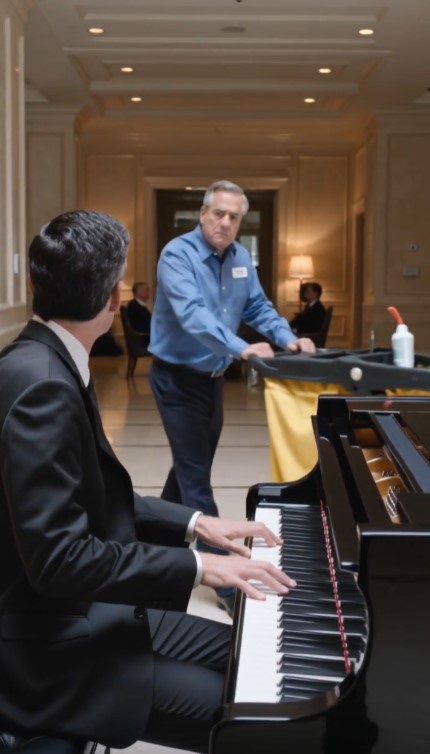
The entire hotel lobby went silent when the pianist suddenly stopped playing.
A janitor had walked past…
quietly whistling one note.
Just one.
The pianist turned around.
“Do that again.”
The janitor looked embarrassed.
“What?”
“That note.”
He whistled it again.
The pianist immediately played four notes on the piano.
The janitor answered by whistling four more.
They stared at each other.
Neither had ever met.
But together…
they had just completed a melody neither man had heard in decades.
The pianist stood.
“My mother used to sing that.”
The janitor shook his head.
“My father wrote it.”
Now everyone nearby was watching.
The pianist asked:
“What was your father’s name?”
The janitor answered.
The pianist’s face went white.
He walked to his piano bench…
opened a small compartment…
and removed a cassette tape he’d carried for 32 years.
The label contained the same name.
But when the janitor saw the handwriting…
he whispered:
“That isn’t my father’s writing.”
Then an elderly woman sitting across the lobby quietly stood up.
Her name was Margaret.
She had been sitting near the window with a cup of tea.
Nobody had noticed her until that moment.
She walked slowly toward the piano.
The janitor stared at her.
The pianist did too.
Margaret looked at the cassette.
Then said:
“I wrote that label.”
The pianist’s name was Daniel.
The janitor was Henry.
Daniel held the cassette carefully.
“You?”
Margaret nodded.
Thirty-two years earlier, she had worked in a small neighborhood recording studio.
Not a famous one.
Mostly local singers.
Wedding demos.
Church groups.
Jingles.
Young musicians who could barely afford an hour.
Henry’s father, Thomas, had been one of them.
He wrote songs constantly.
Most never went anywhere.
One melody was different.
Simple.
Eight notes.
Four answered by four.
Daniel’s mother, Evelyn, had heard Thomas playing it in the studio hallway.
She started humming along.
Thomas laughed.
Then they recorded a rough version together.
Nothing professional.
Just voice and piano.
Margaret labeled the cassette afterward.
THOMAS CARTER – DEMO
Daniel stared.
“My mother never told me any of this.”
Margaret looked sad.
“She probably had reasons.”
Henry frowned.
“What reasons?”
Margaret took a breath.
“Because your father disappeared from the studio three days later.”
Henry’s face hardened.
“He didn’t disappear.”
Margaret looked at him.
“That’s what we thought.”
Thomas had been struggling financially.
He worked construction during the day.
Wrote music at night.
He dreamed of selling one song.
Just one.
Enough to prove the years of notebooks meant something.
Evelyn believed in him.
Not romantically.
She was already married.
They were friends.
She had a beautiful voice.
Thomas had the melody.
They planned to finish the recording that weekend.
Thomas never came back.
The studio called.
No answer.
Margaret eventually assumed he had given up.
Then the building closed years later.
Most tapes were thrown out.
Margaret saved a few.
Including that one.
Daniel asked:
“How did my mother get it?”
Margaret looked toward him.
“She came back for it.”
Months later, Evelyn arrived alone.
She asked for Thomas’s cassette.
Margaret gave it to her.
Evelyn said:
“If he ever comes back, tell him I kept the song safe.”
Daniel swallowed.
“My mother kept this until she died.”
Then Henry asked the question that mattered.
“Why would she have my father’s song?”
Margaret answered:
“Because she thought he had written it for you.”
Henry went still.
“What?”
The melody had started as a lullaby.
Thomas had told them that much.
His son was five.
Couldn’t sleep during storms.
Thomas used to whistle four notes.
Henry would answer with four more.
A game.
Call and response.
That was the melody.
Henry looked stunned.
“That’s why I know it.”
Margaret nodded.
“You were the reason it existed.”
Daniel sat down slowly.
“My mother sang it to me too.”
That changed the room again.
Henry looked at him.
“Why?”
Daniel’s mother Evelyn had met Thomas during a difficult period in her own life.
Daniel had been six.
His father was often away.
Money was tight.
Daniel had trouble sleeping.
One evening at the studio, Thomas heard Evelyn mention it.
He told her about the little tune he used with Henry.
He taught it to her.
She took it home.
Sang it to Daniel.
Two children.
Two families.
Same melody.
Neither boy knew the other existed.
Years later, Daniel became a pianist.
The tune stayed buried in memory.
Henry became a janitor.
He still whistled the first note sometimes without thinking.
And now, in a hotel lobby decades later, the two halves met.
Daniel asked:
“What happened to Thomas?”
Henry looked down.
“He died nine years ago.”
Margaret closed her eyes.
“I’m sorry.”
Henry nodded.
“He never stopped writing.”
That surprised her.
“Really?”
Henry smiled faintly.
“Boxes of songs.”
“Did he ever talk about the studio?”
“Not much.”
Then Henry remembered something.
After Thomas died, he inherited an old metal case.
Inside were notebooks.
A broken microphone.
Receipts.
And one envelope marked:
EVELYN
Henry had never opened it.
He assumed it belonged to some client or friend.
Daniel immediately looked up.
“My mother?”
“Maybe.”
The three of them agreed to meet the next day.
Henry brought the envelope.
Daniel brought the cassette.
Margaret brought an old studio ledger she had kept.
Inside the envelope was a letter.
Thomas’s handwriting.
Henry recognized it immediately.
Daniel read aloud.
Evelyn,
I’m sorry I vanished.
Henry closed his eyes.
Margaret whispered:
“So he did leave.”
Henry shook his head.
“No. Keep reading.”
Thomas explained.
His mother had suffered a stroke.
He left town suddenly to care for her.
He expected to return in days.
It became months.
Medical bills.
Temporary work.
Family obligations.
He lost his apartment.
Phone disconnected.
By the time he returned, the studio had changed ownership.
Evelyn was gone.
He assumed the demo was lost.
He wrote:
If you kept the tape, thank you.
If you didn’t, that’s okay too.
Then:
The melody was never mine alone.
Henry gave me the second half.
Henry looked confused.
Margaret explained.
Thomas always whistled the first four notes.
One night, five-year-old Henry had answered with four of his own.
Thomas wrote them down.
That became the completed melody.
Henry whispered:
“I wrote half the song?”
Margaret smiled.
“Apparently.”
Daniel laughed.
“You were five.”
“I was talented.”
For the first time, everyone smiled.
The letter continued.
Thomas thanked Evelyn for singing the demo.
Then one line changed Daniel’s expression.
Tell your boy the song helped me too.
Daniel stopped.
“What does that mean?”
Margaret didn’t know.
But the ledger held a clue.
Beside one studio date was a note:
Evelyn + Daniel present.
Daniel stared.
“I was there?”
Apparently once.
He had no memory of it.
Margaret remembered vaguely.
A small boy sitting under the piano.
Thomas playing.
Evelyn singing.
Henry’s father may have met Daniel as a child.
Not enough to form a memory.
But enough to know him.
Henry asked:
“Did Dad ever mention a little boy at the studio?”
Then he remembered.
A phrase Thomas used occasionally.
The piano kid.
Henry had assumed it meant a musician.
Maybe it had been Daniel.
The story grew stranger.
But not magical.
Just overlapping lives nobody connected.
Then Margaret found something else in the ledger.
A second cassette number.
Another recording.
Not the one Daniel carried.
A later session.
Thomas had returned years afterward.
Alone.
Recorded the melody again.
Margaret had completely forgotten.
The tape might still exist in a storage box she had kept.
They searched.
Two days later, she found it.
Old.
Dusty.
Labeled:
T. CARTER – FOR HENRY
This time the handwriting was Thomas’s.
Henry held the cassette like glass.
They found a specialist who could safely digitize it.
The recording began with static.
Then Thomas’s voice.
Older.
Tired.
“Henry, if you ever hear this…”
Henry covered his mouth.
Daniel sat beside him.
Thomas continued.
“I know you think I never finished the song.”
“I did.”
Then he played.
The same eight-note melody.
But now longer.
A full piece.
Simple piano.
No lyrics.
Then Thomas spoke again.
“The first four notes were mine.”
“The next four were yours.”
“So I guess this belongs to both of us.”
Henry cried.
He had never heard his father say that.
Then:
“I always meant to give you this.”
“I kept waiting until it sounded perfect.”
“It never did.”
“So this will have to do.”
The tape ended.
Henry laughed through tears.
“Typical.”
Daniel asked:
“What?”
“He waited for perfect.”
Margaret nodded.
“So did the rest of us.”
That became the painful theme.
Thomas waited to contact Evelyn.
Evelyn waited for Thomas to return.
Margaret waited for someone to ask about the cassette.
Henry waited years before opening the envelope.
Daniel carried the tape for thirty-two years without knowing why his mother kept it.
Everyone waited.
Then one whistle in a hotel lobby finally broke it.
Daniel asked Henry if he could play the full piece publicly.
Henry hesitated.
Then agreed.
But with one condition.
No dramatic story about a “lost masterpiece.”
Thomas had never been famous.
The song had never been commercially released.
It was family music.
That mattered.
A month later, Daniel played it in the same hotel lobby.
Henry sat in the front row.
Margaret beside him.
No huge crowd.
Just guests.
Staff.
A few friends.
Daniel introduced it simply:
“This piece began with a father and his five-year-old son.”
Then he played.
Halfway through, Henry realized something.
He knew the transition.
Not consciously.
But his mouth formed the next phrase before Daniel reached it.
Old memory.
Maybe from childhood.
Maybe his father had played versions at home.
Henry whistled softly.
Daniel heard.
Smiled.
And adjusted the piano around him.
For a few seconds, they played together.
No one interrupted.
Afterward, Henry said:
“You changed it.”
Daniel nodded.
“You were flat.”
“I’m a janitor, not a flute.”
Margaret laughed.
The recording was never sold.
Henry didn’t want that.
Instead, Daniel made copies for the family.
One for himself.
One for Henry.
One for Margaret.
Henry later found more of Thomas’s notebooks.
Most songs were unfinished.
Some terrible.
Some beautiful.
Daniel helped organize them.
Not to publish everything.
Just preserve them.
Among the pages was the original eight-note melody.
At the top, Thomas had written:
Storm Song for Henry
Under the first four notes:
Dad
Under the next four:
H
Henry touched the page.
There it was.
Proof.
The song had always been theirs.
Years passed.
Margaret died peacefully in her nineties.
Daniel played the melody at her memorial.
Henry attended.
By then he had retired from janitorial work.
He joked that retirement was exhausting.
Daniel and Henry remained friends.
Not because their parents had known each other.
Because they liked each other.
They argued about music.
Baseball.
Coffee.
Henry claimed Daniel played everything too slowly.
Daniel said Henry whistled everything in the wrong key.
Then one afternoon, Henry brought Daniel a wooden box.
Inside was Thomas’s original handwritten music.
Daniel stared.
“I can’t take this.”
“It belongs with the piano kid.”
“No.”
Henry smiled.
“Then borrow it until I ask for it back.”
Daniel understood.
Years later, after Henry died peacefully, the page stayed with Daniel.
He framed a copy.
The original went to Henry’s daughter.
That was right.
The cassette remained in Daniel’s piano bench.
Same place he had kept it for decades.
But now the label meant something.
Not just a name.
Not just a mystery.
A chain.
Thomas wrote a melody with his son.
Evelyn carried it into Daniel’s childhood.
Margaret preserved it.
Daniel remembered half.
Henry remembered the other half.
And thirty-two years later, in a hotel lobby, one janitor whistled a single note.
One pianist stopped playing.
“Do that again.”
Four notes.
Four more.
Two strangers staring at each other.
Then one old cassette.
One familiar name.
And one elderly woman standing quietly across the lobby because she finally recognized a story she thought had disappeared decades earlier.
Sometimes music survives differently than people expect.
Not in records.
Not in fame.
Not even in memory intact.
Sometimes one person keeps four notes.
Another keeps four more.
And the song waits until they meet.