
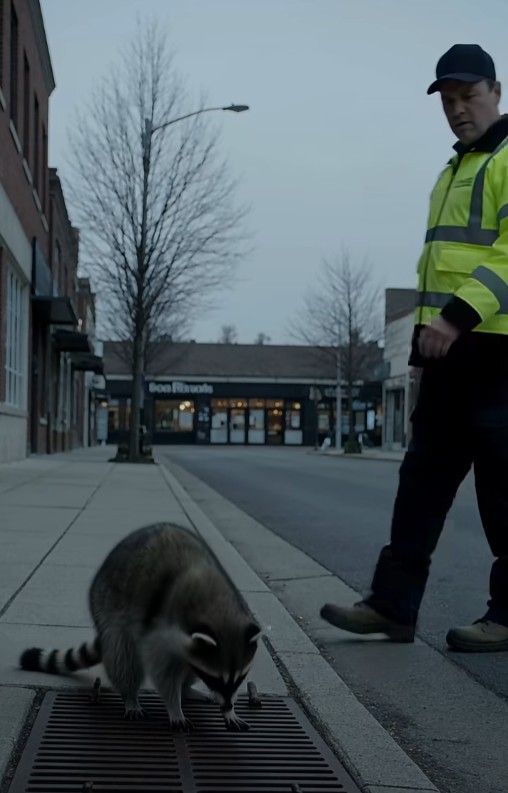
David had spent nearly fifteen years working on city maintenance crews, but he had never seen a raccoon behave quite like the one sitting beside a storm drain.
The animal had remained in almost the same place for hours.
She wasn’t searching for food.
She wasn’t exploring nearby garbage cans.
Instead, she kept looking down through the metal grate, occasionally moving around its edges before returning to the same spot.
At first, David assumed she was simply curious about something beneath the street.
Then he heard a faint squeak.
It came from deep inside the drainage chamber.
When a wildlife rescue specialist arrived and shone her flashlight through the opening, she discovered a tiny baby raccoon trapped on a narrow concrete ledge.
But as the team prepared to help it, another pair of eyes appeared in the darkness.
Then another.
The specialist leaned closer.
“David, there are more babies down here.”
She moved the flashlight toward the far end of the chamber.
And suddenly, she understood why the mother raccoon had refused to leave.
An entire litter was trapped beneath the street, and rising rainwater was slowly cutting off their only safe place to rest.
The Strange Animal Beside the Road
The morning had begun like any other workday for David Miller.
He and his maintenance crew were inspecting drainage systems after several days of heavy rain.
Their job was to clear debris, check stormwater grates, and make sure the city’s drainage network was functioning properly.
By midmorning, they had already inspected several streets.
Then David noticed a raccoon sitting beside a metal storm drain near a quiet residential intersection.
At first, he didn’t think much of it.
Raccoons were common in the neighborhood, especially around wooded areas and older buildings.
But when the crew returned along the same road nearly two hours later, the animal was still there.
David slowed his truck.
“That’s strange,” he murmured.
His coworker, Brian, looked through the window.
“What’s strange?”
“That raccoon. She was sitting there earlier.”
Brian glanced toward the drain.
“Maybe she’s looking for food.”
David watched more closely.
The raccoon approached the grate, lowered her head, and made a soft chattering sound.
Then she moved a few steps away.
After a moment, she returned.
David parked at a safe distance.
“I don’t think she’s looking for food.”
He stepped outside, keeping well away from the wild animal.
That’s when he heard something that made him stop.
A tiny squeak.
Then another.
Both came from beneath the street.
The Sound Nobody Else Had Noticed
David stood quietly beside his truck.
For several seconds, he heard nothing but distant traffic and the sound of water moving through the drainage system.
Then the squeaking returned.
It was faint.
Almost impossible to hear over the passing cars.
But it was unmistakably coming from the drain.
David looked toward the raccoon.
She remained near the grate, her ears raised.
He began to suspect that something was trapped underground.
Rather than attempting to approach the animal or open the drain himself, David contacted the city’s wildlife rescue service.
He explained that an adult raccoon had been remaining beside a storm drain and that he could hear small animal sounds coming from below.
The dispatcher advised him to keep a safe distance and prevent unnecessary activity around the area until a qualified team arrived.
David contacted his supervisor and arranged for the immediate work area to be protected.
The raccoon briefly moved toward a nearby fence.
But she didn’t disappear.
Instead, she remained within sight of the drain.
And every few minutes, she returned to look through the grate.
The First Discovery Beneath the Grate
Wildlife rescue specialist Hannah Brooks arrived with a small response team.
She had handled numerous cases involving animals trapped in buildings, drainage systems, and other urban structures.
But she knew every rescue required a careful assessment.
Storm drains could contain contaminated water, hidden debris, unstable footing, and sudden changes in water flow.
She first examined the grate from above while the maintenance crew secured the surrounding area.
Then she directed a flashlight through the openings.
At first, the beam illuminated only wet concrete and a shallow stream of water.
But as she changed the angle, something moved near the side wall.
A tiny face.
Hannah crouched lower.
“Oh, little one.”
A baby raccoon was sitting on a raised ledge several feet beneath the road.
Its fur was damp, and its small paws gripped the edge of the concrete.
It appeared frightened and unable to climb out.
David leaned forward from a safe distance.
“Is that what we heard?”
Hannah nodded.
“There’s a baby raccoon down there.”
But before she could examine the situation further, another squeak came from behind the ledge.
Hannah moved the flashlight.
Two small eyes reflected the light.
Then another tiny head appeared.
She paused.
“Wait. There’s more than one.”
The Hidden Family Nobody Could See
The rescue team used an inspection camera to examine the deeper section of the drain.
Behind the first ledge was a narrow maintenance recess.
It was partly concealed by a concrete support and a collection of washed-in branches.
Inside, several baby raccoons were huddled together.
Hannah counted carefully.
One.
Two.
Three.
Four.
Then she noticed movement behind the others.
A fifth.
Five baby raccoons were trapped inside the drainage chamber.
Some were resting on the raised ledge.
Others had squeezed into the recess behind it.
The smallest was lying close to the wall, barely visible beneath the others.
David stared at the camera display.
“How did they all get down there?”
Hannah explained that raccoons sometimes use sheltered urban spaces as den sites.
The mother may have entered through another opening or moved her young into the drainage structure before the recent rain.
But the heavy rainfall could have changed the conditions inside.
Washed-in debris had partially blocked one passage.
And water flowing along the floor had left the babies isolated on the narrow ledge.
The mother appeared to be outside while her young remained trapped below.
Hannah looked toward the adult raccoon waiting near the fence.
“We can’t know exactly what happened,” she said. “But these babies need help getting out.”
The Danger Was Greater Than It First Appeared
The rescue team studied the drainage chamber carefully.
The ledge holding the raccoons was above the current water level, but only by a limited distance.
Several days of rain had already soaked the surrounding ground.
And according to the maintenance crew, more showers were forecast later that afternoon.
A sudden increase in runoff could make the situation dangerous.
Hannah also noticed that one section of the chamber contained loose branches and plastic debris.
The debris had become lodged against the concrete support, narrowing the route between the ledge and the nearest accessible opening.
David looked at the inspection camera.
“Can we lift the grate and get them out?”
Hannah nodded cautiously.
“Possibly. But we need to make sure the animals won’t panic and move deeper into the drain.”
The team coordinated with the city’s maintenance department to assess access and water conditions.
They also confirmed that the rescue could proceed safely before opening the chamber.
Meanwhile, the mother raccoon remained nearby.
She occasionally moved behind the fence, but repeatedly returned to the same area.
David watched her quietly.
“She hasn’t given up on them.”
Hannah looked toward the drain.
“She may be staying close to her young. We need to give this family the best chance of being reunited.”
The Rescue Beneath the Street
Once the area was secured, the maintenance crew carefully removed the heavy metal grate using appropriate lifting equipment.
Hannah and another trained wildlife responder prepared a secure carrier lined with clean material.
They worked slowly to avoid frightening the babies.
The first young raccoon was sitting near the accessible edge of the ledge.
Using appropriate protective equipment and wildlife-handling tools, Hannah gently guided it into the carrier.
The little animal squeaked and curled into the corner.
One baby was safe.
The second was slightly farther back.
It moved nervously when the light reached it, but the team managed to retrieve it without injury.
Then came the third.
And the fourth.
David watched every movement.
He had repaired drainage systems for years, but never imagined one would contain an entire family of wild animals.
When Hannah reached the fifth baby, she stopped.
The smallest raccoon was partly hidden beneath a collection of wet leaves.
It didn’t move when the flashlight passed over it.
Hannah’s expression changed.
“Hold on. This one’s not responding like the others.”
The Smallest Baby Was in Trouble
The tiny raccoon appeared cold and exhausted.
Its fur was wet, and its movements were much weaker than those of its siblings.
Hannah carefully lifted it into a separate warm, secure carrier for immediate assessment.
David stepped closer to the designated safe area.
“Is it going to be okay?”
Hannah examined the little animal.
“It’s alive, but it needs attention.”
She contacted the wildlife rehabilitation center and described its condition.
The team arranged prompt transport to an authorized wildlife rehabilitator.
The other four babies were alert and responsive, but they also needed to be checked after spending time in the wet drainage chamber.
Hannah knew the ideal outcome would be to reunite the litter with their mother when it was safe to do so.
But the weakest baby might first require stabilization.
The rescue team carefully documented where each animal had been found and made arrangements for their care.
Meanwhile, David looked toward the nearby fence.
The mother raccoon was still there.
Watching.
The Mother Who Refused to Leave
As the team prepared to transport the babies for assessment, the adult raccoon moved closer to the drain.
The responders maintained a safe distance and avoided attempting to handle her.
She stopped near the edge of the work area.
Raised her head.
And made a series of soft sounds.
One of the babies squeaked from its carrier.
The mother immediately turned toward the sound.
David watched in amazement.
“She knows they’re there.”
Hannah nodded.
“She can hear them.”
The team kept the animals protected and minimized unnecessary disturbance.
They also arranged a suitable reunion strategy with the wildlife rehabilitator.
Because the smallest baby needed medical attention, the team couldn’t simply release the entire litter immediately.
But they hoped that once the babies were healthy enough, the mother would return to collect them.
The best outcome for young wild raccoons is generally to remain with their mother whenever that can be achieved safely.
And Hannah was determined to give this family that opportunity.
A Difficult Night at the Wildlife Center
At the rehabilitation center, the five baby raccoons received examinations from trained professionals.
Four were in relatively stable condition.
They were tired and mildly dehydrated, but showed encouraging signs after receiving appropriate care.
The fifth was more concerning.
The smallest baby had become chilled and weak.
Its body temperature needed careful management, and the rehabilitation team monitored its condition closely.
They provided species-appropriate supportive care and evaluated whether it had any injuries.
For several hours, the little raccoon remained quiet.
The rehabilitators worked carefully, checking its breathing, movement, and responses.
By late evening, it began showing signs of improvement.
Its paws moved.
Its head lifted slightly.
And it responded more normally when examined.
The team remained cautious.
But the progress was encouraging.
The following morning, Hannah received an update.
The little raccoon was stronger.
And if recovery continued, the rehabilitation center hoped to attempt reunification with the mother as soon as it was appropriate.
Hannah immediately called David.
“I thought you’d want to know,” she said.
David smiled.
“Please tell me they’re okay.”
“All five are alive. The smallest one is improving.”
David let out a long breath.
“That might be the best news I’ve heard all week.”
The Plan to Bring the Family Back Together
Over the next day, the rehabilitation team monitored the babies and assessed their readiness for reunification.
Once the smallest raccoon was considered stable enough, the team coordinated with the city to return the litter to a suitable protected location close to where they had been found.
The original storm drain was no longer considered an appropriate place for the young animals.
The maintenance crew had cleared the debris and identified openings that needed attention to reduce the risk of another animal becoming trapped.
But the mother was still believed to be in the area.
Hannah arranged for the babies to be placed in a secure temporary reunion box at a nearby sheltered location, following wildlife rehabilitation guidance.
The box was designed to protect the young animals while allowing their mother to locate and retrieve them.
The team monitored from a distance and used a remote camera to avoid disturbing the site.
Then they waited.
For the first hour, nothing happened.
The street grew quiet.
The sun began to set.
And the babies occasionally made faint calls from inside the protected box.
David asked whether the mother might have left the neighborhood.
Hannah answered carefully.
“It’s possible. But let’s give her an opportunity.”
The Moment Everyone Had Been Hoping For
Shortly after dusk, the remote camera recorded movement near the reunion site.
A raccoon emerged from behind a fence.
She approached cautiously, stopping several times to inspect the area.
Then she moved toward the box.
Hannah watched the live feed.
“David, come look.”
The raccoon lowered her head and sniffed the entrance.
A baby squeaked.
The adult immediately became more attentive.
She entered the box briefly.
Then emerged carrying one of the babies gently in her mouth.
David stared at the screen.
“She came back.”
Hannah smiled.
“Yes. She did.”
The raccoon moved away toward a sheltered area beyond the fence.
Several minutes later, she returned.
This time, she collected another baby.
Then another.
The process continued as the team watched quietly from a distance.
One by one, the mother carried the little raccoons away.
But after she collected the fourth, she didn’t immediately return.
David grew nervous.
“What about the smallest one?”
Hannah kept watching.
“We’ll continue monitoring.”
Several minutes passed.
Then the mother appeared again.
She approached the box.
Paused.
And gently lifted the final baby.
The same tiny raccoon that had been nearly motionless in the storm drain was now being carried away by its mother.
David covered his mouth.
“All five.”
Hannah nodded.
“All five.”
The Discovery That Changed the City’s Maintenance Routine
The following week, David returned to the storm drain with his maintenance crew.
The drainage chamber had been cleaned.
Loose debris had been removed.
And the department was reviewing possible modifications to reduce the chance of wildlife entering dangerous sections of the system, while maintaining proper drainage.
David examined the area where the mother raccoon had sat.
It looked ordinary again.
Just a metal grate beside a residential street.
Cars passed.
Neighbors walked their dogs.
And nobody would have guessed that an entire family of raccoons had been trapped beneath the pavement only days earlier.
Brian approached him.
“Still thinking about those raccoons?”
David smiled.
“Hard not to.”
They discussed how easily the sounds from the drain could have been overlooked.
If David hadn’t stopped to listen, the crew might never have realized what was happening below.
The experience led the team to place greater emphasis on safely reporting unusual animal sounds or behavior discovered during inspections.
They were also reminded not to enter confined drainage structures or attempt wildlife rescues without appropriate training and coordination.
A simple observation had made a meaningful difference.
An Unexpected Encounter Weeks Later
Several weeks passed.
David continued his usual work around the city.
One quiet morning, his crew returned to the same neighborhood to inspect another drainage inlet.
As he stepped out of the truck, he noticed movement near a row of bushes.
A raccoon appeared briefly.
Then disappeared behind a fence.
A moment later, two smaller raccoons followed.
David stopped.
He watched from a safe distance.
The animals moved quickly through the vegetation before vanishing into a wooded area behind the houses.
Brian looked over.
“What are you smiling at?”
David nodded toward the bushes.
“Just saw a raccoon family.”
“Think it’s the same one?”
David shook his head.
“No way to know.”
But the sight reminded him of the five babies hidden beneath the street.
He hoped they were somewhere safe, exploring the world beside their mother.
And although he couldn’t prove the animals he had just seen were part of the rescued family, the moment brought him unexpected happiness.
The Lesson Hidden Beneath an Ordinary Street
David had spent much of his working life repairing things people rarely noticed.
Storm drains.
Pavement.
Roadside barriers.
Underground utilities.
Most days, his work went unnoticed unless something stopped functioning.
But the raccoon rescue reminded him that the city was home to far more living creatures than its human residents.
Animals adapted to the streets, gardens, parks, and buildings around them.
Sometimes, those spaces provided shelter.
Other times, they created unexpected dangers.
And occasionally, a small animal in trouble depended on someone noticing that something wasn’t right.
One afternoon, a neighbor asked David why he had spent so much time watching a raccoon beside a drain.
He thought about the question.
Then smiled.
“Because she kept looking down there,” he said. “And I figured there must be a reason.”
The neighbor laughed.
“Turns out you were right.”
David nodded.
“I’m glad I listened.”
The Mother Who Never Walked Away
Months later, David still remembered the image of the mother raccoon sitting beside the storm drain.
She had remained near the same patch of pavement for hours.
While people walked past.
While cars drove along the street.
And while the city continued its usual routine.
Nobody could know exactly what the animal understood about her babies’ situation.
She may have been responding to their calls, searching for a way back into the drainage chamber, or remaining near a place where she knew her young were located.
But her persistence was unmistakable.
And that persistence had caught the attention of a city worker who decided to investigate rather than ignore it.
David often thought about the moment the fifth baby was carried away during the successful reunion.
The smallest raccoon had been weak, cold, and barely responsive when the rescuers found it.
Yet after receiving appropriate care, it had been returned to its mother.
The family disappeared into the night together.
No cheering crowds.
No cameras flashing.
No grand celebration.
Just a mother carrying her babies toward safety.
A raccoon had spent hours beside an ordinary storm drain, and most people believed she was simply searching for food.
But when a city worker stopped to listen, he discovered five tiny lives hidden beneath the street.
And sometimes, the most extraordinary rescues begin when someone notices the quietest cry for help.