
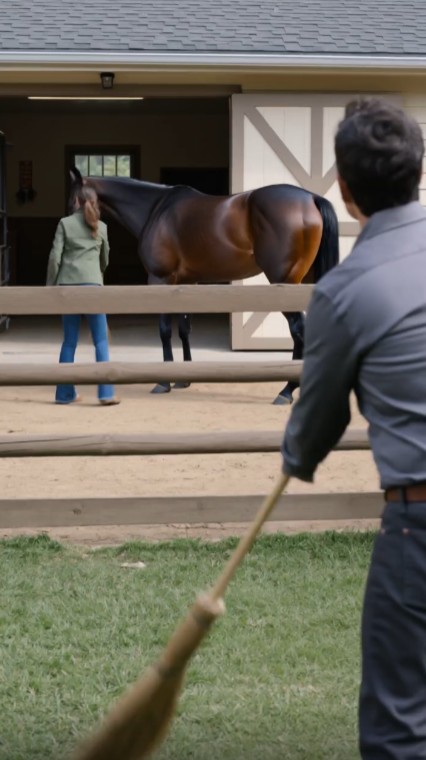
The rescue horse suddenly refused to enter the barn.
The handler tried again.
Nothing.
The horse wasn’t frightened.
He was staring past her…
At the new maintenance worker.
The worker stopped sweeping.
“Is something wrong?”
Then the horse did something nobody expected.
He walked directly toward the fence…
And waited.
The worker looked uncomfortable.
“I don’t know anything about horses.”
Then, almost jokingly…
He whistled three short notes.
The horse’s head shot up.
The handler froze.
“Do that again.”
The man whistled.
Three notes.
The horse immediately walked to the exact same corner of the fence.
Then gently lowered his head.
The worker dropped the broom.
“No…”
The handler asked:
“What?”
He stared at the horse’s forehead.
Then whispered:
“I knew a horse with that marking.”
“When?”
The man didn’t answer.
Instead, he asked:
“Where did you get him?”
The handler told him the name of the rescue facility he’d come from.
The worker stepped backward.
“That place used to be my father’s farm.”
Silence.
The horse softly whinnied.
The worker covered his mouth.
Then the handler said:
“There’s one more thing.”
“What?”
“When he arrived here…”
“He came with a name.”
The worker stared at her.
She said it.
“Jasper.”
The broom fell from his hand.
For several seconds, the man didn’t move.
Then he whispered:
“No.”
The handler, Rachel Carter, looked from him to the horse.
“You know that name?”
The man’s eyes never left Jasper.
“My father named him.”
Rachel stopped.
The maintenance worker’s name was Daniel Wilson.
He was fifty-eight years old.
He had started working at the sanctuary only four days earlier.
He repaired fences.
Fixed doors.
Maintained equipment.
He had deliberately taken a job that required almost no contact with the animals.
Rachel had noticed that immediately.
Whenever the horses approached, Daniel found something else to do.
If staff invited him closer, he declined.
“I fix things,” he always said.
“You people handle the horses.”
Now Rachel understood there might be a reason.
She looked at Jasper.
The horse stood quietly at the fence.
A white marking ran down his forehead, but near the top it split slightly to the left.
Daniel pointed toward it.
“My mother called that his lightning bolt.”
Rachel asked carefully:
“How long ago?”
Daniel swallowed.
“Twenty-one years.”
Rachel looked at Jasper.
Their veterinarian estimated him to be in his mid-twenties.
The age was possible.
But Rachel wasn’t ready to make assumptions.
“Tell me about your father’s horse.”
Daniel leaned against the fence.
“My dad’s name was Henry Wilson.”
“He bought a young chestnut gelding when I was in my thirties.”
“Jasper?”
Daniel nodded.
“He wasn’t supposed to keep him.”
“Why?”
“My father was already getting older.”
“He’d promised my mother he was done buying horses.”
Rachel smiled.
“That promise didn’t last?”
“About six months.”
Daniel looked at Jasper.
“Then this one arrived.”
Henry had spent most of his life around horses.
The Wilson farm wasn’t a large commercial operation.
It was forty-three acres.
A barn.
Several paddocks.
A small farmhouse.
Henry raised a few horses, boarded others and repaired farm equipment for neighbors.
Daniel grew up there.
As a child, he loved the horses.
As a teenager, he tolerated them.
By adulthood, he wanted nothing to do with the farm.
“I wanted a different life,” Daniel explained.
“Dad never understood that.”
Daniel moved to the city.
Became a carpenter.
Married.
Had a daughter.
He visited the farm occasionally.
But every visit eventually became the same argument.
Henry wanted Daniel to come home.
Daniel wanted Henry to stop asking.
Then Jasper arrived.
He was young.
Curious.
And difficult to catch when he didn’t want to be caught.
Henry tried calling him.
Nothing.
Grain worked sometimes.
But Henry wanted a simple cue he could use across the paddock.
So he began whistling.
Three short notes.
The same three notes Daniel had just used.
Rachel asked:
“Why those notes?”
Daniel smiled faintly.
“They weren’t originally for Jasper.”
“Who were they for?”
“Me.”
Rachel looked confused.
Daniel explained.
When he was a child, the farm stretched farther than it did later.
There were woods behind the pasture.
A creek.
An old equipment shed.
Daniel spent entire summer days outside.
His father didn’t want to scream his name across forty acres.
So Henry used a whistle.
Three short notes.
It meant:
Come home.
“When I heard it,” Daniel said, “I knew supper was ready.”
Rachel looked at Jasper.
“And your father later used it with him?”
Daniel nodded.
“He said if it worked on one stubborn animal, it might work on another.”
Rachel laughed.
“So you were the first stubborn animal?”
“Apparently.”
Daniel’s smile disappeared.
He looked at Jasper again.
“But this can’t be him.”
Rachel asked:
“Why not?”
“Because Jasper disappeared.”
“When?”
“Seventeen years ago.”
Now Rachel became serious.
“How?”
Daniel took a long breath.
By then, Henry was seventy.
Daniel’s mother, Margaret, had died.
Henry remained on the farm alone.
Daniel wanted him to sell.
Henry refused.
Their arguments became worse.
One afternoon, Daniel drove out to the farm intending to settle the issue.
Instead, he and Henry shouted at each other in the barn.
Daniel told his father:
“You care more about this place than you care about your family.”
Henry answered:
“This place is part of the family.”
Daniel said something he would regret for the next seventeen years.
“Then keep it.”
He drove away.
Two weeks later, a severe storm damaged fencing on the north side of the property.
Two horses got loose.
One was recovered the next morning.
Jasper wasn’t.
Henry searched.
Neighbors searched.
Local animal-control officers were notified.
Veterinary clinics received photographs.
Notices went up.
Days became weeks.
No Jasper.
Daniel heard about it from a neighbor.
He almost called his father.
He didn’t.
He told himself Henry would call if he needed him.
Henry apparently told himself the same thing.
Months passed.
Then Henry suffered a stroke.
Daniel finally returned to the farm.
The first thing he noticed was the fence.
Repaired.
The second was Jasper’s empty stall.
Henry survived the stroke, but he could no longer manage the property alone.
The farm was sold.
Daniel moved his father into a smaller accessible home nearby.
For a while, the old argument disappeared.
There were doctors.
Rehabilitation appointments.
Medication schedules.
Practical things.
Then one evening Henry asked:
“Did you ever find him?”
Daniel knew exactly who he meant.
“No.”
Henry looked toward the window.
“He knew the whistle.”
Daniel didn’t answer.
“Three notes,” Henry said.
“I remember.”
“If somebody ever finds him…”
“Dad, it’s been almost a year.”
Henry looked at his son.
“I know how long it’s been.”
Daniel immediately regretted his tone.
But Henry never mentioned Jasper again.
Three years later, he died.
Daniel sold the remaining farm equipment.
Packed his father’s belongings.
And found the little leather halter tag Henry had kept.
One side said:
JASPER
The other:
H. WILSON
Daniel put it in a box.
He didn’t look at it again for years.
Rachel listened quietly.
Then she asked:
“Do you still have any photographs?”
Daniel nodded.
“At home.”
“Would you bring them tomorrow?”
“You think this could really be him?”
“I think we should check.”
That afternoon, Rachel pulled Jasper’s complete file.
He had arrived at the sanctuary eight months earlier after being transferred from another equine rescue.
That rescue had received him from an elderly couple who could no longer care for several horses on their property.
The couple had owned him for approximately sixteen years.
Rachel stopped reading.
Sixteen years.
Jasper had disappeared from Henry’s farm seventeen years earlier.
She called the previous rescue.
Then the former owners.
The woman who answered was named Evelyn Miller.
Rachel asked where they’d gotten Jasper.
Evelyn remembered immediately.
“My husband found him.”
“Where?”
“Near County Road 8.”
Rachel pulled up a map.
Henry Wilson’s old farm had been less than twelve miles away.
“What year?”
Evelyn gave her the date.
It was six weeks after Jasper disappeared.
Rachel’s pulse quickened.
“Did you report finding him?”
“My husband did.”
“To whom?”
“I don’t remember. Sheriff’s office, maybe animal control.”
Evelyn sounded uncomfortable.
“We put up notices at the feed store too.”
“Nobody contacted you?”
“No.”
“Did he have identification?”
“Nothing readable.”
Rachel asked about his appearance.
Chestnut gelding.
White marking on the forehead that bent slightly left.
Small old scar near the right hind leg.
Daniel had not mentioned the scar.
Rachel wrote it down.
Then she called him.
“Before you bring the photos tomorrow, I need you to answer something.”
“What?”
“Did your father’s Jasper have any scars?”
Daniel thought.
“One.”
“Where?”
“Right hind leg.”
Rachel stopped writing.
“How did he get it?”
“Old wire when he was young.”
Rachel looked at Jasper’s veterinary file.
Same location.
That still wasn’t absolute proof.
Plenty of horses had scars.
But now they had multiple consistent details.
Approximate age.
Color.
Forehead marking.
Name.
Geography.
Timeline.
Scar.
And the old whistle cue.
The following morning, Daniel arrived carrying a cardboard box.
He had barely slept.
Rachel brought him into the office.
He removed photographs.
The first showed Henry standing beside a young chestnut horse.
The second showed Daniel’s daughter sitting on the fence while the horse grazed nearby.
The third was a close-up.
Rachel held it beside a recent photograph of Jasper.
The facial marking was distinctive.
But they wanted more than visual resemblance.
They contacted the veterinarian who had treated Henry’s horses.
The practice still had archived records.
Eventually, an old paper file was located.
JASPER — CHESTNUT GELDING — HENRY WILSON
Approximate birth year matched.
Scar documented.
A small irregular patch of white hair near the left shoulder was documented too.
Jasper had the same patch.
Then they found the strongest evidence.
A microchip number.
Daniel stared.
“He had a chip?”
“Apparently.”
“Why didn’t anyone find it?”
Rachel explained that older chips and readers weren’t always handled consistently, and Jasper’s previous chain of care might not have included a successful scan with compatible equipment.
The sanctuary had scanned Jasper at intake.
His file contained a chip number.
Rachel compared it.
Same number.
There was no longer any reasonable question.
The horse standing in the sanctuary paddock was Henry Wilson’s Jasper.
Daniel sat down.
“He was alive.”
Rachel nodded.
“All this time?”
“Yes.”
Daniel covered his face.
For seventeen years, he’d imagined every possible ending.
None of them included Jasper living quietly with an elderly couple less than an hour away.
“What was his life like?”
Rachel had asked Evelyn the same thing.
She showed Daniel photographs the woman had sent.
Jasper in a pasture.
Jasper beside another horse.
Jasper wearing a winter blanket.
Jasper standing beside Evelyn’s husband, Thomas.
“He was cared for,” Rachel said.
Daniel stared at the pictures.
“Good.”
That single word seemed to release something inside him.
He began crying.
“Good.”
Rachel waited.
Then Daniel asked:
“Why does he come to that corner when I whistle?”
Rachel was careful.
“We can’t know exactly what he’s associating with the sound.”
“But he does it every time.”
“He may have learned that cue years ago.”
“And the corner?”
Rachel looked toward the paddock.
“That could be part of how he responds now. It might also resemble how he was approached or called in one of his previous homes.”
Daniel nodded.
He wanted the bigger answer.
Anyone would.
That Jasper had recognized Henry’s whistle after seventeen years.
That he had recognized something about Daniel.
That he’d been waiting.
But Rachel wouldn’t claim what nobody could prove.
She didn’t need to.
The documented history was extraordinary enough.
Later that morning, Daniel returned to the fence.
Jasper was grazing.
Daniel stood quietly.
Then whistled.
Three notes.
Jasper lifted his head.
He walked toward the fence.
Then moved to the corner.
Daniel’s eyes filled.
He didn’t reach through.
He didn’t force contact.
He simply stood there.
“Dad used to do that, didn’t he?”
Jasper lowered his head.
Daniel smiled.
“You were always better at listening than I was.”
Over the following weeks, Daniel began spending time around the horses.
Slowly.
Under staff guidance.
He wasn’t suddenly an expert.
He didn’t pretend to be.
He learned Jasper’s current routines rather than assuming the horse was exactly the animal he’d known years earlier.
Seventeen years had passed for both of them.
One afternoon, Rachel asked:
“Why did you take this job?”
Daniel looked confused.
“What?”
“You said you didn’t want anything to do with horses.”
“I didn’t.”
“So why work at a horse sanctuary?”
Daniel stared at the barn.
Then admitted something he’d never told anyone.
His father had kept a list.
After Henry died, Daniel found it in his desk.
It contained the names of equine rescues and sanctuaries.
Henry had contacted them after Jasper disappeared.
Year after year.
At first often.
Then occasionally.
Even after his stroke, Henry had asked others to help him send photographs.
Daniel found one note beside the list:
Still no Jasper.
Then another, dated years later:
Probably gone now. Stop bothering people.
Daniel had hated reading that sentence.
He felt as though his father had finally given up alone.
Years later, after Daniel’s own marriage ended and his daughter moved across the country, he began thinking about the farm again.
He wondered whether working around horses might help him understand the part of his father he’d spent so much time resisting.
So when a maintenance position opened at the sanctuary, he applied.
“I wasn’t looking for Jasper,” Daniel said.
“I didn’t even know he was here.”
Rachel smiled.
“That’s quite a first week.”
Daniel laughed.
“You could say that.”
Then Rachel asked:
“Do you want to know something strange?”
“What?”
“The rescue that transferred Jasper to us wasn’t originally going to send him here.”
“Why did they?”
“They needed a sanctuary placement for an older horse.”
“We had space.”
“That’s it?”
“That’s it.”
No hidden plan.
No secret message from Henry.
No mysterious force arranging a reunion.
Just a chain of ordinary decisions.
A storm.
A lost horse.
A couple who found him.
Years of care.
A later rescue transfer.
A sanctuary opening.
A maintenance job.
And one three-note whistle.
Months later, Daniel brought something to the sanctuary.
Henry’s old leather halter tag.
JASPER
H. WILSON
Rachel held it.
“You kept this?”
“For seventeen years.”
“What do you want to do with it?”
Daniel looked toward Jasper.
“Not put it on him.”
Rachel nodded.
Jasper already had appropriate current identification.
Daniel instead placed the old tag in a small frame.
Beside it he put a photograph of Henry and young Jasper.
The sanctuary hung it in the staff room.
Not in the public visitor area.
Daniel didn’t want Jasper turned into an attraction.
Then Rachel noticed something in the photograph.
Henry stood near the same style of wooden fence used on the old farm.
Jasper was beside him.
Henry’s lips were pursed.
“Was he whistling?”
Daniel smiled.
“Probably.”
On the back of the photograph, Henry had written:
JASPER FINALLY LEARNED TO COME WHEN CALLED.
Then beneath it:
DANIEL NEVER DID.
Rachel burst out laughing.
Daniel stared at the sentence.
Then started laughing too.
“That old man.”
But after a moment, his expression changed.
Because suddenly he understood why the photograph had hurt so much when he first found it.
His father wasn’t only writing about a horse.
Daniel had spent much of his adult life leaving.
The farm.
The arguments.
His father’s expectations.
And Henry had spent years calling him back in the only ways he knew.
Sometimes badly.
Sometimes stubbornly.
Sometimes too late.
Three short notes.
Come home.
Daniel began visiting Jasper even on days he wasn’t working.
He never tried to reclaim him.
The sanctuary was Jasper’s established home now.
The horse had veterinary care, appropriate companionship and a routine.
Daniel respected that.
But he became part of that routine.
Sometimes he brushed Jasper under staff guidance.
Sometimes he repaired fencing while Jasper grazed nearby.
Sometimes he did nothing.
One afternoon, his daughter Emily visited.
She hadn’t seen Jasper since she was a little girl.
Daniel didn’t tell her immediately.
He simply brought her toward the paddock.
She looked at the horse.
Then at her father.
“No.”
Daniel smiled.
“Yep.”
“Grandpa’s Jasper?”
“Grandpa’s Jasper.”
Emily began crying.
She remembered very little about the horse.
But she remembered her grandfather.
She remembered sitting on the fence.
She remembered Henry calling Jasper.
And then she remembered something else.
She whistled.
Three notes.
Jasper lifted his head.
Emily covered her mouth.
Daniel laughed.
“He taught you too?”
“Grandpa taught everybody.”
Jasper walked toward the fence.
Emily remained outside it.
“He really remembers?”
Daniel repeated what Rachel had taught him.
“We don’t know exactly what he remembers.”
Emily nodded.
Then smiled.
“But he knows the whistle.”
“He responds to it.”
“Dad.”
Daniel laughed.
“Fine. That’s close enough for today.”
Years passed.
Jasper grew older.
His face became increasingly gray.
His steps slowed.
Daniel grew older too.
He retired from full-time maintenance work but continued volunteering at the sanctuary.
One morning, Rachel found him repairing a latch.
“You know you’re retired.”
Daniel didn’t look up.
“This latch doesn’t.”
Jasper was standing nearby.
Rachel smiled.
“Still comes when you whistle?”
“Most days.”
“And the other days?”
“He’s old.”
“So are you.”
Daniel looked offended.
Jasper eventually developed the health problems that come with advanced age.
The sanctuary’s veterinary team managed him carefully.
There came a point when everyone knew time was becoming limited.
Daniel visited more often.
One evening, he sat outside Jasper’s paddock as the sun disappeared behind the trees.
He had brought Henry’s photograph.
He looked at it.
Then at Jasper.
“My father looked for you.”
Jasper continued eating.
“For years.”
Daniel smiled sadly.
“He would’ve been impossible if he’d known you were alive.”
Then:
“He would’ve told everyone he was right.”
Daniel waited.
“I wish he had been here.”
The horse moved closer to the fence.
Daniel didn’t turn it into a sign.
Didn’t pretend Jasper understood the words.
He simply appreciated that the old horse was nearby.
Then Daniel whistled.
Three notes.
Jasper lifted his head.
Daniel whispered:
“I came back, Dad.”
Months later, Jasper died peacefully at an advanced age after his care team determined his quality of life could no longer be maintained comfortably.
Daniel was there.
So was Rachel.
Afterward, Rachel asked whether Daniel wanted the framed halter tag.
He shook his head.
“Keep it here.”
“Are you sure?”
“Yes.”
“This was his last home.”
Then he added:
“And somehow it became mine too.”
Daniel continued volunteering.
Eventually new staff arrived who had never known Jasper.
One young employee noticed the framed photograph in the staff room.
“Who’s that?”
Daniel looked.
“My father.”
“And the horse?”
“Jasper.”
“Was he yours?”
Daniel thought for a moment.
“No.”
The employee looked confused.
Daniel smiled.
“He was my father’s.”
Then:
“And for a while, he belonged to some very good people who found him.”
“Then a rescue.”
“Then this sanctuary.”
The employee pointed at the leather tag.
“What’s the story?”
Daniel laughed.
“How much time do you have?”
The employee sat down.
Daniel began with the whistle.
Three short notes.
A horse refusing to enter a barn.
A maintenance worker who insisted he knew nothing about horses.
And a name spoken aloud after seventeen years.
People always wanted to know whether Jasper recognized Daniel that first morning.
Daniel never claimed he did.
Maybe Jasper recognized the whistle.
Maybe the sound had survived somewhere in a long-established learned association.
Maybe Daniel’s presence carried other familiar cues.
Maybe the fence corner had simply become part of Jasper’s current routine.
There was no way to ask him.
But Daniel eventually realized something.
He didn’t need Jasper to recognize him for the story to matter.
Daniel recognized Jasper.
And that recognition forced him to reopen a part of his own life he’d kept closed for seventeen years.
His father.
The farm.
The arguments.
The empty stall.
The phone calls neither man made.
The years Henry spent searching.
And the three-note whistle that had once meant only one thing to a little boy running somewhere across forty-three acres:
Come home.
Henry never lived to see Jasper again.
Daniel could never change that.
But he could stop doing what both he and his father had done for too many years.
Waiting for someone else to cross the distance first.
So Daniel stayed at the sanctuary.
He repaired fences.
Fixed doors.
Helped new workers.
And whenever somebody asked why an old photograph of a horse hung beside the maintenance room, Daniel told them about Jasper.
Not as a miracle.
Not as proof that a horse remembered every detail of a life seventeen years earlier.
But as something simpler.
A lost horse survived.
Records preserved his identity.
A family whistle remained familiar enough to produce a striking response.
And by extraordinary coincidence, the son of his original owner eventually took a maintenance job at the sanctuary where Jasper had been transferred.
On Daniel’s final day as a volunteer, Rachel gave him a small wooden box.
Inside was a copy of Henry’s photograph.
On the back was the same sentence:
JASPER FINALLY LEARNED TO COME WHEN CALLED.
DANIEL NEVER DID.
But Rachel had added one line underneath:
UNTIL HE DID.
Daniel read it.
Then laughed.
Then cried.
Before leaving, he walked to the fence where Jasper had stood that first morning.
The paddock was empty.
Daniel looked across it for a long time.
Then he put two fingers to his lips.
Three short notes crossed the field.
Nothing answered.
Daniel hadn’t expected anything to.
He smiled anyway.
Because seventeen years earlier, Henry Wilson had died believing the horse he loved was gone.
And Daniel had spent almost as long believing there were some parts of his life he could never return to.
Both stories turned out to be more complicated than that.
Jasper had found another life.
And eventually…
so had Daniel.
All because one morning, a rescue horse refused to enter a barn…
looked past his handler at a maintenance worker…
and heard three familiar notes that had once meant:
Come home.