
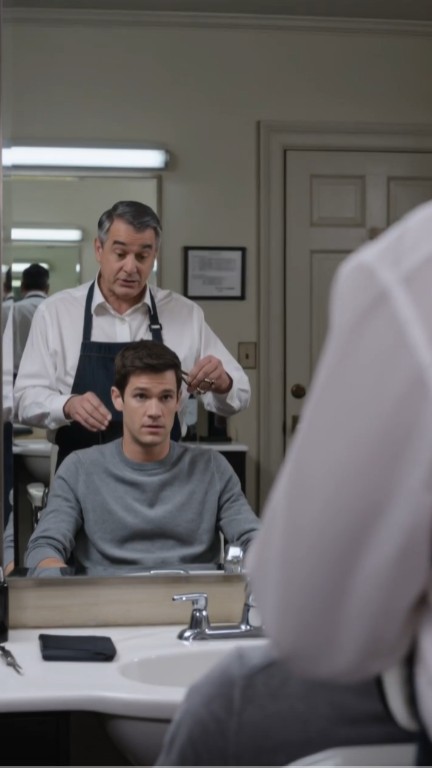
The stranger sat in the barber chair.
The barber looked at him once…
And put down his scissors.
“I can’t cut your hair.”
The man laughed.
“Why not?”
The barber walked around the chair.
Looked at him again.
Then asked:
“Have you ever been in this town before?”
“No.”
“Are you sure?”
The stranger frowned.
“Pretty sure.”
The barber called his wife from the back room.
“Maria… come here.”
She walked out.
Saw the customer…
And froze.
The stranger became uncomfortable.
“Okay… what’s happening?”
Maria whispered:
“He even smiles the same.”
The barber nodded.
The customer stood.
“Same as who?”
Neither answered.
Then an elderly man waiting near the window suddenly stood too.
He had been silent the entire time.
He walked toward the stranger.
Looked closely at his face…
And asked:
“What’s your mother’s name?”
The stranger answered.
“Rachel Carter.”
The elderly man’s eyes immediately filled with tears.
The barber whispered:
“You know her?”
The old man shook his head.
“No.”
Then he asked the stranger:
“What about your father?”
The customer hesitated.
“I never knew him.”
Nobody moved.
The elderly man reached for a chair.
The barber helped him sit.
Then Maria said:
“Tell him.”
The elderly man shook his head.
“Not yet.”
The stranger was getting emotional.
“Tell me what?”
The old man looked directly at him.
Then said:
“I’ve been coming to this barber shop every Saturday for twenty-eight years…”
The stranger waited.
“…because I was told that one day, a man who looked exactly like you might walk through that door.”
The stranger stared at him.
“Who told you that?”
The old man looked toward the barber.
And the barber finally explained why he’d put down his scissors the second the stranger sat in his chair.
The barber’s name was Daniel Miller.
He had owned Miller’s Barber Shop for thirty-four years.
And twenty-eight years earlier, a young man named Michael Walker had sat in the exact same chair.
Daniel remembered him because Michael wasn’t a regular customer.
He came only a handful of times.
But nobody who knew Michael forgot his face.
Especially not Daniel.
“You look exactly like him,” Daniel told the stranger.
The man shook his head.
“Who?”
“Michael.”
“Michael who?”
“Michael Walker.”
The stranger looked toward the elderly man.
The old man was crying now.
“My name is Henry Walker.”
The stranger stared.
Daniel continued quietly.
“Michael was his son.”
Nobody spoke.
Finally the stranger said:
“My name is Thomas Carter.”
Henry nodded slowly.
“I know.”
Thomas immediately stepped backward.
“No, you don’t.”
“I didn’t until you told me your mother’s name.”
Thomas looked toward the door.
For a moment, Daniel thought he might leave.
And nobody would’ve blamed him.
Thomas had walked into a barber shop because he was in town for a business meeting the following morning.
His hotel receptionist had recommended Miller’s.
That was all.
He wanted a haircut.
Now three strangers were telling him he looked exactly like a man he’d never heard of.
A man whose father had apparently spent twenty-eight years waiting for someone like him.
Thomas picked up his jacket.
“I think I should go.”
Henry nodded.
“If that’s what you want.”
Thomas stopped.
He had expected Henry to chase him.
To insist.
To tell him some dramatic secret.
Henry didn’t.
He simply remained seated.
Thomas looked at Daniel.
“Why did you put down the scissors?”
Daniel pointed toward an old photograph on the wall.
Thomas hadn’t noticed it when he entered.
Dozens of photographs covered the shop.
Little league teams.
Wedding parties.
Retired firefighters.
Children getting their first haircut.
Customers who’d been coming for decades.
Daniel walked to one photograph near the corner.
He removed it from the wall.
Then handed it to Thomas.
The photograph was faded.
Four men stood outside the barber shop.
Daniel was much younger.
Henry was there too.
And between them stood a man who made Thomas stop breathing.
Same eyes.
Same jaw.
Same slightly crooked smile.
Even the way he tilted his head toward the camera looked familiar.
Thomas stared at the photograph.
“That’s Michael?”
Henry nodded.
“My son.”
Thomas looked at himself in the mirror.
Then at the photograph.
“No.”
Henry didn’t argue.
Thomas looked again.
“People can look alike.”
“Yes.”
“My mother never mentioned anyone named Michael Walker.”
“I believe you.”
“She told me my father left before I was born.”
Henry closed his eyes.
Daniel quietly asked:
“Did she ever give you his name?”
Thomas shook his head.
“She said there was no point.”
Henry looked at the floor.
Thomas noticed.
“You know something.”
Henry took a slow breath.
“I know Michael knew a woman named Rachel Carter.”
Thomas sat back down.
Not in the barber chair.
In one of the waiting chairs.
“When?”
“Twenty-nine years ago.”
Thomas was twenty-eight.
The room became silent again.
Thomas did the calculation.
Then immediately shook his head.
“No.”
Henry didn’t move.
Thomas repeated it.
“No.”
Maria stepped closer.
“Thomas…”
“No. My mother would’ve told me.”
Henry answered gently.
“Maybe.”
Thomas looked at him.
“What does that mean?”
“It means I don’t know what your mother knew. I don’t know what Michael told her. And I don’t know what happened between them.”
“Then why have you been waiting twenty-eight years?”
Henry looked toward the photograph.
“Because Michael asked me to.”
Twenty-nine years earlier, Michael Walker was twenty-six.
He worked as a mechanic at a garage two streets away from the barber shop.
Henry owned a small construction company.
Michael was his only child.
Michael had been restless since childhood.
He liked motorcycles.
Old cars.
Road trips.
Anything that moved.
Henry used to joke that his son was born looking for the nearest exit.
But Michael wasn’t irresponsible.
He worked hard.
Paid his bills.
Helped his father on weekends.
And every second Saturday, he came to Miller’s Barber Shop.
Same chair.
Same haircut.
Almost the same conversation.
Daniel would ask:
“Shorter?”
Michael would answer:
“Not too short.”
Daniel would cut it too short.
Michael would complain.
Then return two weeks later.
One Saturday, Michael arrived with a woman.
Rachel Carter.
She was twenty-four.
She worked at a small medical office in the neighboring county.
Michael introduced her as his girlfriend.
Henry met her once.
Only once.
Michael brought Rachel to his father’s house for dinner.
Henry remembered that she laughed easily.
She hated mushrooms.
She corrected Michael whenever he exaggerated a story.
Henry liked her immediately.
Then Michael and Rachel began having problems.
Michael had accepted an opportunity to work with a racing team several states away.
Rachel didn’t want to leave her job or family.
Michael didn’t want to lose the opportunity.
They argued.
Then separated.
At least that was what Michael told Henry.
Several weeks later, Michael left town.
He was supposed to be gone for six months.
He never completed the job.
Three months after leaving, Michael returned unexpectedly.
He looked exhausted.
Daniel remembered because Michael came straight from the bus station to the barber shop.
He sat in the chair.
Daniel asked:
“Shorter?”
Michael didn’t answer.
He was holding an envelope.
“What happened?”
Michael said:
“I think I ruined my life.”
Daniel stopped cutting.
Michael explained only part of it.
Rachel had contacted him.
She was pregnant.
Michael believed the child was his.
He wanted to return permanently.
But Rachel was furious.
She believed he’d chosen the job over her.
Michael had tried calling.
She wouldn’t answer.
He sent letters.
Some were returned.
Then Michael received one final letter.
Daniel never saw it.
Henry did.
Rachel wrote that she didn’t want Michael contacting her again.
She said she would raise the child herself.
She told him not to come looking.
Michael was devastated.
Henry told his son:
“You don’t walk away from your child because somebody tells you to.”
Michael agreed.
He planned to drive to Rachel’s town the following Monday.
He never made it.
On Sunday night, Michael was involved in a highway accident.
His car was struck after another vehicle lost control during heavy rain.
Michael survived the initial crash but died in the hospital two days later.
Henry’s world collapsed.
Michael was twenty-six.
At the hospital, Henry found the envelope from Rachel inside Michael’s jacket.
He also found something else.
A small note Michael had written.
It wasn’t a legal document.
It wasn’t a will.
Just a few sentences on garage invoice paper.
Dad, if anything ever happens to me before I fix this with Rachel, don’t make her life harder.
Then:
But if the kid ever comes looking, tell them I was coming back.
Henry read that sentence hundreds of times.
He didn’t know what to do.
He had Rachel’s old address.
Three weeks after Michael’s funeral, Henry drove there.
The apartment was empty.
A neighbor said Rachel had moved.
Nobody knew where.
Henry mailed a letter.
Returned.
He tried the medical office.
Rachel no longer worked there.
He asked mutual acquaintances.
Nothing.
This was before finding people online was easy.
And Rachel Carter wasn’t an unusual name.
Henry searched anyway.
For years.
Eventually, he found several Rachel Carters.
Wrong ages.
Wrong states.
Wrong families.
He hired a private investigator once.
Nothing certain came back.
Then Henry stopped actively searching.
Not because he stopped caring.
Because he began questioning whether he had the right.
Michael’s note had been specific.
Don’t make her life harder.
So Henry made himself a promise.
He wouldn’t chase Rachel indefinitely.
He wouldn’t arrive at strangers’ homes demanding answers.
He wouldn’t disrupt a child’s life based on an assumption he couldn’t prove.
But if Michael’s child ever came looking…
Henry would be ready.
There was one problem.
The child didn’t know Michael’s name.
Henry didn’t know that.
All he knew was that somewhere, possibly, he had a grandchild.
Daniel knew the story.
Maria knew.
Several longtime customers knew.
And because Michael had spent so much time in the barber shop, Henry developed a strange habit.
Every Saturday morning, he came to Miller’s.
Same chair near the window.
Same coffee.
Sometimes he got a haircut.
Usually he didn’t need one.
Daniel once asked:
“Why every Saturday?”
Henry joked:
“Because I’m retired.”
But Daniel knew.
Saturday had been Michael’s day.
And part of Henry believed that if Michael’s child ever returned to the town searching for answers, the barber shop was one of the places they might visit.
It wasn’t logical.
Henry knew that.
Twenty-eight years passed.
Nobody came.
Until Thomas Carter walked through the door.
Thomas sat completely still as Henry finished.
Then he asked:
“You expect me to believe my mother hid all of this?”
Henry shook his head.
“I expect you to believe I don’t know.”
“But she told him to stay away.”
“According to the letter Michael had.”
“Do you still have it?”
Henry nodded.
Thomas’s expression hardened.
“Show me.”
Henry looked at Daniel.
Daniel reached beneath the counter and pulled out a small key.
Thomas frowned.
“You keep it here?”
“No.”
Daniel handed the key to Henry.
Henry stood.
“My house is six blocks away.”
Thomas hesitated.
“I’ll drive myself.”
“Of course.”
Daniel looked at the untouched barber chair.
“You still want the haircut?”
Thomas stared at him.
Daniel smiled.
“Bad timing?”
For the first time, Thomas laughed.
“Very.”
Twenty minutes later, Thomas sat at Henry’s kitchen table.
The house was modest.
Clean.
Quiet.
Photographs covered one wall.
Michael as a baby.
Michael holding a baseball bat.
Michael beside his first car.
Michael at twenty.
Michael at twenty-five.
Thomas couldn’t stop looking.
It was like watching himself grow up in somebody else’s family.
Henry returned with a wooden box.
He placed it on the table.
“I haven’t opened this in years.”
Inside was Michael’s watch.
A few photographs.
Letters.
The garage invoice note.
And Rachel’s final letter.
Thomas recognized his mother’s handwriting immediately.
His stomach tightened.
He read.
Rachel was angry.
Very angry.
She accused Michael of leaving when she needed him.
She told him she didn’t want promises.
She told him not to contact her again.
But near the bottom was a sentence Henry had never understood.
Maybe someday, when you’ve decided what kind of man you want to be, things will be different.
Thomas read it twice.
“This doesn’t say forever.”
Henry nodded.
“I know.”
“You said she told him never to come back.”
“That’s how Michael interpreted it.”
Thomas looked angry.
“At twenty-six?”
“He was hurt.”
“So he just accepted it?”
“No.”
Henry pointed toward Michael’s note.
“He was going to see her Monday.”
Thomas stared at the paper.
Then at the date.
Michael died Tuesday morning.
Thomas leaned back.
For twenty-eight years, he’d believed his father had known about him and chosen absence.
Now he was looking at evidence that the situation might have been completely different.
But he still had only one side.
“My mother is alive.”
Henry looked surprised.
Thomas nodded.
“She lives three hours from here.”
Henry’s hands tightened around the edge of the table.
Thomas noticed.
“Do you want to meet her?”
Henry didn’t answer immediately.
Then:
“Only if she wants to meet me.”
Thomas called Rachel.
She answered on the second ring.
“Hi, sweetheart.”
“Mom.”
She immediately noticed his tone.
“What happened?”
“I’m okay.”
“Where are you?”
“Millbrook.”
Silence.
Thomas heard his mother inhale.
That was enough.
“You know this town.”
Rachel didn’t answer.
“Mom?”
“What are you doing there?”
“I have a meeting tomorrow.”
Another silence.
Thomas looked across the table at Henry.
Then said:
“I walked into a barber shop.”
Rachel began crying.
Not quietly.
Not gradually.
Immediately.
Thomas closed his eyes.
“So it’s true.”
Rachel struggled to speak.
“Is Henry there?”
Henry covered his mouth.
Thomas stared at him.
“You know Henry?”
Rachel answered:
“I know who he is.”
Thomas put the phone on speaker.
Henry whispered:
“Rachel?”
For several seconds, only breathing came through the phone.
Then Rachel said:
“I’m sorry.”
Henry closed his eyes.
“I am too.”
Thomas interrupted.
“No.”
Both became quiet.
“Before anyone starts apologizing, somebody needs to tell me what happened.”
Rachel did.
Her version changed everything again.
She had loved Michael.
She was also furious with him.
When she discovered she was pregnant, she called him.
Michael said he would return.
Weeks passed.
He didn’t.
What Rachel didn’t know was that Michael was trying to end his work contract without owing money he didn’t have.
His calls became inconsistent.
Their conversations became arguments.
Rachel felt abandoned.
So she wrote the letter.
She regretted it almost immediately.
Three days later, she called Michael’s apartment.
No answer.
She called again.
Nothing.
A week later, Rachel learned through a mutual friend that Michael had died.
She was seven weeks pregnant.
Thomas stared at the phone.
“You knew he died?”
“Yes.”
“Why did you tell me my father left?”
Rachel began crying again.
“Because I was twenty-four and angry and terrified.”
“That doesn’t answer me.”
“I know.”
She took a breath.
“When you were little, I told you your father wasn’t around.”
“That’s different.”
“I know.”
“Then when I got older, you told me he chose another life.”
Rachel was silent.
Thomas stood.
“Mom.”
“I couldn’t figure out how to tell you.”
“Tell me what?”
“That the last thing I ever wrote to your father was to stay away.”
Thomas closed his eyes.
Rachel continued.
“I blamed myself for years.”
Henry spoke gently.
“Rachel, Michael was driving to see you.”
She stopped.
“What?”
Henry explained.
Monday.
Michael planned to leave.
The accident happened Sunday night.
Rachel sobbed.
“I didn’t know.”
“I know.”
“I thought he listened to me.”
“He didn’t intend to.”
Thomas sat down again.
Nobody had the simple story they’d carried for twenty-eight years.
Rachel believed one angry letter had driven Michael away forever.
Henry believed Rachel had deliberately shut Michael out.
Thomas believed his father had abandoned him.
Michael, according to the papers he’d left behind, believed he still had time to fix everything.
All four versions were incomplete.
Thomas finally asked:
“Mom, why didn’t Henry find us?”
“He did.”
Henry looked up.
Rachel continued.
“Once.”
Henry frowned.
“What?”
“About a year after Thomas was born.”
Henry shook his head.
“I never found you.”
“You found my sister.”
Henry remembered.
A woman named Evelyn.
He’d located her through an old directory.
She told Henry that Rachel had remarried and wanted the past left alone.
Henry accepted it.
Rachel had never known.
Evelyn apparently believed she was protecting her sister.
Rachel whispered:
“She never told me.”
Thomas almost laughed.
Not because anything was funny.
Because the entire story seemed built from people deciding what was best for other people.
Rachel deciding Thomas didn’t need the truth.
Evelyn deciding Rachel didn’t need Henry.
Henry deciding Michael’s note meant he shouldn’t search too aggressively.
Michael deciding he needed to fix his life before facing Rachel.
Twenty-eight years of decisions.
Mostly made with good intentions.
Almost all made without asking the person affected.
Thomas rubbed his face.
“This is unbelievable.”
Henry nodded.
“Yes.”
Then Thomas looked at him.
“Are you really my grandfather?”
Henry’s eyes filled.
“I don’t know.”
Thomas frowned.
“What?”
“I believe Michael was your father.”
“You just spent two hours telling me—”
“I told you what I know.”
Henry pointed toward the photographs.
“You look like him.”
Then toward the letters.
“Your mother says the dates fit.”
He shook his head.
“But looking alike isn’t proof.”
Thomas stared.
Henry continued:
“If you want certainty, we do this properly.”
Thomas understood.
A DNA test.
Not that night.
Not with some dramatic instant answer.
They arranged it through a reputable laboratory several days later.
Then they waited.
During those days, Thomas returned home.
He confronted his mother in person.
The conversation was difficult.
Rachel apologized.
Thomas was angry.
Then less angry.
Then angry again.
He had twenty-eight years of questions.
Rachel couldn’t answer all of them.
Some memories had faded.
Some details were uncertain.
Some answers simply hurt.
But for the first time, they discussed Michael openly.
Rachel showed Thomas photographs she’d kept hidden in a box.
Michael standing beside an old red car.
Michael asleep on her parents’ sofa.
Michael making a ridiculous face at a county fair.
Thomas found himself laughing.
Then feeling guilty for laughing.
Rachel noticed.
“You’re allowed to like him.”
Thomas looked at her.
“I don’t know him.”
“No.”
Rachel touched the photograph.
“Neither do I anymore. I knew him when we were young.”
That distinction mattered.
Nobody tried to turn Michael into a perfect man.
He wasn’t.
He had left for the job.
He had been inconsistent.
He had allowed pride and fear to interfere with communication.
But he had also been twenty-six.
He had intended to return.
And he had died before he could.
Two weeks later, Thomas received the DNA results.
Henry was his biological grandfather.
Thomas read the report alone.
Then read it again.
He called Henry.
Henry answered:
“Hello?”
Thomas didn’t know what to say.
So he used the first thing that came to mind.
“Saturday.”
Henry was confused.
“What?”
“Are you going to the barber shop Saturday?”
A pause.
“Been going every Saturday for twenty-eight years.”
Thomas smiled.
“I know.”
“Why?”
“I still need a haircut.”
Henry laughed.
Saturday morning, Thomas walked into Miller’s Barber Shop.
Daniel was ready.
Maria stood near the back pretending not to watch the door.
Henry sat in his usual chair beside the window.
Thomas pointed at him.
“You knew I was coming?”
Henry smiled.
“I hoped.”
Thomas sat in the barber chair.
Daniel wrapped the cape around him.
Then paused.
Thomas saw him in the mirror.
“What now?”
Daniel picked up the scissors.
“I’ve waited twenty-eight years to ask this.”
“Ask what?”
Daniel smiled.
“Shorter?”
Henry burst out laughing.
Thomas looked at the photograph of Michael on the wall.
Then at himself.
“Not too short.”
Daniel froze.
Maria covered her mouth.
Henry’s eyes filled.
Thomas frowned.
“What?”
Daniel laughed.
“That was exactly what Michael said.”
Thomas shook his head.
“Okay. That’s getting creepy.”
Everyone laughed.
Daniel began cutting.
This time, he didn’t put down the scissors.
Over the following months, Thomas and Henry learned how to be family.
Slowly.
Awkwardly.
There was no instant grandfather-grandson bond.
Twenty-eight years couldn’t be replaced by one DNA result.
Henry sometimes called too often.
Thomas sometimes didn’t answer.
Henry told stories Thomas had already heard.
Thomas asked questions Henry couldn’t answer.
But they kept showing up.
Thomas introduced Henry to his wife.
Then to his six-year-old daughter, Lily.
Henry cried when he met her.
Lily stared at him.
“Why are you crying?”
Henry laughed.
“Because apparently that’s what this family does.”
Rachel eventually agreed to meet Henry.
They chose Miller’s Barber Shop.
Neutral territory.
Daniel closed early.
Maria made coffee.
Rachel stood outside for almost five minutes before entering.
Henry didn’t hug her.
He simply said:
“Hello, Rachel.”
She answered:
“Hello, Henry.”
Then:
“I’m sorry.”
Henry shook his head.
“So am I.”
They sat for nearly three hours.
Neither blamed the other.
There was enough regret already.
Rachel gave Henry something she’d kept for twenty-nine years.
A photograph of Michael.
Henry had never seen it.
Michael and Rachel were sitting on the hood of the old red car.
Michael had one arm around her.
On the back, Michael had written:
If this thing makes it another year, I’m marrying the mechanic.
Henry laughed.
“He loved that terrible car.”
Rachel smiled.
“He loved anything that needed fixing.”
Then her smile faded.
“Except himself.”
Henry nodded.
“That’s probably true.”
Thomas kept coming to the barber shop whenever he was in town.
Eventually, Daniel moved Michael’s photograph.
Not away.
Just slightly.
He placed a new photograph beside it.
Henry in his usual chair.
Thomas in the barber chair.
Daniel standing behind him with scissors.
Three generations connected by a place none of them could have predicted would matter.
Years later, someone asked Thomas how he found his biological father’s family.
Thomas answered:
“I needed a haircut.”
They thought he was joking.
He wasn’t.
There had been no secret plan that guided Thomas into Miller’s.
Henry hadn’t somehow known which Saturday Thomas would arrive.
Daniel hadn’t been waiting behind the chair for exactly twenty-eight years.
Thomas was simply traveling for work.
His hotel recommended a barber shop.
He walked inside.
Daniel looked at his face.
And for a moment…
saw a twenty-six-year-old man who had been dead for nearly three decades.
That was why Daniel put down his scissors.
Not because he knew Thomas.
Because he knew Michael.
And Henry had spent every Saturday in that same shop carrying one unanswered question:
Had Michael’s child ever been born?
Now he knew.
Thomas had spent his whole life believing his father had chosen not to know him.
That wasn’t true either.
The real story was messier.
Michael and Rachel had hurt each other.
They’d misunderstood each other.
Michael ran out of time.
Rachel hid a painful truth from her son.
Henry searched, then stopped when he believed continuing might cause harm.
And twenty-eight years disappeared.
Nothing could return those years.
Thomas never got to meet Michael.
Henry never got to watch his grandson grow up.
Michael never met his granddaughter.
Those losses remained.
But one Saturday morning, a stranger sat in a barber chair.
Daniel Miller looked at him once…
and put down his scissors.
That single moment didn’t change the past.
It did something else.
It finally gave three people the chance to stop living inside incomplete versions of it.
And every Saturday afterward, Henry still sat near the window.
Only now…
he wasn’t waiting anymore.