
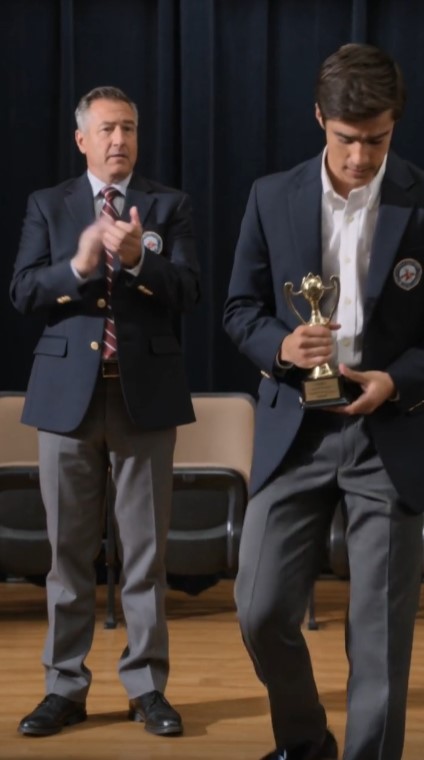
Marcus had just won the biggest award in his school.
Hundreds of people were applauding.
His name was announced.
He walked onto the stage…
took the trophy…
then immediately walked back down.
The principal looked confused.
“Marcus?”
But Marcus wasn’t leaving.
He was heading toward the back row.
Toward a woman still wearing her cleaning uniform.
His mother.
She had worked two jobs for years.
Some nights Marcus barely saw her.
She cleaned offices after midnight…
then woke him for school before sunrise.
Marcus stopped in front of her.
Placed the trophy in her hands.
“This is yours.”
His mother shook her head.
“No. You earned this.”
Marcus smiled.
“I only had time to earn it because you gave up all of yours.”
The auditorium went silent.
Then everyone stood.
But Marcus’s mother suddenly noticed an elderly man applauding near the aisle.
Her face changed.
She hadn’t seen him in more than twenty years.
Marcus looked at her.
“Mom… who is that?”
The elderly man was already walking toward them.
And in his hands…
was the first school trophy Marcus’s mother had ever won.
Her name was Rachel.
And for a few seconds, she couldn’t move.
The elderly man stopped several feet away.
His hands trembled around the small brass trophy.
It was old.
Scratched.
The wooden base was faded.
But Rachel recognized it immediately.
She whispered:
“Mr. Harris?”
The man smiled.
“Hello, Rachel.”
Marcus looked from one to the other.
“You know him?”
Rachel nodded.
Barely.
Mr. Harris had been her high school teacher.
Not just any teacher.
The teacher who once believed she would go to college.
Long before cleaning offices.
Long before raising Marcus alone.
Long before life became a schedule built entirely around surviving the next month.
The principal came down from the stage.
Nobody knew whether to continue the ceremony.
Mr. Harris seemed embarrassed by the attention.
“I didn’t mean to interrupt.”
Rachel stared at the trophy.
“Where did you get that?”
Mr. Harris looked down.
“You gave it back to me.”
Her face changed.
Marcus frowned.
“What do you mean?”
Mr. Harris sighed.
“Maybe this isn’t the place.”
Rachel shook her head.
“No.”
She looked at Marcus.
“He should know.”
So they sat in an empty row while the ceremony paused briefly.
Mr. Harris placed the old trophy between them.
Rachel had won it at seventeen.
Outstanding Student in Literature.
The first major award of her life.
Mr. Harris had nominated her.
Rachel had written constantly back then.
Essays.
Short stories.
Poems she never showed anyone else.
She was good.
Really good.
Mr. Harris once told her:
“You could do something with this.”
Rachel laughed at him.
She came from a family where “doing something” meant getting a job quickly.
College felt like something that happened to other people.
Still, Mr. Harris pushed.
Helped her fill out applications.
Found scholarship information.
Stayed late after school.
For a while, Rachel believed it might actually happen.
Then everything changed.
Her mother became seriously ill.
Her younger brother was twelve.
Her father had already left years earlier.
The rent was behind.
Rachel got a job.
Then another.
College disappeared.
She stopped writing.
Stopped coming to Mr. Harris’s classroom after school.
One afternoon, he found her emptying her locker.
“What are you doing?”
“Leaving.”
“You graduate in three months.”
“I need more hours.”
He argued.
Rachel cried.
Then she got angry.
“I don’t have time for dreams.”
Mr. Harris never forgot that sentence.
He convinced her to stay long enough to graduate.
But college was gone.
At the final school assembly, Rachel won the literature trophy.
She accepted it.
Then later walked into Mr. Harris’s classroom and placed it on his desk.
“I don’t want it.”
He stared at her.
“Why?”
“Because it’s for a person I’m not going to be.”
Mr. Harris pushed it back.
Rachel refused.
“Give it to someone else.”
Then she walked away.
Mr. Harris kept it.
For twenty-three years.
Marcus looked at his mother.
“You wrote?”
Rachel smiled weakly.
“A long time ago.”
“You never told me.”
“There wasn’t much to tell.”
Mr. Harris interrupted.
“There was plenty.”
Rachel shot him a look.
Same look she had apparently given him at seventeen.
He laughed.
“Still stubborn.”
Marcus smiled.
Then asked:
“Why are you here?”
That was the strange part.
Mr. Harris had not come specifically for Rachel.
He had been invited by the school.
He had taught the principal years earlier and now volunteered with a local scholarship organization.
Tonight, the principal had asked him to attend because several scholarship recipients were being honored.
Marcus was one of them.
Mr. Harris had seen the name on the program.
Marcus Williams.
Nothing unusual.
Then he saw Rachel in the back row.
Cleaning uniform.
Hair tied back.
Same face, older.
He knew immediately.
The trophy was in his car.
He had planned to donate it to the school archive after the event.
Instead, he went outside and got it.
Rachel whispered:
“You kept that all these years?”
Mr. Harris nodded.
“I always thought you’d come back for it.”
She laughed sadly.
“I didn’t even know you were still alive.”
“Comforting.”
Marcus picked up the trophy.
His mother’s name was engraved on the front.
RACHEL WILLIAMS — EXCELLENCE IN LITERATURE
He looked stunned.
“This is real.”
Rachel laughed.
“What did you think?”
“I don’t know.”
He turned to her.
“Why did you stop writing?”
Rachel looked at him.
Then at the trophy she had just received from Marcus.
“My life got busy.”
Mr. Harris shook his head.
“Your life got hard.”
Rachel didn’t answer.
There was a difference.
Marcus understood it immediately.
His mother had never been lazy.
Never lacked ambition.
She had sacrificed.
That was different.
After the ceremony, they went to a small diner.
Rachel protested because she had another cleaning shift at midnight.
Marcus said:
“You can be late once.”
“I cannot.”
Mr. Harris smiled.
“Still no time for dreams?”
Rachel stared at him.
“Don’t start.”
He laughed.
Marcus asked him:
“What was she like?”
Rachel groaned.
“No.”
Mr. Harris ignored her.
“Terrifying.”
Marcus laughed.
“She argued with everything.”
“I did not.”
“You argued with punctuation.”
“I had opinions.”
“You still do.”
Marcus was seeing his mother differently.
Not just as Mom.
Not just as the woman who came home exhausted.
Not just as the person who stretched groceries and paid bills.
She had once been seventeen.
Funny.
Angry.
Talented.
Full of plans.
Marcus asked:
“Do you still have anything she wrote?”
Mr. Harris went quiet.
“Yes.”
Rachel looked up.
“What?”
He kept one piece.
Not because he collected student work.
Because Rachel had written something during her final year that stayed with him.
An essay called:
The Rooms We Leave Lit
It was about her mother working nights.
Rachel used to wake up and see the kitchen light on.
No matter how late her mother worked, she left that light for Rachel.
The essay ended with a line:
Some people spend their whole lives becoming the light someone else forgot to turn off.
Marcus stopped breathing.
“That sounds like you.”
Rachel looked away.
Mr. Harris said nothing.
Marcus continued.
“You did exactly that.”
Rachel shook her head.
“Don’t romanticize it.”
“I’m not.”
He knew the hard parts.
He knew what unpaid bills looked like.
He knew why his mother sometimes fell asleep sitting up.
He knew she missed school meetings because she was working.
He knew sacrifices were not beautiful while you were making them.
But they still mattered.
Mr. Harris asked Rachel:
“Do you write at all now?”
“No.”
“Why?”
She gave him the old answer.
“No time.”
Marcus immediately said:
“That’s not true anymore.”
Rachel looked at him.
“What?”
He had recently started driving himself.
He worked weekends.
They were doing slightly better.
Not rich.
Not comfortable.
But different.
Marcus said:
“I can make dinner twice a week.”
Rachel laughed.
“You make eggs.”
“Eggs are dinner.”
Mr. Harris smiled.
“Correct.”
Marcus continued.
“You could write for twenty minutes.”
Rachel stared at him.
“What is this, an intervention?”
“Yes.”
That night, Rachel went to work.
She came home after two.
Marcus was asleep.
On the kitchen table were the two trophies.
His new one.
Her old one.
Beside them was a notebook.
On the first page Marcus had written:
Twenty minutes.
Rachel almost laughed.
Then sat down.
She stared at the blank page.
Nothing came.
She nearly closed it.
Then she wrote:
My son handed me a trophy tonight.
She stopped.
Then continued.
Twenty minutes became forty.
The next morning Marcus found six pages.
He didn’t read them.
That mattered.
They belonged to her.
Over the next months, Rachel began writing again.
Not every day.
Not dramatically.
Some weeks nothing.
Some nights one paragraph.
Then more.
Mr. Harris occasionally checked in.
Never asked:
“Have you finished your book?”
He knew better.
Instead:
“Still writing?”
Sometimes Rachel said yes.
Sometimes no.
He always answered:
“Good.”
Marcus asked why.
Mr. Harris explained:
“Because writing should not become another job she can fail at.”
That stayed with Marcus.
A year passed.
Rachel took a community writing class.
She almost quit after the first session.
Everyone seemed younger.
More educated.
More confident.
Then the instructor read one of her pieces anonymously.
The room went quiet.
The instructor said:
“Whoever wrote this knows how to make ordinary life matter.”
Rachel sat very still.
She remembered being seventeen.
Mr. Harris saying almost the same thing.
Years had passed.
The ability had not vanished.
It had simply been buried under exhaustion.
Eventually Rachel submitted a short essay to a local magazine.
Rejected.
Marcus was furious.
“They’re stupid.”
Rachel laughed.
“No.”
She submitted another.
Rejected.
Then another.
Accepted.
The payment was small.
Almost insulting.
Rachel framed the check anyway.
Marcus asked:
“Why?”
“First money I ever made from writing.”
Mr. Harris came over for dinner.
Rachel showed him the magazine.
He read her essay.
Then looked at her.
“Took you long enough.”
She threw a napkin at him.
Years later, Rachel reduced one of her cleaning shifts.
Not because writing suddenly made her wealthy.
It didn’t.
She found a steadier office job with better hours.
Then kept writing at night because now she wanted to.
Marcus went to college.
The scholarship helped.
So did his own work.
Rachel cried when she dropped him off.
Marcus said:
“You’re embarrassing me.”
“That’s my job.”
Before leaving, she handed him his school trophy.
The same one he had placed in her hands.
Marcus shook his head.
“No.”
She insisted.
“You earned it.”
He smiled.
“So did you.”
They compromised.
The trophy stayed at home.
Beside hers.
Two awards.
Different generations.
Different sacrifices.
Mr. Harris remained in their lives.
He grew older.
Slower.
But still sharp.
One afternoon, Marcus visited him.
He was in graduate school by then.
Mr. Harris asked:
“What did you come here for?”
Marcus placed something on the table.
A printed booklet.
On the front:
THE ROOMS WE LEAVE LIT — Rachel Williams
Rachel had collected some of her essays.
Nothing huge.
No bestseller.
No sudden fame.
Just her work.
Finished.
Printed.
Real.
Mr. Harris touched the cover.
“She used the old title.”
Marcus nodded.
“She said it belonged there.”
Mr. Harris read the dedication.
For my son, who returned a trophy I didn’t know I was still waiting for.
Below that:
And for Mr. Harris, who refused to throw the first one away.
The old teacher cried.
Marcus pretended not to notice.
A few years later, Mr. Harris died peacefully.
Rachel attended his memorial.
She brought the old trophy.
For a moment, she considered leaving it there.
Then changed her mind.
She kept it.
He had saved it for her.
It was hers now.
At the memorial, a former student asked Rachel how she knew him.
She said:
“He was my teacher.”
Then thought.
“No.”
“He was the person who believed in something I had decided to bury.”
That was closer.
Years later, Marcus became a school counselor.
Students sometimes came into his office saying things that sounded familiar.
“I don’t have time.”
“My family needs me.”
“That kind of future isn’t for people like me.”
Marcus never gave speeches.
He remembered his mother would have hated that.
Instead, he listened.
Helped where he could.
Found resources.
Made calls.
Sometimes believing in someone meant practical things.
Forms.
Transportation.
A meal.
A deadline extension.
A quiet place to work.
On a shelf behind his desk stood a photograph.
Rachel in her cleaning uniform.
Marcus beside her.
One trophy in her hands.
Another visible near Mr. Harris.
Students asked:
“What’s that?”
Marcus always smiled.
“The night my mom won the same award twice.”
They didn’t understand.
So he told them.
The first time, she was seventeen.
A student with talent.
A future.
A teacher who believed in her.
Then life demanded something else.
She gave the trophy back.
Twenty-three years later, her son won his own.
He handed it to her.
Then the teacher she had not seen in decades walked down the aisle holding the old one.
Two trophies.
Two versions of the same woman.
The girl who had dreams.
And the mother who thought those dreams no longer belonged to her.
Marcus never forgot what his mother told him years later.
“You didn’t give me my life back.”
“I never lost my life.”
“You just reminded me there was still room in it for something that was mine.”
That mattered.
Because sacrifice does not erase a person.
Being a mother did not erase Rachel the writer.
Working nights did not erase the girl who once filled notebooks.
Hard years had changed the route.
They had not erased the destination entirely.
And that night in the school auditorium…
Marcus thought he was giving his mother a trophy.
What he really gave her was permission to look at the part of herself she had packed away decades earlier.
Then an elderly teacher walked forward…
holding proof that somebody had kept believing in that girl the entire time.