
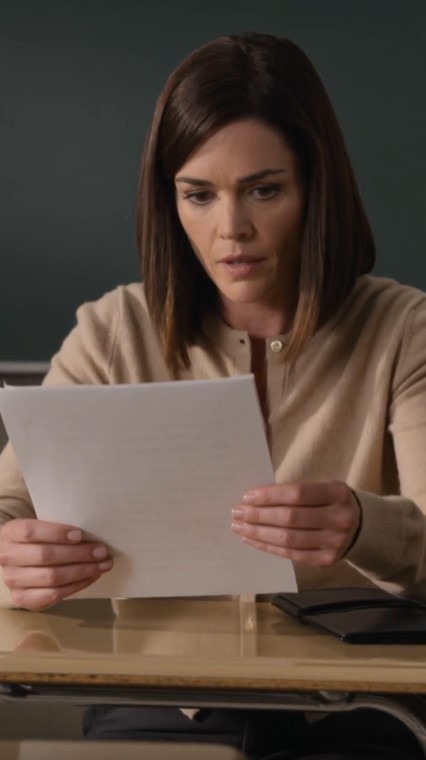
The new teacher was checking homework after class…
When she suddenly stopped.
She stared at one student’s handwriting.
Then pulled an old piece of paper from her wallet.
She placed them side by side.
Same unusual letter.
Same way of writing numbers.
Even the same tiny mistake.
The next morning…
She quietly asked the boy:
“Who taught you to write like this?”
“My grandfather.”
The teacher froze.
“What’s his name?”
The boy answered.
Her face went pale.
“Can he come to school today?”
That afternoon…
An elderly man walked into the classroom.
The moment he saw the teacher…
He stopped in the doorway.
Neither of them spoke.
The boy looked between them.
“Grandpa… do you know my teacher?”
The elderly man slowly reached into his coat.
He removed an old folded piece of paper.
The teacher immediately recognized it.
She whispered:
“You kept it?”
The man nodded.
“For thirty-one years.”
Then the boy asked the one question neither of them was ready to answer.
“What happened thirty-one years ago?”
The teacher, Emily Carter, sat down slowly.
The elderly man was Henry Wilson.
And thirty-one years earlier, he had been her teacher.
Not in a normal classroom.
Not for an entire school year.
For only eleven weeks.
But those eleven weeks had changed Emily’s life.
Henry unfolded the paper.
Across the top, written in the shaky handwriting of an eight-year-old girl, were the words:
WHEN I GROW UP, I WILL BE A TEACHER.
Emily covered her mouth.
“You really kept it.”
Henry smiled.
“You told me I had to.”
His grandson, Noah, looked completely confused.
“You were her teacher?”
Henry nodded.
“A long time ago.”
Noah pointed toward the paper.
“Why did she give you that?”
Emily looked at Henry.
“You tell him.”
Henry pulled a chair beside Noah’s desk.
Then he began.
Thirty-one years earlier, Emily was eight years old.
Her family had just moved across the city.
Her father had left.
Her mother, Rachel, was working nights at a hospital laundry facility and cleaning offices on weekends.
Emily entered a new school halfway through the year.
She struggled immediately.
Not because she couldn’t learn.
Because she’d already decided there was no point trying.
She barely spoke.
She refused to read aloud.
Her handwriting was nearly impossible to understand.
And every afternoon, while the other children hurried home, Emily sat near the front entrance waiting for her mother.
Sometimes for more than an hour.
Henry Wilson was a substitute teacher.
He was supposed to stay for two weeks.
The regular teacher had undergone surgery.
Complications extended her absence.
Two weeks became eleven.
Henry noticed Emily almost immediately.
“She hated me,” Henry told Noah.
Emily laughed.
“I did not.”
“You told me my handwriting looked like a spider fell into an ink bottle.”
Noah burst out laughing.
Emily stared at Henry.
“You remember that?”
“I remember everything about that class.”
Henry had a peculiar style of handwriting.
His capital R leaned backward.
His number seven had a line through the middle.
And whenever he wrote a lowercase G quickly, he left the loop slightly open.
Emily began copying him.
At first, Henry thought she was making fun of him.
Then he realized she was practicing.
Every afternoon while waiting for Rachel, Emily stayed in the classroom.
Henry would give her scrap paper.
He taught her to slow down.
Leave spaces.
Form each letter clearly.
“Your handwriting doesn’t need to look like mine,” he told her.
“But mine looks terrible.”
“Then make yours look like yours.”
Emily practiced anyway.
And because Henry’s writing was the example in front of her, she gradually picked up his habits.
Including one mistake.
Henry occasionally reversed the final two digits when writing dates too quickly.
Emily began doing something similar when copying numbers.
Henry tried correcting it.
Instead, the mistake somehow became part of her writing pattern.
Years later, Emily had mostly corrected it.
But the old piece of paper in her wallet still contained it.
Noah had learned the same habits from Henry.
That was why Emily recognized his homework.
But Noah still didn’t understand why the old papers mattered.
“What happened after eleven weeks?”
Henry became quiet.
Emily answered.
“My mom lost her job.”
Rachel’s employer closed unexpectedly.
Rent was already overdue.
Within weeks, Emily and her mother were evicted.
For several nights they stayed with friends.
Then Rachel found space at a temporary family shelter.
Emily stopped attending school.
Henry noticed immediately.
He asked the office.
Nobody knew where she’d gone.
He called the number on file.
Disconnected.
Henry visited the address.
The apartment was empty.
Emily had simply disappeared.
Noah looked at his grandfather.
“You tried to find her?”
“For months.”
Henry contacted the school district.
Privacy rules limited what anyone could tell him.
Eventually he learned Emily had enrolled in another school across the county.
Then that record changed too.
Rachel had found work in another city.
Mother and daughter moved again.
Henry never saw Emily after that.
Except once.
On her final day at the old school, before everything collapsed, Henry had assigned the class a simple exercise.
Write one sentence about what you want to become.
Some children wrote firefighter.
Doctor.
Basketball player.
Veterinarian.
Emily wrote:
WHEN I GROW UP, I WILL BE A TEACHER.
Henry wrote underneath:
I believe you.
Emily took the page home.
The next morning, she returned with a copy she’d made by hand.
At the bottom she wrote:
YOU KEEP THIS ONE SO YOU REMEMBER.
That was the paper Henry had carried for thirty-one years.
Emily reached into her wallet.
Her own paper was much smaller now because the edges had worn away.
She unfolded it.
It was Henry’s original response to another assignment.
Emily had once written:
I’M NOT GOOD AT SCHOOL.
Henry crossed out only one word.
NOT.
Underneath he wrote:
Don’t decide your whole future at eight years old.
Noah stared at the two papers.
“You both kept them?”
Emily nodded.
“Apparently.”
Henry laughed.
“Apparently.”
But there was another part of the story.
Emily hadn’t become a teacher simply because she’d written it on one assignment.
After leaving Henry’s school, life became more difficult.
Rachel worked wherever she could.
They moved three more times.
Emily attended four schools before finishing eighth grade.
At thirteen, she nearly dropped out emotionally even though she still attended classes.
Then one evening, Rachel found the old note.
Don’t decide your whole future at eight years old.
She taped it above Emily’s desk.
Whenever Emily complained about school, Rachel pointed at it.
“Your teacher believed you.”
Emily would roll her eyes.
But she kept studying.
She graduated.
Then went to college.
She became a teacher.
For years, Emily occasionally searched for Henry Wilson.
But the name was common.
She didn’t know his age.
She didn’t know where he’d gone after substituting at her school.
Eventually she assumed she’d never find him.
Still, she carried the note.
Every job interview.
Every first day of school.
Every difficult class.
It remained inside her wallet.
Then Noah Wilson handed in his homework.
Emily had been grading math exercises.
The answer itself wasn’t what caught her attention.
It was the number seven.
A line through the middle.
Then the strange R in Noah’s name.
Then the open loop in the lowercase G.
Emily stared.
She pulled Henry’s note from her wallet.
The similarities were remarkable.
The next morning she asked:
“Who taught you to write like this?”
“My grandfather.”
“What’s his name?”
“Henry Wilson.”
Emily nearly dropped the paper.
She asked Noah to have his parent or guardian contact the school before any visit was arranged.
That afternoon, Henry arrived.
And now he was sitting inside the classroom of the little girl who had vanished thirty-one years earlier.
Except she wasn’t little anymore.
She was standing beside the teacher’s desk.
Her name was printed on the door.
MS. EMILY CARTER
Henry looked at it repeatedly.
“You actually did it.”
Emily smiled.
“You said I would.”
“No.”
Henry shook his head.
“I said I believed you could.”
He pointed toward her.
“You did the rest.”
Emily’s eyes filled.
Then Noah asked another question.
“Grandpa, why did you keep her paper for so long?”
Henry looked down.
Because Emily hadn’t been the only person struggling thirty-one years earlier.
At the time, Henry was considering leaving education.
His wife had recently died.
He was exhausted.
He felt disconnected from his work.
He’d taken substitute assignments simply because sitting alone at home was worse.
Then he met a stubborn eight-year-old who stayed after school every afternoon.
Teaching Emily handwriting gave Henry something to focus on.
Helping her gave structure to empty afternoons.
Then she wrote:
YOU KEEP THIS ONE SO YOU REMEMBER.
Henry did.
“When she disappeared,” Henry said, “I kept wondering whether I’d done enough.”
Emily’s expression changed.
“You did.”
“I could’ve searched harder.”
“You were my substitute teacher, Henry. You weren’t responsible for fixing our entire life.”
“But I worried.”
Emily moved closer.
“You want to know what happened because of you?”
Henry nodded.
Emily opened a drawer.
Inside were dozens of notes.
Some were thank-you cards from students.
Others were drawings.
One simply said:
THANK YOU FOR NOT GIVING UP ON ME.
Emily handed it to Henry.
“I started keeping them because you kept mine.”
Henry stared at the drawer.
Emily continued.
“Whenever teaching gets difficult, I read one.”
Henry smiled.
“So now you’re carrying too much paper.”
“Your fault.”
Noah grinned.
The reunion didn’t end that afternoon.
Henry began volunteering at the school once a week.
He helped in the library.
Sometimes he assisted students with reading.
Emily refused to let him teach handwriting.
“Absolutely not.”
Henry looked offended.
“My handwriting created a teacher.”
“It also created Noah’s sevens.”
“Those are excellent sevens.”
“They’re unnecessary.”
Noah sided with his grandfather.
Emily declared both of them impossible.
A few months later, Emily created a classroom assignment.
She gave every student one sheet of paper.
At the top she wrote:
WHAT DO YOU WANT YOUR FUTURE SELF TO REMEMBER?
The children wrote their answers.
Some were funny.
Some serious.
Some only a few words.
Noah wrote:
REMEMBER THE PEOPLE WHO HELPED YOU BEFORE YOU KNEW YOU NEEDED HELP.
Emily read it twice.
Then looked toward Henry, who was organizing books at the back of the room.
“Did Grandpa help you write this?”
“No.”
“Really?”
“He only told me how to spell ‘remember.’”
Emily laughed.
At the end of the school year, Henry gave her a small frame.
Inside were copies of both old papers.
Emily’s:
WHEN I GROW UP, I WILL BE A TEACHER.
And Henry’s:
Don’t decide your whole future at eight years old.
Between them was a photograph taken that afternoon.
Henry.
Emily.
And Noah.
Three people connected by handwriting that should have meant nothing.
Underneath, Henry had written:
Some lessons take thirty-one years to come back.
Emily placed the frame beside her desk.
The original note remained in her wallet.
She wasn’t ready to stop carrying it.
Years later, when people asked how she’d reunited with her childhood teacher, Emily always started with Noah’s homework.
She explained the strange R.
The crossed seven.
The open G.
And the tiny number-writing mistake passed from grandfather to grandson.
But the handwriting wasn’t really the important part.
It was simply what made Emily look twice.
What mattered was the paper Henry pulled from his coat when he walked into her classroom.
A promise written by an eight-year-old girl who disappeared before he could learn what happened to her.
Henry had carried it for thirty-one years.
Emily had carried his note for exactly as long.
Neither knew the other had kept anything.
Neither knew they’d spent decades remembering the same eleven weeks.
Until one ordinary afternoon…
A teacher looked down at a student’s homework.
And recognized the handwriting of the man who had once taught her not to decide her entire future at eight years old.