
Parents filled every seat for Emma’s first school performance.
Everyone except the elderly school custodian.
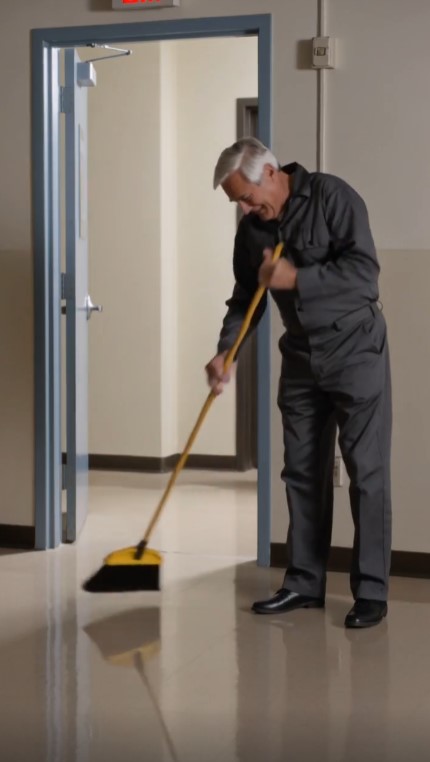
Mr. Walter was quietly sweeping the hallway outside.
Then 8-year-old Emma walked off the stage before the show began.
Her teacher whispered:
“Emma, where are you going?”
Emma ignored her.
She walked into the hallway…
took Walter by the hand…
and led him inside.
“There’s a seat for you.”
Walter looked confused.
Emma pointed toward the front row.
She had saved the best seat in the room.
For him.
Her mother started crying.
Every morning for two years, Walter had opened the school early.
Emma’s mother worked before sunrise.
Walter would sit near Emma while she ate breakfast and waited for class.
He helped her practice reading.
Fixed her broken backpack.
And applauded every little drawing she showed him.
Emma climbed back onto the stage.
Before the music started, she looked directly at Walter.
“This one is for you.”
The old man began crying.
But when the performance ended…
Emma’s mother walked toward him holding something.
A photograph of Walter as a young man.
He stared at it.
“How do you have this?”
Emma’s mother smiled through tears.
“My father kept it his entire life.”
Walter’s hands began to shake.
The photograph showed two young men standing outside an old mechanic shop.
One was Walter.
Maybe twenty-two.
The other was Emma’s grandfather, Thomas.
Walter looked up slowly.
“Your father was Thomas Bennett?”
Emma’s mother, Rachel, nodded.
“Yes.”
Walter sat back down.
For several seconds, he couldn’t speak.
Then he looked at Emma.
“You’re Tommy’s granddaughter?”
Emma smiled.
“Who’s Tommy?”
Rachel laughed through tears.
“My dad.”
Walter covered his face.
“I can’t believe this.”
Rachel sat beside him.
“My father talked about you.”
Walter looked stunned.
“He did?”
“All the time.”
That was not entirely true.
Thomas had not talked about Walter constantly.
He had told one story repeatedly.
But it was the story Rachel remembered most.
When Thomas was seventeen, his family had almost nothing.
His father had died suddenly.
His mother worked two jobs.
Thomas wanted to leave school and work full-time.
He believed staying in class was selfish when his family needed money.
One evening, he packed his textbooks into a box and walked to the mechanic shop where Walter worked.
Walter was only five years older.
But to Thomas, he seemed like an adult who had everything figured out.
Thomas asked him for a job.
Walter looked at the schoolbooks in the box.
Then asked:
“You quitting?”
Thomas said:
“I have to.”
Walter told him:
“No.”
Thomas got angry.
“You don’t know my family.”
Walter answered:
“No. But I know what happens when somebody makes a permanent decision because of a temporary emergency.”
Thomas never forgot that sentence.
Walter hired him for evening work.
Three hours after school.
Saturdays.
Enough to help at home.
But only under one condition.
Thomas had to stay enrolled.
When the shop was quiet, Walter made him do homework at the counter.
Thomas hated it.
Walter didn’t care.
If Thomas claimed he had no homework, Walter made him read.
If he failed a test, Walter asked why.
If he skipped school, Walter refused to let him work that afternoon.
Walter was not his teacher.
Not his father.
Not even much older.
But he paid attention.
Thomas graduated.
Then went to community college.
Later, he became an electrician.
Built a family.
Raised Rachel.
And every time she complained about school, Thomas said:
“I knew a man once who wouldn’t let me quit.”
Rachel had never imagined that man would one day be sitting in her daughter’s school cafeteria at 6:15 every morning.
Walter stared at the photograph again.
“Thomas made it?”
Rachel nodded.
“He did.”
“What did he do?”
“Electrician for thirty-seven years.”
Walter smiled.
“That sounds like him.”
“He had three children.”
Walter looked surprised.
“Three?”
“And six grandchildren.”
Walter glanced toward Emma.
“One of them being…”
Rachel smiled.
“Her.”
Walter started crying again.
Emma had changed out of her costume and was now sitting beside him.
She looked concerned.
“Are you sad?”
Walter shook his head.
“No, sweetheart.”
“Then why are you crying?”
Walter laughed.
“Old people leak.”
Emma accepted that immediately.
Rachel laughed too.
Then she handed Walter another item.
A folded piece of paper.
“My father wrote this years ago.”
Walter opened it.
It was not addressed to him.
It was part of a letter Thomas had written to Rachel when she left for college.
One paragraph had been underlined.
There will be people in your life whose job description never says they are responsible for you. Pay attention to those people. Sometimes they change everything.
Below it:
Walter Lewis did that for me.
Walter stared.
Rachel said:
“Dad kept the photograph in his desk.”
“Why?”
“Because he said it reminded him of the person who saw something in him before he could see it himself.”
Walter shook his head.
“I didn’t do anything special.”
Rachel smiled.
“That’s exactly what he said you would say.”
Walter laughed softly.
Then his expression changed.
“When did Thomas die?”
“Eight years ago.”
Walter looked down.
“I’m sorry.”
“Thank you.”
“Was he sick long?”
“No.”
A heart attack.
Sudden.
Rachel had been thirty-two.
Emma wasn’t born yet.
Walter’s face tightened.
“I wish I’d known.”
Rachel nodded.
“So did he.”
Walter looked at her.
“What do you mean?”
Rachel reached into her purse again.
Another photograph.
This one much newer.
Thomas standing outside the old mechanic shop decades later.
The building was closed.
A FOR SALE sign hung in the window.
On the back Thomas had written:
Tried to find Walter. No luck.
Walter stared.
“He came looking?”
“Yes.”
Five years before Thomas died.
He had driven back to the neighborhood.
The shop was gone.
Nobody nearby knew where Walter moved.
Thomas tried searching online.
But Walter had a common name.
He never found him.
Walter whispered:
“I moved out of state for twenty years.”
He had returned only recently.
After his wife died.
He needed work.
The school district needed a custodian.
So Walter took the job.
Then one morning, a little girl named Emma started arriving early.
At first, she sat alone at a cafeteria table.
Walter noticed she struggled with a reading worksheet.
He asked:
“You stuck?”
Emma said:
“No.”
Walter smiled.
“That means yes.”
He helped with one word.
Then another.
The next morning, Emma brought another book.
Soon they had a routine.
Breakfast.
Reading.
Drawings.
Walter fixed whatever Emma managed to break.
One zipper.
Two backpack straps.
A lunchbox handle.
Once, the wheel fell off her rolling art case.
Walter repaired that too.
Emma began bringing him terrible jokes.
“What do you call cheese that isn’t yours?”
Walter always pretended not to know.
“Nacho cheese!”
Every time.
Two years.
Neither Rachel nor Walter realized the connection.
Rachel usually dropped Emma off quickly on her way to work.
Sometimes they waved.
Sometimes said hello.
But Walter was simply “Mr. Walter.”
Rachel never knew his last name.
Walter never knew hers.
Thomas had died under the surname Bennett.
Walter had known him as Tommy Bennett.
Rachel was now Rachel Collins.
There was no obvious connection.
Until the school performance.
Rachel had brought the photograph because Emma had been talking about Walter for months.
One night she said:
“Mom, Mr. Walter tells me I can do hard things even if I’m slow.”
Rachel froze.
Her father used to say exactly that.
Not identical wording.
But close enough to make her curious.
She asked Emma what Walter’s last name was.
“Lewis.”
Rachel remembered the name immediately.
Walter Lewis.
The man from her father’s story.
She found the old photograph.
That was why she brought it to the performance.
She planned to ask him afterward.
Then Emma walked off the stage and saved him the front-row seat.
Rachel knew before she ever showed the photograph.
This man mattered to her family twice.
Once to her father.
Now to her daughter.
Walter held the picture for a long time.
Then said:
“Thomas would have loved her.”
Rachel looked at Emma.
“He would have.”
Emma frowned.
“Did Grandpa know Mr. Walter?”
Rachel smiled.
“Before I was born.”
Emma’s eyes widened.
“Were they friends?”
Walter answered:
“Yes.”
Then after a pause:
“I hope so.”
Rachel shook her head.
“My father called you one of the best friends he ever had.”
Walter turned away.
That hit him harder than anything else.
They sat in the empty auditorium long after most families left.
Walter told Rachel stories.
Thomas once dropped an entire toolbox down a basement staircase.
Thomas hated algebra.
Thomas fell asleep while reading one evening and woke with a page stuck to his face.
Rachel laughed.
“My dad never told me that.”
“Of course not.”
Then Walter told her one thing she had never known.
Thomas had once tried to repay him.
Years after graduation, Thomas came to the shop with an envelope.
Inside was money.
Walter asked what it was for.
Thomas said:
“You let me work when I needed it.”
Walter refused.
Thomas insisted.
Walter said:
“You earned every dollar I paid you.”
Thomas answered:
“You gave me more than that.”
Walter still refused.
So Thomas asked:
“What am I supposed to do with it?”
Walter told him:
“Keep somebody else from quitting.”
Rachel went silent.
That phrase explained something.
Her father had spent years mentoring apprentices.
Young electricians.
Teenagers from difficult homes.
People who needed a second chance.
Rachel remembered one young man named Marcus who practically lived at their house one summer.
Thomas helped him finish trade school.
Another called Daniel.
Thomas lent him tools and refused repayment.
Rachel had always thought her father was simply generous.
Now she understood.
He had been continuing Walter’s lesson.
Rachel whispered:
“He did.”
Walter looked confused.
“He did what?”
“He kept people from quitting.”
Walter smiled.
“Good.”
That was all.
Not pride.
Not self-congratulation.
Just good.
Then Emma asked:
“Can Mr. Walter come to dinner?”
Rachel laughed.
Walter started to refuse.
Emma frowned.
“You came to my show.”
Walter said:
“That was different.”
“No.”
Walter looked at Rachel.
Rachel shrugged.
“She’s difficult.”
Walter smiled.
“So was her grandfather.”
He came.
That dinner became the first of many.
Walter started telling Emma stories about Thomas.
She loved them.
Especially the embarrassing ones.
Rachel objected.
“You are destroying my father’s dignity.”
Walter replied:
“He destroyed it himself years ago.”
Emma laughed.
Walter became part of their family life gradually.
Not as a replacement for Thomas.
Nobody could replace him.
But as someone who carried a version of Thomas nobody else remembered.
Young Thomas.
Scared Thomas.
Stubborn Thomas.
Seventeen-year-old Thomas who nearly quit school because he thought helping his family meant giving up his future.
Walter knew that boy.
Rachel had only known the man he became.
One evening, Rachel asked Walter something.
“Why did you help him?”
Walter shrugged.
“He was a good kid.”
“That’s it?”
Walter thought longer.
Then:
“No.”
When Walter was fourteen, his own mother died.
His father stopped functioning for a while.
Bills piled up.
Walter skipped school to work.
A teacher named Mr. Harris found out.
Instead of punishing him, Mr. Harris helped arrange a work-study schedule.
He brought Walter food.
Helped him stay in class.
Walter graduated because someone intervened.
Rachel smiled.
“So you did for Dad what somebody did for you.”
Walter nodded.
“I suppose.”
“And Dad did it for other people.”
“Sounds like it.”
“And now you’re doing it for Emma.”
Walter looked toward the living room.
Emma was reading on the floor.
“No.”
Rachel frowned.
Walter smiled.
“She’s doing more for me than I’m doing for her.”
After Walter’s wife died, the mornings had become unbearable.
He hated the empty house.
That was why he volunteered for the earliest school shift.
Then Emma began arriving.
Every morning, someone expected him.
Someone had a story.
A broken zipper.
A drawing.
A spelling word.
Walter said:
“I thought I was keeping her company.”
He smiled.
“She was keeping me company.”
Rachel cried.
Months later, the school principal heard the story.
He wanted to recognize Walter publicly.
Walter refused.
Absolutely not.
The principal suggested a plaque.
“No.”
An award.
“No.”
A local newspaper article.
“Definitely not.”
Emma finally said:
“Can we just give him a chair?”
Everyone looked at her.
“What?”
“The front-row chair.”
She meant the seat she had saved at her performance.
Emma wanted to put Walter’s name underneath it.
Walter laughed.
“Why?”
“So nobody sits there when you come.”
The school compromised.
No plaque.
No ceremony.
But at performances, one front-row chair was reserved for staff members who rarely got recognized.
Custodians.
Cafeteria workers.
Bus drivers.
Office staff.
Teacher aides.
The little card simply read:
A SEAT FOR SOMEONE WHO HELPS US GET HERE.
Walter approved that.
Barely.
Years passed.
Emma grew up.
Walter retired when she was thirteen.
At his retirement breakfast, Emma gave him a framed photograph.
Two pictures side by side.
On the left:
Young Walter and Thomas outside the mechanic shop.
On the right:
Walter and Emma in the school cafeteria.
Underneath:
YOU HELPED US BOTH.
Walter stared at it.
Then corrected her.
“No.”
Emma frowned.
He took a pen.
Crossed out BOTH.
Wrote:
EACH OTHER.
Emma smiled.
“That’s better.”
Walter lived another eleven years.
He attended Emma’s middle-school graduation.
High-school graduation.
And, despite insisting he was “too old for fancy places,” her college graduation.
Emma reserved a front-row seat.
Again.
Walter laughed when he saw it.
“You’re still doing this?”
“Yes.”
He sat.
Of course he did.
When Emma became a teacher, she kept a small photograph on her desk.
Walter and Thomas.
Beside it was another.
Walter sitting in the front row at her first school performance.
Students sometimes asked who the old man was.
Emma answered:
“Someone who noticed.”
That became her own habit.
She noticed.
The child who arrived too early every day.
The student who needed extra time reading.
The kid with the broken backpack.
The one who always claimed everything was fine.
Emma knew small moments could travel farther than anyone imagined.
Walter helped Thomas stay in school.
Thomas helped others.
Walter later helped Emma.
Emma helped students.
Nobody planned the chain.
Nobody kept track.
It just continued.
When Walter died, Emma was twenty-four.
Rachel found the framed photograph in his apartment.
YOU HELPED US EACH OTHER.
Beside it was a wooden box.
Inside were small things.
A crayon drawing Emma made at eight.
A broken zipper pull from her first backpack.
Her old recital program.
And a note.
Emma,
Your grandfather thought I changed his life.
He changed mine too.
You did the same.
Remember that people who help you often need help themselves.
Sometimes all they need is a seat inside the room.
Emma cried for a long time.
At Walter’s memorial, she did not give a huge speech.
She told one story.
The school performance.
The hallway.
Walter sweeping while everyone else took their seats.
Emma walking off stage.
Taking his hand.
Saying:
There’s a seat for you.
Then she explained why.
“At eight years old, I thought I was thanking him for fixing my backpack and helping me read.”
She looked at Rachel.
“I didn’t know he had already helped my family before I was born.”
Then she held up the old photograph of Walter and Thomas.
“My grandfather almost dropped out of school.”
“Walter kept him there.”
“My grandfather built a life because someone helped him through a hard season.”
“Then decades later, without knowing who I was, Walter sat with me every morning.”
Emma smiled.
“Maybe kindness doesn’t come back in the way people say.”
“Maybe it just keeps moving.”
Rachel cried.
The school kept its front-row tradition after Walter was gone.
Every performance.
One chair.
Reserved.
Sometimes for the custodian.
Sometimes a bus driver.
Sometimes a cafeteria worker.
Sometimes a crossing guard.
The card remained:
A SEAT FOR SOMEONE WHO HELPS US GET HERE.
Years later, Emma returned to the same auditorium as a teacher.
Her students were performing.
She stood near the curtain.
Then noticed the current custodian outside collecting trash.
One of Emma’s students, a little boy named Noah, saw him too.
Noah whispered:
“Mr. James should watch.”
Emma smiled.
“Yes.”
Noah ran toward the hallway.
Emma didn’t stop him.
She already knew where he was going.
A few minutes later, Mr. James entered looking embarrassed.
Noah pointed toward the reserved chair.
“There’s a seat for you.”
Emma turned away before anyone saw her cry.
For just a moment, she could almost see Walter again.
Old broom.
Worn shoes.
Confused expression.
An eight-year-old girl holding his hand.
And a photograph waiting afterward that would reveal something none of them knew.
Walter had helped Thomas when Thomas was seventeen.
Then almost fifty years later, he helped Thomas’s granddaughter.
He never recognized the connection.
He didn’t need to.
Because real kindness does not usually ask for a family tree first.
It simply notices someone who needs help.
Thomas needed someone to stop him from quitting.
Emma needed someone to sit beside her while she learned to read.
Walter needed someone to remind him he was still worth saving a seat for.
And on the night of Emma’s first school performance…
an eight-year-old girl made sure the man sweeping outside understood something he had spent most of his life teaching everyone else.
He belonged inside too.