
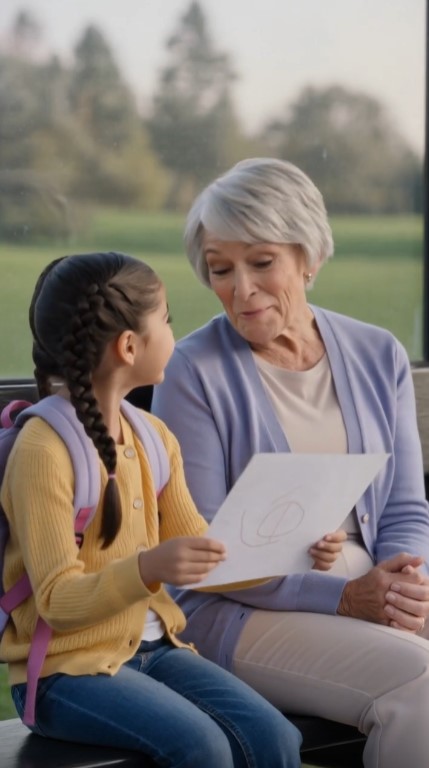
Every Friday afternoon, 8-year-old Sophie sat beside the same elderly woman at the bus stop.
Sophie talked constantly.
About school.
Her drawings.
What she wanted to be when she grew up.
Mrs. Evelyn mostly listened.
Then one Friday, Evelyn wasn’t there.
Sophie waited.
The next Friday…
the bench was empty again.
“Mom, where is she?”
Her mother didn’t know.
So Sophie made something.
A tiny friendship bracelet.
The following Friday she carried it to the bus stop.
Still no Evelyn.
Then a car stopped nearby.
A younger woman stepped out.
She looked at Sophie.
“Are you the little girl who sits with my mother?”
Sophie nodded.
The woman started crying.
“My mom moved into assisted living. She talks about you every day.”
Sophie looked down at the bracelet.
“Can I give her this?”
That afternoon, Sophie visited with her mother.
Evelyn was sitting near a window.
The moment she saw Sophie…
her entire face changed.
“You came!”
Sophie ran to her.
“I thought you forgot me.”
Evelyn hugged her.
“Oh, sweetheart. I was afraid you would forget me.”
Sophie put the bracelet around Evelyn’s wrist.
Then Evelyn opened a drawer.
Inside were dozens of Sophie’s little drawings.
She had kept every single one.
But beneath them was an old photograph.
Sophie looked at it.
The little girl standing beside young Evelyn…
looked exactly like Sophie’s mother.
Sophie picked up the photograph.
“Mom?”
Her mother, Rachel, stepped closer.
Then stopped.
The color disappeared from her face.
“Where did you get this?”
Evelyn looked at her carefully.
For the first time since they arrived, she seemed nervous.
“I wondered when you would recognize it.”
Rachel took the photograph.
The girl in it looked about eight years old.
Same dark hair Rachel had as a child.
Same round cheeks.
Even the same crooked smile.
Beside her stood a much younger Evelyn.
On the back, written in faded blue ink, were two words:
Anna — 1984
Rachel whispered:
“Anna was my mother’s name.”
Evelyn nodded.
Sophie looked between them.
“Grandma Anna?”
Rachel sat down.
Her mother, Anna, had died when Rachel was twenty-three.
Sophie had never met her.
Rachel had few childhood photographs of Anna.
Most had been lost during a move years earlier.
She stared again at the picture.
“That’s really her?”
“Yes.”
“How did you know my mother?”
Evelyn looked toward the window.
“We grew up together.”
Rachel frowned.
“My mom never mentioned you.”
“I know.”
Something in Evelyn’s voice made Rachel uneasy.
Sophie, however, simply climbed onto the chair beside her.
“Were you best friends?”
Evelyn smiled faintly.
“Once.”
That one word carried decades inside it.
Evelyn began explaining.
She and Anna had lived on the same street as children.
They walked to school together.
Shared lunches.
Borrowed clothes.
Spent summers riding bicycles until the streetlights came on.
By high school, they were inseparable.
Then, when they were nineteen, something happened.
Anna became pregnant.
Rachel stared.
“With me?”
Evelyn nodded.
Rachel knew her mother had been young when she had her.
What she didn’t know was how difficult those months had been.
Rachel’s father, Michael, had left town before learning Anna was pregnant.
At least, that was what Anna had always believed.
Her own parents were ashamed.
Money was tight.
Anna considered moving away.
Evelyn was the only friend who stayed close.
“She was terrified,” Evelyn said.
“I was too.”
Rachel looked at her.
“You helped her?”
“For a while.”
Evelyn found Anna a part-time job.
Went with her to medical appointments when she could.
Sat beside her when she cried.
And after Rachel was born, Evelyn helped with whatever she could.
Diapers.
Groceries.
Babysitting.
Nothing extraordinary, Evelyn insisted.
Rachel disagreed.
“Why did she never tell me?”
Evelyn’s eyes lowered.
“Because we stopped speaking.”
“Why?”
Evelyn looked toward her daughter, Laura, who had driven her to the bus stop earlier.
Laura nodded gently.
“Tell her.”
So Evelyn did.
When Rachel was almost nine, Anna learned something that changed everything.
Michael had not intentionally disappeared.
He had written.
Repeatedly.
Letters had been sent to Anna’s parents’ house.
Her father had intercepted them.
He believed Michael was irresponsible and wanted Anna to forget him.
Years later, Anna found several of those letters hidden in an old desk.
She was furious.
But then she discovered something else.
One of the letters had been addressed to Evelyn.
Rachel stared.
“To you?”
Evelyn nodded.
Michael had asked Evelyn to tell Anna that he wanted to come home.
He included a phone number.
Evelyn received the letter.
But she never gave it to Anna.
Rachel’s expression hardened.
“Why?”
Evelyn’s eyes filled.
“I was nineteen.”
“That doesn’t answer me.”
“No.”
Evelyn looked down at the friendship bracelet around her wrist.
“I was afraid.”
“Of what?”
“Losing her.”
Rachel didn’t understand.
Then Evelyn admitted the truth.
At nineteen, she had feelings for Michael too.
She had never acted on them.
Never dated him.
But she was jealous.
And when his letter arrived asking for help reconnecting with Anna, Evelyn hesitated.
She told herself she would give it to Anna the next day.
Then another day passed.
Then another.
By the time she finally decided to do it, Anna had already moved.
Evelyn kept the letter.
And shame kept her silent.
Years later, Anna discovered through a mutual friend that Evelyn had received one.
She confronted her.
Evelyn confessed.
Anna never forgave her.
Rachel stared at the elderly woman who had spent Friday afternoons listening to Sophie talk about crayons and school lunches.
“You kept my parents apart?”
Evelyn shook her head immediately.
“No.”
Then she corrected herself.
“I helped keep them apart longer than they should have been.”
The distinction mattered.
Anna’s father had intercepted most of the letters.
Michael had left.
Life had already been complicated.
But Evelyn had made one selfish choice inside that mess.
And she had regretted it for more than forty years.
Rachel stood.
“I need some air.”
Sophie looked worried.
“Mom?”
“I’m okay.”
She wasn’t.
Rachel walked into the hallway.
Laura followed.
“My mother didn’t plan for you to find out like this.”
Rachel turned.
“Did you know?”
“Only recently.”
“Why does she have the photograph?”
Laura hesitated.
“Because Anna sent it.”
Rachel frowned.
“When?”
“Years later.”
That changed everything again.
Laura explained that after Anna’s anger cooled, she never fully repaired the friendship.
But she did contact Evelyn once.
She mailed the photograph.
Along with a short note.
Evelyn had kept both.
Laura went back into the room and returned with a small envelope.
Rachel recognized her mother’s handwriting immediately.
Her hands shook.
Inside was a single page.
Evelyn,
I’m still angry.
Rachel almost laughed.
That sounded exactly like Anna.
The letter continued.
Maybe I always will be a little angry.
But I don’t want the worst thing you did at nineteen to erase every good thing you did before it.
Rachel stopped reading.
She looked through the doorway at Evelyn.
The old woman was sitting with Sophie.
Sophie was showing her how the bracelet clasp worked.
Rachel continued.
You sat with me when I thought my life was over.
You held Rachel when I was too tired to stop crying.
You bought groceries when I couldn’t.
You made one terrible choice.
I made some too.
I’m not ready to be your friend again.
But I don’t want you believing I forgot everything good.
At the bottom:
Anna
Rachel sat down in the hallway.
Laura remained beside her.
“My mother read that letter hundreds of times.”
Rachel asked:
“Did they ever speak again?”
“Once.”
“Only once?”
Laura nodded.
About fifteen years earlier, Anna and Evelyn had run into each other at a grocery store.
They talked for twenty minutes.
No dramatic reconciliation.
No hug.
Just two older women speaking carefully about children, work, and years that had passed.
Before leaving, Anna apparently said:
“I hope you’re doing okay.”
Evelyn answered:
“I hope you are too.”
That was all.
Then Anna died several years later.
Evelyn attended the funeral.
She stood in the back.
Rachel never noticed her.
Rachel returned to the room.
Evelyn looked terrified.
“I’m sorry.”
Rachel sat across from her.
“I don’t know what to do with this.”
“You don’t have to do anything.”
“I’m angry.”
“You should be.”
“My mother should have told me.”
“Yes.”
“You should have told her sooner.”
“Yes.”
Evelyn didn’t defend herself.
That made Rachel’s anger harder in a strange way.
There was no argument to win.
Only an old mistake.
Sophie looked between them.
“Is everybody mad?”
Rachel looked at her daughter.
“A little.”
Sophie thought.
“Can Mrs. Evelyn still have the bracelet?”
Rachel almost smiled.
“Yes.”
Evelyn started crying.
That first visit ended awkwardly.
Rachel thanked Laura.
Sophie hugged Evelyn.
Rachel did not.
On the drive home, Sophie asked:
“Are we coming back?”
Rachel stared through the windshield.
“I don’t know.”
Sophie went quiet.
Then:
“I want to.”
Rachel looked at her in the mirror.
“Why?”
“Because she’s my friend.”
Rachel sighed.
Children made complicated things irritatingly simple.
The following Friday, Sophie asked again.
Rachel agreed.
Not because she had forgiven Evelyn.
Because Sophie’s relationship with her was separate.
Rachel would not punish her daughter for something that happened decades before Sophie was born.
So they returned.
Evelyn didn’t mention Anna.
Neither did Rachel.
Sophie talked for forty minutes.
About a science project.
A girl at school who stole her purple marker.
A drawing competition.
Evelyn listened.
Exactly as she always had.
Before leaving, Rachel asked:
“Do you still have Michael’s letter?”
Evelyn froze.
“Yes.”
“I want to see it.”
The next week, she brought it.
The envelope was fragile.
Inside, Michael had written:
Evelyn, please tell Anna I’m coming back.
He explained he had found work.
He wanted to talk.
He included an address and phone number.
Then:
Tell her I never meant to leave her alone.
Rachel cried.
She had grown up believing her father chose not to be part of her life.
Anna had eventually found him when Rachel was twelve.
By then, Michael was married.
He and Rachel developed a relationship slowly.
He became part of her life.
But Anna and Michael never reunited romantically.
Too much time had passed.
Rachel suddenly understood why her mother carried so much complicated anger around those years.
Not just toward Michael.
Toward her parents.
Toward Evelyn.
Toward herself.
Rachel photocopied the letter.
Then handed the original back.
“Keep it.”
Evelyn looked surprised.
“Why?”
“Because you’ve carried it longer than I have.”
Their Friday visits continued.
Slowly, Rachel began asking questions about Anna.
Good questions.
What music did she like at eighteen?
Did she really hate tomatoes?
Was she always stubborn?
Evelyn laughed.
“Worse than you.”
Rachel smiled.
Those stories became valuable.
Her mother had been gone for years.
Evelyn remembered a version of Anna nobody else alive seemed to know.
The girl before motherhood.
Before hardship.
Before Rachel.
One afternoon Evelyn showed Sophie another photograph.
Anna and Evelyn sitting on bicycles.
Both making ridiculous faces.
Sophie laughed.
“Grandma looks weird.”
Rachel laughed too.
“She does.”
For the first time, the photograph did not feel like evidence.
It felt like family history.
Months passed.
Evelyn’s health remained stable.
She adjusted well to assisted living.
Sophie kept making bracelets.
Evelyn’s wrist eventually held four.
Laura joked that her mother was becoming fashionable.
Then, on Sophie’s ninth birthday, Evelyn gave her a box.
Inside were all the drawings Sophie had made at the bus stop.
Dozens.
But Evelyn had added something.
Blank pages.
At the front she wrote:
SOPHIE’S STORIES
Sophie asked:
“Why blank pages?”
“For the ones you haven’t made yet.”
Sophie hugged her.
Rachel watched.
She no longer saw only the woman who had hurt Anna.
She saw both.
The nineteen-year-old who made a selfish mistake.
And the eighty-year-old who had spent decades regretting it.
People could be both.
That didn’t erase consequences.
But it made truth more complicated than villain and victim.
Eventually Rachel asked the question she had avoided.
“Why did you sit at that bus stop every Friday?”
Evelyn smiled.
“My doctor wanted me walking more.”
“That’s it?”
“At first.”
Then she looked at Sophie.
“The first Friday she sat beside me, she talked for twenty straight minutes.”
Sophie grinned.
“I remember.”
Evelyn laughed.
“I went home exhausted.”
The next Friday, Sophie appeared again.
Then again.
Soon Evelyn began arranging errands so she would reach the bus stop at the same time.
Rachel smiled.
“You were waiting for her.”
“Yes.”
Sophie pointed triumphantly.
“I knew it.”
Then Evelyn added:
“She reminded me of Anna.”
Rachel went still.
“The photograph?”
Evelyn nodded.
“Not exactly her face.”
“The way she talked.”
Anna had apparently been the same.
Questions.
Stories.
Impossible dreams.
No silence.
Rachel looked at Sophie.
Then at Evelyn.
Suddenly those Friday afternoons felt different.
Not replacement.
Not Evelyn trying to rebuild the past.
Just recognition.
A familiar spark in a child who knew nothing about an old friendship.
One year later, Evelyn’s mobility declined.
Trips outside became harder.
So Sophie brought the bus stop to her.
She drew a large picture of the bench.
Then taped it to the wall beside Evelyn’s window.
At the bottom:
FRIDAYS ARE STILL OUR DAY
Every Friday, if possible, Sophie visited.
When she couldn’t, she called.
Rachel usually came too.
Evelyn became part of their family in a quiet, unusual way.
Not grandmother.
Not replacement for Anna.
Just Evelyn.
Someone connected to their past.
Someone present in their lives now.
Years later, when Sophie was fourteen, Evelyn gave Rachel the old photograph.
“I want you to have it.”
Rachel shook her head.
“You kept it all these years.”
“Exactly.”
Evelyn smiled.
“Now you should.”
Rachel took it.
On the back she added another line beneath Anna — 1984:
Found again through Sophie.
Evelyn died peacefully two years later.
Sophie was sixteen.
At the memorial, Laura displayed photographs from Evelyn’s life.
One showed young Evelyn dancing.
Another with her children.
One with Anna.
And one taken only months earlier.
Evelyn sitting near the assisted-living window.
Sophie beside her.
Both wearing friendship bracelets.
Rachel stood before the photographs for a long time.
Then Laura handed her an envelope.
“My mother wanted you to have this.”
Inside was a note.
Rachel,
Thank you for letting me be more than my worst mistake.
Rachel stopped.
Then continued.
Your mother never owed me forgiveness.
Neither did you.
But you gave me the chance to tell the truth.
And Sophie gave an old woman Friday afternoons to look forward to.
The final line read:
Tell her I kept every drawing. Of course I did.
Sophie cried when Rachel read it aloud.
Years later, Sophie became an elementary-school art teacher.
On Fridays, she kept a small bench outside her classroom.
Students sometimes sat there while waiting for parents.
If one wanted to talk, Sophie listened.
Sometimes for a very long time.
One afternoon, a little girl handed Sophie a drawing.
“Don’t throw it away.”
Sophie smiled.
“I won’t.”
She placed it in a drawer.
Inside were dozens of children’s drawings.
On the bottom lay one old friendship bracelet.
And a faded photograph.
Two young girls.
Evelyn and Anna.
Decades before Sophie was born.
She often thought about how strangely families discover their own histories.
Her mother had spent years without knowing Evelyn existed.
Evelyn had spent decades believing part of her life should remain hidden.
Then an eight-year-old girl sat down beside an elderly stranger at a bus stop.
She talked.
The woman listened.
Friday after Friday.
Until one week the bench was empty.
Sophie made a bracelet.
Went looking for her friend.
And found much more than she expected.
She found a woman who had known her grandmother.
A secret her mother had never heard.
A mistake that had survived for decades.
And eventually, a piece of her family’s story that might otherwise have disappeared forever.
It began with an empty bus-stop bench.
And a little girl asking:
“Where is Mrs. Evelyn?”
Years later, Rachel would sometimes look at the old photograph and think about her mother’s letter:
I don’t want the worst thing you did at nineteen to erase every good thing you did before it.
Maybe that was why Sophie and Evelyn’s friendship mattered so much.
It didn’t erase anything.
It simply gave the story another chapter.
One built not on secrecy…
but on showing up.
Every Friday.