
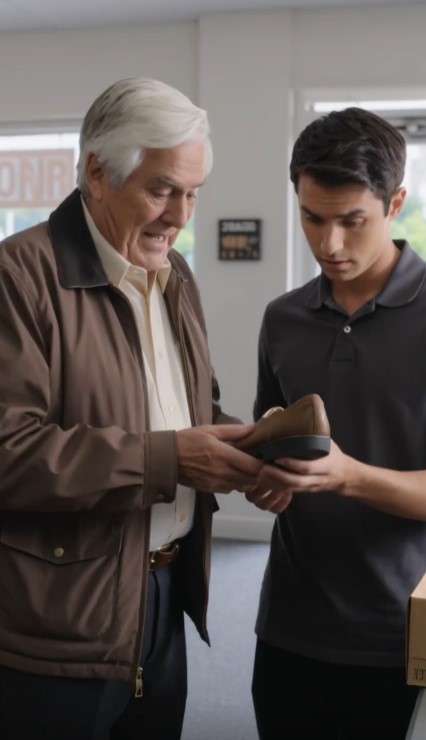
The elderly man asked for the cheapest pair in the store.
The young employee brought them over.
Then noticed something strange.
The man wasn’t checking the size.
He was staring at the stitching.
His hands started shaking.
“My wife used to sew that pattern.”
The employee smiled awkwardly.
“These are factory-made, sir.”
The old man shook his head.
“No. Look underneath.”
The employee turned the shoe over.
Inside the lining was a tiny hand-stitched blue thread.
The old man went pale.
His wife had used that exact hidden stitch on everything she repaired.
But she had died 11 years earlier.
The employee checked the stock box.
The shoes had arrived that morning in an unmarked donation shipment.
There was one more pair in the box.
Inside it was a folded receipt from a tiny repair shop that had closed decades ago.
The old man recognized the shop name.
His wife had worked there when they were young.
Then the employee found a handwritten phone number.
He called it.
An elderly woman answered.
The moment the old man heard her voice…
he dropped the shoe.
“Anna?”
There was silence on the phone.
Then the woman whispered:
“Robert?”
The young employee, Daniel, looked between the phone and the elderly customer.
Robert’s face had gone completely white.
He grabbed the counter.
“My wife’s name was Margaret.”
The woman on the phone began crying.
“I know.”
Robert stared at the shoe on the floor.
“How do you know who I am?”
Anna took several seconds before answering.
“Because Margaret was my sister.”
Robert stopped breathing.
“No.”
“Yes.”
“That’s impossible.”
Robert and Margaret had been married for fifty-two years.
She had never mentioned a sister named Anna.
Not once.
Robert knew about an older brother who died young.
He knew about Margaret’s parents.
Her childhood neighborhood.
The little shoe-repair shop where she had worked as a teenager.
But no Anna.
Robert picked up the phone himself.
“Why did Margaret never tell me?”
Anna answered quietly:
“Because she thought I was dead.”
Daniel stepped away from the counter.
This was no longer about a pair of inexpensive shoes.
Robert sat on a bench.
Anna began telling him what had happened.
More than sixty years earlier, Margaret and Anna had grown up only eighteen months apart.
They were nearly inseparable.
Their father repaired shoes.
Their mother did alterations.
Both girls worked in the little shop after school.
Their mother taught them a special stitch.
One tiny piece of blue thread hidden beneath the lining.
It wasn’t necessary.
It was a signature.
Their mother used to say:
“If you fix something with care, leave a little piece of yourself where nobody else needs to see it.”
Robert looked at the shoe.
The blue thread suddenly meant something much larger.
He asked:
“Why did you disappear?”
Anna explained.
When she was seventeen, she fell in love with a young man named Samuel.
Their father hated him.
One night, after a terrible argument, Anna left.
She and Samuel moved hundreds of miles away.
Anna promised Margaret she would write.
And she did.
But their father intercepted the letters.
He told Margaret that Anna had died in an accident.
Anna, meanwhile, was told by a relative that Margaret wanted nothing to do with her after she left.
Neither story was true.
Two sisters spent decades believing they had been lost to each other.
Robert whispered:
“Margaret searched cemeteries.”
Anna started crying harder.
“She thought I was really dead?”
“Yes.”
Margaret had told Robert about a childhood friend named Annie who had “died young.”
Robert never realized Annie was her sister.
Anna whispered:
“She called me Annie.”
Robert closed his eyes.
Now he remembered.
Margaret sometimes spoke about Annie.
Never with details.
Just fragments.
“Annie could sew faster than me.”
“Annie hated rainy days.”
“Annie once ruined Dad’s best shoes.”
Robert had assumed Annie was an old friend.
“She talked about you,” he said.
Anna cried.
“I talked about her too.”
Daniel quietly asked:
“What about the shoes?”
Both became silent.
That was still unexplained.
Anna said:
“I sent them.”
Robert stared.
“You?”
“Yes.”
“Why?”
“Because I found out Margaret died.”
Robert looked down.
“How?”
Anna’s grandson had begun researching their family.
He found Margaret’s obituary.
Eleven years too late.
Anna learned that her sister had lived in the same state for almost forty years.
At one point, they had lived less than ninety miles apart.
Neither knew.
Anna began searching for Robert.
But Margaret’s obituary was old.
The address no longer worked.
The phone number had changed.
Then Anna found something else.
A photograph online from a community donation drive.
The store Daniel worked at regularly distributed donated shoes to families and seniors.
Robert appeared in the background.
Anna recognized him from photographs Margaret had sent decades before their separation became permanent.
She knew the store.
But she still wasn’t sure how to approach him.
So she sent a box.
Inside were two pairs of shoes she had repaired herself.
And she used the blue stitch.
The same stitch she and Margaret had learned as girls.
Robert whispered:
“You expected me to notice?”
Anna answered:
“I hoped you would.”
Daniel looked amazed.
Robert almost laughed.
“You could’ve just written my name on the box.”
Anna laughed through tears.
“I was scared.”
“Of me?”
“Of finding out I was wrong.”
Anna had spent decades believing Margaret had rejected her.
Then she learned Margaret was gone.
She feared contacting Robert and discovering Margaret really had chosen silence.
So she created a test.
Not a cruel one.
A tiny thread.
If Robert knew what it meant, Anna would know Margaret had carried some part of their childhood into her marriage.
Robert stared at the blue stitch.
“She used it on everything.”
Anna went silent.
“Everything?”
“My work boots.”
“Her handbags.”
“Our daughter’s school costume.”
“Curtains once.”
“She repaired a teddy bear with blue thread.”
Anna began sobbing.
“She remembered.”
Robert whispered:
“She never forgot.”
The store had become completely quiet.
Even the manager had stopped working.
Daniel asked Anna:
“Where are you?”
She lived three hours away.
Robert didn’t hesitate.
“Can you come here?”
Anna laughed nervously.
“Today?”
“I’ve already wasted enough years for people I love.”
Nobody argued with that.
Anna arrived late that afternoon.
Robert remained at the store.
He refused to leave.
Daniel bought him coffee.
They talked while waiting.
Robert told him about Margaret.
How she sang while cleaning.
How she saved buttons from every ruined shirt.
How she repaired everything rather than replacing it.
“She would’ve fixed these shoes even if they cost five dollars.”
Daniel smiled.
“She sounds stubborn.”
“She was.”
Then the door opened.
A small elderly woman entered carrying an old leather sewing case.
Robert stood.
He had never seen her.
But he saw Margaret immediately.
The eyes.
The way she held her mouth when nervous.
The same small tilt of the head.
Anna stopped several feet away.
“Robert.”
He nodded.
“Anna.”
Then she looked at his face and cried.
“You got old.”
Robert laughed.
“So did you.”
They hugged.
Not because they had shared a life.
They hadn’t.
Because both had loved the same woman.
Anna opened the sewing case.
Inside were spools of thread.
Needles.
Old scissors.
And one photograph.
Two teenage girls standing outside a shoe shop.
Margaret and Anna.
Robert touched Margaret’s face.
“I’ve never seen this.”
Anna handed it to him.
“You should have it.”
Robert shook his head.
“No.”
“Why?”
“Make a copy.”
Anna smiled.
“All right.”
Then she pulled out something else.
A tiny notebook.
Their mother’s repair notes.
On the final page was a drawing of the hidden blue stitch.
Beneath it:
For my girls. Always leave one good thing behind.
Robert cried.
Daniel looked down at the shoes.
“That’s why you still use it.”
Anna nodded.
“Margaret did too, apparently.”
Robert laughed.
“Constantly.”
Then Robert asked the question Anna feared most.
“Did you ever write to her?”
Anna nodded.
“Hundreds of times.”
“Do you still have any?”
“Copies of some.”
Robert had something too.
Margaret kept a wooden box in their bedroom closet.
After she died, Robert opened it once.
Then couldn’t bring himself to look again.
Inside were letters addressed to Annie.
Never mailed.
Robert had thought they were letters to a dead childhood friend.
Now he understood.
The next morning, Robert brought the box to the store.
Anna opened the first letter.
Margaret had written it forty-eight years earlier.
Annie,
Today I married Robert.
Anna covered her face.
Margaret described the wedding.
The cheap flowers.
Robert stepping on her dress.
The rain.
Then:
I wish you were here.
Anna cried.
Another letter announced the birth of Margaret’s daughter, Emily.
Another talked about buying their first home.
One said:
Robert snores but denies it.
Anna laughed.
Robert protested.
“She exaggerated.”
There were dozens.
Margaret had written to her sister throughout her life.
Birthdays.
Anniversaries.
Ordinary Tuesdays.
She never mailed them because she believed Anna had died.
But writing made her feel like she was still talking to her.
Anna whispered:
“I did the same thing.”
Two boxes of letters.
Two lives.
Two sisters writing across a distance neither realized could have been crossed.
Robert shook his head.
“This is unbearable.”
Anna nodded.
“Yes.”
Then Daniel, the young employee who had accidentally become part of the reunion, asked:
“Can I say something?”
They looked at him.
“You found each other now.”
Anna smiled sadly.
“Through shoes.”
Daniel shrugged.
“There are worse ways.”
Robert laughed.
That afternoon, Robert took Anna home.
He showed her Margaret’s sewing room.
Almost untouched.
Anna stood in the doorway for a long time.
Then walked to the machine.
A spool of blue thread still sat nearby.
She picked it up.
“Same shade.”
Robert nodded.
“She bought this color by the dozen.”
Anna opened a drawer.
Buttons.
Needles.
Scraps.
Then she found a small cloth pouch.
Inside were five blue-thread samples.
Each labeled with a year.
Anna stared.
“She saved stitches?”
Robert didn’t know why.
Then they found a note.
For Annie, in case impossible things happen.
Anna sat down.
Margaret had written it only months before she died.
If somebody ever tells me I was wrong and you’re still alive, I hope you’re still sewing blue thread into places nobody notices.
Anna could barely read.
If I don’t get to see you, know that I kept doing it too.
Then:
Dad told me you died.
Anna froze.
Robert looked at her.
Margaret had begun doubting the story near the end of her life.
She found inconsistencies in old family papers.
She suspected their father had lied.
But she became ill before she could finish searching.
That was why she wrote the final note.
Not because she knew Anna lived.
Because she had finally allowed herself to hope.
Anna whispered:
“She almost found me.”
Robert nodded.
“Yes.”
For several months, Anna stayed nearby.
She became close to Robert.
Then to Emily, Margaret’s daughter.
Emily had grown up hearing about “Aunt Annie” as if she were a ghost.
Meeting her at age fifty felt impossible.
Anna showed her photographs of Margaret as a child.
Emily showed Anna videos from Margaret’s final years.
They rebuilt a family in reverse.
Not from shared childhood forward.
From old age backward.
Daniel stayed connected too.
Robert returned to the shoe store often.
Not because he needed footwear.
Because he blamed Daniel for starting the whole thing.
Daniel joked:
“I was just trying to sell you the cheapest pair.”
Robert answered:
“Worst customer service of my life.”
The two donated shoes were never sold.
One went to Robert.
One to Anna.
They displayed them in their homes.
The blue stitch visible.
A reminder.
Years later, Anna taught Daniel how to make the stitch.
He was terrible.
She made him redo it six times.
“What’s the point if nobody sees it?” he asked.
Anna smiled.
“That is the point.”
She explained what her mother had taught them.
Care isn’t always something other people notice.
Sometimes you do something properly because you know it’s there.
Daniel remembered that.
When Anna died several years later, Robert attended her funeral with Emily.
On the table beside Anna’s photograph sat the old sewing case.
And one of the shoes.
Robert placed Margaret’s spool of blue thread beside it.
Two sisters together again, at least in memory.
Robert lived a few more years.
Before he died, he gave Daniel the tiny notebook containing the stitch instructions.
Daniel said:
“This belongs to your family.”
Robert shook his head.
“You found the thread.”
“Keep it going.”
Daniel did.
He eventually opened a small shoe-repair counter of his own.
Not because of the dramatic story.
He simply discovered he liked repairing things more than selling replacements.
Inside every repair he completed for someone special, he placed one tiny blue stitch.
Most customers never noticed.
That was fine.
Years later, a little girl asked him why there was blue thread hidden inside her repaired boot.
Daniel smiled.
“An old woman taught me.”
“What does it mean?”
He thought about Margaret.
Anna.
Robert.
Two boxes of letters.
A pair of donated shoes.
Then said:
“It means somebody cared enough to fix it properly.”
The elderly man had entered the store looking for the cheapest shoes he could afford.
He thought his wife had been gone for eleven years.
Then he recognized one tiny stitch hidden beneath a lining.
It led to a closed repair shop.
A handwritten phone number.
A woman whose voice made him drop the shoe.
And the truth about a sister Margaret had spent most of her life believing was dead.
The thread was tiny.
Almost invisible.
But it had survived.
And after more than half a century…
it finally stitched two sides of a family back together.