
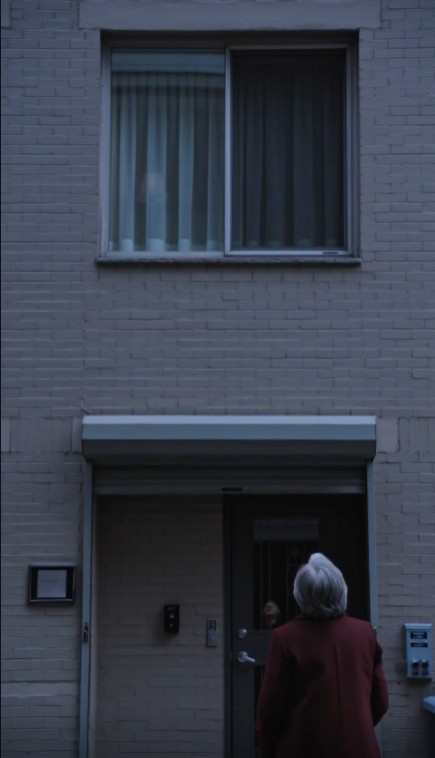
Every night at exactly 8:15…
The elderly woman stopped beneath the same apartment building.
She looked up at one dark window…
And waved.
Nobody ever waved back.
Rain or cold…
She still came.
One night, a building worker finally approached her.
“Ma’am… nobody lives in that apartment.”
She smiled.
“I know.”
He stared at her.
“Then why do you keep waving?”
She looked back at the dark window.
“Because I promised.”
The worker didn’t understand.
Until the next evening.
8:15.
The woman arrived.
She raised her hand.
And suddenly…
The light came on.
She froze.
So did the worker.
A shadow appeared behind the curtain.
The elderly woman whispered:
“No…”
The worker immediately checked his building list.
“That apartment is still empty.”
The shadow moved again.
Then came three slow knocks from inside.
The woman began crying.
The worker asked:
“Do those knocks mean something?”
She nodded.
“My husband used to knock three times whenever he came home.”
The worker went silent.
Then the lobby door opened behind them.
A man in his 40s stepped outside.
He looked at the elderly woman.
Then up at the illuminated window.
And whispered:
“Mom?”
She turned around.
Her face changed completely.
“Daniel?”
He hadn’t called her that in twenty-three years.
Then he said something that explained the light…
The three knocks…
And why he’d secretly returned to the apartment his parents once called home.
“I found Dad’s box.”
The elderly woman’s name was Margaret Carter.
She was seventy-six.
And for twenty-three years, she and her only son had barely spoken.
Not because either had stopped loving the other.
Because both had become very good at waiting for the other person to make the first move.
Margaret stared at Daniel.
“What box?”
“The one Dad hid behind the radiator.”
Margaret’s hand went to her mouth.
Apartment 4C had once belonged to Margaret and her husband, Henry.
They moved into it in 1978.
Daniel was born there six years later.
It wasn’t a beautiful apartment.
Two bedrooms.
A narrow kitchen.
Old radiators that clanged all winter.
A fire escape outside the living-room window.
But for the Carter family, it had been home for more than thirty years.
Henry worked nights at a printing plant.
His shift ended at eight.
If the bus was on time, he reached the building at exactly 8:15.
Margaret would be standing in the kitchen.
Daniel would usually be doing homework at the table.
And before Henry opened the apartment door…
he always knocked three times.
Knock.
Knock.
Knock.
Daniel once asked why he did it when he had a key.
Henry answered:
“So you know it’s me.”
It became a family ritual.
Three knocks.
Every night.
Then Henry would enter and say:
“Anybody miss me?”
Margaret always answered:
“Not particularly.”
And Daniel would run to him anyway.
Years later, after Daniel moved away, Henry added another ritual.
Whenever Margaret was outside the building at 8:15, Henry would stand at the fourth-floor window and wave.
It started as a joke.
Then became something they did without thinking.
Even after retirement, Henry would sometimes deliberately stand there at 8:15.
One wave from the window.
One from the sidewalk.
Forty-three years of marriage reduced to the simplest possible message.
I’m here.
Then everything changed.
Daniel was twenty-four when he accepted a job across the country.
Henry was proud.
Margaret was terrified.
She didn’t say:
“I’ll miss you.”
She said:
“You’re making a mistake.”
Daniel heard only the second sentence.
Their arguments became worse.
Daniel accused his mother of wanting to control his life.
Margaret accused Daniel of forgetting the family that had sacrificed for him.
Henry tried to stay between them.
It didn’t work.
The final argument happened in Apartment 4C.
Daniel had packed two suitcases.
Margaret stood beside the kitchen table.
“If you walk out every time things become difficult, eventually there’ll be nobody left to walk back to.”
Daniel answered:
“Maybe that’s what you want.”
Margaret slapped the table.
“Don’t you dare tell me what I want.”
Henry stepped between them.
“Enough.”
But it was too late.
Daniel left.
He didn’t come back for Christmas.
Then Easter.
Then the following Christmas.
Calls became shorter.
Birthdays became cards.
Cards became occasional messages.
Then even those became rare.
Henry continued speaking with Daniel privately.
Margaret knew.
She pretended she didn’t.
Daniel married.
His wife, Rachel, had a daughter from a previous relationship named Sophie.
Daniel later adopted Sophie.
Henry received photographs.
Margaret sometimes found them in his desk.
She looked at every one.
But she never asked Daniel for copies.
Pride again.
Always pride.
Then, eleven years ago, Henry became ill.
Daniel came home.
For three weeks, father and son were together almost every day.
Margaret and Daniel were polite.
Painfully polite.
Neither mentioned the years they’d lost.
Then Henry died.
At the funeral, Daniel stood beside his mother.
He wanted to say something.
Margaret wanted to say something.
Neither did.
The following morning, they had another argument.
It was over something ridiculous.
Henry’s watch.
Margaret wanted to keep it.
Daniel believed Henry had promised it to him.
Within minutes, they weren’t arguing about a watch anymore.
They were arguing about twenty years of hurt.
Daniel finally said:
“You never wanted me to leave.”
Margaret answered:
“And you never wanted to come back.”
Daniel walked out.
That was the last time he called her “Mom.”
For years afterward, they communicated through occasional texts.
Happy birthday.
Thank you.
Merry Christmas.
You too.
Technically, they weren’t completely estranged.
Emotionally, they might as well have been.
Margaret eventually moved from Apartment 4C.
The building was sold.
The apartment was renovated.
Then left vacant while the new owner prepared several units for another round of work.
But Margaret kept walking past.
Every evening.
8:15.
At first, she told herself it was exercise.
Then she stopped pretending.
She’d stand beneath the old window.
Look up.
And wave.
One night, building worker Marcus Reed noticed her.
The next night, he noticed again.
Then again.
Finally he asked why.
Margaret told him only:
“Because I promised.”
What she didn’t tell him was when she’d made that promise.
It happened six days before Henry died.
He was lying in a hospital bed.
Margaret was beside him.
Henry asked:
“Do you remember our window?”
“Of course.”
“Eight fifteen?”
She laughed.
“You were never actually home at 8:15.”
“Close enough.”
“You were usually late.”
“Margaret.”
“What?”
“When I’m gone, don’t stop waving.”
She thought he was joking.
“Who’s going to wave back?”
Henry smiled.
“Maybe nobody.”
Then he became serious.
“Do it anyway.”
“Why?”
“Because one day Daniel might come home.”
Margaret became angry.
Even beside her dying husband, the name could still do that.
“Henry—”
“Listen to me.”
She did.
“You and that boy have wasted enough years trying to prove which one was hurt more.”
Margaret looked away.
Henry continued.
“If he comes back, don’t make him knock forever.”
Those were the words Margaret remembered.
So after Henry died, she began walking past the building.
Not every night at first.
Then more often.
Eventually, almost every evening.
At 8:15, she waved.
She knew Henry wasn’t standing there.
She didn’t believe his spirit lived in Apartment 4C.
The apartment was empty.
She knew that.
The wave wasn’t for a ghost.
It was for a promise.
Then, one afternoon, Daniel received a phone call.
Not from Margaret.
From a woman named Evelyn Parker.
Henry’s younger sister.
Daniel hadn’t spoken with Aunt Evelyn in years.
She was moving into assisted living and clearing her storage unit.
Inside a box marked HENRY — APARTMENT, she found a small brass key.
There was a note taped to it.
4C — RADIATOR
Evelyn called Daniel.
“I think your father wanted you to have this.”
Daniel flew home.
He didn’t tell Margaret.
He wasn’t ready.
Instead, he contacted the building owner and explained that his parents had once lived in 4C and that family property might have been left behind during the old renovation.
The owner agreed to meet him.
Marcus, the building worker, was asked to assist.
That was why the apartment still showed as empty.
It was empty.
Daniel wasn’t living there.
He had simply been given authorized temporary access.
Behind the old radiator cover, exactly where Henry’s note indicated, they found a shallow compartment.
Inside was a metal box.
Daniel expected photographs.
Maybe documents.
Instead, he found letters.
Dozens of them.
Some addressed to him.
Others addressed to Margaret.
And one envelope said:
FOR WHOEVER FINDS THIS FIRST.
Daniel opened it.
His father’s handwriting filled three pages.
The first sentence made him sit down.
If you’re reading this, then apparently hiding things behind radiators was not as stupid as Margaret said.
Daniel laughed.
Then kept reading.
I have spent most of my life living between two stubborn people I love more than anything.
Unfortunately, both of them inherited their stubbornness from me.
Daniel stopped smiling.
Henry wrote about the night Daniel left.
About Margaret crying after the door closed.
About Daniel calling him from a bus station two hours later and asking:
“Is Mom okay?”
Neither ever knew the other had been crying.
Henry wrote about every birthday Margaret pretended not to care about.
Every photograph of Sophie she secretly copied.
Every time Daniel asked:
“Does Mom ever talk about me?”
Then came the sentence Daniel couldn’t forget.
You both kept asking me whether the other one still cared.
Neither of you ever asked each other.
Daniel read it three times.
Then he found another envelope.
DANIEL — OPEN LAST
Inside was a single sheet.
Your mother will never tell you this, so I will.
Every time you came home as a boy, I knocked three times before opening the door.
After you left, Margaret sometimes stood in the hallway when she heard footsteps and waited for three knocks.
She never admitted it.
She was waiting for you.
Daniel covered his face.
Then he read the final paragraph.
If you ever return to 4C and she’s still here, turn on the lamp by the window.
Knock three times.
Then stop waiting for somebody else to go first.
There was no lamp anymore.
The apartment had been emptied.
But Daniel had brought one.
The next day, he returned with Sophie.
She was now twenty-seven.
Daniel had told her about Margaret over the years.
Not kindly enough.
Not cruelly either.
Mostly incompletely.
Sophie had met Margaret only twice as a child.
She remembered an elegant woman who gave her a red scarf and called her “sweetheart.”
Daniel showed Sophie Henry’s letter.
She read it.
Then asked:
“What are you going to do?”
“I don’t know.”
Sophie folded the letter.
“Yes, you do.”
That evening, Daniel and Sophie went to Apartment 4C.
Marcus let them in with the owner’s authorization.
Daniel placed the lamp beside the window.
At 8:12, Marcus received a maintenance call downstairs.
He left.
Daniel looked through the curtain.
There she was.
Margaret.
Walking slowly toward the building.
Same coat.
Same handbag.
She stopped beneath the window.
8:15.
She raised her hand.
Daniel couldn’t move.
Twenty-three years of arguments suddenly felt ridiculous.
He reached toward the lamp.
His hand stopped.
Sophie stood behind him.
“Dad.”
“I know.”
“You flew three hours.”
“I know.”
“You’ve been carrying Grandpa’s letter around for two days.”
“I know.”
“So turn on the lamp.”
Daniel did.
Below them, Margaret froze.
Daniel stepped behind the curtain.
She saw his shadow.
But from four floors below, she couldn’t identify him.
Daniel looked toward Sophie.
“Three knocks.”
She understood.
There was an old metal heating pipe running beside the wall.
Years earlier, Henry’s knock at the apartment door could be heard clearly through the quiet hallway.
But Daniel knew Margaret wouldn’t hear someone tapping an apartment door from the sidewalk.
So he’d arranged something simpler with Marcus.
Marcus had left the lobby’s old intercom speaker active while Daniel tested the apartment communication line.
When Daniel tapped three times against the metal cover beside the intercom pickup, the sound carried downstairs through the open maintenance connection.
Three slow knocks.
Margaret heard them.
Knock.
Knock.
Knock.
Then Daniel used the service stairs.
Sophie remained upstairs.
That was the shadow Margaret saw moving behind the curtain after Daniel left the window.
Daniel reached the lobby.
Opened the door.
And stepped outside.
“Mom?”
Margaret turned.
“Daniel?”
Now he stood in front of her.
Older.
Gray beginning at his temples.
Looking strangely like Henry.
For several seconds, neither moved.
Then Margaret asked:
“Who is upstairs?”
Daniel smiled.
“Sophie.”
Margaret looked toward the window.
The shadow appeared again.
A young woman raised her hand.
And waved.
Margaret’s knees nearly gave way.
“My Sophie?”
Daniel nodded.
“She wanted to come.”
Margaret started crying.
Then immediately became angry.
“You could have called me.”
Daniel laughed through his own tears.
“I know.”
“You have my number.”
“I know.”
“You made me stand out here thinking I’d lost my mind.”
“I know.”
Margaret hit him lightly on the arm.
Then hugged him.
Daniel hadn’t expected that.
Neither had she.
He wrapped his arms around his mother.
For the first time in twenty-three years, neither cared who had moved first.
Marcus quietly stepped away.
He later said it was the only sensible thing to do.
Upstairs, Sophie turned off the lamp.
Then waited.
Twenty minutes later, Daniel brought Margaret into Apartment 4C.
She stopped inside the doorway.
Everything was different.
New flooring.
Different paint.
No furniture.
But the dimensions hadn’t changed.
She walked toward the kitchen.
“This is where your father burned our anniversary dinner.”
Daniel laughed.
“He said you burned it.”
“He lied.”
She touched the wall.
Then Daniel showed her the metal box.
Margaret recognized Henry’s handwriting immediately.
“You found this here?”
“Behind the radiator.”
She shook her head.
“I told him not to hide things there.”
Daniel laughed.
“He mentioned that.”
They spent the next three hours reading.
Henry had left letters for both of them.
Some were funny.
Some painful.
Some frustrating.
He didn’t pretend either person had been innocent.
He didn’t make himself innocent either.
In one letter he wrote:
I spent years carrying messages between you because I thought I was keeping the peace.
Maybe I was only making it easier for both of you not to speak directly.
Margaret read that sentence twice.
“He’s right.”
Daniel nodded.
Then Margaret found an envelope with her name.
Inside:
Margaret,
If Daniel comes home, don’t ask him why it took so long before you tell him you’re glad he’s there.
She laughed.
“That sounds like your father.”
Daniel handed her his letter.
She read:
Daniel,
If your mother hugs you, don’t waste the moment explaining why you’re still angry.
Margaret looked up.
“Did you?”
“No.”
“Good.”
Sophie sat across from them.
“I think Grandpa understood both of you.”
Margaret smiled.
“He had plenty of practice.”
Reconciliation didn’t happen in one night.
That mattered.
Twenty-three years couldn’t be repaired by one lamp and three knocks.
Daniel and Margaret still disagreed.
They still remembered certain events differently.
Margaret believed Daniel had deliberately avoided her.
Daniel believed Margaret had made every attempt at contact feel like surrender.
Both were partly right.
Both were partly unfair.
So they started smaller.
One phone call every Sunday.
Then dinner once a month.
Sophie began visiting Margaret on her own.
Eventually Margaret showed her old family photographs.
One evening Sophie found a picture of Daniel at twelve.
His hair was enormous.
She immediately photographed it.
Daniel threatened to disown her.
Margaret said:
“Don’t. We already tried that strategy.”
For the first time, they could joke about what had once been unbearable.
The building renovation eventually continued.
Apartment 4C was leased to a young couple.
Margaret stopped visiting every night.
She didn’t need to anymore.
But before the new tenants moved in, the owner allowed the Carter family one final evening inside.
At 8:14, Margaret stood on the sidewalk.
Daniel went upstairs.
Sophie stood beside Margaret.
The clock changed.
8:15.
The light came on.
A figure appeared at the window.
Daniel raised his hand.
Margaret waved back.
Then he disappeared.
A minute later, the lobby door opened.
Daniel walked outside.
Before Margaret could speak, he knocked three times on the glass.
Knock.
Knock.
Knock.
“Anybody miss me?”
Margaret looked at him.
“Not particularly.”
Sophie laughed.
Daniel hugged his mother anyway.
Years later, after Margaret died peacefully at eighty-six, Daniel received the old brass bell that had once hung inside his parents’ apartment before they moved it to their later home.
Sophie asked what he planned to do with it.
Daniel hung it beside his own front door.
“Why there?”
“So nobody has to knock forever.”
Every year on Henry and Margaret’s anniversary, Daniel rang it once at 8:15.
Not because he believed they could hear it.
Not because he expected a light to turn on somewhere.
But because rituals don’t need to be supernatural to matter.
Sometimes they’re simply ways of remembering what people meant to each other.
And when Lucas—Sophie’s little boy—eventually asked why Grandpa Daniel always knocked three times before entering their house, Sophie told him the story.
About Henry.
About Margaret.
About Apartment 4C.
About a dark window.
And about two people who loved each other but lost twenty-three years waiting for the other one to prove it first.
The mystery of the light had a simple explanation.
Daniel turned it on.
The shadow belonged first to Daniel, then Sophie.
The three knocks had been deliberately recreated through the building’s maintenance/intercom connection.
There was no ghost inside the empty apartment.
No impossible visitor.
Just a son who had secretly returned to the home he’d left decades earlier after finding his father’s hidden letters.
And an elderly mother who had continued showing up at exactly 8:15 because of one promise her husband made her give before he died:
Don’t stop waving.
Because one day Daniel might come home.
Henry had been right about one thing.
Daniel did come home.
He was just twenty-three years late.