
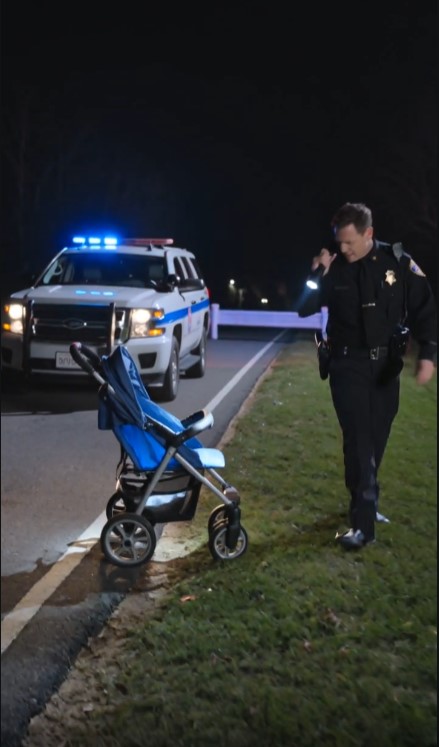
At 2:17 in the morning…
I saw an empty stroller sitting beside the road.
No houses nearby.
No cars.
No people.
My stomach dropped.
I stopped immediately.
The stroller was old…
But completely empty.
I called out.
Nothing.
Then…
A phone started ringing.
The sound was coming from underneath the stroller.
I found an old flip phone tucked inside the storage basket.
It stopped ringing before I could answer.
Then immediately rang again.
Unknown number.
I answered.
“Hello?”
Silence.
Then an elderly man’s voice whispered:
“Did you find the stroller?”
I froze.
“Who is this?”
He ignored me.
“Look at the left wheel.”
I shined my flashlight down.
Tied around the wheel was a small green ribbon.
“Okay. I see it.”
The man exhaled.
“Then I’m not too late.”
“What are you talking about?”
Before he could answer…
Headlights appeared in the distance.
A car was approaching slowly.
The man on the phone suddenly shouted:
“Officer…”
“Do not let that car pass you.”
I stepped safely behind my patrol vehicle and called for backup.
The approaching car stopped far away.
Nobody got out.
Then the elderly man said:
“Now look across the road.”
I turned my flashlight toward the field.
At first…
Nothing.
Then the light caught something.
Another green ribbon.
Tied to a fence post.
Then another.
And another.
Leading away into the darkness.
I asked:
“What do these ribbons mean?”
The man went silent.
Then whispered:
“They mean somebody finally followed the right road.”
My name is Daniel Carter.
I’d been a sheriff’s deputy for eleven years.
And at that moment, I had no idea whether the man on the phone was helping me…
or leading me into something I didn’t understand.
“Tell me your name.”
“Henry Wilson.”
“Where are you, Henry?”
Another pause.
“I don’t know exactly.”
That answer changed everything.
“You’re the one who left the stroller?”
“No.”
“Then who did?”
“My daughter.”
“What’s her name?”
“Rachel.”
“Where is Rachel?”
“I don’t know that either.”
I looked toward the ribbons.
“Henry, I need you to stop giving me pieces. Start at the beginning.”
Before he could answer, the car down the road flashed its headlights twice.
I moved farther behind my patrol vehicle.
My backup was minutes away.
“Henry, do you know who’s in that car?”
“No.”
“Then why did you tell me not to let it pass?”
“Because Rachel told me nobody was supposed to drive beyond the stroller.”
That didn’t make sense.
“Why?”
“Because the road isn’t safe.”
I looked ahead.
The pavement appeared normal.
Then Henry said:
“Look past the car.”
I raised my flashlight.
Nothing.
The beam wasn’t strong enough.
But my patrol lights illuminated part of the shoulder.
Something looked wrong.
The painted edge line disappeared.
Not gradually.
Suddenly.
I radioed dispatch.
“Possible roadway damage. Send public works and fire. Keep incoming units from approaching from the east until we know what we’re dealing with.”
Then my backup arrived from behind me.
Deputy Marcus Reed parked well back.
Together, from a safe position, we assessed the area.
The driver of the approaching car remained stopped as directed.
A few minutes later, fire personnel arrived with stronger lighting.
That’s when we saw it.
Part of the road ahead had collapsed.
Heavy rain earlier in the week had washed out the soil beneath a drainage culvert.
From my original angle, the pavement looked intact.
But beyond the stopped car, one lane had partially fallen away into a deep washout.
Marcus looked at the stroller.
“That thing’s a warning.”
Apparently.
But who had put it there?
And why was Henry somewhere in a field calling an old flip phone?
I asked him again.
“Where are you?”
Henry’s voice was weaker.
“Follow the green.”
“Are you injured?”
“I fell.”
“How badly?”
“My leg.”
“Are you alone?”
Silence.
“Henry?”
Then:
“No.”
Every instinct in me changed.
“Who is with you?”
“My granddaughter.”
“How old?”
“Eight.”
I immediately radioed the update.
Two people possibly injured or stranded.
One child.
Fire and EMS prepared to assist, but nobody rushed blindly into the field.
We needed to know the terrain.
Henry continued.
“My phone’s almost dead.”
“Then don’t waste the battery. Tell me what happened.”
He did.
Henry lived with his daughter Rachel and his eight-year-old granddaughter, Lily, on a small farm several miles away.
That evening, heavy rain had returned briefly.
Around midnight, Rachel received a call from her brother Thomas.
He owned grazing land on the other side of the old county road.
A section of fencing had come down.
Two horses were missing.
Rachel planned to check the nearest pasture entrance.
Henry insisted on going.
Lily was asleep.
They couldn’t leave her alone.
So all three went.
Rachel kept an old stroller in the back of her SUV.
Not for Lily.
Lily had outgrown it years ago.
Rachel used it to carry feed bags, fencing supplies and groceries around the farm.
The old flip phone was also hers.
An emergency backup.
When they reached the county road, Rachel saw the pavement damage.
She stopped well before it.
Then she noticed something worse.
The washout had destroyed part of the normal entrance to Thomas’s field.
The horses were visible beyond the fence.
Rachel called the county emergency number and reported the road damage.
But service was poor.
The call dropped.
She tried again.
Then she made a decision.
She moved the stroller to the roadside before the damaged section as a visible obstruction.
Not in the driving lane.
On the shoulder where approaching motorists would notice it and hopefully slow down.
She tied one of Lily’s green craft ribbons to the wheel because it reflected brightly in headlights.
Then Rachel left the flip phone in the basket.
“Why?” I asked.
Henry answered:
“Because her smartphone had the better signal.”
Rachel had called Thomas and told him the backup phone number.
If someone stopped at the stroller, Thomas could call it and explain the road hazard.
But Thomas wasn’t the man calling me.
Henry was.
“How do you have Thomas’s phone?”
“I don’t.”
“Then what are you calling from?”
“Rachel’s phone.”
I finally understood.
Henry had Rachel’s smartphone.
He was calling the old flip phone left at the stroller.
“But how did you know I’d found it?”
“I could see your lights.”
“From where?”
“The hill.”
I looked across the field.
The ribbons disappeared into darkness.
“What happened after Rachel left the stroller?”
Henry’s breathing became uneven.
They’d driven back a short distance and parked at a safe farm entrance.
From there, Rachel, Henry and Lily followed the fence line on foot.
Rachel had a flashlight.
Henry carried the phone.
Lily stayed between them.
They intended only to reach Thomas’s nearby equipment shed and wait for him.
But the rain had changed the ground.
Part of a shallow drainage area had become muddy and unstable.
Henry slipped.
He fell hard.
His leg became trapped beneath a broken section of lightweight fencing.
Rachel couldn’t safely free him alone.
So she told him:
“Stay here with Lily.”
Then she went toward Thomas’s shed to get help.
Before leaving, Rachel did something Henry initially thought was ridiculous.
She took the bundle of green ribbons from Lily’s craft bag.
Every twenty or thirty yards, she tied one to a fence post or branch.
A trail.
Not for herself.
For whoever came looking.
Henry had laughed.
“You think we’re in a fairy tale?”
Rachel answered:
“No. I think it’s dark.”
Then she disappeared toward the shed.
She never returned.
That was almost two hours earlier.
My grip tightened around the phone.
“Henry, why didn’t you tell me Rachel was missing?”
“I thought she was with Thomas.”
“Did Thomas arrive?”
“I haven’t seen him.”
“Did you call him?”
“No answer.”
“And Lily?”
“She’s here.”
“Is she hurt?”
“No.”
That was something.
“Put Lily on.”
A child’s voice came through.
“Hello?”
“Hi, Lily. My name is Daniel. I’m a police officer.”
“I know.”
“How?”
“Grandpa said.”
“Are you okay?”
“I’m cold.”
“We’re coming to you.”
She whispered:
“Mom said follow the green ones.”
“We see them.”
Then Lily said something that made me stop.
“There are two trails.”
“What?”
“Mom had green ribbons.”
“Yes.”
“Grandpa had some too.”
I looked at Marcus.
“Henry, did you tie ribbons?”
Henry came back on.
“Some.”
“Why?”
“After Rachel didn’t come back, I thought maybe she’d gone the wrong direction.”
My stomach dropped.
The ribbons might not be one trail.
Some could lead toward Rachel.
Others could lead away.
“Which ribbons are yours?”
Henry thought.
“Mine are tied once.”
“And Rachel’s?”
“Double knots.”
That tiny detail probably saved us a great deal of time.
We didn’t simply charge into the field following every green ribbon.
Fire personnel mapped the visible markers from the safe boundary.
Rachel’s double-knotted ribbons formed a line toward the north side.
Henry’s later ribbons branched west.
We followed Rachel’s original route first because it led toward Henry and Lily’s reported position.
About fifteen minutes later, we found them.
Lily was sitting beside her grandfather beneath a tree.
Henry’s right leg was trapped beneath part of a fallen wire-and-wood fence section.
He’d wrapped his coat around Lily.
She had wrapped her scarf around him.
When my flashlight reached them, Lily stood.
“You followed the right ones!”
Henry laughed weakly.
“Told you.”
Firefighters safely freed him.
Paramedics assessed both.
Lily was cold but otherwise okay.
Henry appeared to have a leg injury but remained stable.
I asked the question that still mattered.
“Where’s Rachel?”
Henry pointed north.
“The double knots.”
Marcus and I looked at each other.
The trail continued.
So did we.
The ribbons led toward an old equipment shed.
The door was open.
Rachel wasn’t inside.
But her flashlight was.
So was Thomas’s truck.
That meant he’d reached the property.
“Thomas!” I shouted.
Nothing.
Then Marcus found another ribbon.
Double knot.
Beyond the shed.
Rachel had continued.
We followed.
A hundred yards farther, the trail ended beside another drainage channel.
There was a shoe in the mud.
Then we heard someone shout.
“Over here!”
Rachel.
She was standing farther down the fence line.
Beside her was Thomas.
He was sitting on the ground.
Conscious.
Injured.
And beside them were the two missing horses, secured safely behind an intact section of fencing.
Rachel looked at my uniform.
“You found Dad?”
“Yes.”
“Lily?”
“Safe.”
She closed her eyes.
“Thank God.”
Thomas had reached the shed from another entrance shortly after Rachel left Henry.
He’d gone searching for the horses before seeing her flashlight.
Rachel eventually found him after he slipped near the drainage area and injured his ankle.
She stayed with him.
The phone signal there was almost nonexistent.
Her attempts to call failed.
So she did the only simple thing available.
She kept tying ribbons.
A visible path back.
When we finally reached them, Rachel had one ribbon left.
She was still holding it.
The entire story could have ended there.
But there was still the car.
The one I’d stopped on the damaged road.
When we returned, I learned who was driving.
A middle-aged man named Michael Harris.
He was on his way to an early shift at a distribution center.
He hadn’t seen the road collapse.
He had seen my patrol lights.
He stopped because I signaled him.
Michael looked at the broken pavement under the floodlights.
Then at the stroller.
“That thing made you stop?”
I nodded.
“Initially.”
He stared at it.
“If it wasn’t there?”
I didn’t answer.
There was no point pretending we knew exactly what would have happened.
Maybe I would have noticed the washout.
Maybe Michael would have.
Maybe not.
What we knew was enough.
The stroller caught my attention.
The phone led me to Henry.
Henry led us to the ribbons.
The ribbons led us to Lily.
Then Rachel.
Then Thomas.
The road remained closed until county crews could inspect and repair it.
Henry spent several days recovering.
His leg wasn’t as badly injured as we’d first feared.
Thomas had a fractured ankle.
Lily was perfectly fine.
Rachel was exhausted.
The horses were safely recovered.
A week later, I visited the family.
Lily answered the door.
She was holding a roll of green ribbon.
I laughed.
“You’re not planning another adventure, are you?”
“No.”
“Good.”
“These are for you.”
She handed me the roll.
“Why?”
“In case you get lost.”
Henry shouted from the living room:
“He needs them more than we do.”
I walked in.
Henry was sitting with his leg elevated.
The old stroller was beside the wall.
“You kept it?”
Rachel laughed.
“Dad won’t let me throw it away now.”
Henry pointed at it.
“That stroller found the police.”
Rachel corrected him.
“The stroller did not find anyone.”
“Fine. It aggressively attracted law enforcement.”
I sat down.
There was one question I’d wanted answered.
“Why 2:17?”
Rachel looked confused.
“What?”
“That was the time I found the stroller.”
Henry immediately understood.
He looked at Rachel.
“What time did you leave it?”
She thought.
“Maybe 12:40?”
So the stroller had been sitting beside the road for more than an hour and a half.
Other vehicles may have passed from the opposite direction before the washout worsened.
Nobody knew.
But the time mattered for another reason.
Henry pulled out Rachel’s smartphone.
The call history was still there.
At 2:14 a.m., he’d first tried calling the flip phone.
No answer.
At 2:16, he called again.
No answer.
At 2:17, he tried a third time.
That was the call I answered.
“How did you know someone was there?”
Henry smiled.
“Your flashing lights.”
From his position on slightly higher ground, he could see intermittent red and blue light reflecting against the low clouds.
He didn’t know who had stopped.
He only knew somebody had.
So he called the old phone again.
There was nothing mysterious about it.
No anonymous person watching from the darkness.
No impossible coincidence involving the phone.
Henry saw emergency lights.
He called.
I answered.
But I still asked:
“Why did you say, ‘Then I’m not too late’ when I told you about the green ribbon?”
Henry looked embarrassed.
“I was afraid the stroller had been moved.”
“Why would that matter?”
“Because if the ribbon was still on it, I knew you were standing at the place Rachel marked.”
The stroller was the starting point.
The first green ribbon.
Every ribbon after it was intended to form a chain.
A low-tech trail that didn’t depend on batteries, cellular service or GPS.
Rachel hadn’t expected her plan to become a rescue route.
She’d simply wanted a way back through a dark field.
But when things went wrong, those scraps of green fabric became something more useful.
Months later, the county held a small community safety meeting about rural road washouts after storms.
Rachel was invited.
So was I.
People wanted the dramatic version of the story.
The mysterious stroller.
The ringing phone.
The old man in the darkness.
The ribbons.
Rachel refused to make it mysterious.
She stood at the front and said:
“Nothing about this was planned well.”
Everyone laughed.
Then she became serious.
“We should have waited for emergency services after reporting the road.”
“We shouldn’t have gone farther into unstable ground at night.”
“The ribbons helped after we made several decisions that created more risk than necessary.”
I appreciated that.
Stories often become cleaner after they’re over.
Real emergencies aren’t.
People make imperfect decisions.
Then other people try to make the next decision better.
The county improved warning signs and inspection procedures along that stretch.
Thomas repaired his fencing.
Rachel bought proper emergency lights and reflective markers for her vehicle.
Henry got a location-enabled emergency device his family could monitor when appropriate.
And Lily?
Lily kept the ribbons.
Years later, I saw her again.
She was sixteen.
I barely recognized her.
She recognized me immediately.
“Officer Daniel!”
“Lily?”
She laughed.
Then opened her backpack.
Tied to one zipper was a small green ribbon.
“You still have those?”
“Just one.”
“Why?”
She shrugged.
“So I remember.”
“Remember what?”
She thought for a moment.
“That Mom came back.”
That answer surprised me.
For me, the ribbons had always meant finding people.
For Lily, they’d meant something different.
She’d sat beside her injured grandfather in a dark field while her mother disappeared beyond the fence.
Every few minutes, she looked at the last green ribbon Rachel had tied.
It pointed in the direction her mother had gone.
Lily didn’t know whether Rachel was safe.
She didn’t know whether anyone was coming.
Then lights appeared.
Voices.
Firefighters.
Paramedics.
And eventually her mother returned.
I asked Lily if she remembered the stroller.
“Of course.”
“Your grandfather still have it?”
She rolled her eyes.
“He kept it until it literally fell apart.”
That sounded like Henry.
Before we parted, Lily untied the green ribbon from her backpack.
She handed it to me.
“Here.”
“I thought you wanted it.”
“I have more.”
I laughed.
“Of course you do.”
I kept it.
Not because I believed the ribbons possessed some special meaning.
They didn’t.
They were ordinary strips of green fabric from an eight-year-old’s craft bag.
But one night, when phones barely worked and darkness made an ordinary field difficult to navigate, Rachel used them to mark her route.
Henry added some of his own.
A stroller beside the road marked where the trail began.
An old flip phone allowed a stranded man to speak to whoever finally stopped there.
And at 2:17 in the morning…
that happened to be me.
Years later, people still asked me about the empty stroller.
They expected the ending to involve some hidden crime.
It didn’t.
There was no abandoned baby.
No mysterious stranger stalking the road.
No supernatural message.
There was a damaged road.
A family that had become separated in the dark.
An injured grandfather.
A frightened little girl.
A mother trying to find help.
And a handful of green ribbons tied to fence posts.
The first time I asked Henry what those ribbons meant, he told me:
“They mean somebody finally followed the right road.”
At the time, I thought he was speaking in riddles.
Later I understood.
He wasn’t.
He could see my emergency lights in the distance.
He knew I’d found the stroller.
He knew I’d answered the phone.
And when I told him I could see the first green ribbon across the road…
Henry finally knew someone had found the beginning of the trail that could lead us to his family.
Sometimes the thing that leads you to someone isn’t complicated.
Sometimes it’s nothing more than an empty stroller…
a ringing phone…
and a strip of green ribbon moving in the wind.