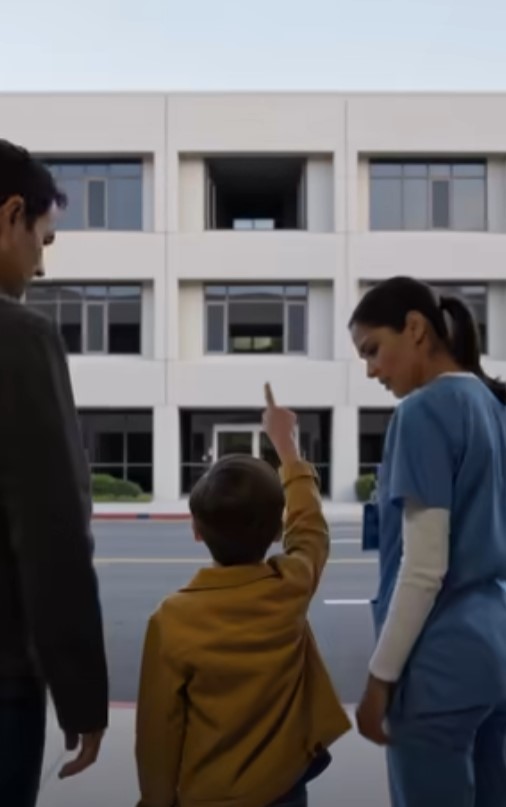
Nine-year-old Oliver insisted his mother was still alive, even though his father said she had died a year earlier. Then a locked hospital room produced a photograph dated just three days before.
Every afternoon at exactly 5:30, nine-year-old Oliver stood across the street from St. Matthew’s Hospital.
And waved.
Always at the same window.
Sixth floor.
Far right.
One dark pane of glass.
At first, nobody paid much attention.
Then nurses began noticing him.
Patients noticed too.
Eventually, security started watching.
The strange part was not that Oliver came every day.
It was the room he was waving toward.
Room 612 had been empty for months.
One afternoon, nurse Rachel Moore finally crossed the street.
Oliver was already standing in his usual place with his backpack at his feet.
Rachel crouched beside him.
“Who are you waving to?”
Oliver pointed upward.
“My mom.”
Rachel followed his finger.
Room 612.
Her stomach tightened.
“Is your mom a patient here?”
Oliver nodded.
“She waves every day.”
Rachel looked again.
Nothing moved behind the glass.
The sixth floor had been partially closed during renovations.
Nobody had stayed in room 612 in nearly a year.
Rachel chose her next words carefully.
“What’s your mom’s name?”
“Emily Carter.”
Rachel searched the hospital system.
The name existed.
But not as a current patient.
Before she could ask anything else, a car stopped abruptly near the curb.
A man rushed out.
“Oliver!”
The boy immediately stepped behind Rachel.
His father, Daniel, looked angry.
But beneath the anger was something else.
Fear.
“I told you not to come here anymore.”
Oliver looked at him.
“But Mom waved today.”
Daniel’s face changed.
Rachel slowly stood.
“Sir, I’m Nurse Moore. Your son says his mother is inside the hospital.”
Daniel closed his eyes.
“My wife died last year.”
Oliver shook his head.
“No, she didn’t.”
The words landed heavily.
Daniel grabbed his son’s backpack.
“We’re leaving.”
Oliver refused to move.
“Take me to room 612.”
“No.”
“Dad.”
“No.”
Rachel looked between them.
Something felt wrong.
Not because Oliver believed his mother was alive.
Children process grief in complicated ways.
But Daniel was not behaving like a father gently correcting a painful misunderstanding.
He looked terrified of the room itself.
Rachel finally said:
“If it helps him understand, we can show him the room.”
Daniel immediately answered:
“That won’t be necessary.”
Oliver looked directly at Rachel.
“Please.”
After several minutes, Daniel reluctantly agreed.
The Sixth Floor Was Almost Completely Silent
The elevator doors opened.
Dust covered sections of the hallway.
Plastic sheets hung over unused equipment.
Room 612 stood at the end.
Locked.
Oliver walked directly toward it.
Daniel stayed several feet behind.
“Mom?”
No answer.
Oliver knocked.
Knock. Knock.
Silence.
Daniel exhaled.
“See? Nobody’s here.”
Then—
Knock. Knock.
From inside.
Rachel froze.
Oliver looked at his father.
Daniel’s face went completely white.
Rachel called security.
A guard arrived with a master key.
The door opened.
Nothing.
An empty hospital bed.
Covered furniture.
Dust.
No patient.
No staff member.
No obvious explanation.
Oliver stepped inside.
He walked straight toward the window.
Then Rachel saw it.
A small handprint on the dusty glass.
Fresh.
Someone had touched that window recently.
Oliver pressed his own palm beside it.
The print was larger than his.
Daniel backed toward the doorway.
“We need to go.”
Rachel turned.
“Why?”
“No reason.”
But now she knew there was a reason.
Then Oliver noticed something beneath the hospital bed.
A yellow envelope.
He reached for it.
Daniel moved faster.
He grabbed the envelope first.
Rachel stopped him.
“Sir.”
Daniel clutched it tightly.
“It’s nothing.”
Rachel stared at him.
“Why are you afraid of that letter?”
Daniel did not answer.
Oliver took it from his hand.
His name was written across the front.
OLIVER
Inside was a photograph.
Oliver looked at it.
His entire face changed.
“Mom.”
Rachel stepped closer.
The woman in the picture matched Emily Carter’s hospital record.
But Emily was not lying in a hospital bed.
She was standing outside a building.
Alive.
Healthy enough to stand.
And holding a newspaper.
Rachel recognized the building behind her immediately.
A private rehabilitation center owned by the same healthcare network.
Then Oliver turned the photograph over.
A date was written on the back.
Three days earlier.
The room became silent.
Daniel slowly sat down.
Oliver stared at him.
“You knew.”
Daniel covered his face.
Rachel felt cold.
“What exactly is going on?”
Daniel began crying.
“My wife didn’t die.”
Oliver stopped moving.
The sentence he had been waiting a year to hear had finally been spoken.
But nothing about it brought relief.
Emily Had Disappeared After an Accident
One year earlier, Emily had suffered a serious head injury in a car crash.
She survived.
But during recovery, she experienced severe memory problems.
At times, she did not recognize Daniel.
Sometimes she remembered Oliver.
Sometimes she became frightened around both of them.
Doctors recommended specialized neurological treatment.
Daniel agreed.
Emily was transferred.
Then something changed.
According to Daniel, Emily asked that Oliver not visit until she was stronger.
Weeks became months.
Daniel began telling Oliver that his mother was “gone.”
When Oliver kept asking when she would return, Daniel finally told him she had died.
Rachel stared at him.
“You told your son his living mother was dead?”
Daniel wiped his face.
“I thought it would hurt less than making him wait.”
Oliver’s expression went completely blank.
“You lied.”
“I was trying to protect you.”
“From Mom?”
Daniel did not answer.
Rachel looked at the photograph again.
Something still did not fit.
If Emily had simply been receiving treatment, why leave clues inside an abandoned hospital room?
Why wave from the window?
Why hide a photograph?
And why was Daniel so desperate to keep Oliver away?
Then the room phone rang.
Everyone jumped.
Rachel stared at it.
“That phone isn’t active.”
Renovation records showed the line had been disconnected months earlier.
It rang again.
Oliver picked it up before anyone could stop him.
“Hello?”
Silence.
Then a woman’s voice came through.
Oliver’s face changed instantly.
“Mom?”
Rachel could faintly hear the voice from several feet away.
“Baby, listen to me.”
Oliver gripped the receiver.
“I knew you were alive.”
“I know.”
“Where are you?”
The woman did not answer.
Instead, she said:
“Don’t let Dad leave the hospital.”
Oliver slowly looked at Daniel.
His father stood.
“Give me the phone.”
Oliver backed away.
“Why?”
“Oliver.”
The boy moved toward the door.
Then locked it.
Daniel stared at him.
“What are you doing?”
Oliver held the receiver against his ear.
His mother continued speaking.
Rachel moved closer.
“Emily, this is Nurse Moore. Are you in danger?”
A pause.
Then:
“Yes.”
Daniel’s eyes widened.
Rachel immediately activated the staff emergency alert.
Security began moving toward the room.
Emily’s voice became urgent.
“Ask him about the night of the accident.”
Oliver looked at his father.
“What happened?”
Daniel shook his head.
“Your mother is confused.”
Emily heard him.
“No, Daniel.”
Rachel felt the atmosphere change.
Emily continued.
“The crash wasn’t an accident.”
Daniel stepped toward the phone.
Security entered before he could reach it.
Two guards positioned themselves between him and Oliver.
Rachel asked the question slowly.
“Emily, are you saying someone caused the crash?”
“Yes.”
“Who?”
Silence.
Then Emily answered.
“Daniel knows.”
Oliver stared at his father.
Daniel collapsed into a chair.
For the first time, he stopped denying everything.
The Truth Was Bigger Than Oliver Expected
Daniel had not caused the crash.
But he knew why it happened.
Months before the accident, Emily discovered irregularities involving money from a charitable foundation connected to Daniel’s business partner.
She gathered documents.
She planned to report what she found.
Someone followed her vehicle.
The crash occurred that night.
While Emily survived, her memory loss made her vulnerable.
Daniel became afraid.
The people behind the fraud threatened him.
They told him that if Emily remembered too much—or if Oliver began asking questions—the family could be targeted again.
So Daniel made a terrible decision.
He hid the truth.
He allowed Emily to remain under another name at a private rehabilitation center.
And he told Oliver she was dead.
“I thought if everyone believed she was gone, they’d stop watching us,” Daniel said.
Oliver was crying now.
“You made me think Mom was dead.”
“I know.”
“For a whole year.”
Daniel could not look at him.
Emily had recently regained enough memory to understand what had happened.
She wanted Oliver back.
But she no longer trusted Daniel to tell him.
So she began leaving clues.
The hospital room had once been part of her original treatment.
A sympathetic former employee had helped her access it briefly after hours.
The handprint.
The photograph.
The calls.
All of it was meant to force the truth into the open.
The photograph pointed investigators toward the rehabilitation facility.
Authorities arrived there that evening.
Emily was found alive.
When Oliver entered the room, he stopped at the doorway.
His mother looked thinner than he remembered.
But she smiled exactly the same way.
Oliver ran.
Emily dropped to her knees.
They held each other for what felt like minutes.
“I waved every day,” Oliver cried.
“I know.”
“You saw me?”
“Every time I could.”
One Year of Grief Ended in One Hospital Room
Daniel later cooperated with investigators.
The financial case was reopened.
Several people connected to the foundation were eventually charged.
But rebuilding the family took much longer.
Oliver did not forgive his father immediately.
Emily did not either.
Trust returned slowly.
Through therapy.
Honest conversations.
And the painful acknowledgment that fear had caused Daniel to make decisions that deeply hurt the people he wanted to protect.
Months later, Oliver returned to the street across from St. Matthew’s.
At exactly 5:30.
This time, he was not alone.
Emily stood beside him.
They looked toward room 612.
The window was dark again.
Oliver lifted one hand.
And waved.
Emily smiled.
“Who are you waving to?”
Oliver looked at her.
“Nobody.”
Then he took her hand.
“I don’t need to anymore.”
For almost a year, everyone who saw Oliver assumed he was a grieving child waving at an empty hospital room because he could not accept his mother’s death.
Oliver knew something they didn’t.
He had seen movement behind the glass.
He had seen someone waving back.
And one afternoon, the locked room finally proved that the person everyone told him to stop waiting for had been alive all along.