
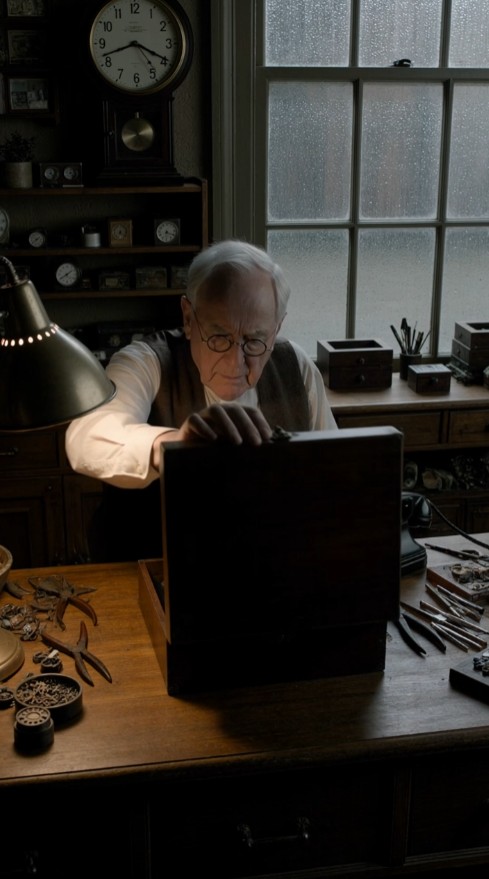
For almost sixty years, Walter Evans had repaired broken watches in the same little shop.
He was eighty-one years old.
His hands weren’t as steady as they once were.
His eyesight had weakened.
But he could still recognize the delicate movement of a watch mechanism better than almost anyone.
He had repaired thousands of timepieces.
Gold watches.
Pocket watches.
Family heirlooms.
And inexpensive wristwatches that meant more to their owners than money could ever explain.
But nothing prepared him for the wooden box that arrived on a rainy Thursday morning.
There was no return address.
No note.
No explanation.
Just nineteen wristwatches arranged carefully on dark velvet.
Walter examined the first.
Its hands showed 4:17.
He picked up the second.
4:17.
Then the third.
The same time.
He checked every watch.
All nineteen displayed exactly 4:17.
Some were gold.
Others were made from inexpensive metal.
Several had cracked glass.
But every watch had a name engraved on the back.
Walter recognized the first.
Thomas Miller.
Then the second.
Eleanor Price.
And the third.
Samuel Bennett.
His breathing became shallow.
These were names he hadn’t spoken in decades.
Names connected to a terrible afternoon in 1980.
The afternoon the Harbor Queen ferry suffered a catastrophic accident.
Walter slowly reached for the nineteenth watch.
A small silver wristwatch.
He turned it over.
And froze.
WALTER EVANS.
He had never owned that watch.
His hands began trembling.
Then he noticed something beneath the velvet lining.
A folded ferry passenger list.
Nineteen names.
All marked with the same recorded departure time.
At the bottom, someone had written:
“Eighteen came home. One was never found. But the official record says something different.”
Walter read the sentence twice.
Then saw a final line.
“Walter Evans was listed among the dead.”
He reached for the telephone.
Because Walter had survived the accident.
He had spent forty-six years believing he understood what happened that day.
And now someone was telling him that the names on the passenger list concealed a mistake that had never been corrected.
The Clock Shop on Harbor Street
Walter’s shop stood on a narrow street near the old harbor.
A brass clock hung above the entrance.
Its face had faded.
The wooden door creaked when customers entered.
And the walls were covered with clocks of every shape and size.
Some chimed on the hour.
Others ticked quietly.
There were grandfather clocks, alarm clocks, pocket watches, and delicate wristwatches arranged beneath glass.
Walter had opened the shop when he was twenty-three.
He’d learned the trade from his father.
And he never imagined doing anything else.
His wife, Margaret, had worked beside him for many years.
She kept the accounts.
Welcomed customers.
And always remembered which families had brought treasured watches for repair.
But Margaret had died seven years earlier.
Since then, Walter spent most days alone.
He opened the shop at nine.
Made tea at eleven.
And closed before sunset.
His life was quiet.
Predictable.
Until the wooden box arrived.
The Afternoon Nobody Forgot
On October 17, 1980, Walter was thirty-five.
He had boarded the Harbor Queen, a passenger ferry that carried residents between two coastal towns.
The journey was usually uneventful.
Families used the ferry to visit relatives.
Workers traveled between communities.
And tourists enjoyed the short crossing.
Walter had boarded with several people he knew.
Among them was Thomas Miller, a schoolteacher.
Eleanor Price, a young nurse.
And Samuel Bennett, who worked at the harbor.
Walter remembered standing near the passenger cabin.
He remembered the sound of the engine.
The gray clouds gathering overhead.
And the uneasy movement of the water.
Then something went wrong.
The Accident
The ferry experienced a serious mechanical failure during the crossing.
As the crew attempted to manage the emergency, the vessel became unstable.
Passengers were instructed to move toward designated safety areas.
Walter remembered people shouting.
The sound of metal striking metal.
Then a violent movement that threw several passengers against the cabin walls.
Water began entering part of the vessel.
The crew initiated emergency procedures.
But the situation deteriorated rapidly.
Nearby boats and emergency responders assisted with the rescue.
Most passengers survived.
Several were injured.
And one person was never recovered.
The disaster changed the small harbor community.
For years afterward, people spoke about the crossing in quiet voices.
Walter rarely discussed it.
He had survived.
But the memory never left him.
Why Every Watch Showed 4:17
Walter examined the watches again.
The same time appeared on every dial.
4:17.
But he knew immediately that something didn’t make sense.
Nineteen separate watches could not reasonably have stopped at the same minute during the accident.
Some were mechanical.
Others appeared to be battery-powered models from later years.
Several didn’t even exist in 1980.
Someone had deliberately set them to 4:17.
The number had been chosen for a reason.
Walter looked toward the ferry passenger list.
The departure column recorded 4:17 p.m.
But the ferry he remembered had departed earlier.
He searched his memory.
The crew had announced a delay.
A mechanical inspection.
Then permission to board.
He could still picture the harbor clock.
And suddenly, he remembered something.
The ferry had not left at 4:17.
That was the time the emergency radio call was received.
Whoever assembled the box had mixed two details from the old records.
Or perhaps wanted Walter to notice the inconsistency.
The Name on the Nineteenth Watch
Walter returned to the silver watch engraved with his name.
He examined it under a magnifying glass.
The engraving was recent.
The watch itself was inexpensive.
But the lettering had been carefully done.
He opened the case.
Inside was a tiny folded piece of paper.
Only four words were written on it.
“Ask about the boy.”
Walter stared.
The boy.
He knew exactly who that meant.
Forty-six years earlier, a little boy had been aboard the Harbor Queen.
He was traveling with his mother.
Walter remembered hearing him cry as passengers gathered near the emergency exits.
He remembered a red sweater.
A small wooden toy boat.
And the boy calling for his mother.
Then the memory became fragmented.
Noise.
Water.
Cold.
And the desperate struggle to reach safety.
Walter sat down.
He hadn’t thought about that child in years.
But now someone wanted him to remember.
The Telephone Call
Walter called the local historical society.
A woman named Helen answered.
“Harbor Historical Archives.”
Walter swallowed.
“My name is Walter Evans.”
There was a pause.
“Mr. Evans?”
“Yes.”
He looked toward the watches.
“I need information about the Harbor Queen accident.”
Helen became quiet.
Then said:
“Mr. Evans, we’ve been trying to contact you.”
Walter’s heart began pounding.
“What?”
She hesitated.
“Someone recently donated a collection of documents connected to the accident.”
Walter stared at the telephone.
Helen continued.
“And your name appears in several of them.”
He looked at the silver watch.
Then asked:
“Was there a little boy on the ferry?”
Helen didn’t answer immediately.
Finally, she said:
“Yes. And I think you need to come here.”
The Hidden Archive
The historical society occupied a former customs building near the harbor.
Walter arrived that afternoon carrying the wooden box.
Helen met him at the entrance.
She was sixty-four and had spent years researching the town’s maritime history.
She led him into a quiet reading room.
On the table were several folders.
Old photographs.
Newspaper clippings.
And copies of official reports.
Walter sat down.
Helen opened the first folder.
“This came from the estate of a former ferry employee.”
She showed him a handwritten notebook.
Inside were names of passengers and crew.
Walter recognized many of them.
Then Helen pointed toward the final page.
A list of survivors.
His name appeared there.
But beside it was a handwritten question mark.
Walter frowned.
“Why?”
Helen looked toward him.
“Because one of the earliest casualty reports listed you as missing.”
The Mistake That Survived for Decades
In the chaotic hours following the accident, emergency personnel worked to identify survivors.
Some passengers had been transported to hospitals.
Others were taken aboard nearby vessels.
Communication was difficult.
Witness accounts were incomplete.
Walter had been rescued by a fishing boat and taken to a small medical facility outside the main harbor.
His name did not immediately appear on the central survivor list.
An early report incorrectly classified him as missing and presumed dead.
The mistake was later corrected in official records.
But one privately compiled memorial list was never updated.
That list circulated among families connected to the ferry.
Over time, copies of it became part of local history collections.
Walter had never known.
He’d returned home after recovering.
Resumed his work.
And avoided discussing the accident.
But somewhere in the surviving paperwork, his name remained among those believed lost.
The Eighteen Other Names
Walter looked again at the watches.
Thomas Miller.
Eleanor Price.
Samuel Bennett.
And sixteen others.
Helen explained that the names represented people who had been part of one particular rescue group.
They were not all victims.
Most had survived.
Several had helped others.
One had later died from unrelated causes.
The watches weren’t original belongings recovered from the ferry.
They were symbolic objects assembled decades afterward.
Each carried the name of a person connected to the same sequence of events.
Walter looked toward Helen.
“Who made them?”
She hesitated.
Then reached for another envelope.
“Someone who has been searching for you.”
The Boy in the Red Sweater
Helen opened a folder containing a photograph.
It showed a little boy standing beside a woman.
The boy wore a red sweater.
In his hands was a small wooden boat.
Walter felt his throat tighten.
“I remember him.”
Helen nodded.
“His name was Peter.”
Walter closed his eyes.
He remembered the child crying.
The crowded cabin.
And the moment passengers began moving toward the emergency exits.
Peter’s mother had been injured during the accident.
Walter had helped guide the boy toward a crew member who was directing passengers to safety.
Then, during the chaos, Walter lost sight of them.
For years, he’d wondered whether the child survived.
But he never found out.
Helen smiled gently.
“He did.”
Walter looked up.
“What?”
“Peter survived.”
His eyes filled with tears.
“And his mother?”
Helen nodded.
“She survived too.”
Walter covered his face.
The Man Who Sent the Watches
Helen placed a recent photograph on the table.
It showed a man in his early fifties.
He wore glasses.
His hair was turning gray.
And he held a small wooden boat.
Walter stared.
“Peter?”
Helen nodded.
“Peter Collins.”
The little boy from the ferry was now a grown man.
He worked as a maritime historian.
For years, he had been researching the accident.
His mother had kept a scrapbook of newspaper clippings and personal memories.
After she died, Peter began reviewing the material.
He discovered the conflicting casualty lists.
Then found a note referring to a man named Walter Evans.
A passenger who had helped guide him toward safety.
Peter began searching.
Eventually, he found Walter’s clock shop.
But he wasn’t sure how to approach him.
So he created the box.
Why Nineteen Watches?
Walter examined the collection again.
Helen explained Peter’s idea.
The nineteen watches represented the people involved in the evacuation of one passenger section.
Each name had appeared in the surviving witness statements and rescue records.
Some were passengers.
Others were crew members.
Together, their actions formed part of the story of how a group of people escaped.
Peter wanted to recognize them.
He chose watches because Walter was a clockmaker.
He set each one to 4:17.
The time recorded on the first emergency call in the documents he’d studied.
He hoped Walter would recognize the significance.
Then he engraved Walter’s name on the final watch.
Not because Walter had died.
But because Peter wanted him to know that his role had never been forgotten.
The Letter Beneath the Velvet
Helen asked Walter to examine the wooden box again.
He carefully removed the velvet lining.
Beneath it was another folded letter.
Walter’s hands trembled as he opened it.
Dear Mr. Evans,
You probably don’t remember me.
I was six years old when the Harbor Queen was involved in the accident.
I wore a red sweater.
And I carried a small wooden boat.
My mother told me that when everyone became frightened, a man helped me reach the crew.
She said he held my hand and told me to keep moving.
For years, we believed that man had died because his name appeared on an early casualty list.
Then I found a corrected record.
You survived.
Walter stopped reading.
Tears rolled down his cheeks.
The Sentence That Broke Him
The letter continued.
My mother wanted to thank you.
She searched for you after the accident, but the information she received was contradictory.
Eventually, life moved on.
She raised me.
I grew up.
And I became a father myself.
Before she died, she asked me to remember the people who helped us that afternoon.
That’s why I began this project.
There were nineteen names connected to our part of the rescue.
Yours was the one I most wanted to find.
Walter’s hands shook.
Then he read the final sentence.
“Mr. Evans, you thought you were simply helping a frightened boy off a ferry. But because of that moment, my mother got to raise her son — and I got to raise mine.”
Walter lowered the letter.
Then began crying.
The Reunion
Helen told Walter that Peter was waiting nearby.
He hadn’t wanted to surprise him without permission.
Walter wiped his eyes.
Then nodded.
“I’d like to see him.”
Several minutes later, a man entered the room.
He was tall.
Gray-haired.
And carried a small wooden box.
Walter stood slowly.
For a moment, neither spoke.
Then Peter smiled.
“Mr. Evans?”
Walter nodded.
“Peter?”
The man began crying.
“Yes.”
Walter looked at him.
Then whispered:
“You were so little.”
Peter laughed through tears.
“I was.”
They embraced.
Forty-six years had passed.
But the memory of that afternoon connected them instantly.
The Wooden Boat
Peter opened the small box he’d brought.
Inside was a little wooden toy boat.
Its blue paint had faded.
One side was scratched.
And the tiny mast had been repaired.
Walter stared.
“I remember that.”
Peter nodded.
“My mother kept it.”
He gently lifted the toy.
“She said I wouldn’t let go of it during the accident.”
Walter smiled through tears.
“You held it so tightly.”
Peter looked surprised.
“You remember?”
Walter nodded.
“I remember the red sweater too.”
Peter began crying.
Then handed him the boat.
“I wanted you to see it.”
Walter held the small toy carefully.
For the first time in decades, a memory he’d carried alone became something he could share with another person who had been there.
What Really Happened at 4:17
Peter and Helen showed Walter the reconstructed timeline.
The ferry had departed late after a mechanical inspection.
During the crossing, it experienced a serious failure.
An emergency call was transmitted at approximately 4:17 p.m.
That was the moment Peter chose for the watches.
Not because the timepieces had physically stopped.
But because the recorded emergency call marked the beginning of the rescue response.
Peter wanted the objects to represent a shared moment in the town’s history.
Walter looked toward the watches.
Then smiled sadly.
“For years, I couldn’t stand hearing people talk about that afternoon.”
Peter nodded.
“My mother was the same.”
Walter continued.
“And now you’ve brought it back.”
He paused.
“But this time, I know the little boy lived.”
The Names Behind the Watches
Peter had spent years researching the nineteen people.
He had interviewed surviving relatives.
Examined archived records.
And reconstructed the rescue accounts as carefully as possible.
The watches represented individual lives.
Thomas Miller had helped frightened passengers remain calm.
Eleanor Price, the young nurse, had assisted injured survivors after reaching safety.
Samuel Bennett had helped crew members organize passengers near an exit.
Others had shared life jackets.
Supported elderly travelers.
Or helped children move toward rescue vessels.
Walter listened quietly.
For decades, he remembered the accident mainly through fear.
Now he was learning about the people who helped one another.
Their actions hadn’t prevented the disaster.
But they had mattered.
The Question Walter Asked
Walter looked toward Peter.
“Why did you send the box anonymously?”
Peter smiled awkwardly.
“I wasn’t sure you’d want to talk about it.”
Walter nodded.
Peter continued.
“I knew the accident might have been painful for you.”
He looked toward the watches.
“So I thought I’d give you the choice.”
Walter examined the silver watch engraved with his name.
Then said:
“You could’ve just written a letter.”
Peter laughed.
“I know.”
Walter smiled.
“But I suppose you got a clockmaker’s attention.”
They both laughed.
For the first time that afternoon, the room felt lighter.
The Invitation
Peter explained that the historical society planned a commemorative exhibition about the ferry accident.
The display would focus on the rescue effort and the lives affected.
He hoped Walter would participate.
Walter hesitated.
He had avoided public discussions of the event for decades.
But the watches changed something.
They reminded him that his memories weren’t only about tragedy.
They were also about survival.
Compassion.
And the choices people made when others needed help.
Finally, Walter nodded.
“I’ll think about it.”
Peter smiled.
“That’s all I ask.”
The Watch Walter Repaired
Back at his shop, Walter examined the nineteen watches individually.
Several were damaged beyond practical repair.
Others had simple mechanical problems.
He knew they were symbolic pieces, not actual recovered artifacts.
Still, he wanted to do something.
He selected the silver watch engraved with his name.
He opened its case.
Cleaned the mechanism.
Replaced a damaged component.
And adjusted the hands.
For the first time since the box arrived, the watch began ticking.
Walter held it close to his ear.
Tick.
Tick.
Tick.
He smiled.
Then placed it on his workbench.
Beside Peter’s letter.
The Exhibition
Several months later, the harbor historical society opened its commemorative exhibition.
Photographs lined the walls.
Newspaper articles described the accident.
A carefully researched timeline explained the rescue response.
And one display case contained nineteen wristwatches.
Each was labeled with the name of someone connected to the evacuation.
The exhibition clearly explained that the watches were modern commemorative objects.
They had not all been aboard the ferry.
Nor had they literally stopped during the accident.
Their hands were set to 4:17 to represent the emergency call.
Beside them was a photograph of Walter and Peter embracing during their reunion.
The caption read:
FORTY-SIX YEARS LATER, A THANK-YOU FINALLY REACHED ITS DESTINATION.
The Families Who Returned
Relatives of several ferry passengers attended the exhibition.
Some brought photographs.
Others shared letters.
A few remembered the accident vividly.
For many, it was the first time they’d spoken openly about what happened.
Walter met Eleanor Price’s daughter.
She showed him an old photograph of her mother in her nursing uniform.
He smiled.
“I remember her.”
Then he met Samuel Bennett’s grandson.
They spoke about the harbor.
The ferry.
And the families whose lives had been affected.
The exhibition didn’t erase the tragedy.
But it gave people a way to remember the courage and compassion that existed alongside it.
The Speech Walter Never Planned
During the opening, Helen invited Walter to say a few words.
He stood beside the display case.
His hands trembled slightly.
He looked toward the nineteen watches.
Then toward Peter.
“For many years,” Walter began, “I tried not to think about that afternoon.”
The room became quiet.
“I remembered the fear.”
He paused.
“The noise.”
“And the people we couldn’t help.”
His voice broke.
“But recently, someone reminded me of something else.”
He looked toward Peter.
“A little boy survived.”
Walter smiled through tears.
“And he grew up.”
The audience listened.
“He became a father.”
He paused.
“Then he spent years finding the people who helped him.”
Walter looked down at the silver watch.
“I suppose that means we did something right that day.”
The Final Gift
After the ceremony, Peter approached Walter.
He handed him a small envelope.
Inside was a photograph.
It showed Peter standing beside his two adult children.
Behind them was a younger photograph of Peter’s mother.
Peter smiled.
“Four generations of our family.”
Walter studied the picture.
Peter pointed toward the people.
“My mother.”
“Me.”
“My children.”
“And my granddaughter.”
Walter’s eyes filled with tears.
Peter continued.
“She was born last year.”
He smiled.
“Her name is Eleanor.”
Walter looked surprised.
“Like the nurse?”
Peter nodded.
“My mother never forgot her.”
Then Peter added:
“And she never forgot you.”
Walter held the photograph against his chest.
The Clock Shop’s New Display
When Walter returned to his shop, he placed the silver watch in a small glass case.
Beside it was the photograph of Peter’s family.
And a copy of the letter.
Customers often asked about the display.
Walter told them the story.
Sometimes briefly.
Other times in detail.
He explained the ferry accident.
The mistaken casualty list.
The boy in the red sweater.
And the wooden box containing nineteen watches.
But he always emphasized one thing.
The watches hadn’t stopped during the disaster.
They were created decades later to remember the people involved.
What mattered wasn’t the mystery of the hands.
It was the names engraved on the backs.
The Call Walter Made Every October
Walter and Peter remained in contact.
Each October, near the anniversary of the accident, Peter called the clock shop.
They spoke about ordinary things.
Family.
Work.
The weather.
Sometimes they discussed the exhibition.
Other times they simply checked on each other.
Walter came to appreciate the friendship.
For decades, the accident had been a memory he avoided.
Now it had connected him with someone whose life had continued beyond that frightening afternoon.
Peter often ended their calls the same way.
“Thank you again, Mr. Evans.”
And Walter always answered:
“You’re welcome, Peter.”
The Last Time Walter Looked at 4:17
One evening, Walter was closing the shop.
Rain tapped against the window.
The clocks were ticking.
And the street outside was nearly empty.
He approached the display case.
The original eighteen watches remained set to 4:17.
But the silver watch with his name had been repaired.
Its hands moved normally.
Walter picked it up.
He remembered the frightened little boy.
The red sweater.
The wooden boat.
And the cold water.
Then he thought about Peter as a grown man.
His children.
His granddaughter.
And the life that continued after the accident.
For the first time in many years, Walter didn’t feel only sadness.
He felt grateful.
The Truth Behind the Nineteen Watches
The mystery began when eighty-one-year-old clockmaker Walter Evans received a wooden box containing nineteen wristwatches.
Every watch displayed exactly 4:17.
Each had a name engraved on the back.
The names belonged to people connected to a ferry accident in 1980.
Walter recognized several.
But the final watch carried his own name.
A note beneath the velvet revealed that an early casualty report had mistakenly listed him among those believed dead.
The box had been created by Peter Collins, a survivor who was only six during the accident.
Walter had helped Peter reach safety.
For decades, Peter’s family believed Walter had died because his name appeared on an outdated list.
After discovering corrected records, Peter searched for him.
He assembled the watches as a tribute to the nineteen people connected to one part of the rescue.
The time 4:17 represented the emergency call.
The watches were commemorative objects, not timepieces recovered from the disaster.
The mystery led to a reunion forty-six years after the crossing.
The Letter Walter Kept
Walter treasured Peter’s letter.
He kept it near the silver watch on his workbench.
Sometimes he reread it before opening the shop.
The words reminded him of a moment he’d almost forgotten.
A frightened child.
A helping hand.
And a small act that mattered more than he realized.
The final sentence always made him emotional.
You thought you were simply helping a frightened boy off a ferry. But because of that moment, my mother got to raise her son — and I got to raise mine.
Walter had spent his life repairing clocks.
Helping people preserve treasured objects.
Returning broken timepieces to their owners.
But he had never imagined that a moment from his own past would return to him in the form of nineteen watches.
The Clockmaker Who Thought Time Had Stopped
For forty-six years, Walter remembered the ferry accident as one of the darkest afternoons of his life.
He rarely spoke about it.
The memories were painful.
And he had never known what happened to the little boy in the red sweater.
Then a wooden box arrived.
Inside were nineteen watches.
All set to 4:17.
And the final one carried Walter’s name.
An elderly clockmaker received nineteen watches engraved with names from a ferry accident decades earlier.
The last watch carried his own name, even though he had never owned it.
A hidden passenger list led him to discover that an early casualty report had mistakenly recorded him among those believed dead.
But the greatest surprise was the person who sent the box.
Peter Collins.
The little boy Walter had helped during the evacuation.
Now grown.
With children and a grandchild of his own.
The watches hadn’t mysteriously stopped.
They were deliberately set to mark the moment of the emergency call.
Peter had created them to remember the people whose actions helped others survive.
Walter repaired the silver watch bearing his name.
And as its hands began moving again, he understood something he had never fully considered.
The accident had changed his life.
But so had the moment when he reached for a frightened child’s hand.
For decades, Walter believed that afternoon was defined by loss.
Then a stranger sent him nineteen watches.
And helped him remember something else.
At 4:17, an emergency call marked the beginning of a terrible rescue.
But for one little boy, the kindness of a clockmaker helped make an entire lifetime possible.