
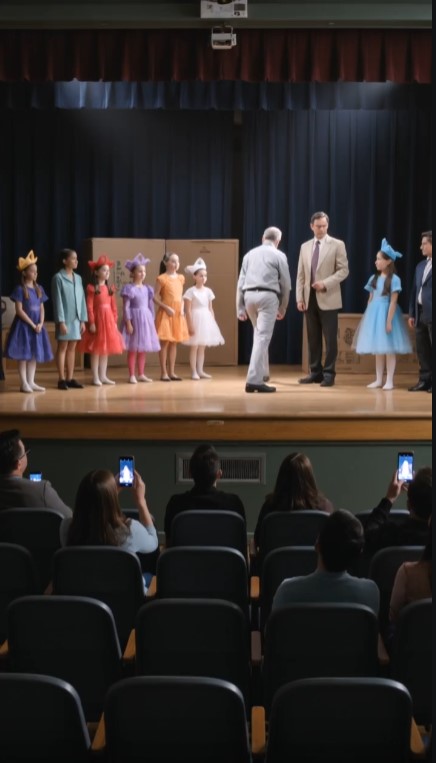
Everyone laughed when Mr. Harris stepped onto the stage.
The school auditorium was packed that evening. Parents sat shoulder to shoulder, phones raised, recording every second of the spring play. Children in bright costumes sang under the stage lights while teachers smiled proudly from the side aisles.
It was supposed to be a perfect night.
But in the middle of the performance, the old janitor walked slowly out from behind the side curtain.
At first, people thought he had made a mistake.
A few parents chuckled.
One boy in the front row whispered, “Why is the janitor on stage?”
Mr. Harris did not look at the audience.
He did not look at the children singing.
He was staring at the heavy red curtain near the back of the stage.
Something behind it had moved.
Just once.
The principal hurried toward him, her face tight with embarrassment.
“Mr. Harris,” she whispered sharply, “you need to step away. The children are performing.”
But he didn’t move.
His eyes stayed fixed on the curtain.
Then he raised one hand.
“Stop the music,” he said.
The piano kept playing for another second before the teacher at the keyboard froze.
The children stopped singing.
Parents lowered their phones.
A strange silence spread through the auditorium.
The principal’s voice became firmer.
“Mr. Harris, this is not the time.”
But the old janitor turned his head slightly and whispered, “Listen.”
No one spoke.
At first, there was nothing.
Only the buzz of the lights above the stage.
Only the nervous breathing of the children in costume.
Only the faint creak of the wooden floor beneath Mr. Harris’s shoes.
Then it came again.
A tiny cough.
So small that most people would have missed it.
But Mr. Harris had spent twenty-three years in that school. He knew every sound in the building. He knew the rattle of the old pipes, the hum of the hallway vents, the squeak of the cafeteria door.
And he knew that sound did not belong behind the curtain.
He walked forward.
The principal reached for his arm, but he gently pulled away.
Parents began whispering.
Some thought he was confused.
Some thought he was ruining the play.
Some even laughed again, nervously this time, as if laughter could make the moment normal.
But Mr. Harris moved straight to the curtain and pulled it back.
Behind it were painted cardboard trees, wooden boxes, folded backdrops, and a large storage trunk pushed against the wall.
The trunk was usually used for costumes.
It had been there for years.
Mr. Harris stared at it.
Then came another cough.
This time, everyone heard it.
The room changed instantly.
No more laughter.
No more whispers.
No more phones held high for cute memories.
The principal covered her mouth.
Mr. Harris moved the props aside and knelt beside the trunk.
“Is someone in there?” he asked softly.
For one terrifying second, there was no answer.
Then a tiny voice came from inside.
“Help.”
A teacher gasped.
Mr. Harris reached for the latch with trembling hands and opened the trunk.
Inside was a little boy named Caleb.
He was curled up between old costumes and stage blankets, his face pale, his cheeks wet with tears. His knees were pulled to his chest, and one hand clutched a torn piece of blue fabric from his costume.
The auditorium went completely silent.
Caleb had been playing one of the forest children in the first scene. During the rush backstage, no one had noticed when he disappeared. The teachers thought he had gone to the bathroom. His classmates thought he was waiting in the wings. His parents thought he was still behind the curtain, ready for his next part.
But Caleb had climbed into the trunk to hide after older boys teased him backstage.
Then the lid had fallen shut.
The latch caught.
And with the music playing, the audience clapping, and children singing, no one heard him.
No one except Mr. Harris.
The old janitor lifted Caleb carefully from the trunk and wrapped him in one of the stage blankets.
The boy was shaking, but he was safe.
His mother ran from the front row, sobbing as she climbed onto the stage and pulled him into her arms.
“I thought everyone forgot me,” Caleb whispered.
Mr. Harris lowered his eyes.
“No,” he said gently. “I heard you.”
The principal stood frozen beside the curtain, her face filled with shame. Minutes earlier, she had tried to push him off the stage. She had been worried about the play, the parents, the embarrassment.
But Mr. Harris had been worried about the sound no one else heard.
The children watched quietly.
The parents who had laughed now looked down at their phones, ashamed that they had been recording the moment instead of understanding it.
One father slowly stood and began to clap.
Then another.
Then another.
Soon the whole auditorium was on its feet.
But Mr. Harris did not smile like a hero.
He simply looked at Caleb, then at the old trunk, then back at the children standing under the stage lights.
“Check the quiet places,” he said softly. “That’s where scared children hide.”
The play never continued that night.
No one cared.
Because the real lesson had already happened.
Not from a script.
Not from a song.
Not from the stage.
It came from an old janitor everyone overlooked, a tiny cough no one noticed, and a child who was saved because one person listened when the rest of the room laughed.
Sometimes the person people ignore is the one paying the closest attention.
Sometimes the smallest sound carries the biggest truth.
And sometimes, the hero of the night is not the one standing in the spotlight, but the one brave enough to walk into it when something feels wrong.