
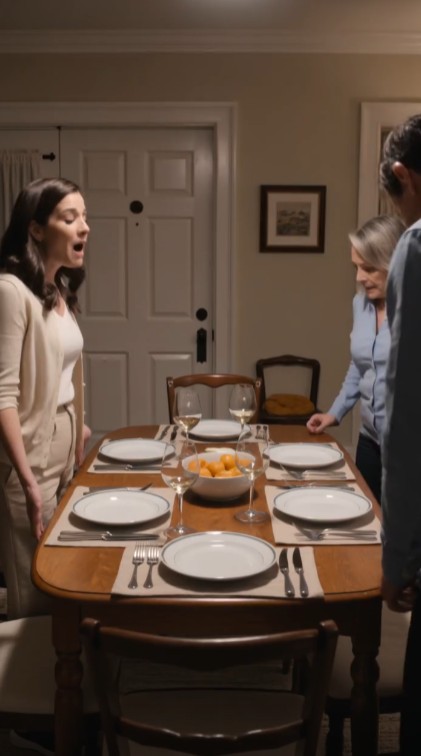
Every Sunday for eighteen years, Claire’s mother cooked dinner for four people.
There were only three people in the family.
Claire.
Her younger brother, Michael.
And their mother, Helen.
But the fourth plate was always there.
Same chair.
Same place at the table.
A fork on the left.
A glass above the knife.
A folded napkin.
Nobody ever sat there.
When Claire was little, she asked about it constantly.
“Mom, who’s that for?”
Helen always gave the same answer.
“Someone who might come.”
Michael used to laugh.
“What if they never come?”
Helen would smile.
“Then we still had room for them.”
As children, Claire and Michael eventually accepted it as one of their mother’s strange habits.
Every family had those.
Or so they thought.
Years passed.
Claire went to college.
Michael moved out.
Their father had died when they were young, and Sunday dinner slowly became one of the few traditions that remained unchanged.
Even when Claire could only come home once a month, Helen still set four places.
Even after Michael married, there were still four original plates before extra settings were added.
Always that same chair.
Always empty.
Then one Sunday, Claire finally had enough.
She was forty years old.
Michael was sitting across from her.
Helen had just placed a bowl of potatoes on the table.
Claire looked toward the empty chair.
“Mom.”
Helen stopped.
“Enough.”
Michael glanced at his sister.
Claire pointed at the fourth plate.
“We’ve been doing this for eighteen years.”
Helen’s expression changed.
“Who are we waiting for?”
Silence.
“Please.”
Helen stared at the untouched plate.
Then, for the first time Claire could remember, she picked it up.
She carried it back toward the kitchen.
“No one anymore.”
Claire froze.
Michael frowned.
“What does that mean?”
Helen placed the plate on the counter.
“Nothing.”
Claire stood.
“After eighteen years you suddenly stop?”
Helen wouldn’t look at her.
“Why now?”
No answer.
Then the doorbell rang.
Michael tried to break the tension.
“Well.”
He smiled.
“Maybe your mystery guest finally came.”
Helen went completely still.
Not surprised.
Terrified.
Claire noticed immediately.
“Mom?”
The bell rang again.
Claire walked toward the door.
A woman about her age stood outside.
She looked nervous.
She held a handbag tightly against her chest.
“I’m sorry,” the woman said. “I think I have the wrong house.”
Claire glanced at the number beside the door.
“What address are you looking for?”
The stranger showed her a folded piece of paper.
Claire read it.
Her house.
Exactly.
“Who are you looking for?”
The woman hesitated.
Then gave Helen’s full name.
Behind Claire came the sound of breaking china.
She turned.
Helen had dropped a plate.
The woman outside looked past Claire.
Her eyes met Helen’s.
Neither moved.
Then the stranger whispered:
“You still set four places?”
Claire slowly turned toward her mother.
“Mom…”
She looked back at the woman.
“She knows about the plate?”
Helen sat down.
Michael entered the hallway.
“What happened?”
Then he noticed the stranger.
“Who is she?”
The woman opened her handbag.
Claire expected a photograph.
Maybe an old letter.
Instead, the woman removed a brass key.
She held it out.
Claire recognized it instantly.
It was old.
But it was the same style as the original key to their front door.
Michael stared at it.
“Why does a stranger have a key to our childhood home?”
Helen finally looked at them.
“Because she isn’t a stranger.”
The woman’s eyes filled.
Helen swallowed.
“Her name is Laura.”
Claire waited.
Helen’s voice became almost inaudible.
“She’s your sister.”
Nobody spoke.
Michael laughed once.
“What?”
Claire stared at her mother.
“We don’t have a sister.”
Helen looked toward Laura.
“Yes.”
“You do.”
Laura stepped inside.
For several seconds, the four of them stood in the hallway.
Claire felt as though she had entered someone else’s family.
“You’re saying she’s Dad’s daughter?”
Helen shook her head.
“No.”
Claire’s confusion deepened.
“Yours?”
Helen nodded.
Michael sat down.
Laura remained near the door.
She seemed ready to leave.
“I shouldn’t have come.”
Helen immediately stood.
“No.”
For the first time since Laura arrived, Helen moved toward her.
“You should have come years ago.”
Laura looked at the dining room.
“I tried.”
Helen closed her eyes.
Claire caught that sentence.
“Tried?”
Laura looked at Helen.
“You want to tell them?”
Helen nodded slowly.
Then she began.
Before Claire and Michael were born, Helen had been nineteen years old.
She was unmarried.
Still living with her parents.
When she became pregnant, the reaction in her family was immediate.
Her parents believed she had ruined her future.
The baby’s father left before Laura was born.
Helen had no money.
No job.
No place of her own.
Her parents gave her a choice.
Either they would help arrange an adoption, or Helen would have to leave their home.
Claire stared at her mother.
“What did you do?”
Helen looked at Laura.
“I was nineteen.”
Her voice broke.
“And I was afraid.”
Laura was adopted by another family when she was only weeks old.
Helen signed the papers.
Then spent decades wondering whether she had made the worst decision of her life.
Several years later, Helen met the man Claire and Michael knew as their father.
They married.
Built a home.
Had two children.
But Helen never told them about Laura.
Michael looked angry.
“Dad knew?”
“Yes.”
Claire whispered:
“He knew we had a sister?”
Helen nodded.
“He was the only person I told.”
Claire looked toward the empty chair.
“Was that for Laura?”
Helen wiped her eyes.
“Not at first.”
The fourth plate began eighteen years earlier.
That was when Helen received her first letter from Laura.
Laura had turned twenty-two.
Her adoptive parents had told her what they knew about her biological family.
Eventually, she found Helen’s address.
She wrote a letter.
Not accusing.
Not angry.
Just one question:
Would you ever want to meet me?
Helen answered yes.
They began corresponding privately.
Claire stared at her.
“For eighteen years?”
Helen shook her head.
“No.”
The correspondence lasted only a few months.
Helen sent photographs.
She told Laura about Claire and Michael.
She told her about Sunday dinners.
Then Laura asked if she could visit.
Helen agreed.
They chose a Sunday.
Seven o’clock.
Helen cooked dinner.
She set four places.
Then she waited.
Laura never arrived.
Helen thought she had changed her mind.
The next Sunday, Helen set the plate again.
Just in case.
Then the next.
And the next.
Weeks became months.
Months became years.
Claire looked at Laura.
“Why didn’t you come?”
Laura took a slow breath.
“Because I got scared.”
She had driven all the way to the street.
She parked nearby.
She could see the house.
Through the front window, she saw Helen moving around the dining room.
Then she saw Claire and Michael.
Children.
Laughing.
Setting the table.
Laura suddenly felt like an intruder.
“I thought you already had a family.”
Helen covered her face.
Laura continued.
“I thought walking through that door would destroy something.”
So she left.
She wrote another letter.
But it never reached Helen.
Laura had sent it to an old post office box Helen stopped using.
Then Laura moved.
Helen wrote to the address she had.
Those letters were returned.
They lost each other.
For eighteen years.
Michael looked at the key in Laura’s hand.
“Then how do you have that?”
Laura stared down at it.
“That’s the strange part.”
Helen immediately knew.
“Your father.”
Laura nodded.
Claire looked between them.
“Our dad gave her the key?”
Helen began crying.
Years earlier, after Laura failed to arrive, Claire and Michael’s father had tried to find her.
Helen didn’t know.
He believed Helen was too hurt to keep searching.
Using the information from Laura’s letters, he eventually found her adoptive family.
By then, Laura had moved again.
So he wrote one final letter.
He included the spare house key.
His message was simple:
If you ever decide you’re ready, you don’t need permission to knock.
You already have a place here.
Claire looked toward the dining room.
Michael whispered:
“Dad did that?”
Laura nodded.
“I received it after he died.”
Her adoptive mother had found the envelope among old forwarded mail.
By the time Laura opened it, Claire and Michael’s father had already passed away.
She wanted to contact Helen.
But again, she hesitated.
Years passed.
She married.
Had a child.
Divorced.
Lost her adoptive mother.
And every major change seemed to make the unanswered question heavier.
Then, several months earlier, Laura found Helen online.
She discovered she still lived in the same house.
She drove past twice.
Never stopped.
Until that Sunday.
Claire looked at her mother.
“But why did you remove the plate today?”
Helen stared at the broken pieces of china on the floor.
“Because yesterday was the anniversary of your father’s death.”
Claire waited.
Helen explained.
For eighteen years, she had set the fourth place partly for Laura.
And partly because her husband had always believed Laura might still arrive.
Every Sunday he used to say:
“Leave it. Maybe this is the week.”
Even after he died, Helen continued.
But the night before Laura appeared, Helen had finally told herself she needed to stop waiting for something that would never happen.
“For the first time,” Helen whispered, “I decided the chair should be empty because nobody was coming.”
Then Laura rang the bell.
Michael laughed softly.
“Your timing is terrible.”
Laura smiled through tears.
“I think that runs in the family.”
Nobody knew what to say next.
Then Claire walked into the dining room.
She picked up another plate.
She set it in front of the empty chair.
Laura watched.
Claire pulled the chair back.
“You might as well sit.”
Laura looked at Helen.
Her mother nodded.
For the first time in eighteen years, somebody sat in the fourth chair.
Dinner was awkward.
There was no magical instant where thirty years of questions disappeared.
Claire was angry.
Michael asked too many questions.
Laura sometimes answered.
Sometimes she couldn’t.
Helen apologized more than once.
At one point, nobody spoke for almost two full minutes.
Then Michael asked Laura:
“So what food do you hate?”
Everyone looked at him.
“What?”
He shrugged.
“If she’s our sister, we should know.”
Laura laughed.
“Peas.”
Claire stared.
“No way.”
Michael pointed toward her.
“Claire hates peas.”
“I do not hate peas.”
“You’ve been hiding them under potatoes since childhood.”
For the first time that evening, all four laughed.
It wasn’t forgiveness.
It wasn’t a complete family reunion.
But it was a beginning.
Over the following months, Laura visited again.
Then again.
Claire met Laura’s daughter.
Michael introduced her to his wife.
Helen showed Laura the letters she had kept.
Every one returned.
Every one unopened.
Laura showed Helen photographs from the childhood she had missed.
Eventually, they talked about the hardest question.
“Do you regret giving me away?”
Helen didn’t try to defend herself.
“Every day.”
Laura looked at her.
“I don’t regret my parents.”
Helen nodded.
“You shouldn’t.”
Both things could be true.
Laura had loved the family that raised her.
And Helen had loved the daughter she lost.
One truth didn’t erase the other.
Months later, Sunday dinner became a tradition again.
But something changed.
Helen no longer automatically set four places.
Sometimes there were five.
Sometimes seven.
Sometimes Laura couldn’t come.
Sometimes Michael brought his family.
Sometimes Claire invited a friend.
The chair stopped belonging to one absent person.
Then, on the first anniversary of Laura’s arrival, Claire noticed something beside the front door.
The old brass key.
Laura had placed it in a small frame.
Underneath was a handwritten note:
The key that took eighteen years to use.
Helen laughed.
“That’s not funny.”
Laura smiled.
“A little.”
Before dinner, Helen began setting the table.
She counted everyone.
Then added one extra plate.
Laura noticed.
“Who’s that for?”
Helen smiled.
“Someone who might come.”
Claire laughed.
“Mom.”
But this time, nobody asked her to remove it.
Because now they understood.
The fourth place had never really been about an empty chair.
It was about refusing to decide that a door had closed forever.
And after eighteen years of waiting, the person it had been saved for finally came home.