
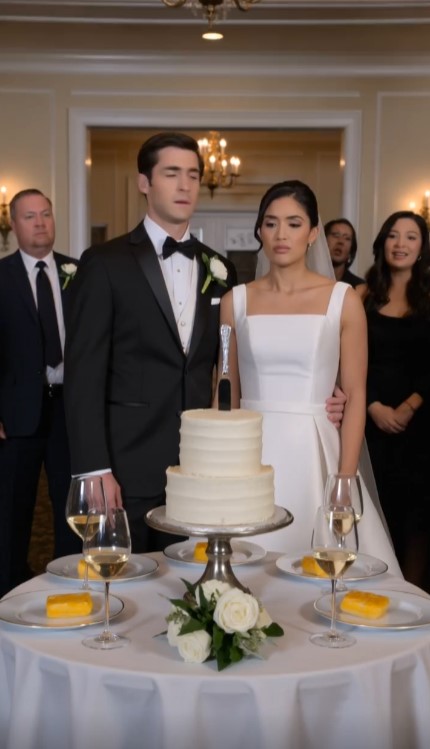
Everyone gasped when the groom’s grandmother stopped the wedding cake cutting.
The reception hall was glowing with soft lights. Guests stood around the dance floor with phones raised, ready to record the moment. The bride and groom stood beside a towering white wedding cake decorated with flowers, ribbons, and delicate gold trim.
It was supposed to be the sweetest part of the night.
The photographer counted down.
“Three… two… one…”
The groom placed his hand over the bride’s.
The knife touched the bottom layer.
Then an old woman’s voice cut through the room.
“Stop.”
Everyone turned.
The groom’s grandmother, Eleanor, was standing near the front table, one hand gripping her cane, her eyes fixed on the cake.
The bride froze.
The groom forced a nervous laugh.
“Grandma,” he said, “not now.”
But Eleanor stepped closer.
“Do not cut that cake.”
A few guests whispered. Someone chuckled awkwardly. The bride’s smile disappeared.
The groom lowered his voice.
“Grandma, please. Everyone is watching.”
But Eleanor was not looking at him.
She was staring at the bottom layer of the cake.
For forty years, Eleanor had worked in bakeries. She had made birthday cakes, wedding cakes, holiday pies, and pastries before most people in that room had even been born. She knew the smell of vanilla, almond, buttercream, fondant, fruit filling, and fresh sponge cake.
And she knew when something was wrong.
The caterer stepped forward quickly.
“Ma’am, everything is fine,” he said. “The cake was delivered safely.”
Eleanor did not move.
“No,” she said quietly. “It smells sour.”
The room went silent.
The bride’s mother gasped.
The groom looked embarrassed.
“Grandma, stop,” he said. “You’re ruining the moment.”
Eleanor turned to him with tired but steady eyes.
“I love you too much to care about a moment.”
Then she reached for the cake knife.
The bride pulled back.
“What are you doing?”
Eleanor gently took the knife from the table and cut into the bottom layer herself.
The caterer’s face changed.
“Please don’t touch that,” he said too quickly.
That was when several guests noticed his hands were shaking.
Eleanor cut deeper into the cake.
The first slice looked beautiful from the outside.
White frosting.
Soft sponge.
Perfect decoration.
But inside the bottom layer, something dark had spread through the filling.
A strange, spoiled smell rose into the air.
One bridesmaid covered her nose.
Another whispered, “What is that?”
Eleanor carefully lifted the slice onto a plate.
The cream inside was not fresh.
It was discolored, sticky, and wrong.
The caterer stepped back.
The bride’s father stared at him.
“What did you put in that cake?”
The caterer swallowed.
“I… I don’t know. It must have happened during transport.”
But Eleanor shook her head.
“No. This was hidden under the frosting.”
The room changed instantly.
The laughter vanished.
The phones lowered.
The groom looked from the cake to his grandmother, his face turning pale.
The hotel manager rushed over and ordered the cake removed from the serving table. A staff member checked the catering documents. Another employee called the kitchen.
Within minutes, the truth began to surface.
The cake had been damaged earlier that day when part of the bottom layer spoiled after being left unrefrigerated too long. Instead of replacing it, someone had covered the damaged section with extra frosting and decoration, hoping no one would notice before it was served.
But Eleanor noticed.
Not because she wanted attention.
Not because she was confused.
Because after forty years in bakeries, she knew the smell of a cake that could make people sick.
The groom stood frozen beside his bride.
“We were about to serve that to everyone,” he whispered.
There were children at the reception.
Elderly relatives.
Guests who had already eaten dinner and were waiting for dessert.
If Eleanor had stayed quiet, dozens of people might have eaten from that cake.
The bride slowly turned toward the caterer.
“You knew,” she said.
He looked down.
No one needed him to answer.
The bride’s eyes filled with tears, but this time they were not from embarrassment. She looked at Eleanor, who still stood beside the cake table holding the knife in one trembling hand.
“I thought you were ruining the wedding,” the bride whispered.
Eleanor’s expression softened.
“I was trying to protect it.”
The groom walked over to his grandmother and hugged her tightly.
“I’m sorry,” he said. “I should have listened.”
Eleanor patted his back.
“People don’t always like the person who stops the celebration,” she said. “But sometimes stopping is the only thing that saves it.”
The reception did not end.
The hotel brought fresh desserts from its own kitchen. Guests were served fruit, pastries, and small cakes instead. The music started again slowly. People returned to their tables, shaken but grateful.
But the mood had changed.
Every guest knew what had almost happened.
Later that evening, the bride and groom stood with Eleanor for a new photo. There was no grand cake behind them anymore. No perfect staged moment. Just a young couple holding hands with the old woman who had been brave enough to interrupt them.
The photographer captured it anyway.
And years later, that became the picture they loved most.
Not the cake cutting.
Not the decorations.
Not the expensive flowers.
The photo of the grandmother who trusted her instincts when everyone else cared only about appearances.
Sometimes love does not look polite.
Sometimes it interrupts.
Sometimes it embarrasses people for a moment to protect them from something worse.
And sometimes, the person everyone thinks is ruining the wedding is the only one saving every guest in the room.