
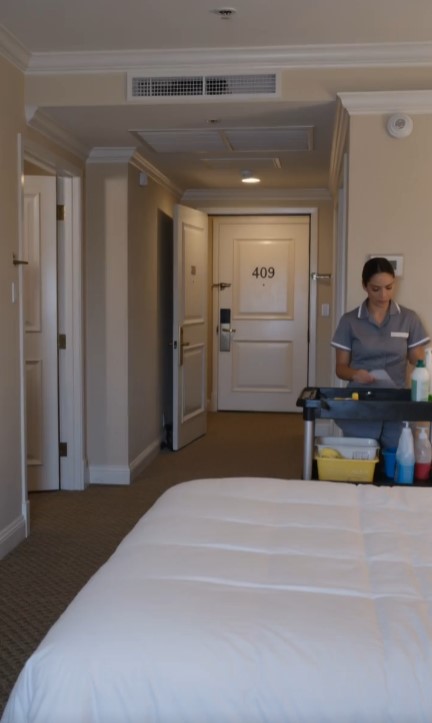
A hotel housekeeper refused to clean room 409.
The guest had already checked out.
The bed was made.
The towels were folded.
The bathroom sink was dry, the mirror was clean, and not a single suitcase or jacket had been left behind. To anyone else, the room looked ready for the next guest.
But Rosa did not move.
She stood just inside the doorway with her cleaning cart behind her, staring at the closet door.
Something felt wrong.
Not because the room was messy.
Because it was too quiet.
The hotel manager stepped into the hallway, holding a clipboard and looking impatient.
“Rosa,” he said, “we need this room ready. We’re fully booked tonight.”
Rosa nodded slowly, but her eyes stayed on the closet.
“The guest left early?” she asked.
“Yes,” the manager said. “Paid cash. Checked out at the desk. Hurry, please.”
Rosa had cleaned hotel rooms for twelve years. She knew the difference between an empty room and a room that felt empty on purpose.
This one felt wrong.
The manager sighed.
“Rosa, there is nothing in there. Please start cleaning.”
Then she saw it.
A tiny piece of paper sticking out from under the closet door.
At first, it looked like trash.
A torn receipt, maybe.
A luggage tag.
Something a guest had dropped.
But Rosa bent down and pulled it gently.
Her hands froze.
Three words were written in shaky handwriting:
“Please don’t leave.”
The manager’s face went pale.
For one second, neither of them spoke.
Then Rosa whispered, “Open the closet.”
The manager reached for the handle, but Rosa stopped him.
“Call security first.”
Within minutes, two security guards arrived. One stood by the door while the other carefully opened the closet.
At first, they saw only spare blankets.
Extra pillows.
A folded ironing board.
Then one blanket moved.
Everyone froze.
Behind the stack, curled in the corner, was a little girl.
She was shaking, silent, and pressed so tightly against the wall that Rosa almost could not see her. Her cheeks were wet with tears. Her small hands clutched another piece of paper.
Rosa stepped forward slowly.
“It’s okay,” she whispered. “You’re safe now.”
The little girl did not answer.
She only looked at the open room door, terrified that someone might come back.
Security called police immediately.
The manager stood in the middle of the room, unable to speak. Minutes earlier, he had thought Rosa was wasting time. Now he stared at the closet as if the whole room had changed shape in front of him.
The little girl’s name was Lily.
She had been reported missing earlier that morning from a nearby bus station. Police later learned that the man who checked into room 409 was not her father. He had brought her into the hotel overnight, then left alone after realizing authorities were searching the area.
He thought nobody would check the closet carefully.
He thought a quiet child would stay hidden.
He thought the room would be cleaned quickly and the evidence would disappear.
But he did not count on Rosa.
The housekeeper noticed the silence.
The paper.
The fear hidden in a room that looked perfectly clean.
When police carried Lily downstairs wrapped in a blanket, hotel staff stood frozen in the lobby. Guests who had complained about waiting for rooms lowered their voices. The manager walked beside Rosa and whispered, “I told you to hurry.”
Rosa looked at the little girl in the officer’s arms.
“You were looking at a room,” she said softly. “I was looking for what didn’t belong.”
Later, Lily’s mother arrived at the hotel, sobbing before she even reached the front doors. When she saw her daughter alive, she collapsed to her knees and held her so tightly that everyone nearby began to cry.
Lily pointed weakly toward Rosa.
“She read my note,” she whispered.
Her mother turned to Rosa and took both of her hands.
“Thank you for not leaving.”
Rosa could barely answer.
Because the truth haunted her.
She had almost walked away.
She had almost started with the bed, the towels, the bathroom, the ordinary things.
But something about that closet had made her stop.
The hotel changed its rules after that day. Every room had to be checked fully before cleaning. Every closet, bathroom, balcony, and storage area. Staff were trained to treat even the smallest sign as important.
But Rosa did not need training to remember.
She kept a copy of the note in her locker.
Not to scare herself.
To remind herself.
Sometimes danger hides in places that look clean.
Sometimes fear is too quiet to hear.
Sometimes a child cannot scream, so she pushes one tiny message under a door and hopes someone will care enough to read it.
Everyone thought Rosa was refusing to work.
But she was doing the most important work of all.
She noticed the child everyone else missed.