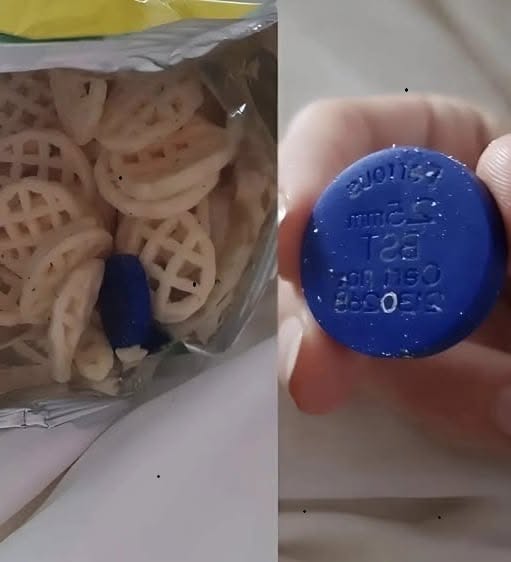
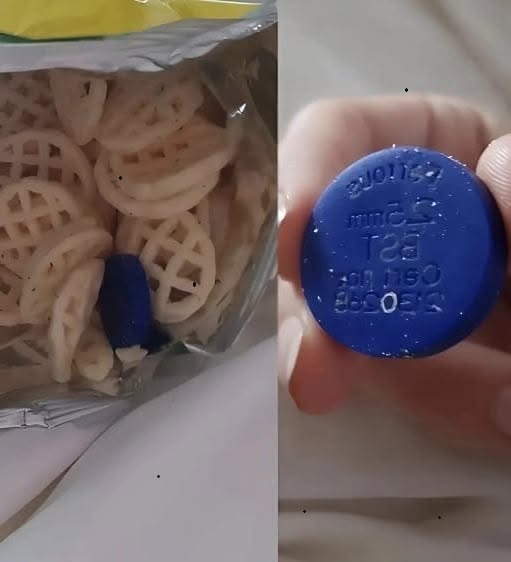
Woman Finds Mysterious Blue Disk Inside a Bag of Chips — Its Real Purpose Surprises Everyone
Opening a fresh bag of potato chips usually comes with few surprises, but one parent was left confused and concerned after discovering a small blue disk mixed in with the snack.
The unfamiliar object was found inside a bag of sour cream-flavored potato chips. It clearly did not look like food, seasoning, or ordinary packaging material, so the parent immediately stopped anyone from eating more of the chips.
At first glance, the strange blue object raised understandable concerns.
Was it a broken part from a factory machine? Could it contain something harmful? Had something gone wrong during production?
Rather than taking a chance, the parent photographed the object and shared the image online in hopes that someone might recognize it.
The explanation turned out to be far different from what many people expected.
The mysterious disk was identified as a food-production testing device — specifically, a plastic-encased metal test piece used to check whether metal-detection equipment on a manufacturing line is working correctly.
Food factories rely on a wide variety of machinery to prepare and package products. Conveyors, slicers, mixers, seasoning systems, and sealing machines can all contain metal components.
Because of that, manufacturers use detection systems designed to identify unwanted pieces of metal before food reaches consumers.
But those detectors also have to be tested regularly.
That is where objects like the blue disk come in.
The test piece contains a small amount of metal specifically designed to trigger the detector as it passes through the production line.
If the machine recognizes the disk, workers know the system is responding properly.
If it does not, employees can stop the process and inspect or recalibrate the equipment before production continues.
Normally, the test piece is introduced during a safety check and then recovered by factory workers.
In this case, however, the disk apparently continued through the production process and accidentally ended up inside the finished bag of chips.
That mistake explains why something designed to improve food safety unexpectedly became the mysterious object that alarmed a consumer.
The bright blue casing also serves a purpose.
Testing devices used in food factories are often made in noticeable colors so workers can easily distinguish them from food, machinery, and other objects on a busy production line.
Their appearance can vary.
Some may look like disks, while others can resemble sticks, cards, balls, or narrow strips depending on the type of equipment being tested.
For consumers who have never seen one before, however, finding such an object inside sealed food can understandably be unsettling.
The parent’s decision to stop eating from the bag was therefore a reasonable precaution while the object was being identified.
According to the account, the blue disk itself was not designed to release chemicals or other substances into the chips. Its metal component was enclosed in plastic and existed specifically as part of the factory’s quality-control procedure.
Still, it was never supposed to remain inside the finished package.
The unusual discovery offers a glimpse into a part of food production most shoppers never see.
Before packaged snacks reach store shelves, they can pass through numerous inspections.
Manufacturers may check package weight, seals, appearance, freshness, and possible physical contaminants.
Metal detection is another layer of that process.
Because detection equipment can lose sensitivity or require adjustment over time, simply installing a detector is not enough.
Factories periodically challenge the system with known test pieces to confirm that it can still identify metal reliably.
The process is similar to testing an alarm rather than simply assuming it will work when needed.
The irony of this particular discovery is that an object designed to help prevent foreign metal from reaching consumers became a foreign object inside the package itself.
Fortunately, once the disk was identified, what initially appeared mysterious and potentially alarming had a much more ordinary explanation.
It was not a piece of food.
It was not supposed to be inside the bag.
And its presence indicated that something had gone wrong when the test device was not removed after the safety check.
But the reason the disk existed in the first place was to help protect consumers by making sure metal-detection equipment was functioning correctly.
For anyone who discovers an unfamiliar object inside packaged food, the safest approach is still to stop eating the product, keep the packaging and contact the manufacturer for guidance rather than assuming the object is harmless.
In this case, however, the strange blue disk turned an alarming snack-time discovery into an unexpected lesson about the hidden safety checks taking place behind factory walls.
What looked like a mysterious contaminant was actually part of a system designed to detect contaminants before they ever reach a customer.
Sometimes the strangest thing you find inside a package has a story that begins long before the bag ever reaches the store shelf.