
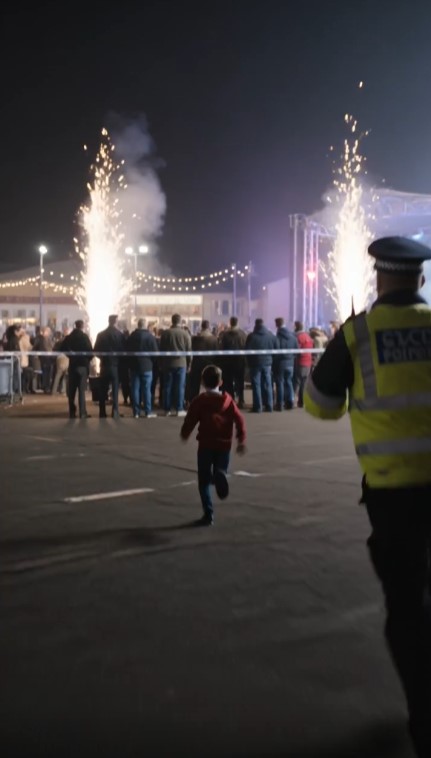
Everyone screamed when a little boy ran toward the fireworks stage.
The town park was packed that night. Families sat on blankets across the grass, children waved glow sticks in the air, and vendors sold popcorn and cotton candy near the walking path. Everyone had come for the annual summer fireworks show.
It was supposed to be the happiest night of the year.
A large stage had been set up near the field, with speakers, lights, and rows of secured fireworks boxes behind a safety barrier. Technicians moved quickly, checking wires and equipment while security guards kept the crowd at a distance.
Then, just minutes before the show began, a little boy suddenly broke away from his father.
His name was Caleb.
He was only eight years old.
He ran straight toward the fireworks stage.
His father shouted, “Caleb! Stop!”
A security guard turned and rushed after him.
People nearby gasped. Some parents pulled their children back. A few teenagers laughed, thinking the boy was trying to get attention.
“Get him away from there!” someone yelled.
The announcer on stage paused mid-sentence.
Caleb did not stop.
He kept running toward one box near the side of the stage, pointing with both hands.
“It’s smoking!” he cried.
But the crowd was too loud.
The music was playing.
People were shouting.
Security reached him and grabbed him by the shoulders before he could get any closer.
“You can’t be here,” the guard said firmly. “This area is dangerous.”
Caleb struggled to point past him.
“That box!” he shouted. “It’s smoking!”
His father arrived, breathless and terrified.
“What were you thinking?” he cried, pulling Caleb close. “You could have been hurt!”
But Caleb kept shaking his head.
“I saw smoke,” he whispered. “Nobody looked.”
At first, nobody believed him.
The box sat near the stage behind a line of equipment. From the crowd, it looked normal. A technician had checked that section only minutes earlier. The guards had been watching the barrier. The adults assumed a child had panicked or imagined something.
Then Caleb pointed again.
“There,” he said. “Behind the black case.”
One technician finally turned.
He walked toward the box slowly, more to calm the boy than because he expected danger.
Then he stopped.
A thin line of smoke was curling from the side.
His face went pale.
“Shut it down,” he shouted.
The other technicians froze.
“What?”
“Shut it down now!”
The music stopped.
The announcer lowered the microphone.
Security guards began pushing people farther back from the field.
“Everyone move back calmly,” one guard ordered. “Move back now.”
The crowd changed instantly.
No more laughter.
No more complaints.
No more people calling Caleb a troublemaker.
The technician knelt near the smoking box and checked the wiring. His hands moved quickly, but carefully. Another worker brought a flashlight.
Then they saw it.
The wrong fuse had been connected.
One line had crossed into the wrong firing sequence, and a small spark had begun heating near the edge of the box. If the show had started as planned, that one mistake could have triggered fireworks too close to the stage.
Too close to the technicians.
Too close to the crowd.
The technician stepped back, shaken.
“That kid just saved us time we didn’t know we needed,” he said.
Caleb stood beside his father, trembling.
His father’s anger disappeared.
He knelt in front of him and held his face gently.
“You really saw it?” he whispered.
Caleb nodded, tears in his eyes.
“I tried to tell you.”
His father pulled him into his arms.
“I’m sorry,” he said. “I should have listened.”
Fire officials arrived and inspected the entire setup before anything continued. The crowd waited behind the new safety line while technicians disconnected the damaged section and removed the unsafe box.
The delay lasted nearly an hour.
But no one complained anymore.
People kept looking at Caleb.
The same boy they had shouted at.
The same boy security had chased.
The same boy everyone thought was ruining the show.
He had noticed the danger every adult missed.
Later, the fire chief walked over to Caleb and crouched beside him.
“You did the right thing,” he said. “You spoke up when something looked wrong.”
Caleb wiped his face with his sleeve.
“Everyone was mad.”
The fire chief nodded.
“Sometimes people get mad before they understand. That doesn’t mean you were wrong.”
When the show finally began, it was smaller than planned, but safer. The first firework rose into the sky and burst into gold above the park. Families cheered, but many parents held their children a little closer.
Caleb sat between his father’s knees on the grass, quiet now, watching the lights reflect in the sky.
His father leaned down and whispered, “You saved people tonight.”
Caleb looked at the stage.
“I just saw smoke,” he said.
But sometimes that is all it takes.
One child looking where adults stopped looking.
One small voice speaking up while everyone else was distracted.
One brave moment that turns anger into gratitude.
The next day, the town shared Caleb’s story everywhere. People called him a hero, but his father remembered something more important.
Before the applause, there had been yelling.
Before the praise, there had been doubt.
Before everyone believed him, Caleb had stood alone pointing at danger.
Sometimes heroes are not the people standing on the stage.
Sometimes they are the ones running toward it, scared but certain, because they noticed the one thing everyone else missed.
And sometimes, the child everyone tries to stop is the reason everyone gets to go home safely.