
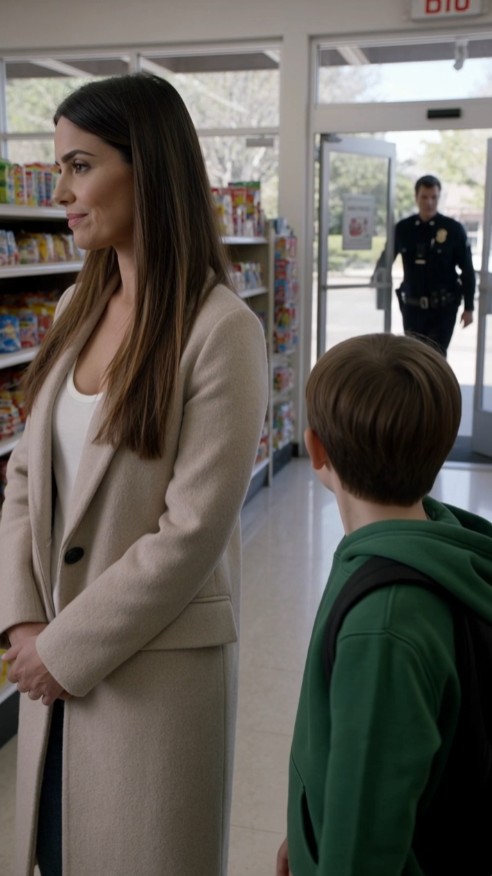
The little boy stopped walking the moment the police officer entered the grocery store.
Seven-year-old Oliver Bennett had been helping his mother choose cereal when he suddenly grabbed her coat.
“Mom.”
His voice was barely a whisper.
Sarah Bennett looked down.
“What is it, sweetheart?”
Oliver stepped behind her.
His eyes were fixed on the uniformed man standing near the checkout counter.
“That’s the man from Grandma’s house.”
Sarah frowned.
“What man?”
Oliver pointed.
“The one who came the night Grandma disappeared.”
Sarah felt her stomach tighten.
Her mother, seventy-three-year-old Margaret Bennett, had vanished eleven days earlier.
Police had searched her home, interviewed neighbors, and examined nearby roads.
But nobody knew where she’d gone.
The officer turned toward them.
His name badge read HAYES.
He was tall, gray-haired, and appeared to be in his late fifties.
When Oliver pointed at him, his expression changed.
“Is there a problem?”
Sarah hesitated.
“My son says he saw you at my mother’s house.”
The officer forced a smile.
“Children sometimes get confused.”
Oliver shook his head.
“No.”
He reached into his school backpack.
Then pulled out an old photograph he’d found inside his grandmother’s kitchen drawer.
It showed a much younger Officer Hayes standing beside Margaret.
Both were smiling.
The photograph appeared to have been taken twenty years earlier.
Sarah stared.
She had never seen it before.
Then Oliver turned it over.
Four words were written across the back in his grandmother’s familiar handwriting.
DON’T TRUST OFFICER HAYES.
The officer stopped smiling.
Sarah looked directly at him.
“Why did my mother write this?”
Hayes glanced toward the store entrance.
Then said quietly:
“Because she knew what happened to your father.”
Sarah went completely still.
Her father had died twenty years earlier.
At least, that was what she’d always believed.
And suddenly, her mother’s disappearance became part of a much older mystery.
The Grandmother Who Never Missed Sunday Dinner
Margaret Bennett had lived in the same small house on Willow Creek Road for more than forty years.
She was a retired school librarian who loved gardening, crossword puzzles, and baking apple pies.
Her neighbors described her as quiet but friendly.
She attended church every Sunday, volunteered at the community library, and rarely traveled without informing her family.
Oliver adored her.
Every Wednesday after school, he visited Margaret for homemade cookies and board games.
She taught him how to grow tomatoes.
Helped him with reading.
And told him stories about the town when she was young.
Eleven days before the encounter at the grocery store, Margaret disappeared.
Sarah had arrived for their usual Sunday dinner and found the front door unlocked.
Her mother’s handbag was sitting on the kitchen table.
Her coat was hanging beside the door.
But Margaret was gone.
The house showed no obvious signs of forced entry.
Her phone remained beside the sofa.
And her car was still in the driveway.
Sarah immediately contacted the police.
The Officer Who Took the Missing-Person Report
Officer Richard Hayes was one of the first officers assigned to Margaret’s disappearance.
He had worked in the local police department for almost thirty years.
He knew many families in the community.
He was also familiar with Margaret.
When Sarah reported her mother missing, Hayes visited the house and asked several questions.
Did Margaret have medical problems?
Had she recently been upset?
Was there anyone she might have visited?
Sarah answered as carefully as possible.
Her mother was generally healthy and lived independently.
She had no plans to travel.
And she wouldn’t leave without telling someone.
Hayes listened.
Then suggested Margaret might have gone away voluntarily.
“Older people sometimes make unexpected decisions,” he said.
Sarah found the explanation strange.
Her mother had never behaved that way.
But Hayes reassured her that officers would investigate.
What Sarah didn’t know was that Hayes had visited Margaret’s house the evening before she disappeared.
And Oliver had seen him.
The Night Oliver Couldn’t Forget
Oliver had been staying at his grandmother’s house that Saturday.
Sarah was working an evening shift at the hospital.
Margaret made dinner, helped Oliver with his homework, and allowed him to watch a cartoon before bed.
At approximately 8:30 p.m., someone knocked at the door.
Oliver was sitting on the living room floor.
He remembered hearing his grandmother’s voice.
“Richard?”
Then a man answered.
“We need to talk.”
Oliver looked toward the hallway.
He saw a tall man wearing a dark jacket.
The man had gray hair and a serious expression.
Margaret seemed frightened.
She asked Oliver to go upstairs.
He obeyed.
But from the landing, he heard raised voices.
Margaret said:
“You promised me this was over.”
The man replied:
“That depends on what you’ve found.”
Oliver didn’t understand.
A few minutes later, the front door closed.
Margaret came upstairs and hugged him tightly.
She told him everything was fine.
But Oliver remembered that her hands were trembling.
The Photograph Hidden in the Drawer
The morning Margaret disappeared, Oliver had been looking for a pencil in her kitchen.
He opened a drawer filled with old photographs and letters.
Inside was a picture of Margaret standing beside a younger Richard Hayes.
It looked unusual.
His grandmother rarely kept photographs of people outside the family.
Oliver turned it over.
He saw the words written on the back.
Don’t trust Officer Hayes.
He didn’t understand the message.
But he recognized the name.
He had heard his grandmother call the visitor Richard the previous evening.
Oliver slipped the photograph into his backpack.
He intended to ask Margaret about it later.
Then she disappeared.
For eleven days, Oliver carried the picture without telling anyone.
He was frightened.
And he wasn’t sure whether he’d done something wrong.
Until he saw Hayes at the grocery store.
The Father Sarah Had Lost Twenty Years Earlier
Sarah Bennett was thirty-nine years old.
Her father, David Bennett, had reportedly died in a boating accident when she was nineteen.
David worked as an accountant for a regional construction company.
He was careful, hardworking, and devoted to his family.
One evening, he left home to meet a business associate.
He never returned.
His vehicle was later found near a lake.
A damaged fishing boat was discovered along the shoreline.
Authorities searched for several days.
No body was recovered.
Eventually, David was presumed dead.
Sarah remembered the funeral.
Her mother’s grief.
And the way Richard Hayes had helped the family with official paperwork.
She had always believed Hayes was a trusted friend.
Now she was looking at a photograph warning her not to trust him.
And the officer himself had just mentioned her father’s death.
The Conversation That Changed Everything
Sarah stepped closer to Hayes.
“What did you mean about my father?”
He looked toward Oliver.
“Not here.”
Sarah shook her head.
“Then where?”
Hayes lowered his voice.
“Your mother found something she wasn’t supposed to find.”
Sarah felt her chest tighten.
“Where is she?”
Hayes didn’t answer.
He glanced toward the store entrance again.
Then said:
“Tell the detective handling her case to look at the old construction records.”
Sarah stared.
“What construction records?”
But Hayes was already moving toward the door.
Oliver grabbed his mother’s hand.
“Mom, he’s leaving.”
Sarah didn’t follow.
Instead, she contacted the detective assigned to Margaret’s case and explained what had happened.
The photograph.
The warning.
And the officer’s reference to David Bennett.
Within hours, investigators began examining a mystery that had remained buried for twenty years.
The Construction Company Nobody Questioned
David Bennett had worked for a company called North Valley Development.
It operated across several counties, building roads, bridges, and commercial properties.
During the late 1990s and early 2000s, the company received several lucrative public contracts.
David handled financial reports.
He reviewed invoices, payment records, and subcontractor agreements.
Shortly before his disappearance, he discovered irregularities.
Several payments had been made to businesses that appeared to exist only on paper.
Other invoices included charges for work that had never been completed.
David began documenting the transactions.
He suspected that company executives were moving money through fraudulent contracts.
He also discovered unusual payments connected to local officials.
One name appeared repeatedly.
Richard Hayes.
At the time, Hayes was a younger officer assigned to investigations involving property crimes.
David believed Hayes had been helping protect people involved in the financial misconduct.
The Night David Disappeared
According to records later recovered by investigators, David had arranged to meet someone who claimed to possess additional evidence.
The meeting was scheduled near the lake.
David left home shortly after sunset.
He told Margaret he’d return before midnight.
But he never came home.
His vehicle was discovered the following morning.
The boating accident explanation quickly became accepted.
Yet several details remained unresolved.
David wasn’t known to take his fishing boat out at night.
The weather had been poor.
And witnesses reported seeing another vehicle near the lake.
Those observations were never fully explained.
Margaret questioned the official account.
But Hayes reassured her that investigators had found no evidence of foul play.
For years, she tried to accept it.
Then, shortly before her disappearance, she discovered something extraordinary.
The Letter Margaret Received
Three weeks before she vanished, Margaret received an envelope without a return address.
Inside was a handwritten letter.
It contained only a few sentences.
Margaret, I’m sorry I waited so long.
David didn’t die at the lake.
The people responsible are still protecting themselves.
If you want the truth, look for the blue ledger.
Margaret recognized the handwriting.
It belonged to a former employee of North Valley Development named Thomas Reed.
Thomas had worked with David.
He disappeared from the area shortly after the supposed boating accident.
Margaret believed he might know what happened.
She began searching through David’s old belongings.
And eventually, she found a small notebook containing financial references.
The notebook mentioned a blue ledger.
It also contained Hayes’s name.
Why Margaret Confronted Hayes
Margaret had known Richard Hayes for decades.
She once believed he was helping her family.
But after receiving Thomas’s letter, she began questioning that trust.
She arranged to meet Hayes at her home.
She wanted him to explain the old financial records.
Hayes arrived on Saturday evening.
Oliver witnessed part of the conversation.
Margaret confronted Hayes about David’s disappearance.
She asked whether the boating accident had been staged.
Hayes became defensive.
He insisted the case had been properly investigated.
But Margaret showed him the letter.
She told him she planned to speak with state investigators.
Hayes warned her to be careful.
Then left.
The following day, Margaret was missing.
And Hayes was among the first officers involved in searching for her.
The Blue Ledger
Investigators obtained access to the old company records.
Several files had been preserved in a storage facility after North Valley Development closed.
Among them was an inventory listing a blue accounting ledger.
The ledger itself wasn’t in the company’s archive.
But investigators discovered a reference to it in David’s handwritten notes.
The notebook contained several initials, account numbers, and payment dates.
Some entries corresponded to suspicious transactions.
Others appeared to involve payments to individuals outside the company.
One set of initials matched Richard Hayes.
Investigators began examining whether Hayes had received improper payments.
They also searched for Thomas Reed.
The man who had sent Margaret the letter.
His testimony could explain what happened twenty years earlier.
The Man Who Finally Came Forward
Thomas Reed was now sixty-seven and living in another state.
When investigators contacted him, he agreed to speak.
He admitted that he’d known about the financial misconduct at North Valley Development.
He also knew David had been investigating it.
According to Thomas, company executives were frightened that David would report the transactions to authorities.
They attempted to pressure him into remaining silent.
David refused.
Then he disappeared.
Thomas believed the boating accident had been staged.
He said Hayes had helped suppress information about suspicious vehicles seen near the lake.
But Thomas had been afraid to report his concerns.
Several people connected to the company held influential positions.
And he feared retaliation.
Years later, he regretted his silence.
So he wrote to Margaret.
He hoped the letter would encourage someone to reopen the investigation.
Where Margaret Had Gone
As investigators examined the old records, they also reviewed Margaret’s recent movements.
A security camera near a bus station showed her entering a vehicle with another woman.
The woman was identified as Linda Foster, a retired social worker and longtime friend.
Police contacted Linda.
She explained that Margaret had asked for help after receiving threatening messages.
The messages warned her to stop investigating David’s disappearance.
Margaret feared that someone was watching her home.
She decided to leave temporarily and stay with Linda.
But she made a serious mistake.
She didn’t tell Sarah.
Margaret believed that keeping her daughter uninformed would protect her.
Linda confirmed that Margaret was staying at her house.
She was alive.
And she wanted to speak with investigators.
The Phone Call Sarah Had Been Waiting For
Sarah was sitting at her kitchen table when the detective called.
Oliver was doing homework nearby.
The detective spoke carefully.
“Sarah, we’ve located your mother.”
Sarah froze.
“Is she alive?”
“Yes.”
Tears filled her eyes.
“Where is she?”
“She’s safe. We’re arranging for you to speak with her.”
Sarah covered her mouth.
For eleven days, she’d imagined terrible possibilities.
Now her mother was alive.
When Margaret’s voice came through the telephone, Sarah began crying.
“Mom?”
“Sarah.”
“Why did you leave?”
Margaret hesitated.
“I was scared.”
Sarah wiped her cheeks.
“You should’ve told me.”
“I know.”
Then Margaret whispered:
“I’m sorry, sweetheart.”
The Reunion Oliver Never Forgot
Two days later, Margaret returned home.
Sarah and Oliver were waiting.
When the front door opened, Oliver ran toward her.
“GRANDMA!”
Margaret knelt carefully.
He wrapped his arms around her.
“I thought you were gone forever.”
She held him tightly.
“I’m here.”
Sarah approached.
For a moment, she simply stared at her mother.
Then she embraced her.
“I was so worried.”
Margaret began crying.
“I know.”
Oliver reached into his backpack.
He removed the old photograph.
“Grandma, I found this.”
Margaret stared at it.
Then turned it over.
When she saw the warning, her expression changed.
“Where did you get that?”
“In your drawer.”
He looked toward her.
“Was Officer Hayes bad?”
Margaret took a breath.
“He’s someone the police need to ask important questions.”
She hugged Oliver again.
“And you did the right thing telling your mom what you saw.”
The Secret Hayes Had Been Hiding
Investigators eventually questioned Hayes about his connection to North Valley Development.
Financial records showed that he had received payments from a company associated with its executives.
The transactions occurred during the period surrounding David’s disappearance.
Hayes initially claimed the money came from legitimate consulting work.
But investigators found no evidence of the services he described.
Additional records suggested that Hayes had interfered with aspects of the original investigation.
He had failed to document a witness statement about a vehicle near the lake.
And he had discouraged further examination of several financial leads.
The evidence raised serious concerns about official misconduct.
Hayes was suspended while authorities investigated.
The case was referred to prosecutors.
But one question remained.
What had actually happened to David Bennett?
The Truth About David
The renewed investigation uncovered evidence that David had been confronted near the lake by people connected to North Valley Development.
According to Thomas Reed, the meeting was intended to pressure David into surrendering financial documents.
An argument occurred.
David was threatened.
He escaped the immediate confrontation but disappeared afterward.
Investigators later discovered records suggesting that David had been transported to another location.
However, the evidence did not conclusively establish whether he survived for long after that night.
The original boating accident explanation was no longer considered reliable.
The case was reopened as a suspicious disappearance.
For Sarah, the findings were painful.
She had spent twenty years believing her father died in an accident.
Now she knew that important information had been concealed.
But she still didn’t have all the answers.
The Final Discovery in the Old House
Margaret remembered something David had said shortly before disappearing.
He told her that if anything happened, she should look beneath the old wooden staircase in their house.
At the time, she didn’t understand.
Years later, the remark had faded from memory.
But after the investigation reopened, she mentioned it to detectives.
With her permission, specialists examined the area.
Behind a removable wooden panel, they found a small metal box.
Inside were photocopies of financial documents.
Several photographs.
And a sealed envelope.
The envelope was addressed to Sarah.
Margaret began crying when she saw it.
David had left a letter for his daughter.
He apparently feared that exposing the financial misconduct could put him in danger.
The Letter Sarah Read Twenty Years Late
Sarah opened the envelope with trembling hands.
Inside was a handwritten letter.
My dearest Sarah,
If you’re reading this, something has gone wrong.
I want you to know that none of this is your fault.
I’ve discovered things at work that I cannot ignore.
I don’t know what will happen next, but I need to do what I believe is right.
Please look after your mother.
And never forget how proud I am of you.
Sarah stopped reading.
Tears streamed down her face.
She had been nineteen when David disappeared.
Now she was thirty-nine.
For two decades, she’d wondered what his final thoughts had been.
The letter didn’t explain everything.
But it gave her something she’d never expected to receive.
Her father’s words.
The Officer’s Final Admission
As the investigation continued, Hayes admitted that he had withheld information during the original case.
He acknowledged receiving improper payments connected to North Valley Development.
He also admitted discouraging witnesses from pursuing leads that might implicate company executives.
However, he denied participating directly in David’s disappearance.
Investigators continued examining his role.
The case resulted in disciplinary action and criminal proceedings connected to the documented misconduct.
Other individuals associated with the construction company were also investigated.
The renewed inquiry could not immediately establish every detail of David’s fate.
But it exposed serious failures in the original investigation.
For Margaret and Sarah, that mattered.
The truth was finally being examined rather than dismissed.
Why Margaret Wrote the Warning
The photograph Oliver found had been taken twenty years earlier.
It showed Margaret standing beside a younger Richard Hayes during a community fundraiser.
At the time, she believed Hayes was a family friend.
After David disappeared, she began questioning his involvement.
She wrote the warning on the back of the photograph during a period when she was collecting documents about the case.
Don’t trust Officer Hayes.
She kept the picture in a drawer with other records.
Over time, it became a reminder of her doubts.
When Oliver found it, he didn’t understand the history.
He only recognized the man he’d seen at his grandmother’s house.
That simple observation brought the warning back into the open.
The Boy Who Remembered a Face
Oliver’s account became an important part of Margaret’s missing-person investigation.
He remembered the man who visited her house.
He recognized him at the grocery store.
And he produced a photograph showing the officer had known his grandmother for decades.
But investigators did not rely solely on the child’s identification.
They examined records, interviewed witnesses, and reviewed communications.
The photograph established a historical connection.
It didn’t prove criminal conduct by itself.
Still, Oliver’s observation prompted Sarah to question Hayes directly.
And that confrontation led investigators toward the older case.
The boy hadn’t solved the mystery alone.
But he helped his family recognize that important information was missing.
The Family Begins Again
After Margaret returned home, Sarah made changes to help her feel safer.
They installed better exterior lighting.
They updated emergency contact information.
And they agreed that Margaret would always tell someone where she was going.
Margaret also began meeting regularly with Sarah and Oliver.
For years, she’d carried the burden of David’s disappearance alone.
Now she understood that hiding the truth had caused additional pain.
She apologized to Sarah.
Her daughter accepted the apology.
But she also explained how frightening those eleven days had been.
The two women began discussing David openly.
They shared memories.
Looked through old photographs.
And talked about the questions that remained unanswered.
The Last Photograph
Several months later, Oliver visited Margaret after school.
They sat at the kitchen table with a box of photographs.
Oliver found the picture of Hayes.
“Grandma?”
“Yes, sweetheart?”
“Why did you keep this?”
Margaret looked at the photograph.
“Because I wanted to remember something important.”
Oliver frowned.
“What?”
“That sometimes people aren’t who they seem.”
He considered that.
Then asked:
“Is that why you wrote the warning?”
Margaret nodded.
“Yes.”
Oliver looked toward another photograph.
It showed David standing beside Sarah when she was a teenager.
“Is that Grandpa?”
Margaret smiled.
“Yes.”
Oliver studied his face.
“He looks like Mom.”
Margaret laughed softly.
“He does.”
Then she began telling Oliver stories about the grandfather he’d never met.
What Really Happened to Margaret Bennett
The mystery began when seventy-three-year-old Margaret Bennett disappeared from her home.
Her seven-year-old grandson, Oliver, later recognized Officer Richard Hayes at a grocery store.
He remembered seeing Hayes visit Margaret the evening before she vanished.
Oliver also produced an old photograph showing Hayes beside Margaret twenty years earlier.
Across the back, Margaret had written a warning not to trust him.
The discovery prompted investigators to examine the disappearance of Margaret’s husband, David Bennett, who had been presumed dead after a boating incident two decades earlier.
David had been investigating financial misconduct at a construction company.
New evidence revealed that Hayes had concealed important information during the original investigation.
Margaret had recently received a letter raising questions about David’s fate.
After receiving threats, she temporarily stayed with a trusted friend without informing her family.
Investigators found her alive.
The renewed inquiry exposed improper payments, withheld evidence, and serious questions about David’s disappearance.
The Last Conversation
One evening, Sarah sat beside Margaret on the porch.
Oliver was playing in the garden.
The sun was setting behind the trees.
Sarah looked toward her mother.
“Do you think we’ll ever know exactly what happened to Dad?”
Margaret sighed.
“I hope so.”
Sarah nodded.
For a while, neither spoke.
Then Margaret said:
“I should’ve told you more.”
Sarah looked toward her.
“You were trying to protect me.”
Margaret shook her head.
“I was afraid.”
Sarah reached for her hand.
“We can be afraid together.”
Margaret smiled through tears.
Then Oliver ran toward them.
“Mom! Grandma! Look!”
He held a small wooden birdhouse he’d built at school.
Sarah smiled.
“That’s beautiful.”
Oliver placed it on the porch railing.
“Grandpa would’ve liked it, right?”
Margaret looked toward the little boy.
Then nodded.
“He would’ve loved it.”
Oliver smiled.
And for a moment, the family sat together in the fading evening light.
They still had questions.
They still carried grief.
But Margaret was home.
Sarah had begun learning the truth about her father.
And Oliver had discovered that speaking up when something feels wrong can matter.
A little boy recognized a police officer from the night his grandmother disappeared. When he showed his mother an old photograph with a handwritten warning, investigators uncovered a connection to his grandfather’s mysterious disappearance twenty years earlier.
The grandmother was eventually found alive, and the investigation exposed evidence that had been concealed for decades.
The photograph hadn’t answered every question.
But it helped reopen a story that had remained unfinished for far too long.
And the little boy who carried it in his backpack became the reason his family finally began asking the questions nobody wanted to answer.
Sometimes the smallest witness remembers the detail everyone else overlooks.
And sometimes, the truth begins with four words written on the back of an old photograph.