
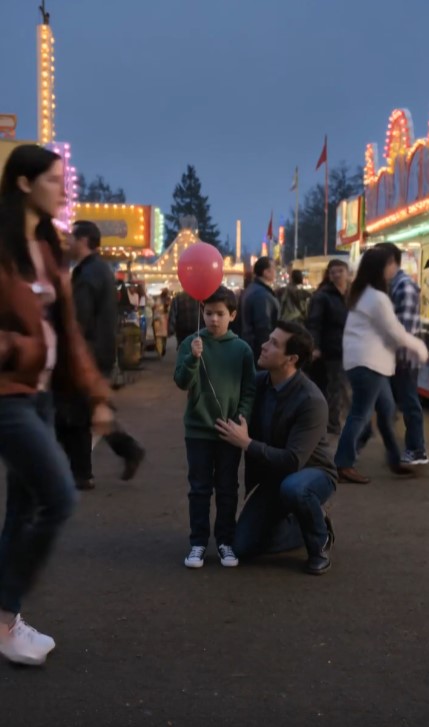
Everyone smiled when a little boy refused to let go of his red balloon.
The carnival was crowded that afternoon. Music played from the rides, children ran between game booths, and the smell of popcorn and cotton candy filled the air. Families moved shoulder to shoulder beneath strings of bright lights while workers called out prizes from every direction.
Noah stood near the carousel, holding the string of a red balloon tightly in one hand.
He was only seven years old.
His father, Mark, was trying to guide him through the crowd before the next show started.
“Come on, buddy,” Mark said. “We need to keep moving.”
But Noah did not move.
He stood frozen, staring at the balloon string.
At first, Mark thought his son was just being stubborn. The carnival was exciting, and Noah had already stopped three times to look at toy prizes, a magician, and a spinning ride shaped like rockets.
“Noah,” Mark said again, a little firmer this time. “Let’s go.”
But the boy lifted the string closer to his face.
“Dad,” he whispered, “something is on it.”
Mark looked down.
Wrapped around the balloon string was a tiny metal bracelet.
It was twisted tightly, almost hidden beneath the knot where the balloon had been tied. Mark frowned and reached for it.
“It’s probably trash,” he said.
He almost pulled it off and threw it away.
Then he saw the engraving.
Mia, age 6.
Mark’s hand stopped.
The crowd noise seemed to fade for one strange second.
Before he could say anything, a scream came from a few yards away.
“Mia!”
A woman near the ticket booth was crying, turning in circles, calling the same name again and again.
“My daughter! Has anyone seen my daughter?”
Mark looked at the bracelet.
Then at the woman.
Then at Noah.
“Noah,” he said slowly, “where did you get this balloon?”
Noah’s face was pale.
“It floated to me,” he whispered. “From over there.”
He pointed across the carnival grounds.
Past the food stands.
Past the game booths.
Toward the old funhouse near the edge of the lot.
The funhouse was not like the newer rides. Its paint was faded. One of the lights above the entrance flickered. A faded clown face smiled from the front sign, but the entrance was blocked by a rope because it was supposed to be closed for repairs.
Mark’s stomach tightened.
He walked quickly toward the crying woman.
“Ma’am,” he said, holding up the bracelet. “Is this your daughter’s?”
The woman froze.
Her knees nearly gave out.
“That’s Mia’s,” she whispered.
The carnival changed in an instant.
Security was called. Workers stopped the nearby rides. Parents pulled their children closer. The woman explained through tears that Mia had disappeared twenty minutes earlier while they were standing near the balloon booth.
She had been holding a red balloon.
Then the crowd shifted.
And Mia was gone.
Everyone had searched the obvious places — bathrooms, food stands, prize booths, the carousel line.
No one had looked inside the closed funhouse.
Noah still pointed at it.
“The balloon came from there,” he said.
Two security guards hurried toward the funhouse with Mark and Mia’s mother close behind. One guard lifted the rope and pushed the front door open.
The inside was dark.
Mirrors lined the narrow hallway, reflecting broken streaks of light. The air smelled dusty and damp. Somewhere deeper inside, a loose panel creaked in the wind.
“Mia!” her mother shouted.
For a moment, nothing answered.
Then came a tiny sound.
A weak cry.
“Mom?”
Mia’s mother screamed and tried to run inside, but the security guard held her back while another used a flashlight to search the hallway.
Behind a loose mirror panel near the back, they found a narrow maintenance space.
Mia was trapped inside.
She was sitting on the floor, shaking, her cheeks wet with tears. Her balloon string had caught on a broken nail near the panel. When she tried to pull free, her bracelet slipped off and tangled around the string. The balloon had later broken loose and floated back through the funhouse exit into the crowd.
Straight to Noah.
Mia had been too scared to scream loudly.
The carnival music had covered her cries.
People had walked past the closed funhouse again and again, never knowing a child was hidden inside.
But Noah had noticed the bracelet.
And he had refused to let go of the balloon.
Police arrived within minutes. Firefighters helped remove the loose panel safely, and Mia was carried out wrapped in her mother’s arms. She was frightened and dusty, but alive.
Her mother dropped to her knees in front of Noah, still holding Mia tightly.
“You found her,” she cried.
Noah looked down at the red balloon string in his hand.
“I just saw her bracelet,” he whispered.
Mark placed a hand on his son’s shoulder, his eyes full of tears.
“I almost threw it away,” he said.
That thought stayed with him.
A tiny bracelet.
A red balloon.
A child who stopped long enough to notice.
The carnival reopened later that evening, but the funhouse stayed closed. Workers inspected every old attraction. Security changed the way lost-child searches were handled. And the balloon booth tied every string shorter after that day.
But for Mia’s mother, none of that mattered as much as one little boy standing still in a moving crowd.
The next week, Mia’s family visited Noah with a small gift.
It was a new red balloon.
Tied to the string was a bracelet that said:
Thank you, Noah.
Mia smiled shyly and said, “My balloon found you.”
Noah smiled back.
“No,” he said softly. “It brought me to you.”
Sometimes heroes do not run into danger.
Sometimes they simply stop when everyone else keeps walking.
Sometimes they notice the small thing adults almost throw away.
And sometimes, a red balloon floating through a crowded carnival carries the only clue that brings a missing child home.