
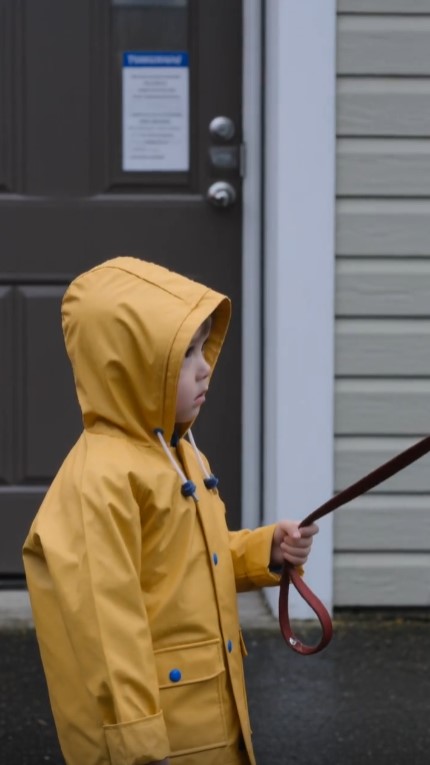
A little boy stood outside the animal shelter holding an empty leash.
Rain fell hard that afternoon, turning the sidewalk dark and shiny. Cars passed slowly along the road, splashing water near the curb. People hurried into the shelter with umbrellas, pet carriers, and bags of donated food.
Most of them walked past the boy without stopping.
He was small, maybe seven years old, wearing a soaked blue jacket and shoes filled with rainwater. His hair stuck to his forehead, and both hands were wrapped tightly around the handle of a red leash.
But there was no dog at the end of it.
Only an empty collar clip swinging in the rain.
A shelter worker named Maria noticed him from the front window.
At first, she thought he was waiting for a parent.
Then ten minutes passed.
Then twenty.
Still, the boy did not move.
Maria stepped outside with an umbrella.
“Sweetheart,” she said gently, “are you okay?”
The boy looked up at her, his lips trembling.
“I’m waiting,” he whispered.
Maria looked at the empty leash.
“Where is your dog?”
The boy turned and pointed toward the highway beyond the shelter parking lot.
“He told me to wait here.”
Maria’s heart tightened.
People nearby exchanged confused looks.
One woman whispered, “Poor thing. He’s scared.”
Another man said, “Maybe he lost his dog.”
Maria crouched in front of the boy.
“What’s your name?”
“Ethan,” he said.
“And your dog told you to wait here?”
Ethan nodded, completely serious.
“Buddy pulled me all the way here. Then he let go.”
Maria looked toward the road.
There was no dog.
Only rain, traffic, and the sound of tires on wet pavement.
She gently reached for the leash.
That was when she noticed something tied near the handle.
A small metal tag.
Not attached to a collar.
Tied to the leash with a piece of string.
Maria turned it over.
On one side was a name.
Buddy.
On the back was an address.
Her expression changed.
“Ethan,” she asked carefully, “is this your address?”
The boy shook his head.
“That’s Grandpa’s house.”
Maria stood up quickly.
Something about the situation no longer felt like a lost pet.
It felt like a message.
She brought Ethan inside, wrapped him in a dry towel, and called the police. The boy kept staring at the door, clutching the empty leash in both hands.
“He said wait,” Ethan whispered again.
An officer arrived within minutes and asked Ethan a few gentle questions.
The story came out slowly.
Ethan had been visiting his grandfather that morning while his mother was at work. His grandfather had gone into the kitchen to make tea. Then there was a loud sound.
Ethan found him on the floor.
He tried to wake him.
He tried to call for help, but he did not know how to unlock the phone.
Then Buddy, the family dog, started barking.
The dog grabbed the leash from the hook by the door and pushed it toward Ethan.
Ethan clipped it on because that was what Grandpa always did before walks.
Then Buddy pulled him outside.
Down the driveway.
Past the mailbox.
Along the sidewalk.
All the way toward the animal shelter.
The shelter was the place Buddy knew.
His grandfather had adopted him there years earlier.
Buddy had led the boy to the only place where people might understand an animal trying to ask for help.
But somewhere near the shelter, Buddy slipped free from the leash and ran back toward the house.
Maria looked at the officer.
“You need to go to that address.”
The officer radioed for a welfare check immediately.
When police reached the house, the front door was unlocked.
Inside, they found Ethan’s grandfather collapsed on the kitchen floor, barely conscious but still alive.
And at the back door, Buddy was scratching desperately, barking so hard his voice was almost gone.
He had returned to his owner.
But he had already done the most important thing.
He had taken Ethan somewhere safe.
Somewhere visible.
Somewhere someone would listen.
Paramedics rushed the grandfather to the hospital. Doctors later said he had suffered a medical emergency and that getting help quickly made all the difference.
Back at the shelter, Ethan sat in Maria’s office with a blanket around his shoulders.
When the officer returned and told him his grandfather was alive, Ethan began to cry.
“Buddy saved him?” he asked.
Maria knelt beside him.
“Buddy saved both of you.”
A little while later, another officer brought Buddy to the shelter.
The dog was soaked, muddy, and exhausted. His paws were dirty from running, and his chest rose and fell with heavy breaths.
The moment Ethan saw him, he dropped the blanket and ran.
“Buddy!”
The dog rushed into his arms, whining softly as Ethan buried his face in his wet fur.
“I waited,” Ethan cried. “I waited like you told me.”
Everyone in the shelter went silent.
Maria wiped her eyes.
The people who had walked past the boy earlier now stood frozen near the lobby, ashamed that they had seen only a wet child with an empty leash.
They had not seen the message.
They had not understood the dog’s plan.
But Buddy had understood enough.
He could not call 911.
He could not explain what happened.
So he led a frightened boy to the one place filled with people who knew animals sometimes speak without words.
Later, Ethan’s mother arrived at the shelter, crying before she even reached the door. She held her son tightly, then knelt beside Buddy and wrapped her arms around him too.
“You brought him here,” she whispered. “You knew.”
Buddy leaned against her, tired but calm.
As if his job was finally done.
When Ethan’s grandfather recovered, he asked to see Buddy before anyone else. The dog climbed carefully beside his hospital bed and rested his head near the old man’s hand.
The grandfather touched his ears with trembling fingers.
“Good boy,” he whispered. “You took care of him.”
Buddy closed his eyes.
The shelter later placed a small photo near the front desk.
It showed Ethan standing beside Buddy, holding the red leash that had once been empty.
Underneath, the staff wrote:
Sometimes an empty leash is not a sign of loss. Sometimes it is a message asking for help.
People still talked about that rainy day.
About the boy who waited.
About the dog who ran.
About the address on the tag.
And about the loyal animal who knew exactly where to take a child when the adults at home could no longer answer.
Sometimes heroes do not bark for attention.
Sometimes they pull a leash through the rain.
Sometimes they leave a child at the safest door they know.
And sometimes, the one who runs away is not abandoning anyone.
He is coming back with help.