
Richard had just ordered breakfast at a roadside diner when he noticed a newspaper on the table beside him.
He wasn’t particularly interested in the news.
He reached for his coffee, glanced at the front page, and was about to turn away.
Then he saw the photograph.
An elderly German shepherd mix was lying beside a little boy in a hospital bed.
The dog had a white patch on his chest.
A gray muzzle.
And a small scar above his left eyebrow.
Richard froze.
He knew that dog.
For eleven years, the animal had slept in his house, followed him through the garden, and waited beside the front door whenever he left for work.
His name was Scout.
But seven months earlier, Richard had tied Scout to a bench beside an isolated boat ramp and driven away.
Now the dog was in a newspaper.
And the headline made Richard’s stomach tighten.
“SENIOR RESCUE DOG HELPS SAVE NINE-YEAR-OLD BOY AFTER LIFE-THREATENING MEDICAL EMERGENCY.”
Richard stared at the photograph.
“That can’t be Scout.”
He picked up the paper.
The article described a family who had adopted an elderly rescue dog.
A boy named Ethan.
And an extraordinary incident that had taken place during the night.
Richard began reading.
Then he reached the third paragraph.
His expression changed.
Because the article revealed that Scout had repeatedly alerted Ethan’s parents when their son became seriously ill.
And that his persistent behavior had helped them discover the emergency in time to call for medical assistance.
Richard slowly lowered the newspaper.
Seven months earlier, he’d decided the old dog wasn’t worth the trouble anymore.
Now he was reading about a family who believed Scout had helped save their child’s life.
But the final paragraph contained another surprise.
The family had made a decision about Scout’s future.
And it was something Richard had never once considered doing for him.
The Dog Richard Once Loved
Eleven years earlier, Scout had entered Richard’s life as a small, energetic puppy.
He had oversized paws, pointed ears that hadn’t quite settled into place, and a habit of tripping over his own feet.
Richard adopted him from a local rescue.
At the time, he was thirty-four years old and loved spending weekends outdoors.
He enjoyed hiking.
Camping.
And exploring trails outside town.
Scout quickly became his favorite companion.
Every Saturday morning, the dog jumped excitedly into the truck.
Richard packed water, snacks, and a leash.
Then they drove toward the hills.
Scout loved running through the grass.
Sniffing new places.
And carrying sticks that were far too large for him.
Richard laughed whenever the puppy proudly dragged another branch toward him.
“You’re a good boy, Scout.”
And Scout’s tail wagged.
Back then, Richard couldn’t imagine life without him.
Eleven Years Together
As Scout grew, he became a familiar sight around the neighborhood.
He waited beside Richard’s truck.
Greeted visitors.
And slept near the living room sofa.
When Richard returned from work, Scout was usually waiting at the door.
Sometimes with a toy.
Sometimes with a shoe he’d found.
But always with the same enthusiastic greeting.
Richard often told friends that Scout was the best dog he’d ever owned.
He took photographs of their hiking trips.
Bought him a comfortable bed.
And spent evenings throwing a ball in the backyard.
For years, they were almost inseparable.
Then Scout began growing old.
His muzzle turned gray.
He became slower.
And the long mountain hikes that once excited him became increasingly difficult.
When Everything Changed
By the time Scout turned eleven, his joints had become stiff.
A veterinarian diagnosed age-related joint problems and recommended appropriate treatment, weight management, and gentler exercise.
Scout could still enjoy walks.
But he needed more rest.
He struggled with stairs.
And sometimes required assistance getting into Richard’s truck.
Richard initially followed the veterinary advice.
Then he became impatient.
He complained about the cost of treatment.
The shorter walks.
And the extra cleaning required when Scout had accidents inside.
He stopped taking the dog on outings.
He left him alone for longer periods.
And he increasingly treated his needs as an inconvenience.
One evening, Richard’s girlfriend asked why he seemed so frustrated.
Richard looked toward Scout, who was resting on his bed.
“I’m tired of taking care of him.”
She frowned.
“He’s old, Richard.”
“I know.”
He sighed.
“But I want my freedom back.”
The Last Morning
The following morning, Richard woke early.
He opened the front door and called Scout.
“Come on, buddy.”
Scout lifted his head.
His tail began wagging.
He struggled to stand, then followed Richard outside.
When he saw the truck, he became excited.
It had been months since Richard had taken him for a drive.
Scout approached the vehicle.
He waited patiently while Richard helped him onto the back seat.
Then he settled down.
His ears were lifted.
His tail moved against the upholstery.
Richard climbed behind the wheel.
For a moment, everything felt familiar.
Scout looked toward the window.
The countryside passed by.
And the dog watched with quiet interest.
He had no way of knowing where they were going.
The Empty Boat Ramp
Nearly forty miles from home, Richard turned onto a narrow road.
The sky was dark.
Heavy clouds were gathering.
And the wind had begun shaking the trees.
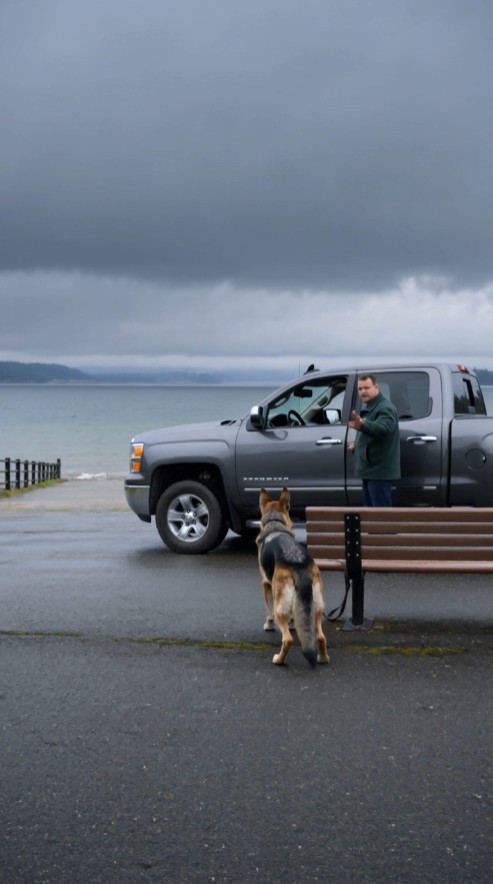
He drove toward an isolated boat ramp near a reservoir.
The parking area was almost empty.
An old wooden bench stood near the edge of the lot.
Richard parked.
Opened the back door.
And helped Scout down.
The dog sniffed the ground.
He moved slowly.
Then looked toward Richard.
His tail wagged.
Richard took the leash.
Walked toward the bench.
And tied it securely around one of the wooden supports.
Scout stood beside him.
Richard avoided looking into the dog’s eyes.
“Stay here, buddy.”
He turned toward the truck.
Scout followed as far as the leash allowed.
Then stopped.
Richard continued walking.
Scout gave a small bark.
Then another.
Richard opened the truck door.
“Somebody else can deal with you.”
He climbed inside.
Started the engine.
And drove away.
The Dog Who Watched the Road
Scout pulled gently against the leash.
His stiff legs made it difficult to move quickly.
He barked toward the disappearing truck.
Then waited.
The vehicle became smaller.
Finally, it disappeared around a bend.
Scout stood beside the bench.
He sniffed the ground.
Looked toward the road.
And listened.
A few minutes later, another vehicle passed in the distance.
Scout lifted his head.
But it didn’t stop.
The wind grew stronger.
Rain began falling.
Scout moved beneath the bench as far as his leash would allow.
His coat became wet.
He curled himself against the wooden support.
And waited.
The storm approached.
The Man Who Stopped
That evening, a marina maintenance worker named Daniel was driving along the access road.
He had spent the day inspecting equipment ahead of the storm.
As he passed the old boat ramp, he noticed movement near the bench.
At first, he thought it was a loose tarp.
Then he saw the dog.
Daniel slowed.
Pulled over safely.
And approached carefully.
Scout lifted his head.
His ears moved forward.
Daniel stopped a short distance away.
“Hey, buddy.”
Scout gave a weak wag of his tail.
Daniel noticed the leash.
The wet coat.
And the old dog’s difficulty standing.
He realized something was wrong.
There were no people nearby.
No vehicle.
And no sign that anyone was returning.
Daniel immediately contacted local animal rescue services.
Then stayed nearby until help arrived.
The Rescue
A rescue worker named Hannah arrived with a colleague.
They assessed the situation carefully.
Scout was cold and exhausted.
He appeared frightened.
But he allowed them to approach.
The team gently secured him.
Checked for an identification tag.
And transported him to a veterinary clinic for evaluation.
The veterinarian examined Scout.
He was dehydrated.
His joints were painful.
And prolonged exposure to cold rain could have made him seriously ill.
Fortunately, he had been found before his condition deteriorated further.
Scout received appropriate treatment and monitoring.
The rescue documented where and how he had been found.
They also began following the required procedures for reporting suspected animal abandonment.
For the first time that day, Scout was warm.
Safe.
And surrounded by people who wanted to help him.
The Dog Who Wouldn’t Eat
During his first few days at the rescue, Scout was unusually quiet.
He accepted gentle attention.
But he didn’t show much interest in toys.
Sometimes he stood near the door.
Sometimes he rested with his head facing the hallway.
The staff couldn’t know exactly what he was thinking.
But they recognized that he’d experienced an abrupt change in circumstances.
They focused on helping him recover.
His meals were carefully managed.
His pain treatment was reviewed.
And his activity was adjusted to suit his age.
Hannah spent time sitting beside him.
She read paperwork.
Answered messages.
And occasionally spoke to him.
“You’re safe here, Scout.”
The dog would lift his head.
Then settle again.
Over the following weeks, he gradually became more comfortable.
The Photograph That Almost Nobody Clicked
Once Scout was medically stable and legally available for adoption, the rescue prepared his profile.
They took photographs.
In one, Scout sat beside Hannah.
His gray muzzle was clearly visible.
In another, he rested on a blanket.
The adoption description explained that Scout was an elderly German shepherd mix who needed a quiet home.
He had joint problems.
Required regular veterinary care.
And wasn’t suited to strenuous exercise.
The staff were realistic.
Senior dogs can take longer to place.
Some adopters prefer puppies.
Others worry about medical costs.
But Hannah believed Scout still had a lot to offer.
She wrote:
“Scout doesn’t need a family that expects him to run mountains. He needs a family that will enjoy the quiet walks, slow mornings, and gentle companionship he has left to give.”
Then she published his profile.
The Boy Named Ethan
Across town, nine-year-old Ethan was sitting beside his mother, Sarah, when she opened the rescue’s adoption page.
Ethan had experienced a difficult year.
He had changed schools after his family moved.
He struggled to make friends.
And he often felt anxious in unfamiliar situations.
His parents had been looking for a calm family dog.
Not a puppy.
Not an especially energetic breed.
Just a gentle companion.
Sarah showed him Scout’s photograph.
Ethan stared.
“He’s old.”
Sarah nodded.
“Yes.”
Ethan looked closer.
“Does anybody want him?”
His mother smiled sadly.
“That’s what we’re hoping.”
Ethan studied Scout’s face.
Then whispered:
“Maybe he needs a friend too.”
The First Meeting
The family arranged to meet Scout at the rescue.
Ethan arrived holding a small blue blanket.
He’d chosen it because he thought the dog might like somewhere soft to rest.
Hannah greeted them.
She explained Scout’s age and medical needs.
Then brought him into a quiet meeting room.
Scout entered slowly.
His tail moved gently.
Ethan sat on the floor at a respectful distance.
He didn’t rush toward him.
He waited.
After a few minutes, Scout approached.
He sniffed Ethan’s hand.
Then lowered himself onto the blanket.
Ethan smiled.
“Hi, Scout.”
The dog rested his chin near the boy’s knee.
Ethan looked toward his mother.
His eyes were bright.
“I think he likes me.”
A New Home
After the adoption process, Scout moved in with Ethan’s family.
They prepared a comfortable bed on the ground floor.
They placed rugs on slippery surfaces.
And followed the veterinarian’s recommendations for managing his joint problems.
Scout no longer needed to climb stairs.
He enjoyed short, gentle walks.
And spent afternoons resting near the living room window.
Ethan quickly developed a routine.
Every day after school, he sat beside Scout.
Sometimes he told him about his day.
Other times he read aloud.
Scout usually rested his head against Ethan’s leg.
The boy seemed more relaxed with the dog nearby.
His parents noticed that he began talking more openly during their afternoon reading sessions.
They were grateful for the companionship.
But they also continued supporting Ethan through family conversations and appropriate professional guidance when needed.
Scout wasn’t a substitute for that support.
He was a beloved member of the household.
The Boy Who Read to His Dog
Ethan wasn’t always confident reading aloud at school.
He worried about making mistakes.
Sometimes he hesitated over difficult words.
But Scout never interrupted.
He never laughed.
And he never became impatient.
One afternoon, Ethan sat beside him with a book about space.
He stumbled over a long word.
Then sighed.
“I’m terrible at this.”
Scout lifted his head.
Ethan looked toward him.
Then smiled faintly.
“You don’t care if I get it wrong, do you?”
Scout wagged his tail.
Ethan laughed.
“Okay. I’ll try again.”
He began the sentence from the start.
Over time, reading beside Scout became one of his favorite activities.
Seven Months After the Boat Ramp
Seven months after Scout had been abandoned, Ethan became seriously ill.
It began late one evening.
He complained of feeling unusually tired.
His mother checked on him.
He seemed uncomfortable but was still speaking normally.
The family monitored him and followed the advice they had received about seeking medical care if his symptoms worsened.
During the night, Ethan’s condition changed.
He developed increasing difficulty breathing.
His parents were asleep in a nearby room.
Scout was resting on his bed outside Ethan’s doorway.
Then the dog became unsettled.
The Barking
Shortly after midnight, Scout stood.
He moved toward Ethan’s room.
Then returned to the parents’ bedroom.
He gave a low bark.
Sarah stirred.
“Scout?”
The dog barked again.
Then paced toward the hallway.
Sarah sat up.
Scout returned.
He barked more insistently.
Her husband, Michael, opened his eyes.
“What’s wrong with him?”
Sarah looked toward the doorway.
Scout was standing there.
His ears were forward.
He appeared agitated.
Michael got out of bed.
“Maybe he needs to go outside.”
But Scout didn’t move toward the front door.
Instead, he turned toward Ethan’s bedroom.
Then barked again.
The Moment Everything Changed
Sarah followed Scout down the hallway.
He stopped outside Ethan’s room.
She opened the door.
Then froze.
Ethan was lying in bed.
His breathing was labored.
He looked pale.
And he was struggling to respond normally.
Sarah immediately called for Michael.
He hurried into the room.
They recognized the situation as a medical emergency.
Sarah called emergency services.
Michael stayed with Ethan and followed the dispatcher’s instructions.
Scout remained nearby until the responders arrived.
The family didn’t know whether Scout had noticed unusual breathing, movement, or another change.
But his persistent barking had prompted them to check Ethan sooner.
And that mattered.
The Ambulance
Paramedics arrived quickly.
They assessed Ethan.
Provided necessary emergency care.
And transported him to the hospital.
Sarah accompanied him.
Michael followed separately after arranging for a family member to stay with Scout.
At the hospital, doctors evaluated Ethan’s breathing difficulties.
He required treatment and careful monitoring.
The medical team explained that prompt assessment had been important.
They couldn’t determine exactly how events would have unfolded if his parents had checked later.
But the family was relieved that they had recognized the emergency and called for help.
Sarah kept thinking about Scout.
The old dog who had refused to stop barking.
The dog they’d adopted because Ethan wanted someone who needed a friend.
The Hospital Room
After treatment, Ethan’s condition improved.
He remained in the hospital for observation.
His parents stayed close.
He was exhausted.
But he was able to speak.
One afternoon, he asked:
“Where’s Scout?”
Sarah smiled.
“He’s at home with Grandma.”
Ethan looked disappointed.
“Does he know I’m okay?”
His mother gently stroked his hair.
“I’m sure he’ll be happy when you’re home.”
Ethan thought for a moment.
Then whispered:
“He came to get you, didn’t he?”
Sarah nodded.
“He certainly made sure we checked on you.”
Ethan smiled weakly.
“Good boy, Scout.”
The Photograph
Several days later, after Ethan was medically stable, the hospital arranged a brief, approved visit with Scout under its animal visitation procedures.
The family coordinated with staff to ensure the visit was appropriate and safe.
Scout arrived on a leash with Michael.
He moved slowly through the designated area.
When Ethan saw him, his face brightened.
“Scout!”
The dog approached calmly.
He sniffed Ethan’s hand.
Then, with permission and assistance, settled beside the boy on a protective blanket near the hospital bed.
Ethan gently stroked his gray muzzle.
Scout rested his head close to him.
Sarah took a photograph.
The image showed a little boy smiling from a hospital bed.
And an old German shepherd mix resting peacefully beside him.
It was a simple picture.
But it meant everything to the family.
The Rescue Hears the News
After Ethan returned home, Sarah contacted Hannah at the animal rescue.
She wanted to share what had happened.
Hannah listened carefully.
She remembered Scout’s arrival.
The boat ramp.
The rain.
And the frightened elderly dog.
Now Sarah was telling her that Scout had repeatedly barked during the night, leading the family to discover Ethan’s breathing emergency.
Hannah became emotional.
“How is Ethan now?”
Sarah smiled.
“He’s recovering well.”
“And Scout?”
Sarah looked toward the living room.
Scout was resting beside Ethan.
“He’s doing wonderfully.”
Then she added:
“We thought we were giving him a second chance. We never imagined he’d help us through something like this.”
The Newspaper Story
With Ethan’s parents’ consent, the local newspaper published a human-interest article about Scout.
The story explained that he had been found abandoned near a boat ramp.
He’d received veterinary care.
Then been adopted by a family with a nine-year-old boy.
Months later, Scout’s persistent barking had alerted the parents to a medical emergency.
The article included the hospital photograph.
And a statement from the family.
Sarah said:
“We can’t know exactly what Scout sensed. But he was persistent, and because of that, we checked on Ethan. We’re deeply grateful.”
The article also emphasized that Scout wasn’t a trained medical alert dog.
His behavior was an observation, not a guaranteed method of detecting illness.
Families should always seek prompt medical help when concerning symptoms appear.
Richard Recognizes the Dog
Richard was eating breakfast when he saw the newspaper.
He recognized Scout immediately.
The white patch.
The gray muzzle.
And the small scar above his eyebrow.
His hands began trembling.
He read about the rescue.
The adoption.
And Ethan’s medical emergency.
Then he reached the part describing Scout’s barking.
He stared at the page.
For years, Richard had complained that Scout was becoming slow.
Old.
And inconvenient.
He’d stopped seeing the dog as a companion.
He’d seen only the extra effort required to care for him.
Now he was reading about a family who valued everything Scout still had to offer.
The old dog hadn’t become young again.
He still had stiff joints.
Still needed treatment.
And still moved slowly.
But none of those things had prevented him from becoming deeply important to someone else.
The Final Paragraph
Richard continued reading.
The article ended with an announcement from Ethan’s family.
They had decided to become long-term supporters of the rescue that had saved Scout.
They were helping sponsor veterinary care for other senior dogs and encouraging people to consider adopting older animals.
But the family also made a personal promise.
Scout would remain with them for the rest of his life.
They understood that senior dogs could develop increasing medical needs.
They knew caring for him might become more difficult.
But they had committed to providing appropriate veterinary treatment, comfort, and companionship.
The final quotation came from Ethan.
“Scout doesn’t have to be young or fast. He’s my best friend, and we’re keeping him forever.”
Richard slowly placed the newspaper on the table.
He stared toward the window.
For the first time, he couldn’t avoid thinking about what he’d done.
The Consequences
The rescue had reported Scout’s abandonment to the appropriate authorities.
Records from the veterinary examination, the location where he was found, and available identification information helped investigators review the circumstances.
Richard had not simply surrendered an animal through a responsible process.
He had tied an elderly dog to a bench in an isolated place before a storm.
That decision had exposed Scout to serious risk.
As the investigation proceeded, Richard was contacted by authorities.
Any legal consequences would depend on the applicable law and the evidence established.
The newspaper article didn’t erase what he’d done.
And Scout’s happy adoption didn’t make the abandonment harmless.
Richard had made a decision that could have cost the old dog his life.
The Call Richard Made
Several days after seeing the article, Richard contacted the rescue.
Hannah answered.
He gave his name.
Then asked about Scout.
Hannah became quiet.
She recognized the name from the case records.
She explained that she couldn’t discuss private details or arrange contact with the adoptive family.
Richard hesitated.
Then said:
“I saw the newspaper.”
Hannah waited.
Richard continued:
“I didn’t think anyone would want him.”
Hannah’s voice remained calm.
“Scout is doing well in his new home.”
Richard swallowed.
“Can I see him?”
Hannah explained that Scout’s current welfare and the adoptive family’s privacy came first.
There would be no meeting without their consent.
Richard lowered his head.
“I understand.”
For once, he didn’t argue.
The Boy Who Didn’t Know Richard
Ethan never met the man who had abandoned Scout.
His parents didn’t believe introducing them would benefit the dog or their son.
They wanted to focus on Scout’s present life.
Not the circumstances that had brought him to the rescue.
Ethan knew Scout had once been left somewhere unsafe.
He knew a kind worker had found him.
And he knew the rescue had helped him recover.
But he didn’t spend much time thinking about Richard.
He had more important things to do.
Homework.
Reading.
Short walks with Scout.
And choosing which blanket the dog would sleep on that night.
For Ethan, Scout wasn’t a newspaper story.
He was family.
A New Routine
After Ethan recovered, his days returned to a familiar pattern.
He came home from school.
Put down his backpack.
Then went looking for Scout.
The old dog usually rested near the living room window.
When Ethan entered, Scout lifted his head.
His tail moved against the floor.
Ethan sat beside him.
“Hi, buddy.”
Scout leaned closer.
Sometimes Ethan read aloud.
Other times he told Scout about his day.
If the weather was pleasant, they took a short walk with an adult.
Scout moved slowly.
Ethan matched his pace.
He never complained.
“That’s okay, Scout. We can take our time.”
The Senior Dog Fund
The family followed through on its promise to support senior rescue animals.
Working with the shelter, they contributed to a fund that helped cover appropriate veterinary treatment for older dogs.
The program supported examinations.
Pain management.
And other care needed to improve quality of life.
The rescue also shared educational information about the responsibilities of adopting senior animals.
Not every household was suited to caring for an elderly dog.
Some required frequent veterinary appointments.
Others had mobility limitations.
But with realistic expectations and proper care, many senior dogs could enjoy meaningful companionship.
Scout became a familiar face in the rescue’s educational materials.
His photograph showed him resting beside Ethan.
The boy’s hand gently touching his gray fur.
The Anniversary
One year after Scout was found at the boat ramp, Daniel, the marina worker, visited the rescue.
He wanted to know how the old dog was doing.
Hannah smiled.
“You’re going to love this.”
She showed him photographs.
Scout in his new home.
Scout resting beside Ethan.
And Scout enjoying a short walk.
Daniel stared.
Then smiled.
“Look at him.”
Hannah nodded.
“He has a wonderful family.”
Daniel looked toward the photograph of Scout and Ethan.
Then became quiet.
“I remember finding him that night.”
He paused.
“He was soaked through.”
Hannah nodded.
Daniel smiled sadly.
“I’m glad I stopped.”
The Visit to the Rescue
With the adoptive family’s agreement, Scout later returned to the shelter for a planned visit.
Ethan accompanied him.
Hannah greeted them at the entrance.
She knelt a short distance away.
“Hello, Scout.”
The old dog approached.
His tail wagged.
Hannah smiled.
“Remember me, buddy?”
Scout sniffed her hand.
Then leaned toward her.
Ethan laughed.
“He likes everybody.”
Hannah smiled.
“He certainly likes you.”
Ethan looked toward her.
Then said:
“Thank you for saving him.”
Hannah shook her head gently.
“Daniel found him. Our team helped him recover.”
She paused.
“And your family gave him a home.”
Ethan looked down at Scout.
Then smiled.
“I’m glad we did.”
The Birthday Party
On Ethan’s tenth birthday, the family held a small celebration at home.
There were balloons.
A chocolate cake for the people.
And a veterinarian-approved treat for Scout.
The dog rested comfortably near the table.
Ethan placed a paper party hat beside him for a photograph, rather than forcing him to wear it.
His friends laughed.
Scout wagged his tail.
After the party, Ethan sat beside him on the floor.
He looked toward the old dog’s gray muzzle.
Then whispered:
“You helped me have another birthday, buddy.”
Scout rested his head against Ethan’s leg.
The boy gently stroked his fur.
Neither needed anything more.
Growing Older Together
As Scout continued aging, his care needs increased.
His joints became stiffer.
He required regular veterinary monitoring.
And his walks grew shorter.
Ethan understood.
He no longer expected the dog to follow him everywhere.
Instead, he brought his books to Scout’s bed.
Sometimes they sat together in the garden.
Other times they watched rain through the living room window.
Sarah occasionally worried about how Ethan would cope when Scout eventually reached the end of his life.
She talked with him honestly about the responsibilities and emotions involved in caring for an older animal.
Ethan listened.
Then said:
“I know he won’t live forever.”
He looked toward Scout.
“But I want his days to be good.”
Sarah hugged her son.
“That’s exactly what we’re trying to do.”
The Old Blue Leash
Scout still had the blue leash he had arrived with at the rescue.
It had been cleaned and checked for safety.
The family kept it as a reminder of his journey.
One afternoon, Ethan asked why his parents hadn’t thrown it away.
Michael explained that it was part of Scout’s history.
The leash had been used when he was abandoned.
But it had also been there when Daniel found him.
And when the rescue brought him somewhere safe.
Ethan thought about that.
Then said:
“Maybe we should keep it.”
Michael nodded.
“Why?”
Ethan looked toward Scout.
“Because it reminds us he found his way home.”
The Final Photograph
Two years after Scout’s adoption, Ethan’s family took another photograph.
This time, they weren’t in a hospital.
They were sitting in their garden.
Ethan was eleven.
Scout was thirteen.
His muzzle had become almost completely gray.
He lay on a soft blanket beside the boy.
Ethan smiled toward the camera.
One arm rested gently around Scout’s shoulders.
The photograph was simple.
No dramatic headline.
No emergency.
Just a child and his aging dog enjoying a quiet afternoon.
Sarah framed it.
Then placed it beside the earlier hospital photograph.
Together, the pictures told a story.
Not only of the night Scout had alerted them.
But of the years of companionship that followed.
The Man Who Finally Understood
Richard never regained ownership of Scout.
He never became part of Ethan’s family.
And the fact that he later felt regret did not erase the abandonment.
He had to face the consequences of his actions.
But the newspaper article forced him to confront something he’d ignored.
Scout had never stopped being worthy of care.
He was old.
He moved slowly.
And he needed help.
But those needs didn’t make him disposable.
Richard had once loved Scout when the dog was young and energetic.
Then rejected him when caring for him became inconvenient.
Ethan’s family had done the opposite.
They adopted Scout knowing his limitations.
And valued him for the companionship he could still offer.
The Truth Behind the Newspaper Photograph
Scout was an eleven-year-old German shepherd mix when he was abandoned near an isolated boat ramp.
His previous owner had become unwilling to manage the costs and responsibilities of caring for an aging dog.
A maintenance worker found Scout tied to a bench as a storm approached.
The rescue arranged veterinary treatment and rehabilitation.
Several weeks later, Scout was adopted by a family with a nine-year-old boy named Ethan.
The two developed a close bond.
Ethan spent afternoons reading beside Scout.
And Scout became an important part of the family’s daily life.
Seven months after the abandonment, Ethan developed a serious medical emergency during the night.
Scout became agitated and repeatedly barked near the boy’s bedroom.
His behavior prompted Ethan’s parents to investigate and call emergency services.
The boy received treatment and recovered.
A local newspaper published a photograph of Scout beside Ethan in the hospital.
The article described the family’s gratitude and their decision to support other senior rescue dogs.
Scout’s former owner saw the photograph.
And realized that the dog he’d abandoned had become deeply loved by another family.
The Dog Who Was Never Too Old to Matter
For eleven years, Scout lived with Richard.
When he was young, Richard loved him.
He took him hiking.
Bought him toys.
And proudly called him his best friend.
But as Scout grew older, the relationship changed.
The dog needed slower walks.
Medication.
And more patience.
Richard began seeing those needs as problems.
Eventually, he drove Scout to an isolated boat ramp.
Tied him to a bench.
And left.
Scout waited in the approaching storm.
He was cold.
Exhausted.
And unable to free himself.
Then a maintenance worker stopped.
That decision gave Scout another chance.
Weeks later, he met Ethan.
A quiet nine-year-old boy who wanted a friend.
The two became inseparable.
And seven months after the abandonment, Scout’s unusual nighttime barking helped the family discover Ethan’s medical emergency.
An eleven-year-old German shepherd mix was abandoned beside an isolated boat ramp shortly before a storm.
After a maintenance worker rescued him, the dog recovered and found a home with a family whose nine-year-old son formed a close bond with him.
Months later, the dog’s persistent barking prompted the parents to check on their seriously ill child, leading them to seek emergency medical care.
When Richard saw the newspaper, he recognized Scout immediately.
The gray muzzle.
The white patch.
And the familiar scar above his eyebrow.
Then he read the family’s statement.
“Scout doesn’t have to be young or fast. He’s our family, and we’re going to care for him for the rest of his life.”
Richard stared at those words.
He had spent months complaining that Scout was too old.
Too slow.
And too expensive.
But the family in the newspaper saw something different.
A loyal companion.
A gentle friend.
And an animal who deserved comfort and care during his senior years.
The most important thing wasn’t that Scout had become a local hero.
It was that he’d finally found people who would stand beside him even when he needed help.
Richard had abandoned Scout because he believed the old dog had nothing left to give.
Ethan’s family adopted him because they believed he still had a life worth living.
And every evening, when Scout settled beside Ethan’s bed, he no longer had to wait beside an empty road for someone who wouldn’t return.
He had a warm home.
A comfortable place to rest.
And a little boy who loved him exactly as he was.
For an old dog who had once been left alone in the rain, that was the greatest second chance of all.
Amazing loyalty! x x
Amazing loyalty between a human and a loving animal! x