
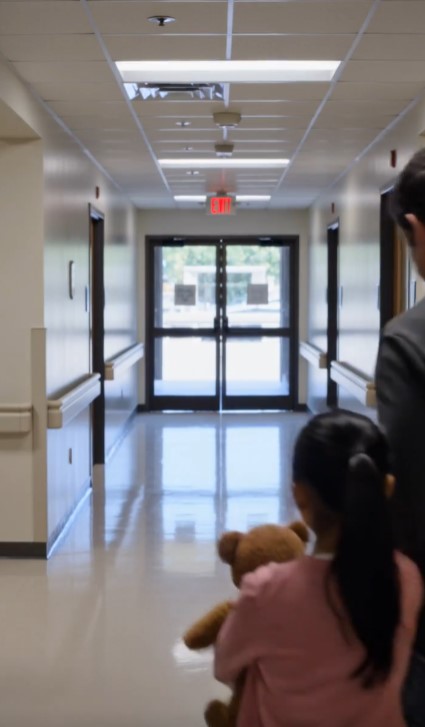
A nurse stopped a family from leaving the hospital.
The father was already holding the discharge papers. The mother had one hand on their daughter’s shoulder and the other wrapped around a small overnight bag. Their little girl, Lily, sat quietly in a wheelchair near the hallway exit, hugging a brown teddy bear against her chest.
Everyone looked tired.
They had spent the whole night in the pediatric ward, waiting through tests, paperwork, and long stretches of silence. Now they just wanted to go home.
But Nurse Amelia did not move from the doorway.
“Please wait,” she said.
The father sighed sharply.
“We’ve already been discharged,” he said. “The doctor said she’s fine.”
The mother nodded, trying to keep her voice calm.
“She just needs rest. We’re taking her home.”
But Nurse Amelia was not looking at the parents.
She was staring at the teddy bear.
Lily held it tightly, its soft brown head tucked beneath her chin. One of its ears was bent, and its little red bow was twisted to the side.
At first, it looked like any child’s toy.
Then Amelia heard it again.
A tiny sound.
Beep.
So faint that it almost disappeared beneath the hospital noise.
Beep.
Beep.
The father frowned.
“What are you doing? We need to leave.”
Nurse Amelia raised one hand.
“Quiet for just a second.”
The hallway grew tense.
A hospital cart rattled somewhere in the distance. A phone rang at the nurses’ station. Footsteps passed behind them.
Then the sound came again.
Beep.
Amelia stepped closer to Lily.
“Sweetheart,” she asked gently, “can I see your teddy bear for a moment?”
Lily looked up with tired eyes and shook her head.
“My bear is scared,” she whispered.
The mother’s face softened.
“She’s been holding it since last night.”
But Amelia’s stomach had already tightened.
That sound was not music.
It was not a toy button.
It was not a battery dying inside a stuffed animal.
It was a monitor alarm.
A very small one.
A very important one.
Amelia knelt in front of Lily and kept her voice soft.
“I promise I’ll give him right back,” she said. “I just need to check something.”
Lily slowly loosened her arms.
The moment Amelia lifted the teddy bear, she saw the thin wire caught in the fur.
A monitor clip.
It had slipped from Lily’s finger and tangled beneath the bear’s arm. The tiny alarm had been coming from the sensor, muffled by the fabric.
Amelia’s face changed.
She looked at Lily’s hand.
Then at the discharge papers.
Then at the wristband around the little girl’s arm.
“Wait,” she whispered.
The father’s anger faded.
“What is it?”
Amelia checked the wristband again.
Then she checked the chart in the folder.
Her blood ran cold.
The name matched.
But the patient number did not.
The chart belonged to another child.
For a second, Amelia could not speak.
Then she turned toward the nurses’ station and shouted, “I need a doctor here now!”
The mother froze.
“What’s happening?”
Amelia took Lily’s wrist gently and looked at the girl’s face again. Lily was pale. Too pale. Her breathing was shallow, and her lips had lost color beneath the hallway lights.
“She wasn’t supposed to be discharged,” Amelia said. “This isn’t her chart.”
The father dropped the papers.
Within seconds, the hallway exploded into motion.
Doctors rushed from the pediatric unit. A nurse pushed a monitor stand toward them. Another called for the correct file. Amelia carefully placed the sensor back on Lily’s finger.
The monitor came alive.
The numbers flashed.
The room went silent.
Then one doctor said, “Get her back into treatment now.”
Lily’s mother covered her mouth.
“No,” she whispered. “They said she was fine.”
The doctor’s voice was calm but urgent.
“She needs to be checked immediately.”
They wheeled Lily back into the room she had just left. Her teddy bear was placed beside her on the bed, the monitor clip now properly attached to her finger.
The parents stood outside the door, shaking.
The father looked at Nurse Amelia with tears in his eyes.
“I yelled at you,” he said.
Amelia shook her head.
“You were scared. You wanted to go home.”
“But you stopped us.”
Amelia looked through the glass window at Lily.
“No,” she said softly. “Her teddy bear did.”
The mistake was uncovered within minutes.
Two children with similar first names had been treated in the same ward that morning. During a shift change, the wrong discharge chart had been placed with Lily’s paperwork. Her parents, exhausted and relieved, had trusted what they were told.
Everyone had.
The doctor.
The clerk.
The family.
Even the system.
But the teddy bear had been holding the monitor clip.
And that tiny muffled alarm was the only warning left.
Hours later, Lily was stable.
Her parents sat beside her bed, holding her hands, unable to stop looking at the stuffed bear resting against her blanket.
Lily opened her eyes and whispered, “Can Bear come home too?”
Her mother broke down.
“Yes,” she said. “Bear is never leaving you.”
Nurse Amelia came in quietly to check the monitor.
Lily lifted the teddy bear toward her.
“He beeped,” she whispered.
Amelia smiled through tears.
“Yes, sweetheart,” she said. “He told us to listen.”
The father stood and took Amelia’s hand.
“Thank you for not letting us leave.”
Amelia looked down at the small brown bear, its fur still tangled where the wire had been.
“Sometimes,” she said softly, “the smallest sound is the one you can’t ignore.”
By the next morning, the hospital had changed its discharge rules. Every wristband had to be checked twice. Every chart had to be verified by two staff members. Every monitor clip had to be accounted for before a child left the ward.
But for Lily’s family, the lesson was simpler.
A nurse had noticed what everyone else missed.
A teddy bear had carried the warning no one heard.
And a little girl was still alive because someone stopped, listened, and trusted the tiny sound that did not belong.
Sometimes heroes wear uniforms.
Sometimes they carry clipboards.
And sometimes, they are soft, worn teddy bears held tightly in the arms of a child who almost went home too soon.