
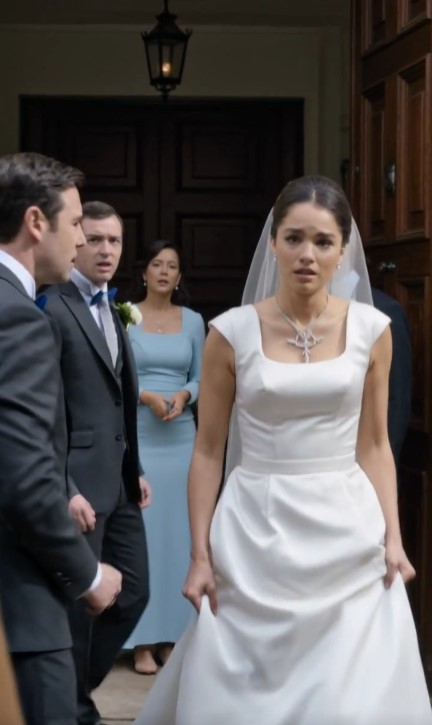
Everyone gasped when an old man stopped the bride at the church doors.
The church was full of flowers, soft music, and quiet excitement. Guests stood from their pews as the bride appeared at the entrance, holding a white bouquet with trembling hands.
Her dress brushed softly against the aisle runner.
Her veil covered part of her face.
The groom waited near the altar, smiling at first.
Then an old man stepped into the aisle.
He was dressed in a worn gray suit, the kind that looked like it had been saved for one important day. His hands shook as he held a faded envelope against his chest.
Security moved quickly.
“Sir, you can’t be here,” one guard said, grabbing his arm.
Guests began whispering.
The groom’s smile disappeared.
“What is this?” he snapped. “Get him out.”
But the old man did not look at the groom.
He did not look at the crowd.
He stared at the necklace around the bride’s neck.
A small silver necklace with a blue stone hanging just above her heart.
The old man’s face broke.
“That belonged to my daughter,” he whispered.
The bride froze.
Her name was Emma, and she had worn the necklace because she believed it came from her late mother. She had been told the story since childhood — that her mother had worn it when she was young, that it had been saved for Emma, that it was the only thing left from the woman who gave her life.
Emma touched the necklace with shaking fingers.
“What did you say?” she asked.
Security tried to pull the old man away, but he resisted just enough to lift the envelope.
“Please,” he said. “Just look at the photograph.”
The church went silent.
The groom stepped forward, angry now.
“This is ridiculous. Emma, don’t listen to him.”
But Emma could not take her eyes off the old man.
Something in his voice did not sound like madness.
It sounded like grief.
The priest raised one hand.
“Let him speak.”
The old man opened the envelope and pulled out a faded photograph.
The edges were bent. The color had softened with time. But the image was clear enough.
A young woman stood in a small garden, smiling through tears, wearing the same silver necklace with the same blue stone.
In her arms was a baby.
Emma’s breath caught.
The old man stepped closer, tears running down his face.
“My daughter’s name was Clara,” he said. “She disappeared twenty-five years ago with her baby girl. We searched everywhere. Police. Hospitals. Shelters. Every town we could reach.”
Emma shook her head slowly.
“No,” she whispered. “My mother died when I was born.”
The old man looked at her gently.
“That’s what someone told you.”
Emma’s hand moved from the necklace to her wrist.
Her fingers found the small birthmark near her thumb.
The old man saw it.
His face changed completely.
In the photograph, the baby’s tiny hand rested against the young woman’s dress.
And on that hand was the same birthmark.
Same shape.
Same place.
Emma’s knees nearly gave out.
Her maid of honor caught her arm.
The groom stepped closer, his voice low and sharp.
“Emma, this is insane. We’re in the middle of our wedding.”
But Emma did not answer him.
She stared at the photograph as if the whole world had narrowed into one impossible truth.
“Who are you?” she whispered.
The old man pressed one hand to his chest.
“My name is Arthur. I’m Clara’s father.”
Then his voice broke.
“And I think I’m your grandfather.”
No one moved.
No one whispered.
Even the organist sat frozen with her hands above the keys.
Emma looked at the necklace again. She remembered the woman who raised her saying it had belonged to her mother. She remembered being told never to ask too many questions about the past. She remembered locked drawers, missing documents, and the strange sadness that appeared whenever she asked about her birth.
For years, those details had felt like old family pain.
Now they felt like pieces of a hidden story.
The wedding stopped.
Not because of scandal.
Not because of shame.
But because one old man had walked into a church carrying twenty-five years of loss in a faded envelope.
Emma stepped away from the altar.
The groom grabbed her hand.
“You’re not seriously doing this now,” he said.
Emma looked at him with tears in her eyes.
“I need to know who I am.”
The room stayed silent as she walked toward Arthur.
He held out the photograph with both hands.
Emma took it carefully.
For a long moment, she stared at the young woman in the picture.
The same eyes.
The same smile.
The same necklace.
Then Arthur pulled another paper from the envelope.
It was a missing person notice from twenty-five years earlier.
Clara Bennett.
Age twenty-two.
Last seen with infant daughter.
Silver necklace with blue stone.
Emma covered her mouth.
The priest quietly led them into a side room while police were called, not to arrest anyone, but to reopen a truth that had been buried for decades.
The ceremony never continued that day.
The guests did not complain.
They waited in the pews, stunned, while Emma sat across from the old man and listened to the story of the mother she had never known.
Arthur told her how Clara had vanished after leaving home with her baby.
How the family had searched until money, strength, and hope ran thin.
How he had carried that photograph everywhere.
How every year on Clara’s birthday, he visited churches, shelters, and city offices, asking questions no one could answer.
Then, one week before the wedding, he saw a bridal announcement online.
The bride in the photo wore a necklace he recognized instantly.
So he came.
Not to ruin her wedding.
Not to embarrass her.
Not to demand anything.
Only to ask one question before it was too late.
Could she be the baby he had lost?
DNA testing later confirmed what Arthur had felt the moment he saw her.
Emma was his granddaughter.
The truth about what happened to Clara took longer to uncover, but Emma finally had something she had been denied her whole life.
A name.
A family.
A photograph.
A grandfather who had never stopped looking.
Weeks later, Emma visited Arthur’s small home. On the mantel were candles, old letters, and dozens of photographs of Clara.
Arthur handed Emma one more picture.
In it, Clara was laughing, the blue stone necklace bright against her dress.
“She would have loved you,” Arthur whispered.
Emma held the photo against her chest.
“I wish I had known her.”
Arthur reached for her hand.
“She found her way back through you.”
Emma cried then, not the quiet tears she had held back in the church, but deep tears for a life she had never been allowed to remember.
The wedding day had not ended the way anyone planned.
There had been no cake cutting.
No first dance.
No perfect exit under flowers.
But Emma later said it was the day her life truly began.
Because sometimes love does not arrive quietly.
Sometimes it interrupts a ceremony.
Sometimes it stands at the church doors in a worn gray suit, holding a faded photograph and a heart full of hope.
And sometimes, the person everyone tries to remove is the one carrying the truth you have waited your whole life to find.