
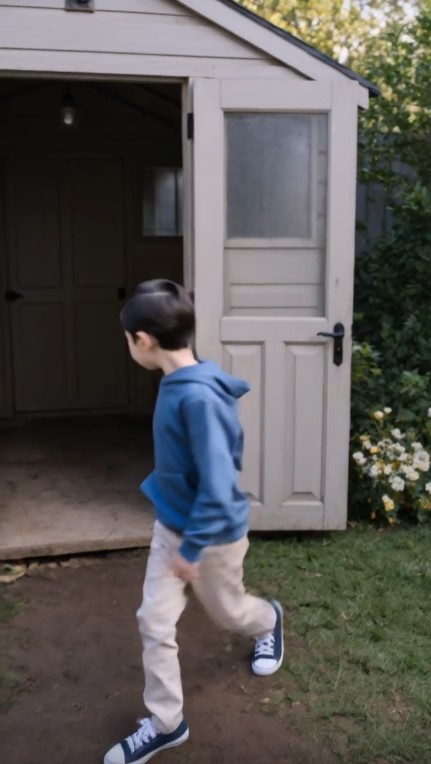
Rex had followed my seven-year-old son everywhere since the day we adopted him.
So when Ethan walked toward our old backyard shed and Rex suddenly blocked the door…
I laughed.
“Move, buddy.”
Rex didn’t move.
Ethan tried walking around him.
Rex stepped sideways again.
Then he began barking.
Loudly.
Desperately.
I had never heard him bark like that.
I walked toward them, annoyed.
Then Rex grabbed Ethan’s sleeve gently and pulled him backward.
“REX!”
Two seconds later…
the ground directly in front of the shed gave way.
A section of soil collapsed into an old underground cavity.
Ethan would have stepped directly onto it.
I grabbed my son.
My hands were shaking.
Rex had saved him.
But instead of calming down…
he started staring into the opening.
Then he whimpered.
Something was down there.
We called professionals.
After the area was secured, they found a small sealed trunk inside the old cavity.
We expected tools.
Maybe junk from a previous owner.
Instead, the trunk contained children’s drawings.
A tiny red jacket.
And an old family photograph.
My wife stared at it for several seconds.
Then whispered:
“That little boy is my father.”
Her father had grown up hundreds of miles away.
At least…
that was what he had always told her.
Then the investigator found something taped beneath the trunk lid.
A letter.
Addressed to my wife.
Written decades before she was born.
My wife’s name was Laura.
She stared at the envelope as if touching it might make the entire thing disappear.
Across the front, in faded blue ink, were the words:
For Laura, if she ever finds this.
Laura looked at me.
“My father didn’t even know me when this was written.”
The investigator, a man named Harris, carefully turned the envelope over.
No date.
No return address.
Only one set of initials in the corner.
T.M.
Laura’s father was Thomas Miller.
Her hands started shaking.
“That’s him.”
I asked:
“How old was he in the photograph?”
She looked again.
“Maybe eight.”
In the picture, young Thomas stood beside another boy.
They were in front of our shed.
Same sloped roof.
Same crooked window.
Same yard.
Even the old tree near the fence was visible in the background.
Laura whispered:
“He told me he grew up in Ohio.”
We lived in North Carolina.
Thomas had always said he moved south for the first time in his twenties.
There was no reason for him to be standing behind our house as a child.
Laura’s father was still alive.
He was eighty-one and living in assisted living less than an hour away.
She called him immediately.
“Dad.”
He heard something in her voice.
“What happened?”
Laura looked at the trunk.
“Did you ever live on Willow Creek Road?”
Silence.
Not confusion.
Silence.
Laura closed her eyes.
“You did.”
Thomas finally whispered:
“Where did you hear that?”
“We found something.”
Another long pause.
Then:
“Don’t open the letter.”
Laura stared.
“Why?”
“Because I should be there.”
He arrived that afternoon with Laura’s older brother, Michael.
The moment Thomas saw the backyard, he stopped walking.
He looked at the shed.
Then the collapsed ground.
Then Rex.
For several seconds he said nothing.
Finally:
“I thought they filled that in.”
Laura crossed her arms.
“Filled what in?”
Thomas looked toward the cavity.
“The old root cellar.”
That was the first surprise.
The underground space had once been a root cellar connected to an earlier version of the property.
The entrance had been sealed long before we bought the house.
Thomas had known about it because he had lived here.
Not briefly.
For almost six years.
Laura looked stunned.
“You lived in this house?”
Thomas nodded.
“From seven until thirteen.”
“Why did you lie?”
Thomas sat down.
“I didn’t know how to tell you the rest.”
The other boy in the photograph was named Samuel.
Thomas’s younger brother.
Laura’s uncle.
A man she had never heard of.
She stared.
“You had a brother?”
Thomas nodded.
“Yes.”
Michael looked equally shocked.
“You told us you were an only child.”
“I know.”
Thomas looked toward the little red jacket inside the trunk.
“That was Samuel’s.”
The jacket had tiny wooden buttons and a patch sewn over one elbow.
Thomas reached toward it but stopped before touching it.
“He wore that thing everywhere.”
Laura sat beside him.
“What happened to him?”
Thomas looked down.
“He disappeared.”
Samuel was nine.
Thomas was twelve.
They lived in this house with their mother, Eleanor, and their father, Robert.
The boys spent most afternoons behind the shed.
The root cellar had become their secret clubhouse.
Their mother hated it.
Their father told them repeatedly to stay away because parts of it were unstable even then.
They ignored him.
Inside, they kept drawings.
Toy cars.
Comic books.
The little trunk.
Then one summer evening, Samuel vanished.
Thomas had been the last person to see him.
Laura whispered:
“What happened?”
Thomas took a long breath.
The brothers had argued.
Samuel wanted to follow an older neighborhood boy named Daniel toward the river.
Thomas said no.
Samuel laughed at him.
Thomas told him:
“Fine. Go. I don’t care.”
Samuel left.
He never came home.
Search parties formed.
Police searched the river.
Fields.
Roads.
Nothing.
Daniel said Samuel never actually reached him.
No one knew where the boy went.
Thomas blamed himself.
Their mother blamed the town.
Their father became almost silent.
Within a year, the family moved away.
That was when Thomas began telling people he grew up in Ohio.
Technically, he did live there afterward.
But he erased the years here.
Laura said:
“You erased Samuel too.”
Thomas nodded.
“Yes.”
“Why?”
“Because every time I said his name, your grandmother cried.”
Then, when Thomas became an adult, silence became habit.
He married.
Had children.
And still never told them.
Michael looked angry.
“You let us grow up without knowing we had an uncle.”
“I know.”
Laura pointed toward the envelope.
“Then how could you write a letter to me before I was born?”
Thomas looked at it.
“I didn’t.”
Everyone went silent.
Laura frowned.
“Those are your initials.”
“Yes.”
“But that isn’t my handwriting.”
Harris carefully opened the envelope.
Inside was a letter written in different handwriting.
The first line:
Thomas, if you ever have a daughter, and if you name her Laura like you always said you would, give her this.
Thomas stopped breathing.
He whispered:
“Samuel.”
Laura stared.
“Samuel wrote this?”
Thomas grabbed the edge of the table.
The letter was dated two days before Samuel disappeared.
Suddenly the entire room felt different.
Samuel had not written to Laura personally.
He had written to the future daughter Thomas used to talk about.
Laura asked:
“You wanted to name your daughter Laura when you were twelve?”
Thomas smiled faintly.
“Our favorite teacher was Mrs. Laura Bennett.”
Then his face broke.
“I forgot this letter existed.”
The letter continued.
Samuel wrote about the root cellar.
The drawings.
Their secret plans.
Childish things.
He teased Thomas for acting like a father all the time.
Then came the line that changed everything.
If Dad finds out about Daniel’s hiding place, he’s going to be furious.
Thomas frowned.
“What hiding place?”
Everyone looked at him.
He didn’t know.
The next paragraph explained.
Daniel, the older neighborhood boy, had been hiding letters and small objects in the root cellar.
Not criminal things.
Messages.
Photographs.
Food.
He was planning to run away.
His father was violent and controlling.
Samuel had discovered the stash.
Daniel made him promise not to tell.
Thomas shook his head.
“Samuel never told me.”
The letter continued:
I’m going to make Daniel tell somebody tomorrow. He’s scared of his dad, but he can’t stay in that cellar forever.
Laura looked at Thomas.
“Tomorrow was the day Samuel disappeared.”
Thomas nodded.
For sixty-nine years, he had believed Samuel wandered toward the river after their argument.
But Samuel had planned to meet Daniel.
The old investigation had focused on the river because that was where Daniel said he was going.
Maybe Daniel had lied.
Thomas stood.
“We need to find him.”
Daniel would now be in his eighties.
If he was alive.
Harris searched old property records and archives.
There had indeed been a Daniel Carter living nearby.
His family moved less than a month after Samuel disappeared.
That was suspicious.
But there was more.
A later court record showed Daniel’s father had been charged with assault in another state.
Thomas closed his eyes.
“Samuel was trying to help him.”
Laura asked:
“Could Samuel have gone with them?”
Nobody knew.
Then Michael found something else in the trunk.
Beneath the children’s drawings was a photograph of Samuel and Daniel.
On the back:
Bus station — Friday
Thomas stared.
“What Friday?”
The photo was dated the morning Samuel vanished.
They had gone to the bus station.
Harris tracked old bus routes.
One route traveled from town to Richmond.
Another continued north.
Then they found an archived missing-person follow-up from two years after Samuel’s disappearance.
A witness in Virginia had reported seeing a boy who resembled Samuel with an older teenager.
Police at the time dismissed it as unconfirmed.
Thomas whispered:
“He left with Daniel.”
Maybe.
The investigation now had direction.
Within days, they found a Daniel Carter living in Pennsylvania.
Age eighty-two.
Alive.
Thomas refused to call.
“I can’t.”
Laura took the phone.
A frail voice answered.
“Hello?”
She explained who she was.
The line went silent.
Then Daniel whispered:
“Thomas is alive?”
Laura looked at her father.
“Yes.”
Daniel began crying.
Thomas took the phone.
“Where is Samuel?”
Daniel did not answer immediately.
Thomas’s voice cracked.
“Please.”
Finally:
“He lived.”
Thomas sat down.
Those two words undid almost seven decades of grief.
Samuel had not died at nine.
He had left with Daniel.
Not because he wanted to abandon his family.
Because the situation became chaotic.
Daniel planned to run away from his father.
Samuel followed him to the bus station intending to stop him.
Then Daniel’s father appeared.
He was furious.
Samuel became frightened.
The two boys boarded a bus.
Samuel planned to call home from the next town.
But Daniel begged him not to.
He believed his father would track them through police.
Samuel agreed to wait one day.
Then two.
Then Daniel’s father reported both boys as troublemakers who had run away together.
The boys became terrified they would be punished or separated.
Eventually they were taken in by a church-run youth program under incomplete information.
Samuel gave a false surname at first.
By the time adults learned the truth, months had passed.
Daniel asked Samuel to go home.
Samuel wanted to.
Then he learned his family had moved.
Letters were returned.
Their old phone disconnected.
He kept searching.
Thomas whispered:
“So why didn’t he find us later?”
Daniel cried.
“He did.”
Thomas froze.
Samuel found Thomas when they were both in their thirties.
At least, he found an address.
He wrote.
No response.
Thomas said:
“I never got anything.”
Daniel answered:
“Your father did.”
Robert had intercepted the letter.
Thomas’s father.
He had never forgiven Samuel for leaving.
He believed the boy’s disappearance had destroyed the family.
According to Daniel, Robert wrote back telling Samuel:
Thomas has a family now. Leave him alone.
Thomas covered his face.
“My father did that?”
Daniel said:
“Samuel believed him.”
That was the second tragedy.
Samuel had spent decades alive, thinking Thomas wanted nothing to do with him.
Thomas had spent those same decades thinking Samuel disappeared at nine.
Laura asked:
“Is Samuel alive?”
Silence.
Daniel answered:
“No.”
Samuel died six years earlier.
Thomas closed his eyes.
Too late.
Again.
But Samuel had a family.
A wife.
A son.
Two daughters.
Grandchildren.
Thomas whispered:
“He had children?”
“Yes.”
Daniel had remained his lifelong friend.
The frightened teenager Samuel tried to help became the man who stayed beside him for nearly seventy years.
Then Daniel said:
“There’s someone you need to meet.”
Three weeks later, a woman named Emily arrived at our house.
Samuel’s daughter.
Laura’s cousin.
Thomas stood in the backyard waiting.
When Emily walked through the gate, he started crying before she reached him.
She looked like Samuel.
Not exactly.
But enough.
Emily held out an old photograph.
Samuel at seventy.
Gray-haired.
Smiling.
Thomas touched the picture.
“He got old.”
Emily smiled through tears.
“Yes.”
Thomas laughed.
“I never got to imagine him old.”
That sentence broke all of us.
For decades, Samuel had remained nine years old in Thomas’s memory.
Red jacket.
Dirty knees.
Angry because his brother wouldn’t let him go to the river.
Now Thomas saw him as a father.
Grandfather.
Old man.
Alive for an entire lifetime Thomas never knew about.
Emily had brought something else.
Samuel’s box of letters.
Many were addressed to Thomas.
Never mailed.
One said:
Tommy, I don’t know whether Dad told the truth when he said you don’t want me back.
Another:
I saw a man today who looked like you and followed him for half a block.
Another:
Daniel says I should stop writing letters I never send. He’s probably right.
Then one written shortly before Samuel died:
If Thomas is still alive, tell him I never blamed him for telling me to go. I knew he didn’t mean it.
Thomas sobbed.
For sixty-nine years, those had been the last words he remembered saying to his little brother.
Fine. Go. I don’t care.
Samuel knew he cared.
That mattered.
Then Emily asked about the trunk.
Thomas showed her.
She immediately recognized the tiny red jacket.
“My dad kept a picture of that.”
Apparently Samuel had talked about it.
He believed the jacket stayed behind.
He had always wondered what happened to the root-cellar trunk.
Now they knew.
It had remained buried beneath our yard for almost seven decades.
The children’s drawings were still there.
One showed two boys standing beside a huge dog.
Thomas laughed.
“We didn’t own a dog.”
Ava—sorry, Ethan—looked at Rex.
“Maybe they wanted one.”
Thomas nodded.
“Samuel definitely did.”
Ethan asked:
“Can Rex be in the family picture?”
Everyone laughed.
“Absolutely.”
The cavity beneath the shed was professionally filled and stabilized.
Before workers sealed it permanently, Thomas asked to stand nearby one last time.
He looked into the old space.
“This was our whole world.”
Laura stood beside him.
“And you never told me.”
Thomas nodded.
“I should have.”
She took his hand.
“Yes.”
No easy absolution.
Just truth.
The old shed was repaired.
The trunk came inside.
We cleaned it carefully but kept the dents and rust.
The little red jacket was preserved.
The drawings were scanned.
Samuel’s letter to the future Laura was framed.
Underneath it, Laura added:
She found it.
Thomas became part of Emily’s family.
Slowly.
He met Samuel’s grandchildren.
Saw home videos.
Listened to recordings of Samuel laughing.
The first recording was almost unbearable.
Thomas cried.
Then asked to hear it again.
And again.
One video showed Samuel telling a story about a childhood treehouse.
Thomas interrupted the screen.
“That never happened.”
Emily laughed.
“He lied about childhood constantly.”
Thomas smiled.
“He always did.”
That was how the grief changed.
At first, every new detail hurt.
Then the details became gifts.
Samuel liked jazz.
Hated tomatoes.
Worked as an electrician.
Made pancakes every Saturday.
Called all his grandchildren “kiddo.”
Thomas learned the brother he lost as a child had become a full person without him.
He couldn’t recover the years.
But he could know them.
And that was something.
Rex became strangely important to Thomas.
Every time he visited, Rex sat beside him.
Thomas would scratch behind his ears and say:
“You found my brother’s box.”
Technically, Rex had noticed unstable ground.
Maybe smelled something unusual in the cavity.
Maybe heard soil shifting.
Nobody knew.
But without Rex blocking Ethan…
the outcome could have been terrible.
And without the collapse…
the trunk might have remained underground forever.
Thomas started bringing Rex treats.
Too many.
Laura complained.
“Dad, he’s gaining weight.”
Thomas said:
“He earned it.”
Rex agreed.
Years later, Thomas died peacefully at eighty-six.
At his memorial, Emily sat beside Laura.
Two women who had grown up without knowing the other existed.
On the table was a photograph.
Thomas and Samuel as boys.
Beside it was a newer photograph.
Thomas.
Emily.
Laura.
Michael.
Ethan.
And Rex sitting front and center.
Underneath, Laura wrote:
Nobody missing from the picture anymore.
The old letter stayed in our family.
The one addressed to Laura decades before she was born.
At first, it seemed impossible.
In reality, it was a child’s joke about the daughter Thomas always said he would someday name after his favorite teacher.
Samuel had no idea whether Laura would exist.
But she did.
And decades later, she opened the letter.
The final lines became the part we remembered most.
Samuel had written:
If you really exist someday, Laura, tell Tommy he worries too much.
And tell him I know he cares even when he says he doesn’t.
Laura read those lines to Thomas dozens of times before he died.
He always cried.
Then smiled.
Because that was what he had needed to hear since he was twelve.
The day Rex blocked our son from reaching the shed, I thought our dog was being difficult.
Then the ground collapsed.
He saved Ethan from stepping into an unstable underground cavity.
But he also opened something else.
A sealed trunk.
A hidden childhood.
A brother erased by grief.
And a letter written by a nine-year-old boy to a niece he could only imagine.
Thomas had spent almost seventy years believing his final angry words were the last thing Samuel ever carried from him.
They weren’t.
Samuel knew.
He knew his brother loved him.
And because one dog refused to let a little boy take one more step…
Thomas finally got to know that too.