
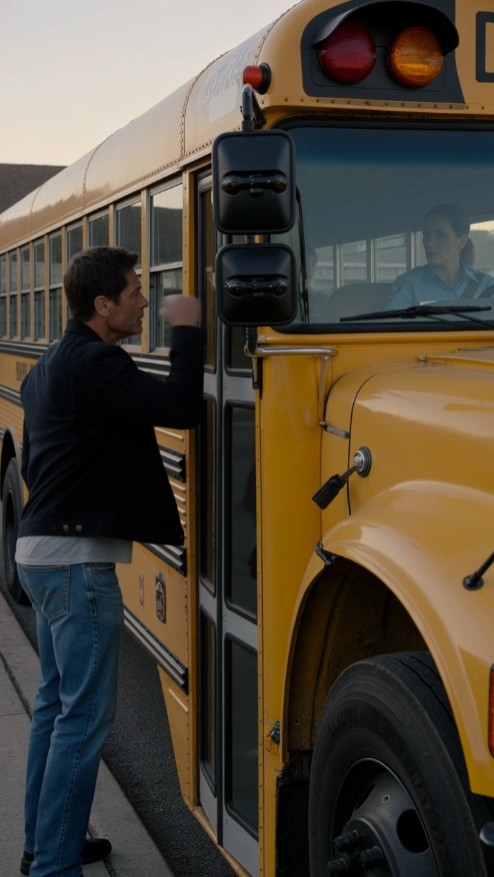
The school bus driver had been working for nearly eighteen years, but she had never seen a little girl look so frightened of someone claiming to be her father.
It was 3:42 on a Thursday afternoon when Margaret Hayes stopped her yellow school bus outside Brookfield Elementary School. Parents were waiting along the sidewalk, and children were gathering their backpacks as they prepared to go home.
Everything seemed normal until a man approached the open doorway and asked for seven-year-old Lily Carter.
“I’m here for my daughter,” he announced.
Margaret glanced toward Lily, who was sitting quietly near the front of the bus.
“Sweetheart, is that your daddy?”
The girl didn’t answer.
The man grew impatient and held up his phone. On the screen was a photograph of himself standing beside Lily, her pink backpack hanging from one shoulder.
“See? That’s my little girl. Now open the door.”
But Margaret noticed something he hadn’t.
Lily was staring directly at her, slowly moving three fingers against the side of her backpack.
Once.
Twice.
Three times.
Margaret recognized the movement immediately. She had taught the children a private signal they could use when they felt unsafe and couldn’t speak openly.
Without opening the door, she reached for her radio.
“I need the principal at my bus immediately. We have a child safety concern.”
The man outside stopped shouting.
And when the school security officer asked him one simple question, his confidence began to disappear.
“Sir, if you’re her father, why aren’t you listed as an authorized person to collect her?”
The Signal Nobody Else Understood
Margaret had introduced the three-finger signal several months earlier as part of a school transportation safety activity.
Children were reminded that they could always tell a trusted adult if something felt wrong. For situations where speaking was difficult, Margaret encouraged them to use a simple, discreet gesture to ask for help.
She made one thing clear: the signal wasn’t a game, and it didn’t replace telling an adult what was happening whenever it was safe to do so.
Lily remembered the lesson.
Now, sitting in the bus with her backpack clutched against her chest, she was using that signal for the first time.
Margaret kept her voice calm.
“Sir, I need you to wait while we confirm the pickup arrangements.”
The man stepped closer.
“I’m her father. I don’t understand why you’re making this difficult.”
Margaret didn’t argue.
She had no intention of releasing a frightened child without verifying that the adult was authorized to take her.
The security officer, James Porter, moved toward the doorway and asked the man to step back while the school checked its records.
The man reluctantly complied.
But Lily continued watching Margaret, her face pale and her eyes filled with tears.
The Photograph That Didn’t Prove Everything
The man introduced himself as Daniel Carter.
He showed James several photographs of himself with Lily, including one from a birthday party and another taken at a playground.
At first glance, there was nothing unusual about the pictures. The child clearly knew the man.
But James understood that a photograph couldn’t establish whether someone was currently authorized to collect a student.
He asked Daniel for identification and requested that he wait while the principal reviewed Lily’s emergency contact information.
Daniel handed over his driver’s license.
His name matched the one he had given.
But when James asked whether Lily’s mother had arranged the pickup, Daniel hesitated.
“She knows I’m coming,” he answered.
“Did she notify the school?”
“She doesn’t need to. I’m her father.”
James repeated the question.
Daniel’s expression hardened.
“Look, I haven’t got time for this.”
That reaction increased the security officer’s concern.
Meanwhile, Margaret quietly asked another staff member to supervise the remaining children while Lily stayed seated in a safe area.
The Emergency Contact Record
Principal Rebecca Collins arrived within minutes carrying the school’s current student pickup information.
She reviewed Lily’s records and immediately noticed something important.
Daniel Carter was identified as Lily’s biological father, but he wasn’t on the current authorized pickup list.
The records contained a specific instruction requiring any change to Lily’s dismissal arrangements to be confirmed through the school’s designated administrative process.
Her mother, Sarah Carter, was listed as the primary contact.
Lily’s grandmother was the approved alternate.
Daniel’s name appeared in the family information section, but not among the adults permitted to collect her directly from school.
Rebecca looked toward James.
“We need to contact her mother and follow the safeguarding procedure.”
Daniel overheard the conversation.
“This is ridiculous,” he protested. “She’s my daughter.”
Rebecca remained calm.
“We understand your relationship to Lily. But we’re required to verify permission before releasing any student.”
She then asked whether he had received confirmation from the school that the pickup arrangements had changed.
Daniel had no such confirmation.
And when Rebecca asked for the name of the staff member who had supposedly approved the collection, he couldn’t provide one.
Why Lily Was So Afraid
Inside the bus, Margaret sat a short distance from Lily.
“You did the right thing by letting me know you were worried,” she said gently.
Lily looked down.
“I thought you might not remember.”
“I remembered.”
The little girl began to cry.
Margaret didn’t press her for details or suggest what she should say. Instead, she reassured Lily that she was safe with school staff and that the adults would check the arrangements.
After a moment, Lily whispered, “He told me not to tell Mommy he was coming.”
Margaret’s expression changed, but she kept her voice steady.
“Thank you for telling me.”
Lily wiped her cheeks.
“He said we were going somewhere, and I couldn’t call her until we got there.”
That was enough for Margaret to report the child’s exact words to the principal without asking her to repeat them unnecessarily.
The school immediately contacted Sarah and requested police assistance to clarify the situation.
The Phone Call That Explained the Fear
Sarah answered the principal’s call while she was at work.
When Rebecca explained that Daniel was attempting to collect Lily, Sarah became alarmed.
“He’s at the school?”
“Yes. Lily is safe with staff. We have not released her.”
Sarah explained that there were formal arrangements concerning contact and collection. Daniel was not authorized to make an unscheduled school pickup, and Sarah had not agreed to any change that afternoon.
She also disclosed that a disagreement earlier in the week had raised concerns about Daniel attempting to take Lily without following those arrangements.
Rebecca documented the information and passed it to the responding officers.
The school avoided making its own legal determination about the family dispute. Its immediate responsibility was to protect the child, follow its records, and allow the relevant authorities to assess the circumstances.
When Daniel realized the school had contacted Sarah, he stopped demanding that Lily be brought outside.
His posture changed.
For the first time since arriving, he seemed uncertain about what would happen next.
The Moment the Truth Came Out
Two police officers arrived and spoke separately with Daniel and the school staff.
The principal provided the pickup records and explained the sequence of events.
Margaret reported exactly what she had observed: Lily’s silence, her frightened expression, and the three-finger signal.
She also shared the child’s statement that Daniel had instructed her not to contact her mother until after they traveled somewhere.
Daniel initially insisted that the entire situation was a misunderstanding.
He acknowledged that he hadn’t arranged the pickup through the school.
He had assumed that because he was Lily’s father, staff would release her without questioning the request.
The officers reviewed the available information, including the applicable family arrangements, before deciding what further action was necessary.
Daniel was not permitted to take Lily from school that afternoon.
The officers handled the incident according to the relevant safeguarding procedures, and the school arranged for Lily to remain with familiar staff until Sarah arrived.
For Margaret, the most important outcome was that Lily had been heard.
The Hug That Made the Driver Cry
Sarah reached Brookfield Elementary School shortly afterward.
She hurried into the office, where Lily was sitting beside Margaret with her pink backpack on her lap.
The moment Lily saw her mother, she ran into her arms.
“Mommy!”
Sarah held her tightly.
“I’m here, sweetheart.”
Lily began crying.
“I didn’t go with him.”
Sarah knelt in front of her.
“I know. You stayed with Mrs. Hayes, and she helped you.”
The little girl looked toward Margaret.
“I did the signal.”
Margaret smiled through tears.
“You did.”
Sarah turned toward the driver.
“I don’t know how to thank you.”
Margaret shook her head.
“You don’t have to thank me. Lily let me know something was wrong, and we followed the school’s safety procedures.”
Sarah took Margaret’s hand.
“But you listened.”
For a moment, Margaret couldn’t speak.
She had spent years reminding children that their concerns mattered, even when adults were busy or impatient.
That afternoon, one of those children had trusted her enough to ask for help.
Why Margaret Never Opened the Door
In the days that followed, school administrators reviewed the incident.
The investigation highlighted the importance of maintaining accurate pickup records, verifying changes through official channels, and ensuring staff knew how to respond when a child appeared frightened.
A photograph, family relationship, or confident explanation was not enough to override the school’s authorized release procedures.
Margaret was relieved that the security officer and principal had supported her decision to pause the pickup.
She hadn’t assumed Daniel was dangerous simply because he was impatient.
Nor had she tried to determine the outcome of a complicated family situation herself.
Instead, she had recognized a child’s distress and followed the process designed to keep students safe.
That distinction mattered.
Child safety depended on careful observation, verification, and appropriate responses, not guesses about someone’s appearance or intentions.
The Little Drawing Left on the Driver’s Seat
A week later, Margaret found a folded piece of paper on her driver’s seat.
It was a drawing from Lily.
The picture showed a yellow school bus beneath a blue sky.
Inside was a little girl sitting behind the driver.
Outside stood a woman with a big smile.
Across the bottom, in uneven purple letters, Lily had written:
“Thank you for understanding me when I couldn’t talk.”
Margaret stared at the drawing for several seconds.
Then she carefully placed it inside a folder where she kept thank-you cards from students.
She had received many over the years.
But this one was different.
It reminded her that children don’t always know how to explain fear, especially when the person causing that fear is someone familiar to them.
Sometimes they remain silent.
Sometimes they avoid eye contact.
And sometimes they find another way to communicate.
Margaret was grateful that Lily had felt able to use the signal she remembered from their safety lesson.
The Lesson That Spread Through the School
Following the incident, Brookfield Elementary reviewed its safety education with students and families.
Teachers reminded children that they could ask trusted adults for help whenever they felt uncomfortable or unsafe.
The school also reinforced that no single gesture was a substitute for proper safeguarding procedures.
Children were encouraged to speak openly when they could and to use whatever safe means of communication were available when they couldn’t.
Parents received updated information about pickup authorization and how to notify the school about changes.
Staff members practiced responding calmly to unexpected collection requests, including situations involving adults who were known to a student but weren’t currently authorized to collect them.
The principal later thanked Margaret for her careful handling of the situation.
“You didn’t let the pressure at the bus door make the decision for you,” Rebecca told her.
Margaret smiled.
“I knew I needed to check.”
“And that’s exactly what you did.”
The Day Lily Returned to the Bus
Several weeks later, Lily climbed onto Margaret’s bus after school.
She was smiling again, carrying the same pink backpack and wearing her hair in two little ribbons.
Margaret greeted her warmly.
“Hello, Lily.”
“Hi, Mrs. Hayes.”
Lily sat in her usual seat near the front.
Before the bus departed, she leaned forward.
“Can I tell you something?”
“Of course.”
Lily smiled.
“I told Mommy I want to be a bus driver when I grow up.”
Margaret laughed.
“Is that right?”
“Yes. Because bus drivers help children.”
Margaret felt her eyes grow warm.
She smiled at Lily through the mirror.
“That’s a pretty good reason.”
As the bus pulled away from the school, Margaret thought about the afternoon when everything had changed.
The impatient man outside.
The frightened little girl.
The quiet movement of three fingers.
And the decision not to release a student until the adults responsible for her safety had verified the situation.
A Small Signal That Made a Big Difference
Years later, Margaret would remember many children who traveled on her bus.
Some were loud and energetic.
Others were shy.
Some needed extra encouragement on their first day of school.
And some became familiar faces she looked forward to seeing every afternoon.
But Lily remained one of the students she never forgot.
Not because she had caused trouble.
Not because her situation attracted attention.
But because she had trusted Margaret enough to communicate that she was afraid.
The incident reinforced something the experienced driver had always believed: a child’s silence doesn’t necessarily mean everything is fine.
When an adult asks a child whether they’re comfortable leaving with someone, the child’s behavior and any expression of concern deserve to be taken seriously.
And when the situation involves an unexpected pickup, the proper records and safeguarding procedures must be checked regardless of the adult’s relationship to the child.
Everyone thought the school bus driver was being unreasonable when she refused to release a little girl to a man claiming to be her father.
But the child had made a discreet signal asking for help, and the school’s records revealed that the man wasn’t authorized to collect her that afternoon.
What saved the situation wasn’t a dramatic confrontation. It was one experienced driver who paid attention, followed the rules, and made sure a frightened little girl was heard.