
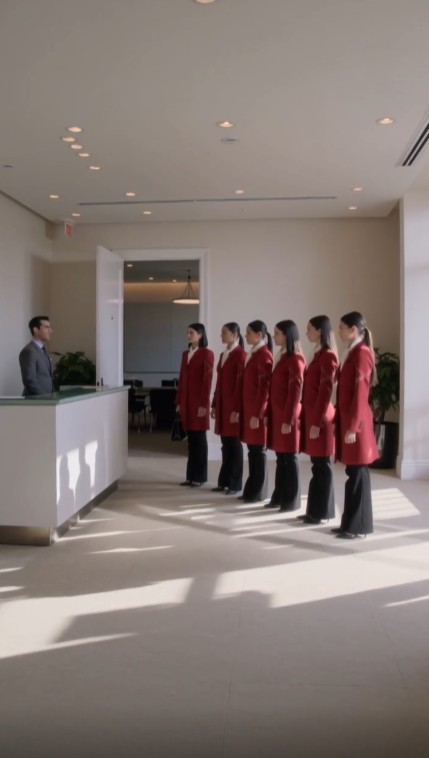
Seven women arrived for a job interview wearing exactly the same outfit.
Same red coat.
Same black trousers.
Same white scarf.
Even the unusual white stitching along the sleeves matched perfectly.
The receptionist stared at them.
“Is this some kind of joke?”
Nobody laughed.
The seven women stood quietly in a straight line.
Then the company director walked into the lobby.
And froze.
His name was Adrian Cole.
For twelve years, he had led one of the fastest-growing fashion companies in the city.
Their most successful collection had launched three years earlier.
It centered around one signature piece.
A deep red coat with white hand-stitched detailing along the sleeves.
It had appeared in magazines.
On celebrities.
In department-store campaigns.
The coat had become so closely linked to the brand that customers sometimes called it simply “the Cole Red.”
Adrian looked at the seven women.
Then at their coats.
“Where did you get those?”
One woman stepped forward.
Her name was Elena.
“We’re here for the interview.”
Adrian frowned.
“What interview?”
Elena opened her handbag.
She removed a folded sheet of paper.
Then placed it carefully on the reception desk.
It was a fashion sketch.
A red coat.
Black trousers.
White scarf.
And the same distinctive sleeve stitching.
Adrian stopped breathing for a moment.
The drawing was old.
The paper had yellowed slightly.
In the bottom corner was a handwritten date.
Five years before his company launched the collection.
Adrian looked at Elena.
“Where did you get this?”
She smiled.
“You should recognize it.”
The receptionist looked from the sketch to Adrian.
“What’s going on?”
Adrian turned toward the women.
“Who are you?”
Elena answered calmly:
“We’re the women your company forgot.”
The lobby went silent.
Adrian asked everyone to move into a conference room.
The seven women sat along one side of the table.
Adrian sat opposite them.
The receptionist remained because Elena insisted.
“No private conversation.”
Adrian looked at the sketch again.
“Start from the beginning.”
Elena nodded.
Five years earlier, before Adrian’s company had become nationally known, it operated from a much smaller studio.
The business had only eleven full-time employees.
Most production was outsourced.
But for one year, Adrian’s company participated in a workforce-training partnership with a nonprofit sewing cooperative.
The cooperative employed women returning to work after long absences.
Some had cared for children.
Some had cared for elderly parents.
Some had recently immigrated.
Others simply needed updated skills and references.
The fashion company sent simple sample garments to the cooperative.
The women practiced construction techniques.
In exchange, the company received prototype work at a discounted rate.
At least, that was how the arrangement was officially described.
Elena had been one of the seven women assigned to a winter outerwear project.
Their task was straightforward.
Take a basic coat pattern.
Experiment with practical details.
Submit variations.
No guarantee that anything would be used commercially.
No royalties promised.
No design credit discussed.
At first, that seemed reasonable.
They were trainees.
Not recognized designers.
But over several weeks, something changed.
The women began making suggestions.
One altered the collar.
Another changed the pocket placement.
A third suggested heavier lining.
Elena drew the first sleeve pattern.
White stitching in a broken geometric line.
It was not decorative at first.
The stitching marked reinforced seams.
Another woman suggested exaggerating it.
Another adjusted the spacing.
A seventh changed the coat from charcoal to red because the prototype fabric supplied by the cooperative happened to include a leftover roll of deep crimson wool blend.
By the time the sample was finished, all seven women had contributed.
They jokingly called it:
The Seven Coat.
Elena showed Adrian photographs.
The women wearing early prototypes.
A sewing table covered with red fabric.
Close-ups of the white stitching.
Then a group picture.
Seven women.
Seven unfinished coats.
Adrian stared at it.
“I’ve never seen these.”
Elena nodded.
“That’s the problem.”
The cooperative submitted the prototypes to Adrian’s company.
Then heard almost nothing.
Months passed.
The training partnership ended after the nonprofit lost funding.
The women moved on.
Some found jobs.
Some did not.
A year later, Elena walked past a department store.
In the window was a red coat.
Same silhouette.
Same stitched sleeves.
Same unusual placement of the pockets.
She went inside.
Turned over the label.
Adrian Cole.
Elena assumed there had to be an explanation.
Maybe the coat had been based on an in-house sketch.
Maybe the similarities were coincidence.
Then she saw the campaign photographs.
The white stitching matched almost exactly.
Even one small asymmetrical detail near the cuff was there.
A detail introduced because one trainee had made a cutting mistake and the group decided they liked how it looked.
That was when Elena called the other women.
Within days, they had gathered old notebooks.
Photos.
Emails.
Workshop schedules.
One woman still had a prototype sleeve.
Another had fabric receipts.
Elena had kept the original sketch.
They contacted the company.
No meaningful response.
They emailed.
Called.
Sent letters.
Most were redirected to customer service.
Eventually, someone from legal responded.
The message was polite.
It said the company independently developed the collection.
There was insufficient evidence that the cooperative trainees held any rights in the commercial design.
The women were devastated.
But they were also unsure what to do.
Hiring lawyers was expensive.
The nonprofit that had organized the training had closed.
Its records were scattered.
So they let it go.
For a while.
Then the red coat became a phenomenon.
The company built an entire collection around it.
Matching scarves.
Dresses with similar stitching.
Handbags using the same geometric motif.
Adrian gave interviews describing the collection as inspired by “urban craftsmanship and overlooked details in everyday clothing.”
That sentence made Elena furious.
Not because he claimed to have sewn the coat himself.
He never did.
Fashion companies rarely operate that way.
It was because the people who had actually created the overlooked details had become invisible.
Three years later, the company announced something new.
An initiative called:
BACK TO WORK.
It offered entry-level design and production jobs to women re-entering the workforce.
The campaign celebrated opportunity.
Second chances.
Untapped talent.
Elena saw the advertisement online.
Seven open positions.
Seven interview slots on the launch day.
She called the others.
“You’re not serious,” one said.
“I am.”
“What are we supposed to do?”
“Apply.”
“For jobs at the company that ignored us?”
“Yes.”
Then Elena added:
“And wear the coat.”
Not the company’s version.
Their own.
Using the original pattern.
Each woman reconstructed one.
Red fabric.
Black trousers.
White scarves.
Same stitching.
It took weeks.
They submitted applications honestly.
No fake identities.
No tricks.
All seven were selected for preliminary interviews based on their work histories.
The company had no idea who they were.
Until they walked into the lobby together.
Adrian looked at Elena.
“Why didn’t this come to me years ago?”
One of the women laughed bitterly.
“It did.”
“No.”
“We wrote to your company.”
“That’s not the same as coming to me.”
Elena leaned forward.
“That’s exactly the problem.”
Adrian said nothing.
She continued.
“You built a company large enough that seven women could tell you something was wrong and never reach the person whose name was on the label.”
Adrian looked down.
The receptionist remained completely still.
Then Adrian asked:
“Who approved the original training project?”
He already seemed afraid of the answer.
Elena placed another document on the table.
A name.
Marcus Vale.
Former head of product development.
Adrian knew him immediately.
Marcus had left the company two years earlier.
During the period of the cooperative project, he had overseen prototype sourcing.
Adrian asked:
“Did he receive the samples?”
Elena nodded.
“We have delivery confirmation.”
That did not automatically prove misconduct.
Adrian understood that.
A company receiving prototype work did not mean every feature belonged legally to the people who sewed it.
Fashion design rights could be complicated.
Contracts mattered.
Original contributions mattered.
What could be protected varied by jurisdiction.
But ethically, the evidence was becoming uncomfortable.
The women were not claiming Adrian had personally stolen a drawing.
They were saying the company had benefited from collaborative work and then erased the contributors.
Adrian called the company’s general counsel.
Then its archive manager.
He requested every surviving document connected to the cooperative project.
The interview schedule was canceled for the morning.
The women stayed.
Three hours later, the archive team found something.
An old internal email.
Marcus had attached photographs of the prototype.
His message read:
Strong direction here. Needs cleaning up before internal presentation.
Another email followed two weeks later.
This time, an internal designer had redrawn the coat digitally.
The white stitching remained.
Pocket placement remained.
Collar shape remained.
The original cooperative name had disappeared from the file.
The project was now labeled:
WINTER 17 — AC STUDIO.
Adrian stared at the screen.
“Was this shown to me?”
The archive manager checked.
“Yes.”
A presentation deck contained the revised version.
Adrian’s initials appeared in the approval column.
The room became quiet.
Elena looked at him.
“So you did see it.”
Adrian shook his head slowly.
“I saw this version.”
He pointed to the polished digital sketch.
“I never saw your names.”
“That doesn’t change the result.”
“No.”
He looked at her.
“It doesn’t.”
That was the first moment the women believed he might actually listen.
Adrian explained that large collections passed through many hands.
Mood boards.
Technical designers.
Pattern makers.
Sample rooms.
Product teams.
He remembered approving a red coat.
He did not remember being told that the core concept came from a trainee cooperative.
But ignorance did not make the company blameless.
He asked for time.
Elena replied:
“We already gave you years.”
Adrian nodded.
“Then stay today.”
The women agreed.
By evening, the company had reconstructed enough of the development history to see what happened.
Marcus had treated the cooperative prototypes as raw development material.
Because the training agreement contained broad language allowing samples to be reviewed and adapted, he apparently assumed the company could use the work without further recognition.
Internal designers then modified construction details.
Fabric changed.
Lining changed.
Fit changed.
Commercial production required major technical work.
So the final coat was not literally identical to the trainees’ prototype.
But the recognizable visual concept was clearly derived from it.
The white stitching.
The red body.
The sleeve detail.
The unusual cuff asymmetry.
Those elements survived almost intact.
Legally, the situation was complicated.
Morally, it was much clearer.
Adrian called the women back the following week.
This time, not for an interview.
He brought independent counsel.
So did they.
Nobody pretended a handshake could solve everything.
The company commissioned an external review.
The seven women’s evidence was formally documented.
Former employees were interviewed.
Marcus responded through an attorney.
He denied deliberately stealing anyone’s work.
He argued that the cooperative agreement allowed the company to develop submitted samples.
The review did not conclude that one individual had secretly taken a finished design and claimed it as his own.
The truth was more ordinary.
And in some ways worse.
A group of people with less power contributed creatively.
Their contributions entered a corporate process.
Then their names disappeared.
No dramatic theft in a dark office.
No stolen sketch hidden under a coat.
Just a system that made it very easy for people at the bottom to become invisible.
Adrian eventually issued a public statement.
He did not call the women the sole designers of the commercial coat.
That would not have been accurate.
Many employees had contributed to turning the prototype into a manufactured product.
Instead, the company acknowledged that the original development direction grew substantially from work completed through the cooperative project.
For the first time, the seven women were named.
Elena Ruiz.
Maya Chen.
Nora Patel.
Grace Okafor.
Sofia Marin.
Layla Haddad.
And Ruth Bennett.
The company also reached a confidential financial settlement with them.
The amount was never disclosed.
More importantly to Elena, the company corrected its archives.
The original prototype photographs were preserved.
The cooperative was added to the collection history.
Future exhibitions of the coat would include its development story.
Then Adrian did something unexpected.
He asked:
“Do you still want the jobs?”
Elena laughed.
“No.”
Two of the women immediately agreed with her.
Another said:
“Absolutely not.”
The room laughed.
But three were interested.
Not because the company had suddenly become perfect.
Because they still wanted careers in fashion.
So the hiring process started again.
Properly.
No symbolic appointments.
No automatic jobs as compensation.
The candidates interviewed for roles based on their current skills.
Two were eventually hired.
One joined quality development.
The other entered sample coordination.
Elena chose a different path.
She and three of the women opened a small design cooperative.
They called it Seven Lines.
Their logo consisted of seven short white stitches.
Adrian asked whether that was aimed at him.
Elena replied:
“Obviously.”
He laughed.
Years later, an exhibition on the history of the famous red coat opened at the company’s flagship store.
The original commercial version stood in the center.
Beside it was something the public had never seen.
The first cooperative prototype.
Slightly uneven.
Hand-finished.
White stitching imperfect in places.
One pocket sitting a little higher than the other.
Beneath it was the original sketch Elena had carried into the lobby.
The label did not say:
Designed entirely by seven forgotten women.
That would have simplified the truth.
It said:
EARLY DEVELOPMENT PROTOTYPE
Created through a collaborative workforce-training project.
Contributions by Elena Ruiz, Maya Chen, Nora Patel, Grace Okafor, Sofia Marin, Layla Haddad and Ruth Bennett formed key elements of the design direction later developed into the company’s signature red coat.
Elena stood in front of the display for a long time.
One visitor asked:
“Are you one of them?”
She smiled.
“Yes.”
The visitor looked surprised.
“Did they steal it from you?”
Elena considered the question.
Then answered carefully.
“They forgot where it came from.”
That was the story she preferred.
Because forgetting can sound innocent.
But institutional forgetting rarely happens equally.
People with titles remain in archives.
People without them disappear.
The seven women had not walked into the company that morning to destroy it.
They wanted the record corrected.
They wanted people to know that the famous coat had not appeared magically on a designer’s desk.
It had emerged from hands.
Arguments.
Mistakes.
Shared ideas.
Seven women standing around a worktable trying to make one ordinary training project better.
Years earlier, they had been told the exercise might help them find work.
Instead, their work helped create something far more valuable than anyone expected.
The company remembered the product.
But forgot the people.
Until one morning, seven women walked back through the front doors wearing identical red coats.
The receptionist thought it was a joke.
The director thought he recognized the design.
And when Elena placed the original sketch on the counter, an old story the company had told about itself suddenly became much harder to defend.
They had come for an interview.
But what they really wanted was recognition.
And this time, nobody could pretend not to see them.