
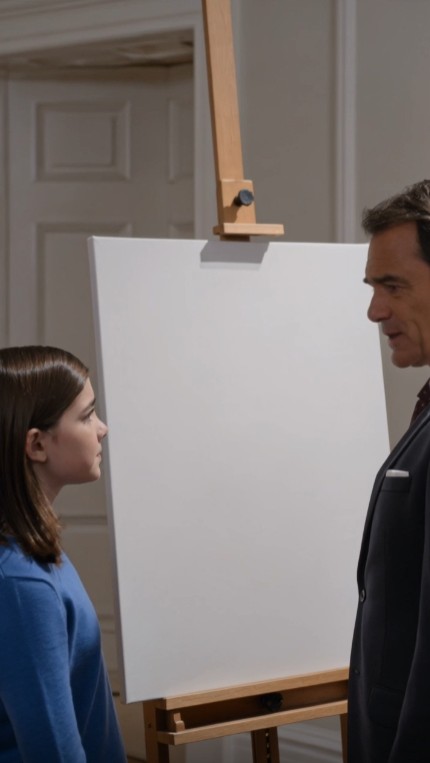
Everyone laughed when the sixteen-year-old girl entered the art competition carrying a completely white canvas.
Her name was Lily.
She was the youngest finalist in the regional exhibition.
Around her hung enormous paintings.
Bright landscapes.
Detailed portraits.
Abstract pieces full of color.
Then there was Lily’s canvas.
White.
Nothing else.
The head judge stared at it.
“Is this supposed to be a joke?”
A few people laughed.
Lily remained beside the painting.
“No, sir.”
The judge folded his arms.
His name was Daniel Bennett.
He had spent more than forty years in the art world.
He had taught.
Curated exhibitions.
Judged competitions.
And he had very little patience for what he considered gimmicks.
He looked at the canvas again.
“No colors.”
“No visible drawing.”
“Not even a brushstroke.”
Then he looked at Lily.
“What exactly am I supposed to judge?”
Lily pointed toward the gallery spotlight.
“Could you move that light?”
Daniel sighed.
One of the assistants glanced at him.
He nodded reluctantly.
“Go ahead.”
The assistant slowly adjusted the spotlight.
The light moved from directly above the canvas toward the side.
And suddenly the laughter stopped.
Something began appearing.
A line.
Then another.
A forehead.
A nose.
Round glasses.
A gentle smile.
The entire portrait had been built from tiny raised areas in the white surface.
No colored paint.
No obvious pencil marks.
Only texture.
When the light hit from the side, shadows revealed everything.
An elderly woman appeared across the canvas.
Every detail was subtle.
Beautiful.
Her hair.
The wrinkles beside her eyes.
The faint curve of her smile.
Daniel stepped closer.
His expression changed.
“Move the light again.”
The assistant did.
The portrait almost disappeared.
Then reappeared from another angle.
Daniel reached toward the canvas, then stopped himself before touching it.
“How did you make this?”
Lily smiled.
“Layered gesso and tiny tools.”
“Who taught you?”
“My mother.”
Daniel looked at her.
“What is your mother’s name?”
“Elena Carter.”
Daniel stopped breathing for a moment.
The room was quiet enough that Lily heard him whisper:
“No.”
He turned slowly.
On the far wall hung an old black-and-white photograph from the gallery’s history.
A group of young artists stood outside the building nearly twenty-five years earlier.
One woman in the photograph looked exactly like the person on Lily’s canvas.
Round glasses.
Same smile.
Same eyes.
Daniel walked toward the photograph.
Lily followed.
He pointed at the woman.
“Is that your mother?”
Lily stared.
“Yes.”
She looked surprised.
“I’ve never seen this picture.”
Daniel’s eyes filled with tears.
“Your mother never told you?”
“Told me what?”
Daniel looked at Lily for several seconds.
Then said:
“She was my student.”
Lily smiled slightly.
“I knew she went to art school.”
Daniel shook his head.
“No.”
“She wasn’t just a student.”
He looked back toward the portrait.
“She was the most gifted artist I ever taught.”
Lily’s smile disappeared.
Her mother had never described herself that way.
Elena worked from home restoring old furniture.
She painted occasionally.
Mostly for herself.
Lily grew up seeing sketches tucked into drawers.
Half-finished canvases behind cupboards.
Small sculptures on shelves.
But Elena always called art a hobby.
Daniel looked at Lily.
“Do you know what this competition is called?”
“The Bennett Emerging Artist Prize.”
“Do you know how it started?”
Lily shook her head.
Daniel pointed toward Elena’s photograph.
“Because of her.”
The room went completely silent.
Twenty-four years earlier, Elena Carter had entered the same gallery with a piece nobody understood.
It looked like a blank panel.
Daniel had been a young instructor then.
Several teachers dismissed it.
One even told Elena she had submitted unfinished work.
But when Daniel moved a lamp beside the piece, an image appeared.
A child sitting near a window.
Created entirely through relief and shadow.
The technique was unusual.
Subtle.
And incredibly difficult.
Daniel immediately understood what Elena was trying to do.
He helped her enter several exhibitions.
Within two years, she began receiving attention.
Then one day, she disappeared from the program.
No announcement.
No graduation exhibition.
No explanation.
Lily stared at him.
“Why?”
Daniel looked toward her.
“I hoped you could tell me.”
She shook her head.
“My mother never talks about school.”
Daniel became quiet.
Then another judge spoke.
“Maybe this isn’t the place for a family history lesson.”
Daniel nodded.
He was right.
The competition still needed to be judged fairly.
Lily’s work could not win simply because Daniel knew her mother.
So Daniel did something nobody expected.
He removed himself from scoring Lily’s piece.
“I have a personal connection to the artist’s family.”
“The other judges should evaluate it.”
Lily looked relieved.
She did not want special treatment.
The judging continued.
The remaining panel examined her technique.
The craftsmanship.
The stability of the raised surface.
How successfully the portrait changed under different lighting.
They asked Lily questions.
She answered all of them herself.
No references to Elena.
No emotional advantage.
When the scores were eventually announced, Lily won second place.
Not first.
And she was thrilled.
Daniel smiled when he saw her reaction.
“You’re happy with second?”
“I thought they were going to throw me out twenty minutes ago.”
He laughed.
Then asked:
“Would your mother come here?”
Lily hesitated.
“She’s outside.”
Daniel stared.
“What?”
“She didn’t want to come inside.”
Lily explained.
Elena had driven her to the gallery.
But when she saw the building, she suddenly said she would wait in the car.
She claimed she had a headache.
Lily hadn’t questioned it.
Now she understood.
Daniel walked toward the entrance.
Then stopped.
“Maybe you should ask her first.”
Lily nodded.
She went outside alone.
Elena sat in the parked car.
When Lily approached carrying the second-place certificate, her mother immediately smiled.
“You did it?”
“Second.”
Elena hugged her.
“I knew you could.”
Then Lily asked:
“Mom, why didn’t you tell me about Daniel Bennett?”
Elena went completely still.
Lily continued.
“He recognized you.”
Elena looked toward the gallery doors.
“He’s here?”
“Yes.”
For a moment she looked like she might drive away.
Then Lily said:
“He told me this competition exists because of you.”
Elena laughed sadly.
“That sounds like Daniel.”
“Is it true?”
Elena looked down.
“Partly.”
Then Lily asked the harder question.
“Why did you stop?”
Elena took a long breath.
She had not planned to tell the story that day.
But after twenty-four years, avoiding it suddenly seemed more difficult than speaking.
When Elena was twenty-one, she had been one of the strongest students in the program.
She loved working with texture.
She loved the idea that an image could exist without color.
Visible only when someone looked from the right place.
Daniel encouraged her.
Other teachers did too.
Then Elena’s mother became seriously ill.
Elena was an only child.
There was nobody else to provide daily care.
She began missing classes.
Then exhibitions.
Then deadlines.
At first, she believed it would last a few months.
It lasted almost three years.
By the time her mother died, Elena had no money left.
Her place at the program was gone.
Her confidence was gone too.
Daniel had written.
Called.
Tried to help.
But Elena stopped answering.
She felt ashamed.
Lily frowned.
“Ashamed of what?”
“Leaving.”
“But you had to.”
“I know that now.”
“At twenty-one, I thought everyone else was moving forward while I had failed.”
So she took practical work.
Furniture restoration.
Decorative painting.
Anything that paid reliably.
Then Lily was born.
Elena loved being a mother.
She loved the life she built.
But she never returned to the gallery.
Not because Daniel had rejected her.
Because she had convinced herself that the artistic part of her life belonged to someone younger.
Lily looked at her.
“Then why did you teach me?”
Elena smiled.
“Because I didn’t want you to be afraid of making things.”
“You taught me your technique.”
“Yes.”
“Did you know what I was entering?”
“I knew you were entering a white relief portrait.”
“Did you know it was his competition?”
Elena looked guilty.
“Yes.”
Lily stared.
“You knew?”
“I saw the name on the form.”
“Then why didn’t you tell me?”
“Because I wanted your work to enter the room before my story did.”
Lily understood.
Her mother did not want anyone comparing her daughter with a former student.
She wanted Lily judged as Lily.
Then Lily asked:
“Who is the woman in my portrait?”
Elena looked confused.
“You know who she is.”
“Grandma.”
The portrait was Elena’s mother.
Lily’s grandmother.
A woman Lily knew only through photographs.
Elena had given Lily an old picture months earlier when she needed a subject for the competition.
She never explained the connection to the gallery.
Now everything connected.
The technique.
The woman.
The competition.
Lily reached for the car door.
“Come inside.”
Elena shook her head.
“No.”
“Mom.”
“I’m not ready.”
Lily thought for a moment.
Then smiled.
“You taught me that the picture only appears when the light moves.”
Elena looked at her.
“So?”
“Maybe you’ve been standing in the wrong light for twenty-four years.”
Elena stared at her daughter.
Then laughed.
“That is extremely dramatic.”
“I’m sixteen.”
“That’s fair.”
Eventually, she got out of the car.
When Elena entered the gallery, Daniel was standing near Lily’s canvas.
He turned.
Neither moved.
Then Daniel smiled.
“You’re late.”
Elena laughed.
“Only twenty-four years.”
They hugged.
Not dramatically.
Not like two people recovering a lost romance.
There had never been one.
They were teacher and student.
Mentor and artist.
Two people whose story had ended without either understanding why.
Daniel stepped back.
“You disappeared.”
“I know.”
“I thought I did something wrong.”
“You didn’t.”
“I wrote you.”
“I know.”
“I called.”
“I know.”
“You could have answered once.”
Elena nodded.
“I should have.”
Daniel looked at Lily.
“Your daughter is annoyingly talented.”
Elena smiled.
“I know.”
Lily rolled her eyes.
Then Daniel asked Elena something that made her uncomfortable.
“Do you still work?”
“With furniture.”
“That wasn’t what I asked.”
Elena looked toward the white portrait.
“Sometimes.”
“Show me.”
“No.”
“Elena.”
She laughed.
“You haven’t changed.”
Neither had he.
Over the following weeks, Daniel encouraged her to bring several pieces to the gallery.
Elena refused three times.
On the fourth invitation, Lily packed two of her mother’s relief panels into the car without asking.
Elena was furious.
Until Daniel saw them.
One showed an elderly man’s hands resting on a workbench.
Another showed a mother brushing a child’s hair.
Both appeared almost blank under direct light.
Then became detailed images as the light moved.
Daniel stood silently.
“You kept doing it.”
Elena shrugged.
“Sometimes.”
“You told your daughter you quit.”
“I stopped showing anyone.”
“That isn’t the same thing.”
He was right.
Elena had never stopped being an artist.
She had simply stopped letting anyone see it.
Months later, the gallery held a small exhibition.
Not a grand comeback.
Not a celebrity event.
Just twelve pieces.
The exhibition was called:
WHERE THE LIGHT FALLS.
Two artists were listed.
Elena Carter.
Lily Carter.
One wall displayed Elena’s work.
The opposite wall displayed Lily’s.
In the middle hung the portrait from the competition.
The portrait of Elena’s mother.
Beneath it was a small description written by Lily:
My grandmother taught my mother to keep going.
My mother taught me how to make this.
Daniel stood near the entrance the entire evening.
At one point, Lily asked:
“What did you mean when you said the competition existed because of Mom?”
Daniel explained.
After Elena disappeared from school, he began noticing how many talented young artists left programs because life interrupted them.
Money.
Family care.
Illness.
Work.
Not lack of talent.
So years later, when he helped create the Bennett Emerging Artist Prize, he insisted it remain open to young artists outside traditional art schools.
No degree required.
No gallery representation.
No expensive materials.
Just work.
“Elena made me understand how easily institutions confuse opportunity with talent.”
Lily looked toward her mother.
“So the competition wasn’t named after her.”
“No.”
“But the rules were partly because of her.”
“Yes.”
That was the part Elena had never known.
Her absence had changed something.
Not in the way she once dreamed.
But it mattered.
At the end of the exhibition, Daniel adjusted the spotlight over Lily’s original canvas.
Under direct light, the portrait almost disappeared.
Then he moved it sideways.
Her grandmother’s face emerged again.
Elena stood beside Lily.
For a while, neither spoke.
Then Elena said:
“You know what your grandmother used to say?”
“What?”
“Some things aren’t invisible.”
“They’re just waiting for the right light.”
Lily smiled.
“Did she really say that?”
Elena laughed.
“No.”
“I just made it up.”
Lily laughed too.
Years later, Lily would still remember entering that competition and hearing people laugh at her white canvas.
At sixteen, she thought the important moment was when the portrait appeared.
It wasn’t.
The real reveal came afterward.
She discovered that the technique her mother quietly taught her had once been the beginning of a promising artistic career.
That her mother had not stopped because she lacked talent.
Life had simply demanded something else from her.
And the judge who recognized Elena had spent years wondering why his best student vanished.
Lily did not win first place that day.
She gained something stranger.
A piece of her mother’s life that had remained hidden in plain sight.
Just like the portrait.
Always there.
Waiting for someone to move the light.