
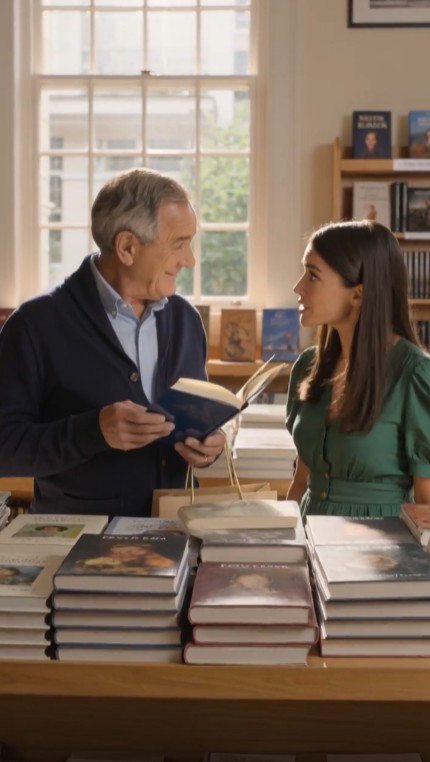
A young author walked into a bookstore and found her seventy-six-year-old grandfather holding her new novel.
At first, she smiled.
Then she noticed something that made her stop.
He was reading the first page.
Slowly.
One word at a time.
Her name was Anna.
His name was George.
And Anna knew something about her grandfather that almost nobody outside the family did.
Reading had always been difficult for him.
George had left school when he was very young.
His father became ill.
The family needed money.
So George went to work.
Factories.
Construction.
Delivery jobs.
Anything that paid.
By the time life became more stable, returning to school felt impossible.
He could recognize common words.
Read signs.
Understand numbers.
Fill out basic forms if he took his time.
But longer paragraphs frightened him.
Books were worse.
George spent most of his life hiding that.
He developed strategies.
At restaurants, he ordered what someone else ordered.
If paperwork arrived, he took it home and asked his wife to “double-check” it.
If someone handed him a long letter, he said:
“I forgot my glasses.”
People rarely questioned him.
Anna had discovered the truth when she was a teenager.
But George made her promise not to tell anyone.
He was embarrassed.
That was the part Anna never understood.
Because the same man who struggled to read had spent her entire childhood filling her room with books.
Whenever Anna asked for one, George found a way to buy it.
He took her to the library.
Carried stacks home.
Waited while she chose another.
When she was six, Anna once handed him a picture book and said:
“Grandpa, read this.”
George looked at the pages.
Then smiled.
“You read it to me.”
Anna thought he was being playful.
So she did.
She sat beside him and stumbled through every sentence.
George listened as if she were performing on a stage.
When she finished, he applauded.
“That was excellent.”
“I got lots wrong.”
“Then tomorrow you’ll get fewer wrong.”
For years, that was how they read together.
Anna read.
George listened.
When she won her first school writing prize, George framed the certificate.
When a teacher told Anna she had talent, George told everyone in the family.
When Anna said at twelve:
“I think I want to write books someday.”
George answered immediately:
“Then write books.”
No hesitation.
No warning that it was difficult.
No lecture about practical careers.
Just:
“Then write books.”
Years later, Anna did.
Her first novel took almost four years.
She wrote before work.
After work.
On weekends.
There were rejections.
Many.
George heard about every one.
Anna once called him crying after receiving another rejection from a publisher.
“Maybe I’m not good enough.”
George answered:
“You know how many times I got turned down for jobs when I was young?”
“That’s different.”
“No.”
“It means someone said no today.”
“That is all.”
“Tomorrow still exists.”
Anna kept trying.
Eventually, a publisher said yes.
When the book was released, George was the first person she called.
“Grandpa.”
“What?”
“It’s happening.”
“What’s happening?”
“My book.”
“They’re publishing it.”
There was silence.
Then George shouted so loudly that Anna had to hold the phone away from her ear.
“I knew it!”
“You absolutely did not.”
“I did.”
“You told me last month you didn’t understand how publishing works.”
“I still don’t.”
“But I knew.”
Anna laughed.
The bookstore launch was scheduled for a Saturday afternoon.
Anna expected George to arrive with the rest of the family.
Instead, she arrived early and found him already there.
Standing alone beside the new-release table.
Her novel was in his hands.
He was reading.
Not pretending.
Actually reading.
His finger moved beneath each line.
His lips formed some of the words silently.
Anna stopped several feet away.
“Grandpa…”
George looked up.
His face changed.
He looked caught.
“What are you doing here early?”
Anna almost laughed.
“This is my book launch.”
“Yes, but early.”
She stepped closer.
“What are you doing?”
George looked down at the novel.
Then gave a nervous smile.
“I’m reading your book, sweetheart.”
Anna stared.
She had never seen him read a full page of anything.
“Since when?”
George shrugged.
“A while.”
Then Anna noticed the shopping bag beside his feet.
Inside was a thin workbook.
She reached down.
“Can I?”
George looked embarrassed.
Then nodded.
Anna opened it.
The first pages contained basic reading exercises.
Short sentences.
Common words.
Handwriting drills.
Some words were crossed out.
Others had been written five or six times.
Several pages were covered in notes.
Chapter.
Character.
Whispered.
Memory.
Promise.
Anna recognized one word immediately.
It was a word from the first chapter of her novel.
Then another.
And another.
She looked at George.
“Grandpa…”
He stared at the floor.
“What is this?”
George sighed.
“I’ve been taking lessons.”
Anna felt tears rising.
“For how long?”
“Eight months.”
“You never told me.”
“I didn’t tell anyone.”
“Why?”
George looked at the novel.
“Because I wanted to see if I could do it first.”
After Anna announced her book deal, George made a decision.
For decades, he had told himself he was too old.
Too embarrassed.
Too far behind.
Then he realized something.
His granddaughter had spent years writing a book.
And George might never be able to read it for himself.
He could listen to the audiobook.
Anna had already offered.
But he wanted something else.
He wanted to sit with the pages.
He wanted to recognize her sentences.
Turn them himself.
Read the dedication without someone else speaking it first.
So George contacted an adult literacy program at a local community center.
His first visit almost ended before it began.
He sat in the parking lot for twenty minutes.
Then drove home.
The next week, he returned.
This time he went inside.
A tutor named Helen met him.
George told her:
“I’m not trying to become a scholar.”
Helen smiled.
“Good.”
“Neither am I.”
“What do you want to do?”
George hesitated.
Then removed a newspaper clipping announcing Anna’s novel.
“I want to read this girl’s book.”
Helen looked at the photograph.
“Your granddaughter?”
George nodded proudly.
“That’s my Anna.”
So they began.
Very slowly.
George practiced sounds.
Word patterns.
Short passages.
Then longer ones.
At home, he practiced secretly.
He kept the workbook inside a toolbox because nobody ever opened it.
Anna laughed through tears when he told her that.
“You hid homework in a toolbox?”
“Nobody suspects education in a toolbox.”
George struggled.
Sometimes badly.
There were evenings when he could not remember a word he had learned the day before.
Days when the letters seemed to blur together.
He became frustrated.
Once, he told Helen:
“This is ridiculous.”
“I’m seventy-six.”
Helen answered:
“Yes.”
“You’ve mentioned that.”
“You think I’m too old?”
“No.”
“I think you’re using your age as an excuse because today was difficult.”
George stared at her.
Then laughed.
“That sounds exactly like something I told Anna.”
“Then apparently you already know the lesson.”
So he continued.
When Anna’s publisher released advance copies, George secretly obtained one through her mother.
He told Anna he wanted a copy for the shelf.
That was true.
But every night, he opened it.
At first, one paragraph took almost an hour.
He marked unfamiliar words.
Copied them into the workbook.
Practiced.
Then tried again.
By the week of the launch, George had made it through the first seven chapters.
Slowly.
But on his own.
Anna held the workbook against her chest.
“You did all this for my book?”
George shook his head.
“Not only for the book.”
“For what, then?”
He thought for a moment.
“For myself too.”
That answer made Anna smile.
George had spent decades assuming his opportunity to learn had expired.
Her novel gave him a reason to test that belief.
But once he started reading, something changed.
He discovered he liked it.
Not every book.
Not every lesson.
But he liked being able to read a letter without hiding.
He liked understanding a newspaper article without asking someone for help.
He liked reading text messages his great-grandchildren sent without squinting and pretending the font was too small.
Anna sat beside him at a small reading table.
Then noticed a bookmark inside her novel.
“What page are you on?”
George reached for the book quickly.
“None of your business.”
“Grandpa.”
“Authors should respect reader privacy.”
She laughed.
Then he became serious.
“There is one part I’ve been practicing.”
Anna looked at him.
“What part?”
George opened the book.
Not to chapter one.
Near the front.
The dedication page.
Anna’s expression changed.
She already knew what it said.
She had written it months earlier.
For Grandpa George,
who bought me books before I could read them,
listened before I knew how to write them,
and never once made me feel that a dream was too big.
George placed his finger beneath the first line.
His hands trembled.
Anna whispered:
“You don’t have to.”
“Yes, I do.”
He began.
“For…”
A pause.
“Grandpa George…”
His voice was slow.
Careful.
He continued.
“Who bought me books…”
Another pause.
“Before I could read them…”
Anna covered her mouth.
George kept going.
“Listened before I knew how to write them…”
He stumbled on the next line.
Stopped.
Tried again.
“And never once made me feel…”
He took a breath.
“That a dream was too big.”
Silence.
Then George looked up.
Anna was crying.
He smiled nervously.
“Was that close enough?”
She hugged him.
So suddenly that the book nearly fell from his hands.
“You read it.”
“I made two mistakes.”
“I don’t care.”
“I care.”
She laughed into his shoulder.
People nearby began noticing.
Anna’s editor approached but stopped when she saw them.
George whispered:
“I wanted those to be the first words from your book I read to you.”
Anna pulled back.
“Why?”
He looked almost surprised.
“Because you spent your whole life reading to me.”
That broke her completely.
As a child, Anna believed she had been practicing when she read stories aloud to George.
She never realized she was also giving him access to something he could not comfortably reach himself.
Now, decades later, the direction had reversed.
George was reading to her.
The bookstore event began shortly afterward.
Anna spoke about the novel.
Answered questions.
Signed copies.
Then someone in the audience asked:
“Who was the biggest influence on you becoming a writer?”
Anna looked toward George.
He was sitting in the second row.
Her answer came easily.
“My grandfather.”
George shook his head immediately.
Anna smiled.
“He thinks that’s not true.”
The audience laughed.
“But when I was little, he bought me more books than we could afford.”
“He listened to every terrible story I wrote.”
“And whenever I said I wanted to become an author, he treated it as though I had announced something completely ordinary.”
“Like of course I could.”
She paused.
“And today I learned he has spent the last eight months learning to read more confidently because he wanted to read my book himself.”
The room became very quiet.
George looked mortified.
“You weren’t supposed to tell everybody.”
Anna laughed.
“Too late.”
People applauded.
George waved them off.
But his eyes filled.
After the event, several people approached him privately.
One elderly woman said:
“I’ve always struggled too.”
George looked at her.
“Go to the community center.”
Another man admitted he had difficulty reading forms.
George gave him Helen’s program information.
Within months, something unexpected happened.
The literacy program received several new older students who said they had heard George’s story.
George hated that people called it inspirational.
“I’m doing homework,” he complained.
But he kept going.
A year later, he completed his first entire novel.
Anna’s.
It took him almost fourteen months.
When he finished the final page, he called her.
“I have a complaint.”
Anna laughed.
“What?”
“The ending.”
“What’s wrong with it?”
“I wanted another chapter.”
“That is the nicest complaint I’ve ever received.”
George eventually read other books.
Short ones first.
Then longer ones.
His speed improved.
His confidence improved more.
But Anna kept one object above her writing desk.
George’s first workbook.
He eventually gave it to her.
The pages were messy.
Words repeated.
Corrections everywhere.
Nothing beautiful about it.
Except what it represented.
Next to it sat the photograph taken at the bookstore.
George holding Anna’s novel.
Anna beside him.
Both crying.
Years later, when Anna published another book, George received the first copy.
Inside she wrote:
This time, Grandpa, you have no excuse not to read the whole thing.
He called immediately.
“You writers are very demanding.”
“You created this problem.”
“How?”
“You told me I could become anything.”
George laughed.
“Fair.”
The most important thing George gave Anna was never money for books.
It was never rides to school.
Never even the confidence to become a writer.
It was the example that learning does not have an expiration date.
For most of his life, he carried a secret he thought made him lesser than other people.
Then, at seventy-six, he finally challenged it.
One workbook.
One word.
One page at a time.
All because the little girl who once sat beside him reading picture books had grown up and written one of her own.
And when Anna found him in that bookstore, the greatest moment was not seeing her novel in his hands.
It was hearing him slowly read the dedication aloud.
Words she had written for him.
Words he had worked for months to be able to read himself.
He had given her a lifetime of stories before he could comfortably read them.
And now, at last, she got to hear one come back in his own voice.