
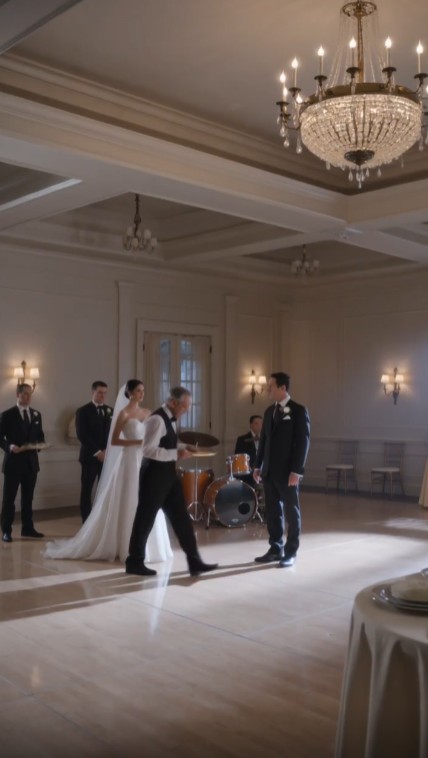
The bride and groom were about to begin their first dance…
When the entire band suddenly stopped playing.
Not one musician moved.
The bride looked confused.
“What happened?”
The bandleader wasn’t looking at her.
He was staring across the ballroom.
At an elderly caterer carrying a tray of empty glasses.
The caterer noticed.
His face changed.
He quietly turned around…
And started walking toward the kitchen.
The bandleader stepped away from the stage.
“Sir!”
The caterer stopped.
Everyone watched.
The bandleader walked closer.
Then asked:
“Where did you learn to do that?”
The caterer frowned.
“Do what?”
The musician tapped a rhythm against his leg.
Tap.
Tap-tap.
Pause.
Tap.
The caterer’s eyes widened.
Without thinking…
He finished the rhythm.
Tap-tap.
The bandleader went completely still.
The bride whispered:
“What’s happening?”
The musician asked:
“What’s your name?”
“Henry Walker.”
The bandleader’s eyes filled with tears.
Then he turned toward the drummer.
“Play number seventeen.”
The drummer hesitated.
“We’ve never played seventeen publicly.”
“I know.”
They started.
A completely unfamiliar melody filled the ballroom.
Henry dropped his towel.
Not the tray.
Just the towel.
He stared at the stage.
Then whispered:
“Where did you get that song?”
The bandleader answered:
“From the man who spent forty years looking for you.”
Henry grabbed the back of a chair.
“Who?”
The bandleader looked toward the ballroom entrance.
The doors opened.
And suddenly…
the wedding wasn’t the reason everyone was crying anymore.
The bandleader’s name was Daniel Carter.
He was forty-two years old.
And until three months earlier, the strange melody known to his band only as Number Seventeen had never been played outside rehearsals.
Daniel’s father, Thomas Carter, had written it.
But he’d never considered it finished.
For as long as Daniel could remember, an old yellow folder had lived inside his father’s piano bench.
On the front, Thomas had written:
17 — H.W.
Daniel had asked about it as a teenager.
“What’s H.W.?”
Thomas closed the folder.
“Someone I knew.”
“Who?”
“Someone I lost.”
Daniel assumed he meant someone who had died.
He was wrong.
Thomas had grown up in a working-class neighborhood nearly fifty years earlier.
His family lived in a small apartment above a hardware store.
They didn’t have much money.
But when Thomas was twelve, his mother found an old upright piano being given away by a church.
It was badly out of tune.
Two keys stuck.
One pedal didn’t work.
Thomas loved it anyway.
He taught himself simple melodies.
Then, when he was fourteen, he met Henry Walker.
Henry lived three blocks away.
He didn’t play piano.
He played drums.
Or at least he claimed he did.
His “drum kit” consisted of two paint cans, an upside-down bucket and a cracked cymbal his uncle had given him.
Thomas thought it was ridiculous.
Henry thought Thomas’s piano was worse.
They became best friends.
Every afternoon after school, Henry went to Thomas’s apartment.
Thomas played.
Henry tapped rhythms against the piano, the wall, the floor or his knees.
One particular rhythm became their signal.
Tap.
Tap-tap.
Pause.
Tap.
The answer:
Tap-tap.
Nobody remembered exactly how it started.
Sometimes Henry tapped the first half from the sidewalk below Thomas’s window.
Thomas answered against the glass.
Sometimes Thomas tapped it on a classroom desk.
Henry finished it from across the room.
It simply meant:
I’m here.
Over time, the boys began writing music together.
Thomas created melodies.
Henry created rhythms.
Neither could properly notate everything.
So they invented their own system.
Arrows.
Numbers.
Dots.
Circles.
Notes in the margins.
Their seventeenth attempt was different.
Thomas played four slow notes.
Henry added the familiar rhythm underneath.
Then Thomas changed the melody.
Henry changed the rhythm.
They spent weeks on it.
It became the first piece they both thought sounded like an actual song.
At the top of the page, Thomas wrote:
17
Henry added:
Don’t ruin this one.
Thomas crossed it out.
Henry wrote it again.
They planned to perform it at their school’s spring concert.
They never did.
Two weeks before the concert, Henry disappeared.
Thomas went to his apartment.
Empty.
He knocked on a neighbor’s door.
The woman told him Henry’s family had moved.
“Where?”
She didn’t know.
Henry’s father had lost his job.
There had been financial problems.
Arguments.
Then one morning a truck arrived.
By afternoon, they were gone.
This was decades before social media.
Before everyone carried a phone.
Thomas had no email address.
No mobile number.
He had only Henry’s old home address.
And Henry no longer lived there.
Thomas wrote three letters anyway.
All were returned.
He asked the school.
They couldn’t give him useful information.
He asked friends.
Nobody knew.
Weeks became months.
Months became years.
Thomas finished high school.
Henry never returned.
But Thomas kept Number Seventeen.
He couldn’t finish it.
Every time he tried, something felt wrong.
The melody belonged to him.
But the rhythm belonged to Henry.
Thomas eventually studied music.
He became a teacher.
Then a composer and arranger for local theater productions.
He married a woman named Margaret.
They had Daniel.
Life moved forward.
But Number Seventeen remained inside the piano bench.
Every few years, Thomas searched for Henry.
Telephone directories.
Old classmates.
Alumni lists.
Later, the internet.
The problem was the name.
Henry Walker.
Hundreds of them.
Thomas found one in Texas.
Wrong age.
Another in Ohio.
Wrong family.
Another had died years earlier.
Thomas never knew where Henry’s family had gone after leaving town.
Meanwhile, Henry’s life had gone in a completely different direction.
His father had moved the family nearly nine hundred miles away.
Henry was fifteen.
He had no choice.
The move happened quickly because his father had found temporary work.
Henry thought they’d return.
They didn’t.
He wrote Thomas a letter.
But he sent it to the apartment.
Thomas’s family moved less than a year later.
The letter was returned.
Henry tried contacting the school.
Thomas had already graduated.
Then Henry’s mother became ill.
His father worked long hours.
Music disappeared from Henry’s life.
The homemade drums were left behind during another move.
By twenty, Henry was working in hotel kitchens.
Then restaurants.
Then event catering.
He married.
Raised two children.
Later divorced amicably.
Worked.
Paid bills.
Became a grandfather.
The years accumulated.
Thomas became a story from adolescence.
But Henry never forgot the rhythm.
Tap.
Tap-tap.
Pause.
Tap.
Tap-tap.
Sometimes he caught himself doing it while waiting for an elevator.
Or tapping a serving tray.
Or standing in a kitchen.
Nobody ever answered.
Then, forty years after the boys lost contact, Thomas received an unexpected envelope.
It came from his old high school.
Inside was a photocopy of a document discovered during an archive cleanup.
A program from the spring concert they had never performed.
Someone had written beside Number 17:
Thomas Carter / Henry Walker — withdrawn
Thomas stared at Henry’s name.
He started searching again.
This time Daniel helped.
They found former classmates.
Old addresses.
Public records.
Nothing gave them a confident match.
Then Thomas’s health began declining.
Not dramatically at first.
He was simply getting older.
His hands became stiff.
Playing piano became difficult.
Daniel eventually asked:
“Why does finding Henry matter so much?”
Thomas thought for a long time.
Then answered:
“Because he disappeared before either of us was old enough to understand that people can vanish without choosing to leave you.”
Daniel never forgot that.
Thomas finally told him the whole story.
Including the rhythm.
Including Number Seventeen.
Including something Daniel had never known.
Thomas had finished the melody years earlier.
He just refused to call it finished.
“Why?”
“Because I don’t know if Henry would’ve liked the ending.”
Daniel laughed.
“After forty years?”
“Especially after forty years.”
Thomas gave Daniel the yellow folder.
Inside were pages covered in teenage handwriting.
And newer pages written decades later.
On the final sheet, Thomas had written:
If Henry is ever found, play this for him before telling him anything. If he recognizes it, you’ll know.
Daniel stared at his father.
“You think I’m going to randomly encounter this man?”
Thomas smiled.
“No.”
“Then what’s the plan?”
“Keep looking.”
Daniel did.
Then Thomas died.
He was seventy-six.
That was three years before the wedding.
Daniel inherited the piano.
The yellow folder remained inside the bench.
For a while, Daniel couldn’t open it.
Eventually he did.
He arranged Number Seventeen for his band.
But he refused to perform it publicly.
He told the musicians:
“This belongs to someone we haven’t found yet.”
They rehearsed it occasionally.
Mostly because Daniel didn’t want the piece to disappear.
The drummer jokingly called it “the secret song.”
Then, three months before the wedding, Daniel received a message from a woman named Rachel Walker.
She had seen an old alumni post Daniel had shared asking about Henry.
Rachel’s father was named Henry Walker.
Correct age.
Correct school.
Correct childhood neighborhood.
Daniel called her.
“Did your father ever know someone named Thomas Carter?”
Rachel became quiet.
“I’ve heard that name.”
Daniel nearly dropped the phone.
“Where?”
“My father mentioned him years ago.”
“Can I speak to Henry?”
Rachel hesitated.
Her father had recently gone through a difficult period.
He’d lost his longtime partner the previous year.
He’d also retired from full-time catering, although he still worked occasional events because he hated sitting at home.
Rachel didn’t want a stranger arriving with an emotional story unless she was certain.
So Daniel sent her one question.
Ask him what comes after: tap, tap-tap, pause, tap.
Rachel called back eleven minutes later.
Her voice was shaking.
“He answered with two taps.”
Daniel closed his eyes.
They’d found Henry.
But Rachel asked Daniel not to contact him immediately.
Henry’s seventy-third birthday was approaching.
She wanted to tell him carefully.
Daniel agreed.
Then life complicated the plan.
Rachel’s daughter had a baby.
Henry traveled to help.
Daniel’s band began a packed wedding season.
Calls were missed.
Dates changed.
They kept planning to arrange a meeting.
It hadn’t happened yet.
Then came Emily and Marcus Reed’s wedding.
Daniel’s band had been booked almost a year earlier.
The caterer was supplied by the venue.
Daniel knew none of the staff names.
Henry had accepted the shift that morning because another caterer was sick.
Neither man knew the other would be there.
During dinner service, Daniel noticed the elderly caterer.
But he didn’t recognize him.
He’d never seen a recent photograph of Henry.
Rachel had intentionally avoided sending one because she wanted the eventual introduction to be personal.
Then, while waiting for the bride and groom’s first dance, Daniel heard something.
A caterer was standing near the wall.
Waiting for guests to finish with their glasses.
His fingers were tapping against his leg.
Tap.
Tap-tap.
Pause.
Tap.
Daniel stopped breathing.
He stared across the ballroom.
The caterer finished the rhythm himself.
Tap-tap.
Daniel raised his hand.
The musicians stopped.
The bride looked confused.
“What happened?”
Daniel stepped down.
“Sir!”
Henry turned.
Daniel approached him.
“Where did you learn to do that?”
“Do what?”
Daniel tapped:
Tap.
Tap-tap.
Pause.
Tap.
Henry’s expression changed instantly.
His fingers answered before he seemed to make a conscious decision.
Tap-tap.
Daniel knew.
“What’s your name?”
“Henry Walker.”
Daniel’s eyes filled.
He turned toward the drummer.
“Play Number Seventeen.”
The drummer stared.
“We’ve never played seventeen publicly.”
“I know.”
The bride and groom stood motionless in the center of the ballroom.
Nobody understood.
Then the band began.
Four quiet notes.
A pause.
The rhythm.
Henry’s towel slipped from his hand.
He stared at the stage.
He hadn’t heard that melody since he was fifteen.
But he knew it.
Not every note.
Thomas had changed it.
Expanded it.
Matured it.
But beneath everything was the same piece two teenage boys had created beside a broken piano and two paint cans.
Henry whispered:
“Where did you get that song?”
Daniel answered:
“From the man who spent forty years looking for you.”
Henry grabbed the back of a chair.
“Who?”
Daniel looked toward the ballroom entrance.
The doors opened.
A woman entered.
Henry stared.
It wasn’t Thomas.
It was Rachel.
His daughter.
Beside her was another woman Henry didn’t recognize.
Margaret Carter.
Thomas’s widow.
She was seventy-four.
Henry covered his mouth.
Daniel hadn’t known Margaret would come.
Rachel had finally contacted her two days earlier.
When Rachel learned her father had unexpectedly been assigned to the same wedding where Daniel’s band was performing, she’d called Daniel immediately.
They decided not to manufacture some elaborate reunion.
They simply planned to speak to Henry after his shift.
Margaret asked to come.
She wanted to meet the boy her husband had spent decades trying to find.
But nobody expected Henry to tap the rhythm before the first dance.
That part was coincidence.
Daniel walked toward Margaret.
Henry remained frozen.
Margaret stopped several feet away.
“You’re Henry.”
He nodded.
“You’re Thomas’s…”
“Wife.”
Henry’s eyes moved toward the doors.
He understood before asking.
“Is he here?”
Margaret’s expression answered first.
“No.”
Henry looked down.
“When?”
“Three years ago.”
For several seconds, the ballroom was silent.
Then Henry asked:
“He really looked for me?”
Margaret smiled sadly.
“For decades.”
Henry closed his eyes.
“I looked too.”
“I know.”
“How?”
“Because Rachel told us.”
Henry looked at his daughter.
Rachel was crying.
“I found them, Dad.”
Henry whispered:
“When?”
“Three months ago.”
“You knew?”
“I wanted to make sure.”
Henry nodded.
He wasn’t angry.
He understood.
Then Margaret handed him something.
The yellow folder.
Henry recognized Thomas’s handwriting immediately.
17 — H.W.
His fingers trembled.
“He kept this?”
“All his life.”
Henry opened it.
The first pages were written by two teenagers.
Thomas’s notes.
Henry’s ridiculous symbols.
Arguments in the margins.
At the top of one page:
Don’t ruin this one.
Crossed out.
Then written again.
Henry laughed through his tears.
“I wrote that.”
Margaret nodded.
“He told me.”
Near the back was a letter.
Henry,
If you ever hear Number Seventeen again, Daniel probably found you.
Henry stopped reading.
He looked at Daniel.
“You’re his son.”
Daniel nodded.
“My name’s Daniel Carter.”
Henry stared at him.
“You have his eyes.”
Daniel smiled.
“So I’ve been told.”
Henry returned to the letter.
Thomas had written it several years before his death.
It wasn’t an apology for failing to find Henry.
It wasn’t a dramatic farewell.
It was Thomas being Thomas.
You still owe me for the cracked piano bench.
Henry laughed loudly.
Several wedding guests laughed with him, even though they didn’t know why.
Thomas continued:
I spent years wondering whether you left because you wanted to. Then I got old enough to realize fifteen-year-olds don’t usually control where their families move.
If you tried to find me too, I’m sorry we missed each other.
If you didn’t, that’s okay. Life happened.
I finished Number Seventeen, but I left the rhythm exactly where you put it.
Then came the final paragraph.
We were kids when we started it. If you hear it again, don’t think of it as forty years late. Think of it as finally getting to the next measure.
Henry lowered the letter.
The ballroom had gone completely quiet.
Then he looked toward the bride and groom.
And suddenly appeared horrified.
“Oh no.”
Emily, the bride, blinked.
“What?”
Henry pointed toward the dance floor.
“Your first dance.”
Everyone had forgotten.
Including the bride.
Daniel immediately apologized.
“I’m so sorry.”
Emily shook her head.
“No.”
She looked at Henry.
“Finish the song.”
Henry stared at her.
“This is your wedding.”
“And that’s your song.”
Marcus, the groom, nodded.
“We can wait three minutes.”
Henry shook his head.
“I haven’t played anything in fifty years.”
Daniel smiled.
“You don’t need drums.”
He tapped against his leg.
Tap.
Tap-tap.
Pause.
Tap.
Every person in the ballroom looked at Henry.
Henry smiled.
Then answered.
Tap-tap.
The band continued.
This time, Henry listened to the entire piece.
Thomas had written a gentle middle section.
Then the melody grew.
The rhythm returned.
And at the end, instead of resolving with a large final chord, the music became quiet.
Four notes.
Then two.
Henry laughed.
“He changed the ending.”
Daniel nodded.
“Several times.”
“He always did that.”
When the song ended, nobody moved for a second.
Then the room applauded.
Henry didn’t bow.
He simply held Thomas’s yellow folder against his chest.
Daniel approached the bride and groom.
“Ready?”
Emily smiled.
“Now we are.”
The band began their actual first-dance song.
Henry stepped toward the kitchen.
Margaret stopped him.
“Where are you going?”
“I’m working.”
The catering manager, who had been watching everything, shook her head.
“Not for the next ten minutes.”
Henry laughed.
So he stayed.
He stood beside Margaret and watched the couple dance.
After the wedding, Henry, Rachel, Margaret and Daniel sat at one of the empty tables.
The ballroom staff cleaned around them.
Henry told stories about Thomas at fifteen.
Thomas lying about knowing piano chords.
Thomas refusing to admit when Henry’s rhythm was better.
Thomas’s terrible haircut.
Margaret laughed harder than anyone.
Then she told Henry about the man Thomas became.
A teacher.
A husband.
A father.
A grandfather.
Henry learned that Thomas had kept music in his life.
Thomas had learned, before his death, that Henry had probably built a life somewhere too.
Neither had spent forty years frozen in the past.
They had simply carried one unfinished piece with them.
Daniel asked:
“Do you want the original folder?”
Henry looked surprised.
“No.”
“It has your writing in it.”
“And your father’s.”
Daniel hesitated.
Henry smiled.
“Make me a copy.”
So Daniel did.
A week later, Henry visited Margaret’s house.
The old upright piano was there.
Not the childhood piano.
That one had been lost decades earlier.
But Thomas’s later piano.
Daniel sat at it.
Henry stood beside him.
“Number Seventeen?”
Henry smiled.
“One condition.”
“What?”
“Your father got the ending wrong.”
Daniel laughed.
“You’re criticizing a dead composer’s work?”
“I’ve been waiting fifty years.”
They spent the afternoon changing four measures.
Daniel recorded Henry tapping several rhythms.
They didn’t pretend they were recreating the exact song two teenagers would’ve written.
That song was impossible to recover.
They were doing something else.
Finishing it together.
When the revised version was complete, Daniel changed the title.
Not publicly.
Just on the sheet music.
NUMBER SEVENTEEN — CARTER/WALKER
Henry stared at it.
“You don’t need my name.”
“My father disagreed.”
“How do you know?”
Daniel opened the original folder.
On the first page, beneath the number 17, Thomas had written two initials.
T.C. / H.W.
Henry touched them.
Then nodded.
“All right.”
The following year, Daniel’s band performed Number Seventeen publicly for the first time at a small community concert.
Henry sat in the front row.
Margaret sat beside him.
Rachel sat on his other side.
Before playing, Daniel told the audience only the basic story.
Two teenage friends wrote a song.
Life separated them.
The song survived.
Their families eventually found one another.
Daniel didn’t turn the story into something supernatural.
There had been no mysterious message.
No impossible coincidence beyond Henry happening to work an event where Daniel was performing.
Even that coincidence would have meant nothing if Rachel hadn’t already found Daniel months earlier.
What stopped the wedding band wasn’t fate.
It was a rhythm.
Five taps one way.
Two taps in reply.
A tiny habit two boys had repeated so often that one of them still did it without thinking more than fifty years later.
Henry continued occasional catering work.
Not because he needed to.
Because he liked people.
And because retirement, in his words, involved “far too many weekday afternoons.”
Sometimes wedding guests recognized him after hearing the story.
Henry hated that.
“I’m here to collect your glass, not discuss my adolescence.”
Daniel and Henry became close.
Not as replacements for Thomas.
Nobody could replace him.
But Daniel finally got to know the person represented by the initials H.W.
And Henry got to know the son of the boy he’d once called his best friend.
One afternoon, Henry asked Daniel:
“Did your father really spend forty years looking for me?”
Daniel thought before answering.
“Not every day.”
Henry smiled.
“Good.”
“He had a life.”
“I hoped so.”
“But he never stopped wondering.”
Henry nodded.
“Neither did I.”
Years later, Daniel still kept the original Number Seventeen inside the yellow folder.
The first pages remained exactly as the boys had left them.
Arrows.
Circles.
Crossed-out instructions.
Bad jokes.
And one repeated sentence:
Don’t ruin this one.
Daniel never erased any of it.
At the very bottom of the final page, however, he added one line.
Finished fifty years late.
When Henry saw it, he crossed out the word late.
Daniel looked at him.
“What are you doing?”
Henry picked up the pencil.
Underneath, he wrote:
Finished when we finally found each other.
Daniel didn’t change it.
And whenever his band played Number Seventeen afterward, the piece still contained the same tiny rhythm two boys had created before either understood how easily people could disappear from one another’s lives.
Tap.
Tap-tap.
Pause.
Tap.
And somewhere near the end…
Tap-tap.
The answer.
Still there.