
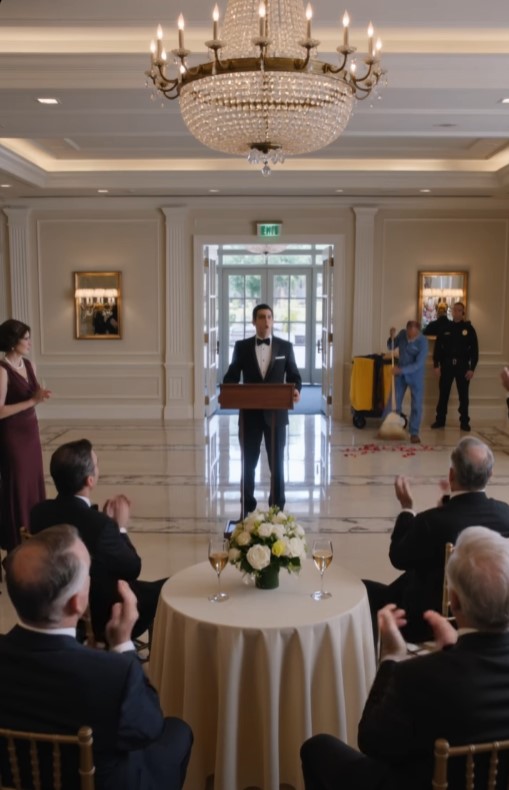
The applause started before the old man even reached the door.
It was not loud at first. Just a few polite claps from people who thought they were watching security handle an embarrassing interruption. Then more guests joined in, smiling into their champagne glasses, whispering to one another as if the evening had just been saved from an unpleasant scene.
To them, he was just a homeless janitor.
A dirty old man with a faded blue shirt, dust-covered boots, and a cleaning cart that looked as if it belonged in an alley behind the hotel, not beneath the crystal chandeliers of the Sterling Grand ballroom.
But they were wrong.
They were not watching a trespasser being removed.
They were watching a billionaire make the biggest mistake of his life.
The Sterling Grand Hotel had always been more than a building. For generations, it stood at the heart of the city like a monument to money, power, and old-world elegance. Presidents had slept in its suites. Movie stars had stepped through its revolving doors. Royal families, senators, billionaires, and oil heirs had all been photographed beneath its famous gold awning.
But time had not been kind to it.
The marble floors had cracked. The velvet curtains had faded. The grand lobby that once smelled of roses and polished wood had begun to smell faintly of dust and old pipes. For years, people said the Sterling Grand’s best days were behind it.
Then Ethan Sterling arrived.
At only thirty-four, Ethan had built a reputation as a ruthless hotel investor with an eye for famous properties and no patience for sentiment. He bought struggling landmarks, stripped away what he called “dead history,” and turned them into luxury playgrounds for the ultra-rich.
When he purchased the Sterling Grand for nearly $200 million, business magazines called him a visionary.
Ethan called himself the man who saved it.
The grand reopening was designed to prove it.
The ballroom glowed beneath chandeliers that had been cleaned for the first time in decades. Thousands of white roses climbed the marble columns. A string quartet played beside a champagne tower. Waiters in black jackets moved through the crowd with silver trays, serving guests who had arrived in private cars and designer gowns.
Investors stood near the stage.
Celebrities posed for cameras.
Politicians laughed too loudly at Ethan’s jokes.
Every detail had been arranged to show the world that the Sterling Grand had returned, not as a piece of history, but as a symbol of Ethan’s power.
At the center of the ballroom, Ethan lifted a glass of champagne and smiled for the cameras.
“This hotel begins a new chapter tonight,” he announced.
The room erupted in applause.
Ethan let it wash over him. He loved that sound. He loved the look on people’s faces when they treated him like a man who could buy anything he wanted and turn it into gold.
Then the ballroom doors opened.
At first, no one paid attention.
An elderly janitor pushed a worn cleaning cart quietly into the room. His steps were slow but steady. His gray beard had not been shaved in days. His work shirt was patched at both elbows, and one sleeve was slightly darker than the other, as if it had been washed too many times.
He did not look at the guests.
He did not interrupt the speech.
He simply stopped near the edge of the marble floor, lowered his broom, and began sweeping a few broken flower petals away from the aisle.
It was a small thing.
Almost invisible.
But Ethan noticed.
His smile tightened.
The cameras were still pointed at him. The investors were watching. The room was filled with people he wanted to impress, and in the corner of his perfect evening stood a man who looked like everything Ethan wanted erased from the hotel’s image.
Ethan lowered his glass.
“Who let him in?”
The music faltered.
A manager hurried forward, his face pale.
“Sir,” he whispered, “he’s just one of the cleaning staff.”
Ethan’s eyes stayed on the old man.
“I don’t care.”
The manager froze.
Ethan pointed across the ballroom.
“My investors didn’t fly across the world to look at homeless people.”
A few guests laughed.
Not everyone. But enough.
The old janitor heard it.
He paused for only a second, then continued sweeping the petals into a small dustpan.
That seemed to make Ethan angrier.
“Throw him out,” he said.
The words landed sharply.
Security guards near the entrance immediately began walking toward the old man.
The janitor did not argue.
He did not raise his voice.
He did not explain who he was or why he was there.
He simply leaned his broom against the wall, gripped the handle of his cleaning cart, and began moving toward the exit.
The guests watched as though the matter had already been settled.
Some looked embarrassed.
Some looked amused.
Some seemed relieved that the messy old man was leaving before he ruined the photographs.
Halfway to the door, the old janitor passed the front table.
That was when an elderly woman stood up.
“No.”
Her voice was not loud, but it cut through the ballroom with the force of a slammed door.
Everyone turned.
The woman was small, elegant, and dressed in a dark green gown with a pearl brooch pinned near her shoulder. Her silver hair was pulled neatly back. She had been sitting quietly among the older guests all evening, barely noticed by the crowd of executives and celebrities.
Now every eye in the room was on her.
Ethan gave a tight smile.
“Mrs. Caldwell,” he said, trying to sound polite, “please sit down. This is just a staffing matter.”
The woman did not sit.
Instead, she walked toward the janitor.
Her steps were slow, but there was nothing weak about them. Security stopped as she passed. The manager stepped aside. Even Ethan looked uncertain for the first time that evening.
The old janitor lowered his eyes.
The woman stopped in front of him and reached into her purse.
From inside, she removed a thick leather folder.
The leather was dark, worn, and cracked at the edges. It looked older than half the people in the room.
She placed it carefully into the janitor’s hands.
Ethan chuckled, though the sound came out thinner than before.
“You can pay him somewhere else,” he said. “This is a private event.”
The woman turned toward him.
Her expression did not change.
“I don’t work for him,” she said quietly.
The ballroom went still.
Then she added, “I work for Mr. Harrison.”
The name moved through the room like a cold wind.
Most of the guests did not understand it.
But the older employees did.
One waiter near the champagne tower nearly dropped his tray. The hotel’s former concierge covered her mouth. The manager’s face went completely white.
Ethan looked irritated.
“Who is Mr. Harrison?”
The old janitor slowly opened the leather folder.
Inside was a stack of old documents, preserved carefully in plastic sleeves. The top page was yellowed with age, but the seal at the bottom was still visible.
The original ownership deed to the Sterling Grand Hotel.
Signed sixty-two years earlier.
The room seemed to stop breathing.
Ethan stared at the page.
Then at the old man.
Then back at the page.
“That’s impossible,” he said.
The elderly woman looked at him with quiet pity.
“No, Mr. Sterling,” she replied. “What’s impossible is that you spent two hundred million dollars without reading what you truly bought.”
The guests began whispering.
Ethan snatched the folder from the janitor’s hands and scanned the first page. His confidence cracked line by line. His jaw tightened. The champagne glass in his other hand trembled slightly.
He had purchased the building.
The land.
The furnishings.
The renovation rights.
But the operating company that held the Sterling Grand name, the historical licensing rights, the service contracts, and the controlling legacy shares had never been part of the sale.
That company still belonged to one man.
The old janitor standing in front of him.
For the first time that night, the janitor looked directly at Ethan.
His voice was calm.
“You bought the building,” he said. “But you never bought the company.”
The ballroom fell completely silent.
No one laughed now.
The cameras were still recording.
Ethan’s face turned red.
“This is a trick,” he snapped. “This man is a cleaner.”
The janitor gave a faint, tired smile.
“I was many things,” he said.
The elderly woman stepped beside him.
“His full name is Samuel Harrison,” she said. “He is the last living son of Thomas Harrison, the original founder of this hotel.”
A gasp moved through the guests.
Ethan shook his head.
“That family disappeared decades ago.”
Samuel lowered his eyes toward the marble floor.
“We didn’t disappear,” he said. “We were pushed out.”
Those words changed the air in the room.
The hotel employees who had worked there for years listened without moving. The investors glanced at one another. The politicians stopped smiling. The celebrities who had been laughing minutes earlier now looked desperate not to be seen reacting.
Samuel rested one hand on the cleaning cart.
“My father built this hotel with borrowed money, broken hands, and twenty years of his life,” he said. “He believed a hotel was not judged by how it treated the rich. He believed it was judged by how it treated the people nobody important noticed.”
Ethan opened his mouth, but no words came out.
Samuel continued.
“When I was a young man, I worked every job in this building. Bellhop. Porter. Kitchen assistant. Night cleaner. Elevator attendant. I knew every hallway, every pipe, every staff entrance. My father made sure I understood the hotel from the basement before I ever stepped into the office.”
He looked around the ballroom.
“I was supposed to inherit it.”
The elderly woman’s eyes filled with tears.
“But after my father died, the board forced my mother out, buried documents, and sold pieces of the property until the Harrison name meant nothing. I fought for years. I lost money. I lost family. I lost almost everything.”
His voice softened.
“But my father had protected one thing they never found.”
He touched the leather folder.
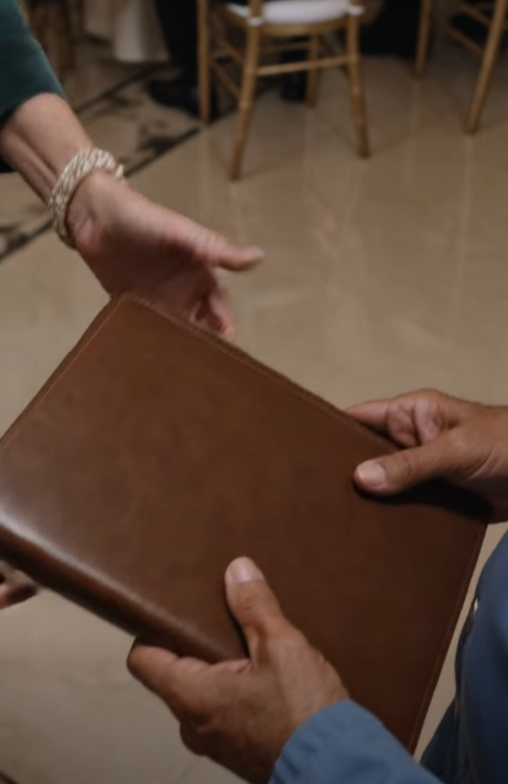
“The company.”
Ethan tried to recover.
“If that were true,” he said, “why would you be pushing a mop?”
Samuel looked at him for a long moment.
“Because I wanted to see what kind of man bought my father’s hotel.”
The words struck harder than any shout could have.
The room went cold.
Samuel explained that for six months, he had worked quietly inside the Sterling Grand under a cleaning contractor’s name. He had watched the renovations. He had listened to managers speak to staff. He had seen which employees were respected and which were ignored.
He had watched Ethan walk past housekeepers without a glance.
He had watched old workers dismissed because they did not fit the new image.
He had watched loyal staff members replaced by people hired only for appearance.
And that night, he had watched Ethan reveal himself in front of everyone.
Ethan looked toward his investors, searching for support.
None came.
Mrs. Caldwell took a document from the folder and held it up.
“The company bylaws are clear,” she said. “The owner of the operating company has final approval over any public use of the Sterling Grand name, any executive appointment, and any management contract attached to the hotel’s legacy identity.”
The manager leaned against a table as if his knees might give out.
Ethan whispered, “You can’t do this.”
Samuel’s face remained calm.
“I didn’t do this,” he said. “You did.”
The cameras moved closer.
Ethan suddenly seemed aware of them.
The same cameras he had invited to capture his triumph were now recording his humiliation.
The same guests who had applauded his speech had now witnessed him insult the one man who held the hotel’s future in his hands.
Samuel turned slowly toward the employees standing near the service doors.
Housekeepers.
Waiters.
Kitchen staff.
Security guards.
Porters.
People who had spent the entire evening making the wealthy feel comfortable while remaining almost invisible.
His voice grew stronger.
“My father used to say the soul of a hotel is not in the chandeliers,” Samuel said. “It is in the hands that polish them.”
A few employees lowered their heads.
Some wiped their eyes.
Samuel looked back at Ethan.
“You wanted a hotel without people like me in it,” he said. “So tomorrow morning, you may have the building.”
He paused.
“But you will not have the name.”
A shock passed through the room.
Ethan stepped forward.
“Do you have any idea what that would cost?”
Samuel nodded.
“Less than what pride already cost you.”
The elderly woman closed the folder.
For a moment, no one moved.
Then something unexpected happened.
A waiter began clapping.
One soft clap.
Then another.
A housekeeper joined.
Then a security guard.
Then the former concierge.
Within seconds, applause spread through the ballroom again.
But this time, it was not for Ethan Sterling.
It was for the man he had tried to throw out.
Ethan stood frozen beneath the chandeliers, surrounded by the sound of his own collapse.
Samuel did not smile.
He simply picked up his broom, placed it back on the cleaning cart, and began walking toward the exit.
Before he reached the door, he stopped and turned back.
“The grand reopening is over,” he said quietly.
Then he looked at the employees.
“But the Sterling Grand may still have a future.”
The old janitor pushed his cart through the ballroom doors and disappeared into the hallway.
No one followed him at first.
They were too stunned.
The cameras kept rolling.
The investors whispered urgently.
Ethan stared at the leather folder as if it had ruined his entire life.
And somewhere beyond the ballroom, Samuel Harrison walked through the hotel his father built, no longer invisible.
The guests had arrived expecting champagne, speeches, and celebration.
Instead, they witnessed a lesson none of them would forget.
Money can buy marble.
It can buy chandeliers.
It can buy cameras, applause, and a room full of powerful people.
But it cannot buy dignity.
And it cannot erase the truth forever.
That night, the billionaire learned that the man he mistook for a homeless janitor was not there to clean his hotel.
He was there to reclaim it.