
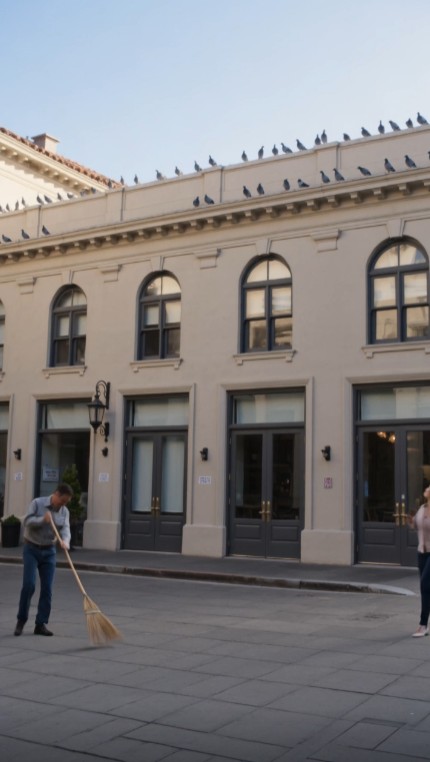
Every morning, hundreds of birds landed on the same rooftop.
Always around the same time.
People in the neighborhood had started filming it.
At 7:30, the roof was empty.
At 7:34, still nothing.
Then an elderly street sweeper turned the corner.
Within seconds, birds began appearing.
First a few.
Then dozens.
Soon, nearly the entire rooftop was covered.
The man never seemed to notice.
He simply continued sweeping the sidewalk.
His name was George.
He had recently returned to work in the neighborhood after being away for years.
A café owner named Maria watched the strange routine for three mornings.
Finally, she couldn’t resist.
She stepped outside.
“George?”
He looked up.
“Yes?”
“Why do they do that?”
George frowned.
“Do what?”
Maria pointed toward the roof.
George turned.
Then stopped.
Hundreds of birds were sitting above him.
His smile disappeared.
“They’re still coming?”
Maria stared at him.
“Still?”
George leaned his broom against the wall.
“You know about this?”
He looked toward the birds.
“Years ago, there were only two.”
Maria crossed her arms.
“Two what?”
“Birds.”
George explained.
Long before he retired from that part of the city, he had worked the same street almost every morning.
Winters were the hardest.
The pavement froze.
Water sources disappeared.
Birds gathered around gutters and puddles that quickly turned to ice.
One morning, George placed a small bird basin behind the building.
He filled it with fresh water.
Two birds arrived.
The following morning, they returned.
George filled the basin again.
Two became five.
Five became twenty.
Over time, more birds began appearing.
George never fed them directly.
He simply made sure there was clean water in a safe place.
He did it every winter morning.
For years.
Then George retired.
He moved to another part of town.
The routine stopped.
Or so he assumed.
Maria looked at him.
“But you’ve been sweeping this street every morning.”
George shook his head.
“I only came back three days ago.”
Maria looked toward the rooftop.
The birds had appeared all three days.
At almost exactly the same time.
George stared upward.
“That doesn’t make sense.”
Then something unusual happened.
Every bird suddenly lifted into the air at once.
The sound of wings filled the street.
They circled the building.
Then crossed the road.
One by one, they landed on a second rooftop.
George stared.
“I’ve never seen them do that.”
Maria looked across the street.
A protected rooftop terrace sat above an older apartment building.
An elderly woman had just stepped outside.
She carried a small metal container.
George dropped his broom.
“Helen?”
The woman looked down.
Then froze.
For several seconds, neither moved.
Maria looked between them.
“You know her?”
George couldn’t answer.
The woman placed the container down.
Then slowly raised one hand.
George raised his.
Maria suddenly realized something.
The birds weren’t reacting only to George.
They knew Helen too.
A few minutes later, Helen came downstairs.
George was waiting on the sidewalk.
They stood several feet apart.
Then Helen laughed.
“You got old.”
George laughed too.
“So did you.”
Maria stared at them.
“What is going on?”
Helen smiled.
“George started the water.”
George shook his head.
“No.”
“You did.”
Maria looked confused.
Helen explained.
Years earlier, she had lived in the same building.
Still did.
Every morning, she watched George fill the little basin behind the café.
She noticed the birds gathering.
One winter, George became ill and missed work for several days.
Helen worried the basin would freeze.
So she went downstairs and filled it herself.
When George returned, he found fresh water waiting.
From that day on, they quietly shared the routine.
George handled mornings.
Helen checked again later.
They rarely spoke.
But the birds became a strange kind of schedule between them.
If the basin was full, one of them had already been there.
If it was empty, the other handled it.
Maria smiled.
“So you two were friends?”
George looked at Helen.
Helen looked at George.
“Not exactly.”
That answer surprised Maria.
George explained.
He and Helen had known each other since they were children.
They grew up only a few streets apart.
They went to the same school.
As young adults, they became close.
Very close.
Then life became complicated.
George married.
Helen married.
They built separate lives.
For decades, they barely saw each other.
Then years later, both ended up in the same neighborhood again.
Older.
Widowed.
Quieter.
That was when the bird routine began.
Maria looked between them.
“So you reconnected because of birds?”
Helen laughed.
“Not at first.”
At first, they simply waved.
Then one morning, Helen left a note near the basin.
Too cold tonight. I’ll check the water at noon.
George answered the next day.
Already done. Stay warm.
The notes continued.
Eventually, coffee followed.
Then conversations.
Then walks.
But neither called it anything.
They were simply two old friends who had found one another again.
Then six years earlier, George disappeared.
Helen looked at him.
“You never said goodbye.”
George lowered his eyes.
His daughter had become ill in another state.
George left suddenly to help her family.
What he expected to be a few weeks became months.
Then years.
His daughter recovered, but George stayed nearby to help raise his grandchildren.
He tried writing to Helen.
But the apartment building changed management.
Mail was returned.
George assumed Helen had moved.
Helen thought George had chosen not to come back.
Maria looked stunned.
“For six years?”
Helen nodded.
“I kept the basin going.”
George looked up.
“You did?”
“Every morning.”
Even after George disappeared, Helen continued filling the water.
At first, because the birds needed it.
Later, because it reminded her of him.
The flock grew.
New generations of birds appeared.
Some stayed only during winter.
Others returned season after season.
The routine outlasted both of them.
Then three days earlier, George came back.
The city department had temporarily reassigned him to help cover the neighborhood route.
The first morning he appeared, the birds gathered on the rooftop again.
Helen hadn’t seen him.
She had been inside.
But the birds had.
George looked toward the roof.
“You think they remembered me?”
Helen smiled.
“Maybe some of them remembered the routine.”
Maria nodded.
“Or they noticed the person who used to appear before the water did.”
George laughed.
That seemed more likely.
Birds respond to repeated patterns, locations, movement, and familiar routines.
Nobody could say exactly what the flock recognized.
But the timing was hard to ignore.
Then Maria asked:
“Why did they all fly to Helen when she came outside?”
Helen pointed upward.
“Because I bring this.”
The metal container held fresh water.
She had been carrying it to the rooftop basin every morning.
The birds had likely learned both routines.
George below.
Helen above.
Two familiar parts of the same daily pattern.
But there was more.
Helen looked at George.
“You really came back only three days ago?”
“Yes.”
She smiled.
“That explains something.”
“What?”
“The birds started gathering earlier.”
George frowned.
Helen had noticed the flock behaving differently.
For years, they usually arrived gradually.
A few at a time.
But three mornings earlier, they suddenly began gathering all at once.
Maria laughed.
“They noticed him before you did.”
Helen shook her head.
“Apparently.”
George looked embarrassed.
Then Helen reached into her coat pocket.
She pulled out a folded piece of paper.
“I kept this.”
George recognized it immediately.
One of their old notes.
The paper read:
If I ever disappear, keep the water going.
George had written it as a joke during a winter storm.
Helen had kept it for six years.
George stared at the note.
“I didn’t mean that literally.”
“I know.”
“Then why keep it?”
Helen looked toward the birds.
“Because you disappeared.”
George looked away.
Maria quietly returned to the café.
She understood this conversation belonged to them.
The following morning, she watched from inside.
7:30.
Empty roof.
7:34.
George appeared.
Birds began landing.
Dozens.
Then hundreds.
At 7:36, Helen stepped onto the terrace.
The flock lifted.
Some remained above George.
Others crossed toward Helen.
For several minutes, the sky between the two buildings seemed full of movement.
George looked up this time.
Then across the street.
Helen waved.
He waved back.
Weeks passed.
George’s temporary assignment ended.
But he continued visiting the neighborhood.
Not every day.
Just often enough.
Sometimes he brought coffee.
Sometimes Helen came downstairs.
They began taking morning walks together.
Maria eventually placed a small sign near the café’s back garden.
Please keep the bird basin clean and filled with fresh water. Do not feed wildlife from the sidewalk.
The routine became a neighborhood tradition.
Not because people wanted to attract huge flocks.
They were careful to keep the area clean and follow local wildlife guidance.
But residents liked the story.
One morning, Maria asked George whether he believed the birds had been waiting for him.
George smiled.
“I think people like making animals part of our stories.”
He looked upward.
“Maybe they were just following a routine.”
Helen joined them.
George handed her coffee.
She smiled.
“Sometimes routines are stories.”
George laughed.
Years later, people in the neighborhood still remembered the mornings when the rooftops filled with birds.
Some remembered George.
Some remembered Helen.
Most remembered both.
But Maria always told the story carefully.
The birds hadn’t performed a miracle.
Nobody knew exactly what they recognized.
What mattered was simpler.
For years, two people had quietly shared one small act of care.
Fresh water.
Same place.
Same time.
Morning after morning.
Then life separated them.
The routine continued anyway.
And when George finally returned six years later, something about that old pattern seemed to begin again almost immediately.
By then, the birds were no longer the biggest mystery.
The real surprise was that two people who thought they had lost each other had spent years returning to the same place for the same reason.
They just hadn’t realized they were still connected.