
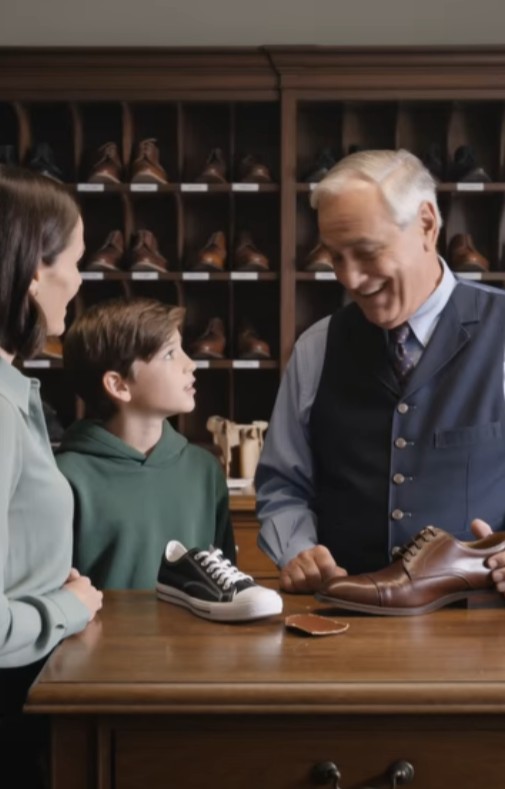
The boy brought two shoes into the repair shop.
One belonged to him.
The other was enormous.
The elderly shoemaker looked at the old brown shoe and laughed.
“Son, I don’t think this one’s your size.”
Eleven-year-old Ethan didn’t smile.
“Can you fix it?”
The shoemaker’s name was Samuel.
He had been repairing shoes in the same small shop for more than forty years.
He picked up the brown shoe and examined the cracked sole.
Then he stopped.
His expression changed.
He turned the shoe over.
Looked closely at the stitching.
Then at a small patch near the heel.
“Where did you get this?”
Ethan pointed toward his mother, Sarah.
“It was Grandpa’s.”
Samuel looked at her.
“Your father’s name?”
“Robert Miller.”
Samuel’s hands froze.
For several seconds, he said nothing.
Then he walked behind the counter and pulled open an old wooden drawer.
He searched through pieces of leather, buckles, laces, and tiny tools.
Finally, he removed a small piece of brown leather.
Same color.
Same age.
Same unusual stitching.
Sarah stared.
“What is that?”
Samuel slowly sat down.
“Your father brought me this shoe thirty-four years ago.”
Ethan looked at him.
“You remember one shoe?”
Samuel shook his head.
“No.”
Then he looked directly at Ethan.
“I remember what your grandfather did when he couldn’t pay me.”
Sarah’s expression changed.
“What did he do?”
Samuel turned toward another drawer.
This one was locked.
He removed a key from around his neck.
Opened it.
And reached inside.
When he turned back, he was holding a small envelope.
The paper had yellowed with age.
On the front was written:
For Robert Miller — if he ever comes back.
Sarah covered her mouth.
“My father?”
Samuel nodded.
“I’ve kept this for thirty-four years.”
Ethan stared.
“What’s inside?”
Samuel looked at Sarah.
“I think you should open it.”
Sarah’s hands trembled as she broke the old seal.
Inside was a folded note.
And a fifty-dollar bill.
Old.
Crisp.
Untouched.
Sarah frowned.
Then she started reading.
Robert,
You came into my shop wearing the only pair of work shoes you owned.
You told me you needed them fixed because you started a new job the next morning.
You had seven dollars.
The repair cost twelve.
You promised to return with the rest.
But that isn’t why I remember you.
Sarah looked up.
Samuel smiled faintly.
“Keep reading.”
The note continued.
When I told you not to worry about the five dollars, you noticed the little boy sitting behind my counter.
My son, Daniel.
You asked why he wasn’t in school.
I told you he had been sent home because I couldn’t afford the shoes required for his school uniform.
You left without saying much.
An hour later, you came back.
Not with the five dollars you owed me.
With a brand-new pair of school shoes for Daniel.
Sarah stopped.
Ethan stared at Samuel.
“Grandpa bought your son shoes?”
Samuel nodded.
“With money he didn’t have.”
Robert had been twenty-seven years old.
Newly married.
Sarah was still a baby.
He had just found work at a warehouse after months of unemployment.
His own shoes were worn almost completely through.
Samuel remembered Robert standing at the counter, embarrassed because he couldn’t afford the repair.
Samuel agreed to fix them anyway.
Then Robert noticed Daniel.
Eight years old.
Sitting quietly in the back of the shop.
His school had introduced a uniform rule.
Daniel needed black shoes.
Samuel had planned to buy them eventually.
But rent came first.
Food came first.
Everything came first.
Robert asked Daniel what size he wore.
Samuel told him not to worry about it.
Robert left.
When he returned later, he placed a shoebox on the counter.
Inside was a simple pair of black school shoes.
Samuel immediately protested.
“You can’t afford this.”
Robert laughed.
“Neither can you.”
Samuel tried refusing.
Robert pushed the box back.
Then said something Samuel never forgot.
“You fixed the shoes that get me to work.”
“Let me fix the shoes that get him to school.”
Sarah began crying.
“That sounds like Dad.”
Samuel nodded.
“I asked him where he got the money.”
Robert had sold the small wristwatch his own father had given him.
Not an expensive watch.
But one of the few things he owned.
Samuel was furious.
He told Robert he had gone too far.
Robert shrugged.
“A watch tells time.”
“Shoes get a kid somewhere.”
Then Robert left.
Samuel expected him back eventually.
Not for payment.
Just because people from the neighborhood usually returned.
But Robert never did.
A few weeks later, Samuel learned that Robert’s new job had transferred him to another town.
Years passed.
The shoe shop stayed.
Samuel’s son grew.
The old brown leather scrap remained in a drawer because Samuel had used it to test the stitching before repairing Robert’s shoe.
For some reason, he never threw it away.
Then Daniel finished school.
Went to university.
And became a teacher.
Sarah looked up.
“He became a teacher?”
Samuel smiled.
“For thirty-one years.”
Ethan looked impressed.
Samuel continued.
Daniel never forgot the stranger who bought him those school shoes.
When he received his first paycheck as a teacher, he gave Samuel fifty dollars.
“Find Robert,” he said.
“Give this to him.”
Samuel laughed at the time.
He told Daniel fifty dollars was far more than the shoes had cost.
Daniel answered:
“It isn’t repayment.”
“It’s for the next person.”
That was the money inside the envelope.
Samuel kept asking around for Robert.
Nobody knew where he had gone.
Eventually, the neighborhood changed.
People moved.
Businesses closed.
Samuel assumed he would never see Robert again.
But he kept the envelope.
Year after year.
Sarah sat quietly.
“My father died three years ago.”
Samuel’s smile disappeared.
“I’m sorry.”
“He never mentioned this.”
“I didn’t expect him to.”
Sarah looked at the old shoe.
After Robert died, the family had sorted through his belongings.
Most of his clothes were donated.
But Ethan found the brown work shoe in an old garage box.
Only one survived.
Its partner had disappeared decades earlier.
Ethan became fascinated by it because Robert had apparently repaired it again and again.
He wanted to use it for a school project about objects people keep.
Then the sole began separating.
Ethan asked whether they could get it repaired.
Sarah almost threw it away.
Instead, she brought it to Samuel’s shop.
Ethan pointed toward the patch.
“Did you do that too?”
Samuel examined it.
“Yes.”
“That was my repair.”
He traced the stitching gently.
“I was still learning this pattern.”
Sarah smiled.
“So Dad kept the shoe all those years.”
Samuel nodded.
“Maybe because he needed it.”
Then Ethan looked at the envelope.
“What happens to the fifty dollars now?”
Samuel turned toward Sarah.
“It belongs to your family.”
She immediately shook her head.
“No.”
“Daniel wanted your father to have it.”
“My father wouldn’t take it.”
Samuel laughed.
“You’re probably right.”
Ethan looked from one adult to the other.
Then said:
“Can we use it for somebody else?”
Both of them stopped.
Ethan continued.
“Grandpa bought Daniel shoes.”
“Daniel gave you money.”
“So maybe we buy shoes for another kid.”
Samuel stared at him.
Then smiled.
“That sounds exactly like something Robert would say.”
Sarah agreed.
But they didn’t stop with fifty dollars.
Samuel placed a small jar on the counter.
On it, he wrote:
ROBERT’S SHOES
No explanation.
No photograph.
Just the name.
Whenever a customer picked up a repaired pair of shoes, they could leave a little extra if they wanted.
Some gave one euro.
Some five.
Others nothing.
Samuel used the money quietly.
If a parent came into the shop unable to afford a necessary repair for a child’s shoes, the jar covered it.
If an elderly customer needed a safe new sole but couldn’t pay the full amount, the jar helped.
No applications.
No public announcements.
No embarrassing questions.
Within months, customers began asking about the name.
Samuel told the story.
A young man once walked into the shop with seven dollars and a broken pair of shoes.
He left having spent even more on somebody else’s child.
The story spread.
Then something unexpected happened.
Samuel’s son Daniel came to visit.
He was retired now.
Samuel showed him the old brown shoe.
Daniel stared at it.
“That’s his?”
Sarah nodded.
Daniel sat down.
For a moment, he looked like the eight-year-old boy Samuel remembered.
“My father told me about you,” Sarah said.
Daniel looked surprised.
“He did?”
Sarah smiled.
“Not by name.”
But after hearing Samuel’s story, she remembered something Robert used to tell Ethan.
Whenever Ethan complained that his shoes were old, Robert would say:
“Good shoes can change where somebody gets to go.”
Sarah had always assumed it was just one of her father’s sayings.
Now she finally knew where it came from.
Daniel touched the old leather patch.
Then looked at Ethan.
“Your grandfather changed my life.”
Ethan shook his head.
“He just bought shoes.”
Daniel smiled.
“At eight years old, sometimes that’s the same thing.”
He explained.
Those shoes allowed him to return to school without being singled out.
But more importantly, he never forgot the stranger who noticed his problem without making him feel ashamed.
Years later, when Daniel became a teacher, he kept an extra pair of simple school shoes in his classroom cupboard.
If a student needed them, he quietly found a way to help.
Over his career, he bought dozens of pairs.
He never told Samuel.
Samuel stared at him.
“You did?”
Daniel laughed.
“You taught me not to announce everything.”
Samuel looked toward the ceiling.
“No. Robert taught you that.”
A week later, Samuel finished repairing Robert’s old shoe.
He replaced the damaged sole carefully but left the original patch untouched.
When Sarah came to collect it, she asked the price.
Samuel shook his head.
“No charge.”
She protested.
Samuel smiled.
“Your father already paid.”
Ethan carried the shoe home.
But it never returned to the garage box.
Sarah placed it inside a simple glass case with the old leather scrap beside it.
Underneath she added a copy of Samuel’s note.
Not the money.
That had gone into Robert’s Shoes.
At the bottom of the display, Ethan wrote one sentence for his school project:
My grandfather once needed somebody to repair his shoe.
Instead, he helped somebody else walk forward.
Years later, Samuel still kept the wooden drawer behind his counter.
The envelope was gone.
The fifty dollars was gone.
But the space remained.
He never filled it.
Whenever Ethan visited, he sometimes asked why.
Samuel always gave the same answer.
“Some drawers are better left open.”
“For what?”
Samuel would smile.
“For whatever kindness comes next.”