
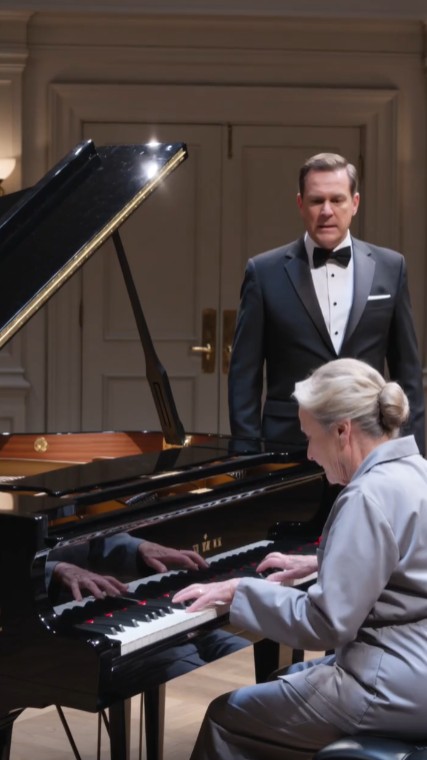
A wealthy concert director caught an elderly cleaner sitting at a $200,000 grand piano.
“GET AWAY FROM THAT PIANO!”
His voice echoed through the empty concert hall.
The woman’s hands immediately left the keys.
Her name was Evelyn.
She was sixty-nine years old.
For almost twelve years, she had cleaned the same stage where internationally known musicians performed.
She polished railings.
Vacuumed carpets.
Collected programs from beneath seats.
And every evening, after the audience disappeared, she carefully cleaned around the enormous black grand piano at center stage.
Nobody had ever seen her touch it.
Until that evening.
The concert director, Richard Bennett, hurried down the aisle.
“That instrument is not for staff use.”
Evelyn slowly stood.
“I’m sorry.”
“Do you have any idea what that piano costs?”
“Yes, sir.”
“Then why were you playing it?”
Evelyn looked down.
“I only wanted to hear something once.”
Richard pointed toward the backstage exit.
“Leave the stage.”
Evelyn nodded.
She did not argue.
But before she could walk away, a voice came from backstage.
“Wait.”
Everyone stopped.
A man stepped through the curtain.
His name was Alexander Vale.
He was one of the most celebrated conductors performing at the hall that season.
He had been rehearsing privately with musicians in another room when he heard several notes through the open backstage door.
Now his face looked unusually pale.
“Who played that melody?”
Richard answered impatiently.
“The cleaner.”
Alexander barely seemed to hear him.
He walked toward the piano.
Then looked at Evelyn.
“Where did you learn that?”
She hesitated.
“From someone I lost.”
Alexander stared at her.
“How long ago?”
“More than forty years.”
Something in his expression changed.
He walked backstage again.
When he returned, he was carrying an old music notebook.
The leather cover was cracked with age.
In one corner was a tiny blue flower painted by hand.
Evelyn saw it.
Her hand went immediately to her mouth.
Alexander noticed.
“You recognize this?”
She nodded slowly.
“My sister painted that flower.”
Richard’s expression changed.
Alexander opened the notebook.
Several pages were filled with handwritten music.
Then he reached one page that had been folded inward for decades.
He carefully opened it.
Inside were several unfinished measures.
Evelyn stepped closer.
Her eyes widened.
The notes matched the melody she had just played.
Below them was a date.
And two initials.
E.M.
Evelyn whispered:
“You were there that night?”
Alexander looked at her.
“Yes.”
Richard stood frozen.
Evelyn sat down again.
Not at the piano.
On the edge of the stage.
Her sister’s name was Margaret.
Forty-three years earlier, Margaret had been twenty-five and Evelyn was twenty-six.
They grew up in a family with almost no money for formal music education.
But their mother had an old upright piano.
Several keys stuck.
The pedal squeaked.
One note barely worked.
Margaret loved it anyway.
So did Evelyn.
Margaret was the talented one.
At least that was what Evelyn always said.
She could hear a melody once and find it on the keyboard.
She wrote little pieces in notebooks.
Most were never finished.
Evelyn played only enough to accompany her.
“We weren’t professionals,” Evelyn explained.
“We played at home.”
Alexander shook his head.
“Margaret was more than that.”
Evelyn looked at him.
“You knew her?”
Alexander nodded.
As a young man, he had not yet become a conductor.
He was a scholarship student at a nearby conservatory.
One evening, a professor brought several students to a small community music event.
Margaret was there.
She had entered one of her compositions anonymously.
She was terrified of performing publicly.
So she asked Evelyn to sit beside her.
They played together.
The piece had no official title.
Margaret called it:
The Blue Flower.
It began with the exact melody Evelyn had played moments earlier.
Alexander was in the room that night.
He never forgot it.
“Why?”
Evelyn asked.
Alexander looked toward the notebook.
“Because she stopped halfway through.”
Evelyn remembered.
Margaret’s hands had begun trembling.
The room was crowded.
She panicked.
She stopped playing and left the stage.
Evelyn followed.
They never returned.
Margaret was humiliated.
She said she would never perform again.
Evelyn tried to convince her otherwise.
But Margaret’s life changed soon afterward.
Their father became ill.
Margaret started working full time.
Music became something she did late at night.
Then she became sick herself.
Within a few years, Margaret died.
She was only thirty-one.
Evelyn looked toward the notebook.
“I thought all her music was gone.”
Alexander lowered his eyes.
“That’s partly my fault.”
Evelyn frowned.
“What do you mean?”
After the failed performance, Margaret accidentally left the notebook on a chair backstage.
Alexander found it.
He intended to return it.
He asked the event organizer for Margaret’s contact information.
But because the composition had been entered anonymously, the organizer had only a first name and phone number.
The number was disconnected weeks later.
Alexander kept the notebook.
At first, expecting he would find her.
Then as a reminder.
He studied the unfinished music many times.
But he never performed it publicly.
He felt it wasn’t his.
Richard finally spoke.
“You’ve had that notebook for forty-three years?”
Alexander nodded.
“I’ve carried it around the world.”
Evelyn stared.
“Why?”
Alexander smiled sadly.
“Because that night changed me.”
At twenty-two, Alexander had been obsessed with technical perfection.
Speed.
Precision.
Awards.
He believed great musicians never froze.
Never missed notes.
Never failed publicly.
Then he saw Margaret.
She played something simple and beautiful.
Then fear stopped her.
Alexander expected the room to forget her.
But he couldn’t.
The unfinished melody stayed in his head longer than the technically perfect performances that followed.
“It taught me something I needed to learn,” he said.
“Music isn’t only valuable when it reaches the final bar.”
Evelyn wiped her eyes.
Then she looked at the piano.
“I haven’t played that melody in decades.”
Richard stared.
“You can play?”
Evelyn laughed softly.
“A little.”
That was an understatement.
Evelyn had learned beside Margaret.
After her sister died, she stopped almost completely.
The piano reminded her too strongly of what they had lost.
Life moved on.
Evelyn married.
Raised two children.
Worked in a school cafeteria.
Later, after her husband died, she took the cleaning position at the concert hall.
For twelve years, she worked beside magnificent instruments without sitting at them.
“Why tonight?” Alexander asked.
Evelyn looked embarrassed.
Earlier that day would have been Margaret’s birthday.
The hall had emptied.
Evelyn had finished cleaning.
The grand piano remained open after rehearsal.
She sat down only to play the first few notes.
Nothing more.
Richard interrupted before she could finish.
Alexander looked at the score.
“Would you play it again?”
Evelyn shook her head immediately.
“No.”
“Please.”
“I don’t remember everything.”
“Neither does the notebook.”
That made her look at him.
Alexander placed the notebook on the piano stand.
“Maybe between the two of you, there’s enough.”
Evelyn sat cautiously.
Her fingers hovered over the keys.
Then she played.
Slowly.
The opening melody.
Alexander followed the score.
After several measures, the notation stopped.
But Evelyn continued.
Alexander stared.
“You remember the rest?”
“Some.”
“How?”
“Margaret played it at home hundreds of times.”
The melody changed.
Became quieter.
Then rose again.
Evelyn missed notes.
Stopped once.
Started again.
Nobody cared.
When she reached the part she could no longer remember, she stopped.
The hall went silent.
Alexander whispered:
“That’s more than I’ve heard in forty-three years.”
Richard stood several rows away.
For the first time, he seemed to understand how badly he had misjudged the moment.
He approached.
“Evelyn.”
She looked at him.
“I owe you an apology.”
She waited.
Richard continued.
“I was right to protect the instrument.”
“But I was wrong in the way I spoke to you.”
“I treated you as if your job meant you couldn’t possibly understand what was sitting in front of you.”
Evelyn answered quietly:
“You didn’t know me.”
Richard nodded.
“That’s exactly the problem.”
Evelyn accepted the apology.
But the story did not end with the director suddenly discovering the cleaner was secretly a famous pianist.
She wasn’t.
Evelyn had never studied professionally.
Never toured.
Never recorded.
She was simply a woman who had once made music with her sister.
That truth mattered more.
Alexander asked if he could have the notebook formally restored and digitized.
Only with Evelyn’s permission.
He also offered the original back to her.
Evelyn shook her head.
“You kept it safe for forty-three years.”
“You should keep it.”
Alexander disagreed.
“It belongs to your family.”
Eventually they compromised.
The notebook went to a professional conservator.
High-resolution copies were made.
The original was returned to Evelyn.
Alexander kept a facsimile.
Then something extraordinary happened.
With Evelyn’s help, they reconstructed more of Margaret’s unfinished piece.
Not by inventing an ending and pretending it was hers.
They clearly separated what Margaret had written from what Evelyn remembered.
Measures confirmed from the notebook were marked.
Melodies recalled by Evelyn were documented as oral memory.
Anything newly arranged by Alexander was credited as an arrangement.
Accuracy mattered.
Months later, the concert hall announced a small performance.
Not a glamorous world premiere.
A remembrance.
The program listed:
THE BLUE FLOWER
Fragments by Margaret Ellis
Reconstructed from surviving manuscript and family recollections
Arranged by Alexander Vale
Evelyn nearly refused to attend.
Then Alexander asked:
“Would Margaret want an empty seat?”
Evelyn smiled.
“No.”
“She hated empty seats.”
On performance night, Evelyn sat in the front row.
Not in her cleaning uniform.
Not because the uniform was something to be ashamed of.
Because that evening she was there as Margaret’s sister.
Before the orchestra began, Alexander spoke briefly.
He did not tell the audience that a cleaner had secretly been a genius.
That was not true.
He said something simpler.
“More than four decades ago, I heard a young woman begin a piece she never completed in public.”
“I carried her notebook with me for years without knowing what became of her.”
“By extraordinary coincidence, her sister and I met in this hall.”
Then he looked toward Evelyn.
“And tonight, we are giving those unfinished notes somewhere to go.”
The piece began.
The melody was small.
Tender.
Almost hesitant.
Exactly as Evelyn remembered it.
When the first few notes sounded, she began crying.
Not because Margaret had finally become famous.
She never would.
Because something her sister created in an ordinary living room had survived.
The blue flower.
The notebook.
The melody.
All of it.
Afterward, the audience stood.
Evelyn remained seated for several seconds.
Then Alexander walked down from the stage.
He placed the conductor’s score in her hands.
On the front, beside Margaret’s blue flower, he had written:
She finished more than she knew.
Evelyn hugged him.
Richard watched from nearby.
Later, he made one quiet change at the hall.
Staff members were invited to free monthly music sessions led by volunteer musicians.
Cleaners.
Ushers.
Security officers.
Administrative workers.
Anyone interested.
No assumption of talent.
No auditions.
Just access.
Evelyn attended occasionally.
Eventually, she began taking basic piano lessons.
At sixty-nine.
Her teacher asked:
“What do you want to learn?”
Evelyn smiled.
“One song.”
She eventually learned others too.
Years later, a framed copy of Margaret’s first handwritten page hung in a small backstage corridor.
Not in the grand entrance.
Evelyn preferred it there.
Above it was a tiny blue flower.
And beneath it, one sentence:
Not every unfinished song is forgotten.
Visitors often heard a simplified version of the story.
An elderly cleaner touched an expensive piano.
A famous conductor recognized the melody.
A forgotten composer was rediscovered.
But Evelyn knew the story was quieter than that.
She had never secretly been someone famous.
Margaret had never secretly been a celebrated composer.
They had been two sisters who loved music.
Life interrupted one of them before she could discover where that love might lead.
Forty-three years later, Evelyn played a few familiar notes on a piano she had cleaned for more than a decade.
Someone happened to hear them.
And the notebook everyone thought was lost was carried back into her life.
When Alexander opened that folded page, Evelyn asked:
“You were there that night?”
He was.
And because he had been, a melody that existed only in an elderly woman’s memory and a faded notebook finally found its way back to the stage.