
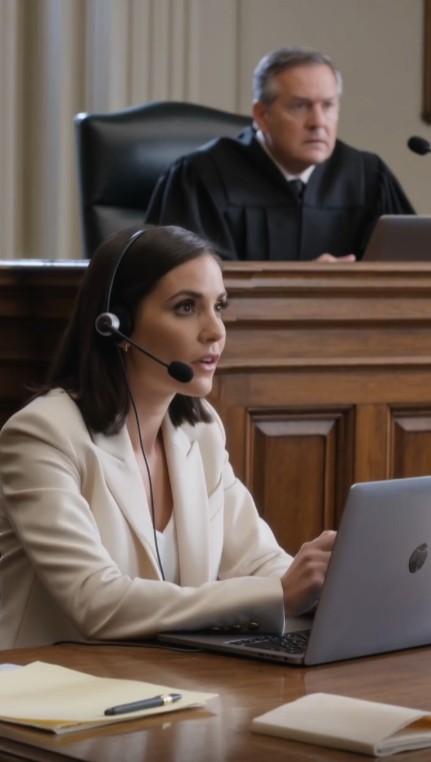
A courtroom translator suddenly removed her headset and refused to continue.
The judge looked up.
“Is there a problem?”
The translator stood.
“Your Honor… I need everyone to listen.”
The courtroom went silent.
Her name was Elena.
She had been interpreting testimony in a complicated civil case involving a disputed property agreement between two families.
Most of the evidence was ordinary.
Contracts.
Emails.
Bank records.
Recorded telephone conversations.
That afternoon, the attorneys were playing one of those recordings.
According to the witness who provided it, the conversation had taken place inside his private office.
That detail mattered.
The witness, Victor Hale, claimed he had been alone there when another man called and admitted altering an agreement.
If the recording was authentic and the circumstances were as Victor described, it supported an important part of his case.
Elena’s job was simple.
Listen to the foreign-language conversation.
Translate it accurately for the court.
She had already translated most of the recording once.
Then something bothered her.
Not the words.
The background.
She put one hand against her headset.
“Your Honor, may we replay the last section?”
The opposing attorney frowned.
“Why?”
The judge looked at Elena.
“Is there a translation issue?”
“Possibly not with the language.”
That answer caught everyone’s attention.
The judge allowed it.
The recording began again.
A man speaking.
Another voice on the telephone.
A pause.
Then, barely audible beneath the conversation:
Chime.
Chime.
Chime.
Three bells.
Elena immediately removed her headset.
“There.”
The attorney shrugged.
“Background noise.”
Elena looked directly at him.
“No.”
“What does it have to do with anything?”
“Everything.”
The judge leaned forward.
“What are you suggesting?”
Elena chose her words carefully.
“I’m not suggesting who made the recording or whether the conversation itself is genuine.”
“But I do not believe this was recorded where the witness said it was.”
The courtroom became completely still.
Victor’s attorney stood.
“Based on bells?”
Elena nodded.
“Based on those particular bells.”
The judge asked:
“Where do you believe it was recorded?”
Elena answered:
“At Saint Margaret’s courtyard.”
Victor’s face changed.
The attorney laughed once.
“A translator is now identifying buildings from bells?”
The judge raised a hand.
“Let her explain.”
Elena had grown up only a few streets from Saint Margaret’s.
It was an old civic building that had once been a convent before becoming a cultural center.
At the center of its interior courtyard was a small clock tower.
The bell mechanism was unusual.
Instead of sounding a standard hourly sequence, it played three notes several seconds apart shortly before certain scheduled community events.
Elena knew the sound because her mother had worked at the center for almost twenty years.
She had heard those bells hundreds of times.
Still, memory alone was not evidence.
Elena understood that.
She said:
“I may be wrong.”
“But if location matters to the case, the audio should be professionally examined.”
That was a much more serious statement than claiming she had solved anything.
The judge agreed.
The hearing paused while both sides discussed the issue.
Victor sat very still.
Then the opposing attorney asked the obvious question.
“Mr. Hale, have you ever been to Saint Margaret’s?”
Victor answered:
“Of course.”
“On the day this recording was made?”
“No.”
Elena looked down at her notes.
She said nothing.
It was not her role to question witnesses.
The judge ordered the audio preserved and sent for forensic examination.
The court also requested schedule records from Saint Margaret’s cultural center.
Two days later, the parties returned.
The first result was simple.
The three bell tones on the recording closely matched archived recordings from Saint Margaret’s courtyard bell.
Not merely because there were three chimes.
The timing between them matched.
The tonal characteristics were consistent.
Then came something more important.
The cultural center kept automated event logs.
On the date of Victor’s recording, the bells sounded at exactly 3:27 p.m. before a scheduled memorial lecture.
The recording’s metadata showed that it had been created at approximately the same time.
The judge turned toward Victor.
His attorney immediately objected.
The evidence still did not prove Victor had been physically present.
That was true.
The court did not jump to a conclusion.
Instead, the judge allowed additional examination.
Then investigators found another background sound.
A train horn.
Very faint.
Approximately forty seconds after the bells.
Railway records showed a commuter train normally passed a crossing behind Saint Margaret’s around that time.
Still not definitive.
But the pieces were accumulating.
The final clue did not come from the audio.
It came from the building’s visitor log.
Victor Hale’s name appeared.
3:06 p.m.
He had signed into Saint Margaret’s that afternoon.
His face went pale when the record was shown.
His attorney requested a private consultation.
When proceedings resumed, Victor changed part of his testimony.
Yes.
He had been at Saint Margaret’s.
But only briefly.
He claimed he recorded the telephone conversation later in his office.
The judge asked why he had previously denied being there.
Victor said he had forgotten.
That explanation created another problem.
A forensic audio expert testified that the file appeared continuous.
No obvious signs of splicing were found in the relevant portion.
Again, the expert was careful.
Audio analysis could not magically determine every detail.
But the recording did not support Victor’s new explanation.
The opposing attorney then presented something that had seemed irrelevant weeks earlier.
A photograph from the memorial lecture.
Victor appeared in the background.
The timestamp was eight minutes before the recorded conversation.
Now the location was difficult to dispute.
The recording had almost certainly been made at or near Saint Margaret’s.
The question became:
Why had Victor lied about it?
The answer changed the direction of the case.
Victor’s original story depended on the claim that the conversation was spontaneous.
He said he had been alone in his office when the other man unexpectedly called and made damaging admissions.
But Saint Margaret’s had not been a random location.
Another person connected to the property dispute had been there that afternoon.
Daniel Mercer.
A former business associate of both families.
Victor had insisted throughout the case that he had not met Daniel in months.
The cultural center’s records showed Daniel signed in twenty minutes before Victor.
Security footage confirmed both men entered the same courtyard area.
The court did not automatically conclude they had conspired.
More evidence was required.
So the judge ordered further disclosure.
That produced text messages.
Victor and Daniel had arranged to meet.
One message read:
Call him while I’m there.
Another:
We need him talking about the old agreement.
The context of the recording changed completely.
The phone conversation itself had not necessarily been fabricated.
But it had not happened under the circumstances Victor described.
It appeared to have been deliberately arranged.
And portions of Victor’s sworn testimony about the recording were false.
The judge was visibly frustrated.
“This court has spent considerable time evaluating evidence under a factual account that was inaccurate.”
Victor lowered his head.
His attorney asked for time.
The hearing was adjourned again.
Elena returned to the interpreters’ room.
She felt unsettled.
A court clerk found her there.
“You okay?”
Elena nodded.
“I almost didn’t say anything.”
“Why?”
“Because I’m the interpreter.”
“My job is the words.”
The clerk answered:
“Your job is also to tell the court when something affects whether you can accurately understand what you’re hearing.”
Elena knew that.
Still, she worried.
What if she had been wrong?
What if she had recognized an ordinary sound and created a distraction?
That was why she had not testified that the recording was definitely from Saint Margaret’s.
She had asked the court to verify it.
That distinction protected everyone.
The final outcome of the civil case came weeks later.
It was less dramatic than the courtroom moment.
There was no instant arrest.
No judge slamming a gavel and declaring the entire case over.
Instead, Victor’s credibility was seriously damaged.
The court excluded some portions of his testimony because his changing explanations could not be reconciled with verified records.
The recording was admitted only with the correct circumstances documented.
Other evidence became more important.
Financial records.
Original contracts.
Independent witnesses.
Ultimately, the disputed property agreement was found to have been modified improperly, but not in exactly the way either side first claimed.
Liability was divided among several parties.
Separate proceedings were considered regarding false statements made during the case.
The three bell chimes did not single-handedly decide the lawsuit.
They did something more realistic.
They exposed a factual inconsistency.
That inconsistency forced everyone to check the evidence again.
And when they did, the story surrounding the recording began to fall apart.
Several months later, Elena visited her mother at Saint Margaret’s.
They sat in the courtyard drinking coffee.
At 3:27, the bells sounded.
One.
Pause.
Two.
Pause.
Three.
Her mother smiled.
“You still hate those bells?”
Elena laughed.
“As a child, yes.”
She used to complain that the bells interrupted conversations.
Her mother would say:
“Then listen between them.”
Now Elena understood the irony.
A sound she had spent half her childhood ignoring had become the detail nobody else in a courtroom noticed.
Her mother asked:
“So you recognized them immediately?”
“Not immediately.”
“That’s why I asked them to play the recording again.”
Elena looked toward the tower.
“I needed to make sure.”
That became the part of the story she emphasized whenever young interpreters later asked her about the case.
Not:
Trust every instinct.
Something more careful.
Notice when something does not fit.
Then verify it.
Interpreters carry enormous responsibility.
Their role is not to become investigators.
Not to add theories.
Not to change testimony.
But accuracy sometimes requires acknowledging more than vocabulary.
Tone.
Context.
Overlapping speech.
Background sounds that affect what can be heard.
And when something material falls outside an interpreter’s expertise, the right response is not to invent certainty.
It is to say:
This needs to be checked.
Years later, the case was still remembered around the courthouse as “the three-bell hearing.”
People embellished it.
Some claimed Elena identified the exact room from a single chime.
She did not.
Others said the bells proved the recording was fake.
They didn’t.
The conversation was real.
What was false was the story about where and how it had been recorded.
The truth began with three faint sounds almost everyone else ignored.
Chime.
Chime.
Chime.
And one translator willing to remove her headset and say:
“Your Honor, I think we need to listen again.”