
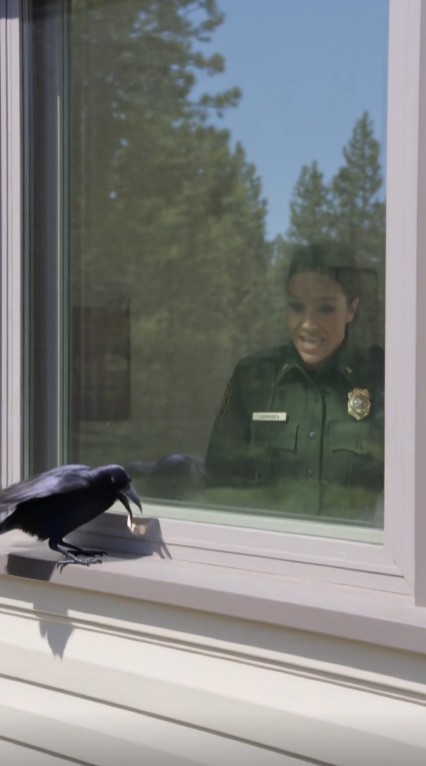
A black crow landed outside a ranger station and dropped a gold ring.
Then flew away.
The ranger stood there for several seconds, unsure whether she had actually seen what she thought she saw.
Her name was Claire.
She had worked at the mountain ranger station for almost nine years.
She had seen crows carry food.
Twigs.
Bits of plastic.
Small shiny objects.
But never anything like this.
She opened the station door.
Walked outside.
And picked up the ring.
It was heavier than she expected.
Old.
Scratched.
And set with a tiny green gemstone.
“Ben,” she called.
“Come look at this.”
Her colleague stepped outside.
Claire held up the ring.
“A crow just dropped it.”
Ben laughed.
“No, it didn’t.”
“I watched it happen.”
He took the ring.
Then turned it over.
Inside the band was a small engraving.
A mountain.
And beneath it, three short horizontal lines.
Ben’s expression changed.
Claire noticed.
“What?”
He walked back inside without answering.
Then stopped in front of an old wooden display mounted near the station’s entrance.
Claire followed.
The display had been there longer than either of them.
Dark wood.
Glass front.
Inside were photographs of early rangers.
Old trail maps.
A rusted compass.
A whistle.
And a brass plate displaying the exact same symbol.
Mountain.
Three lines.
Claire looked at the ring again.
Then at the display.
“How is that possible?”
Ben leaned closer.
“That symbol belonged to the original mountain patrol.”
Claire frowned.
“The one from before the park service took over?”
“Yeah.”
The ranger station had originally been built almost seventy years earlier by a small volunteer mountain rescue group.
Back then, there were fewer roads.
No reliable radios.
No GPS.
Search teams worked with paper maps, signal fires, whistles, and handwritten trail logs.
The group called itself the Three Ridge Patrol.
The mountain represented the landscape they covered.
The three lines represented three main ridges.
Claire turned the ring in her fingers.
“So somebody from the patrol owned this?”
“Maybe.”
Then she noticed something beneath the brass symbol on the display.
A small circular recess in the wood.
Almost exactly the size of the ring.
She moved closer.
“What goes there?”
Ben quickly raised a hand.
“Wait.”
Claire stopped.
“What?”
“There’s something you should know about this display.”
He pointed toward the old photographs.
The wooden case was not originally decorative.
It had once been a memorial.
One of the photographs showed six young men and one woman standing outside the newly built ranger station.
All wore simple jackets with the mountain-and-three-lines emblem.
At the center stood a man named Samuel Reed.
Ben said:
“He founded the patrol.”
Claire looked at the photograph.
“Was the ring his?”
Ben hesitated.
“That’s the story.”
Claire stared.
“What story?”
Decades earlier, Samuel had worn a gold ring bearing the patrol symbol.
It was not an official award.
His wife had commissioned it after the group completed its first major winter rescue.
The tiny green stone represented the forest valley below the three ridges.
Samuel wore it for years.
Then, during a search operation, it disappeared.
Claire looked down at the ring.
“You’re telling me this could be the same one?”
Ben shook his head.
“Could be.”
“But that would be a huge claim.”
They needed proof.
The station’s archive contained old records in a locked cabinet.
Ben brought out a binder.
Inside were handwritten inventories.
Photographs.
Donation notes.
And a faded document describing the memorial display.
Claire read the relevant line.
Ring recess reserved for Samuel Reed patrol ring if ever recovered.
Her eyes widened.
“They left a space for it?”
Ben nodded.
Samuel’s disappearance from the patrol was part of local history.
Not mysterious in the supernatural sense.
Sad.
Years after founding the group, Samuel joined a winter search for two missing hikers.
The hikers were found alive.
But during the operation, Samuel suffered a serious fall.
He recovered, but never returned to active rescue work.
Sometime during that search, his ring disappeared.
He believed it had come off somewhere along the upper trail.
Searchers looked later.
Nothing.
Samuel eventually moved away.
The patrol continued.
Then the region became more formally managed.
The original volunteer station became part of the modern ranger system.
When Samuel died, former patrol members built the wooden display.
They included the circular recess because one man insisted:
“If that ring ever comes back, it belongs here.”
Claire laughed softly.
“And a crow brings it?”
Ben smiled.
“Maybe.”
But they were careful.
Crows are curious, intelligent birds and sometimes move small objects.
That did not mean the bird had intentionally returned a historical artifact.
It could have picked the ring up nearby.
Or farther away.
The timing was remarkable.
The interpretation needed to remain realistic.
Claire asked:
“How do we verify it?”
First, they photographed the ring.
Then contacted the regional historical office.
A conservator examined it.
The engraving style matched the period.
So did the metalwork.
The green stone was confirmed to be a small piece of polished chrysoprase, a material mentioned in Samuel’s wife’s original receipt preserved by the family.
That was stronger evidence.
Then came the most important comparison.
An old photograph showed Samuel wearing the ring.
The shape of the setting matched.
The slight flattened section on one side matched.
Even a tiny repair mark documented in a family letter appeared in the same place.
The historian said:
“It is extremely likely this is Samuel Reed’s ring.”
Claire stared at it.
“After all these years?”
The historian nodded.
But one question remained.
Where had the crow found it?
Rangers inspected the area around the station.
No answer.
Then a maintenance worker mentioned something.
A week earlier, heavy rain had washed out part of an old drainage channel uphill from the ranger station.
The channel crossed beneath a former trail used by the Three Ridge Patrol.
The soil had shifted.
Small objects washed downhill.
Claire looked at Ben.
“That could explain it.”
They searched carefully.
Not by tearing up protected land.
Just visually inspecting the exposed wash area.
Near the old trail, they found several pieces of rusted metal.
An old buckle.
A spoon.
Fragments from what appeared to be early camp equipment.
Nothing else valuable.
But the washout provided a plausible route.
The ring could have remained buried near the trail for decades.
Heavy rain exposed it.
A crow picked it up.
Then dropped it near the station.
No intention required.
No animal solving history.
Just weather.
Chance.
And curiosity.
Claire liked that explanation.
It made the story more remarkable, not less.
Then another discovery came.
Samuel’s granddaughter still lived several hours away.
Her name was Margaret.
The historical office contacted her.
When she saw the photographs, she immediately recognized the design.
“My grandmother talked about that ring my whole childhood.”
Margaret agreed to visit the station.
She was seventy-four.
When she arrived, Claire showed her the ring.
Margaret held it carefully.
Then cried.
“My grandfather thought he lost this on the worst day of his life.”
Claire asked what she meant.
Margaret explained.
Samuel never cared about the ring’s monetary value.
What troubled him was the day it disappeared.
The winter rescue had gone badly before it went well.
Weather deteriorated.
Communication failed.
Samuel made a route decision that delayed part of the search.
The missing hikers were eventually found by another team.
Although nobody blamed him, Samuel blamed himself.
Then he fell.
Afterward, he associated the lost ring with failure.
He stopped wearing patrol symbols.
Stopped attending reunions.
Eventually moved away.
Claire said:
“But the hikers survived.”
Margaret nodded.
“That wasn’t enough for him.”
Samuel had been proud of the patrol.
Maybe too proud.
He believed leaders were supposed to get everything right.
When he didn’t, he carried the guilt.
Margaret looked toward the old display.
“My grandmother wanted him to understand that the ring represented the whole patrol.”
“Not one decision.”
Claire asked:
“Did he ever?”
Margaret smiled sadly.
“Eventually.”
Years later, Samuel attended one final reunion.
Several former patrol members told him something he had not known.
The route decision he regretted had actually prevented another search team from entering an unstable section of trail before an avalanche came through.
There was no dramatic secret heroism.
No single action that saved everyone.
Just a complicated operation where some choices worked, others did not, and a group succeeded together.
Samuel finally stopped treating one difficult day as the summary of his entire service.
That mattered to Margaret.
“He forgave himself.”
Claire looked at the ring.
“Then maybe it belongs in the display.”
Margaret agreed.
The historical office formally documented the artifact.
No one simply pushed the ring into the circular recess.
A conservator created a secure mount.
Then, almost seventy years after the original memorial was built, the empty space was finally filled.
Margaret attended.
So did several current rangers.
Ben stood beside Claire.
There was no big ceremony.
No media crowd.
Just a few people.
Margaret placed a copy of her grandfather’s photograph beneath the display.
Then said:
“He would have laughed if he knew a crow brought this back.”
Claire smiled.
“He probably would’ve blamed the crow for taking it in the first place.”
Everyone laughed.
The original gold ring remained behind protective glass.
Beside it, the station added a small note:
Samuel Reed
Three Ridge Patrol
Ring lost during winter operations, later recovered near the original patrol route.
No mention of destiny.
No claim that a bird understood where the object belonged.
But the station staff told visitors the full story when asked.
A storm exposed something buried.
A crow carried it.
A ranger noticed an engraving.
And an old empty space in a memorial finally made sense.
Months later, Claire still watched the crows around the station differently.
Not because she thought they were delivering messages from the past.
Because she understood how easily chance could connect one moment to another.
One bird.
One ring.
One symbol.
One wooden display almost everyone had stopped noticing.
The extraordinary piece of ranger history had been sitting beneath the soil for decades.
And somehow, on one ordinary morning, it ended up exactly where someone would recognize it.