
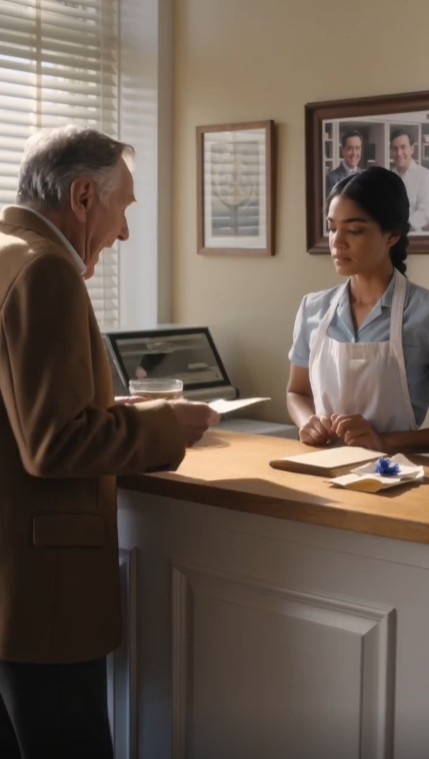
An elderly man walked into a bakery and placed a forty-seven-year-old receipt on the counter.
The young owner thought he was joking.
“Sir… this receipt is older than I am.”
The man smiled.
“I know.”
His name was Arthur.
He was seventy-four years old.
And he had driven nearly three hours that morning to reach the bakery.
The young owner, Emma, carefully picked up the faded piece of paper.
The ink was barely visible.
But the bakery’s original stamp was still there.
A tiny flower.
The same little flower that appeared in an old black-and-white photograph hanging on the wall behind the counter.
Emma looked at Arthur.
“Where did you get this?”
He turned toward the photograph.
“Your grandmother gave it to me.”
Emma froze.
Her grandmother, Rose, had founded the bakery decades earlier.
Rose had started with one oven, one wooden counter, and enough money for only a few bags of flour.
By the time Emma was born, the bakery had become part of the neighborhood.
Rose eventually passed it to Emma’s mother.
Then, years later, Emma took over.
Rose had died nine years earlier.
Emma knew hundreds of stories about her.
But she had never heard Arthur’s name.
Arthur looked around the shop.
“Not much has changed.”
Emma laughed.
“Almost everything has changed.”
“No.”
He pointed toward the old shelves.
“That corner hasn’t.”
Emma looked.
An original wooden cabinet still stood beside the kitchen entrance.
Rose had refused to replace it.
Arthur smiled.
“She kept it.”
Emma’s curiosity grew.
“You knew my grandmother well?”
Arthur nodded.
“For a little while.”
Then he touched the receipt.
“She made me a promise.”
Emma leaned forward.
“What kind of promise?”
Arthur did not answer.
Instead he asked:
“Do you still have her old ledgers?”
Emma frowned.
“Somewhere.”
The bakery had boxes of records upstairs.
Old invoices.
Recipes.
Employee schedules.
Handwritten account books.
Emma called her mother.
After several minutes of searching, they found a thick ledger from forty-seven years earlier.
The cover was worn almost smooth.
Emma carried it downstairs.
Arthur’s hands trembled when he saw it.
“That’s the one.”
Emma opened it.
Rose’s handwriting filled the pages.
Orders.
Prices.
Names.
Small notes in the margins.
Then, as Emma turned one page, something fell onto the counter.
A tiny dried blue flower.
Everyone went quiet.
Arthur slowly reached into his jacket pocket.
He removed another dried flower.
Almost identical.
Emma stared.
Then looked at him.
“What happened here?”
Arthur smiled sadly.
“Your grandmother kept one.”
“I kept the other.”
Emma touched the fragile petals carefully.
They looked as though they might crumble.
Arthur began telling the story.
Forty-seven years earlier, he was twenty-seven.
He had just lost his job at a local factory.
He had very little money.
No savings.
And a young wife named Margaret expecting their first child.
Arthur spent weeks looking for work.
Nothing.
One cold morning, he walked past Rose’s bakery.
He had not eaten since the previous day.
The smell of bread stopped him.
Arthur entered.
Rose was behind the counter.
She asked what he wanted.
Arthur looked at the prices.
Then said:
“Nothing.”
Rose knew immediately.
She wrapped two rolls and a pastry in paper.
Arthur shook his head.
“I can’t pay.”
Rose answered:
“Then pay later.”
Arthur was embarrassed.
He refused.
Rose took out a receipt.
Wrote the amount.
Then stamped it with the little flower.
She handed it to him.
“There.”
“Now you owe me officially.”
Arthur laughed.
That made it easier to accept.
He returned the next day.
Then again.
Rose began giving him small jobs.
Carrying flour.
Fixing shelves.
Delivering bread.
Nothing permanent.
Just enough for him to earn a little money.
Eventually, Arthur found steady work elsewhere.
Before leaving, he came to repay every cent.
Rose accepted the money.
But she gave the receipt back.
Arthur looked confused.
“Why?”
She said:
“Keep it.”
“For what?”
Rose pointed toward the little flower stamp.
“So you remember there may be a day when someone else needs you to trust them before they can pay you back.”
Arthur folded the receipt carefully.
Then Rose did something else.
She picked two tiny blue flowers from a pot near the bakery window.
She pressed one into his hand.
Then kept the other.
“Why the flowers?”
Rose smiled.
“One for you.”
“One for me.”
“When you come back someday, we’ll see which one survived.”
Arthur laughed.
He assumed she was joking.
Then life moved quickly.
Margaret gave birth to a son.
Arthur worked.
Then moved to another city for a better job.
He and Rose exchanged a few letters.
Then fewer.
Then none.
But Arthur kept the receipt.
He kept the dried blue flower.
Every time he opened the small box where he stored important papers, he saw them.
And remembered Rose.
Emma listened quietly.
“Why did you wait forty-seven years?”
Arthur looked embarrassed.
“At first, I thought I’d come back the next year.”
“Then the next.”
“Then the next.”
He smiled sadly.
“You know how life does that.”
Emma nodded.
Arthur continued.
Years later, Margaret became ill.
Arthur became her caregiver.
Travel stopped mattering.
Then their son moved away.
Grandchildren came.
Retirement came.
Margaret died.
And eventually Arthur found himself sorting through old boxes.
That was when he found the receipt again.
He decided it was time.
Emma looked down at the ledger.
Then turned another page.
A folded note appeared.
Her grandmother’s handwriting was on the outside.
ARTHUR — IF HE EVER COMES BACK.
Emma froze.
Arthur stared.
“Did she leave something for me?”
Emma carefully opened it.
She read the first lines.
Then her expression changed.
“Sir…”
Arthur looked up.
“What?”
Emma shook her head.
“This isn’t for you.”
He looked confused.
“Then who is it for?”
Emma turned the paper around.
At the top, Rose had written:
For whoever is running this bakery when Arthur returns.
Emma’s eyes filled.
She began reading aloud.
If Arthur comes back with the old receipt, do not take his money.
He already paid me a long time ago.
Arthur closed his eyes.
Emma continued.
Ask him whether he kept the blue flower.
If he did, then tell him I kept mine too.
And tell him the promise was never about the bread.
Arthur whispered:
“What promise?”
Emma read on.
The promise was that one act of trust should become another.
If Arthur returns, ask him what he did with the kindness.
The bakery went quiet.
Arthur stared at the receipt.
Then smiled.
“I suppose she knew I’d need to answer that.”
Emma looked at him.
“So… what did you do?”
Arthur sat down.
For years, he had carried Rose’s lesson without talking about it.
After getting stable work, he became a supervisor at a warehouse.
One day, a young employee named Samuel asked for an advance.
His wife had just given birth.
His car had broken down.
He was afraid he would lose his job if he could not get to work.
Company policy said no.
Arthur remembered Rose.
He personally lent Samuel the money.
No interest.
No lecture.
Just:
“Pay me when you can.”
Samuel did.
Years later, Samuel became a manager.
Then helped another employee.
The pattern continued.
Arthur never knew exactly how far it traveled.
But there were more examples.
A neighbor struggling with rent.
A young mechanic who could not afford tools.
A woman trying to finish night school.
Arthur helped when he reasonably could.
Not with enormous sums.
Not recklessly.
Sometimes just with time.
A recommendation.
A ride.
A meal.
A chance.
Emma smiled.
“So you kept the promise.”
Arthur shook his head.
“I don’t know if anyone keeps it perfectly.”
“But I remembered.”
That was enough.
Then Emma noticed another line at the bottom of Rose’s note.
There is one more thing.
If he kept the flower, give him the wooden box from the top shelf.
Emma looked toward the old cabinet.
Arthur followed her eyes.
“The cabinet.”
Emma opened it.
On the top shelf sat a small wooden box.
Her mother had seen it for years but never opened it because Rose had written:
LEAVE CLOSED.
Emma lifted it down.
Inside was a photograph.
Rose, much younger.
Arthur standing beside her.
Both holding tiny blue flowers.
Arthur laughed.
“I forgot this existed.”
There was another photograph too.
A young pregnant Margaret stood outside the bakery.
Arthur stared.
“My wife.”
Emma looked surprised.
“You brought her here?”
“Once.”
Rose had baked them a small cake after learning about the baby.
Arthur had completely forgotten anyone took a picture.
He touched the edge carefully.
Then found one final note.
Rose had written:
Arthur,
If you are reading this, then we were both fortunate enough to get old.
Do not apologize for taking so long.
That is what time does.
It fills itself.
Arthur’s eyes filled.
The note continued.
I hope you had a good life.
And if you used that receipt as an excuse to help even one person, then it was worth the price of two rolls and one pastry.
Arthur laughed through tears.
Emma did too.
Then Rose added:
P.S. If you try to pay for the bread now, whoever is running the bakery has permission to throw you out.
Arthur looked at Emma.
“She would have done it too.”
“I believe you.”
Emma framed the old receipt.
Not permanently at first.
She asked Arthur’s permission.
He agreed on one condition.
“The flower stays with me.”
Emma smiled.
“Fair.”
The receipt was placed beside Rose’s photograph on the wall.
Underneath, Emma added a small card:
PAID IN FULL — 47 YEARS AGO.
Customers started asking about it.
Emma told them only part of the story.
A man could not afford breakfast.
Rose trusted him.
He returned decades later.
That was enough.
But the story changed the bakery too.
Emma started a small board near the counter.
Customers could quietly pay for an extra coffee, loaf, or sandwich.
Someone who needed one could ask.
No questions.
No public embarrassment.
Emma called it the Blue Flower Board.
Arthur protested when he heard.
“You’re turning this into a whole thing.”
Emma laughed.
“My grandmother would approve.”
Arthur visited again a few months later.
This time, he brought Samuel.
The young warehouse employee he had once helped was now elderly himself.
Samuel stood beneath Rose’s photograph and said:
“So this is where it started.”
Arthur shook his head.
“No.”
“It probably started before her too.”
That thought stayed with Emma.
Rose had likely been helped by someone once.
Maybe that was why she recognized hunger without making Arthur explain it.
Maybe kindness rarely begins with the person we associate with it.
Maybe people simply pass it along.
Years later, the forty-seven-year-old receipt still hung on the bakery wall.
The ink faded a little more.
The paper became increasingly fragile.
But the tiny flower stamp remained visible.
Emma eventually placed it behind protective glass.
Beside it sat a photograph of two dried blue flowers.
Rose’s original flower was too delicate to display.
Arthur kept his until he died several years later.
Afterward, his son brought it back to the bakery.
“My dad wanted this here.”
Emma placed the two flowers together.
Rose’s.
Arthur’s.
They had survived nearly half a century apart.
Just as Rose had joked they might.
People often assumed Arthur returned because he wanted to settle an old debt.
He didn’t.
The money had been paid forty-seven years earlier.
The real reason he carried the receipt all that time was simpler.
It reminded him that during one of the most frightening periods of his life, someone trusted him before he had anything to prove.
Rose had given him bread.
But more importantly, she gave him dignity.
She turned charity into a receipt so he would not feel ashamed.
Then she sent him away with a small blue flower and a challenge.
Someday, do this for somebody else.
Forty-seven years later, Arthur finally brought the receipt back.
And discovered Rose had never been waiting for repayment.
She had only been waiting to learn whether the kindness had continued.
It had.