
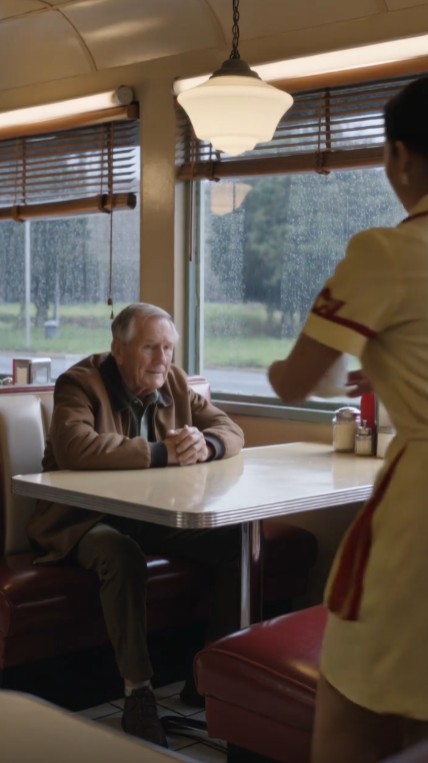
Every Sunday for eighteen years, an elderly man ordered two coffees at the same diner.
One for himself.
One for the empty chair across from him.
His name was Arthur.
He always arrived at 9:10 in the morning.
Same booth.
Same brown jacket in winter.
Same newspaper folded beside his cup.
The first coffee he drank slowly.
The second remained untouched.
New waitresses sometimes asked:
“Are you waiting for someone?”
Arthur would smile.
“Something like that.”
Regular customers knew better than to ask.
Most assumed the empty chair belonged to someone Arthur had lost.
A wife.
A brother.
An old friend.
Nobody knew for sure.
Then, one rainy Sunday morning, the diner door opened.
A young woman stepped inside.
She was about thirty.
Dark hair.
Blue raincoat.
An old photograph clutched in one hand.
She looked around once.
Then saw Arthur.
More specifically, she saw the two coffees.
Her face changed.
She walked toward the booth.
Arthur barely noticed her until she stopped beside the table.
Without saying anything, she placed the photograph beside the untouched cup.
Arthur looked down.
His hands began trembling.
He picked it up.
A young woman stood outside the same diner decades earlier.
Beside her was Arthur.
Much younger.
Both smiling.
Arthur whispered:
“Where did you get this?”
The woman sat in the empty chair.
“My mother told me to find you.”
Arthur looked at her properly for the first time.
The eyes.
The shape of the mouth.
The tiny dimple on the left cheek.
He went pale.
“What is your mother’s name?”
“Claire.”
Arthur closed his eyes.
For several seconds, he could not speak.
The waitress standing behind the counter noticed and quietly stepped away.
The young woman waited.
Finally, Arthur whispered:
“Claire is alive?”
The woman nodded.
“Yes.”
Arthur’s eyes filled with tears.
He looked toward the untouched coffee.
For eighteen years, he had ordered it for Claire.
Not because he believed she would suddenly walk through the door.
Because the booth had been theirs.
Long before Arthur became the quiet old man everybody recognized, he had been a twenty-five-year-old mechanic with grease on his hands and very little money.
Claire worked mornings at the diner.
She was funny.
Impatient.
Always saving for something.
At first, Arthur came in because the coffee was cheap.
Then because Claire was there.
She teased him for ordering the same thing every Sunday.
Black coffee.
Toast.
Nothing else.
One morning, she placed a second cup across from him and sat down during her break.
“If you’re going to spend every Sunday staring at the wall,” she said, “at least stare at someone interesting.”
That became their routine.
Two coffees.
Same booth.
Every Sunday.
They eventually fell in love.
Not dramatically.
Slowly.
Through ordinary things.
Arthur fixing Claire’s bicycle.
Claire bringing soup when Arthur was sick.
Long walks after her shift.
Arguments over whether the radio should stay on during breakfast.
They planned to marry.
Then Claire’s younger sister died.
She left behind a little girl named Emily.
Claire became responsible for her almost overnight.
Arthur offered to help.
Claire refused.
Not because she did not love him.
Because she was overwhelmed.
She moved temporarily to another city where relatives could help care for Emily.
Arthur expected her back within months.
Instead, things became complicated.
Claire found work there.
Emily needed stability.
Letters arrived at first.
Then less often.
One day, they stopped completely.
Arthur wrote.
No answer.
He called the number he had.
Disconnected.
He even traveled to the address Claire had given him.
The apartment was empty.
Arthur believed she had chosen another life.
He was hurt.
Angry.
Eventually, he stopped searching.
But every Sunday, he kept coming to the diner.
At first because he was stubborn.
Then because the ritual became part of him.
Two coffees.
One for him.
One for the person who once sat across from him.
Years passed.
Arthur dated a few people.
Nothing lasted.
He built a life anyway.
Worked.
Retired.
Helped his brother raise children.
Volunteered at a repair shop.
He was not waiting helplessly for Claire.
But he never stopped ordering the second coffee.
The young woman listened silently.
Then said:
“She didn’t leave because she stopped loving you.”
Arthur looked at her.
“What happened?”
Her name was Sophie.
She explained.
Claire had tried to contact Arthur.
Repeatedly.
But something went wrong after the move.
Claire’s relatives strongly disapproved of the relationship.
They believed Arthur had no future.
No degree.
No money.
A mechanic from a struggling family.
One relative intercepted several letters.
Another told Claire that Arthur had come looking once but said he wanted nothing more to do with her.
That was a lie.
Claire believed it.
Arthur stared.
“No.”
Sophie nodded.
“She found out years later.”
“How?”
After Claire’s aunt died, a box of old belongings was returned to the family.
Inside were several unopened envelopes.
Arthur’s handwriting.
All addressed to Claire.
Never delivered.
Arthur put down the photograph.
“Why didn’t she contact me then?”
Sophie looked uncomfortable.
“Because by then, she was married.”
Arthur became quiet.
Claire had eventually believed Arthur was gone.
She met someone else.
A man named Daniel.
He was kind.
Patient.
He helped raise Emily.
Later, Claire and Daniel had a daughter.
Sophie.
Arthur looked at her again.
That explained the resemblance.
Sophie was Claire’s daughter.
Arthur said softly:
“So you’re not…”
She understood.
“No.”
“I’m not your daughter.”
Arthur looked almost embarrassed.
“I’m sorry.”
Sophie smiled.
“It’s okay.”
Then she added:
“But Mom said you were one of the most important people in her life.”
Arthur looked toward the rain-streaked window.
“Was she happy?”
Sophie nodded.
“Yes.”
“With my dad, yes.”
Arthur smiled.
“Good.”
And he meant it.
Daniel had died four years earlier.
Claire remained in the same city.
Recently, while sorting old boxes, she found the photograph of herself and Arthur outside the diner.
She also found the old letters.
For the first time, she fully understood that Arthur had never rejected her.
Someone else had broken the connection.
Claire wanted to call him.
But she was afraid.
After more than forty years, what could she possibly say?
So she told Sophie the whole story.
Then gave her the photograph.
“Find out if the diner is still there.”
Sophie searched online.
It was.
Then she found something unexpected.
A local newspaper had once published a small feature about longtime customers.
One photograph showed Arthur sitting at the same booth.
Two coffees on the table.
The caption said:
Arthur Miller has ordered two cups every Sunday for nearly two decades.
Claire stared at the article for a long time.
Then she started crying.
Sophie asked:
“Why don’t you go?”
Claire shook her head.
“I don’t know if I have the right.”
Sophie disagreed.
So she went first.
Arthur listened to all of this without touching his coffee.
Then asked the question that mattered most.
“Why did she send you instead of coming herself?”
Sophie reached into her bag.
She placed a cream-colored envelope on the table.
“Because she wanted you to decide.”
Arthur stared at his name written across the front.
Claire’s handwriting.
Older.
But recognizable.
He opened it.
Arthur,
If Sophie found you, then I finally became brave enough to stop pretending the past doesn’t matter.
I am not writing to ask for anything.
I had a good life.
I loved my husband.
I know you may have built a life of your own too.
But I recently learned that the silence between us was not what either of us chose.
I needed you to know that.
Arthur stopped reading.
His eyes blurred.
He continued.
I never forgot the diner.
Or the two coffees.
Or the Sunday you fixed the kitchen radio because I complained the music sounded terrible.
It still sounded terrible afterward.
You lied and said it was the speaker.
I knew you had no idea what you were doing.
Arthur laughed out loud.
Sophie smiled.
Claire ended with:
If you would rather leave the past where it is, I will understand.
But if you would like one more coffee, I will be at the diner next Sunday at 9:10.
Arthur read that line twice.
Then looked at Sophie.
“Next Sunday?”
She nodded.
He glanced at the untouched coffee.
For the first time in eighteen years, he pushed it slightly toward the center of the table.
“You’re sitting in her chair.”
Sophie immediately stood.
“Oh my goodness. I’m sorry.”
Arthur laughed.
“No.”
“Sit.”
“You earned it.”
They talked until almost noon.
Sophie told him about Claire’s life.
Her work as a teacher.
Her terrible cooking.
Her habit of keeping receipts for absolutely everything.
Arthur told Sophie stories Claire had forgotten to mention.
How she once quit the diner for three hours after arguing with the owner.
How she loved red scarves.
How she once made Arthur walk two miles in the rain because she refused to get into his unreliable car.
Sophie laughed.
“That still sounds exactly like her.”
The following Sunday, Arthur arrived early.
8:40.
The waitress stared.
“You’re never early.”
“Today is different.”
He ordered one coffee.
The waitress looked surprised.
“Only one?”
Arthur smiled.
“Bring the second when someone sits down.”
At 9:08, the door opened.
Claire walked in.
Seventy-four years old.
Gray hair.
Red scarf.
Arthur stood.
Neither moved at first.
Forty-three years had passed since they had last seen each other.
They were not the young couple from the photograph.
They did not pretend they were.
Claire smiled.
“You got old.”
Arthur laughed.
“So did you.”
That was enough.
She walked toward the booth.
Then hesitated beside the empty chair.
Arthur pulled it out.
“Still take milk?”
Claire looked stunned.
“You remember?”
“You complained about black coffee for five years.”
She sat.
The waitress brought the second cup.
Claire wrapped both hands around it.
For a moment, neither spoke.
Then Claire whispered:
“I’m sorry.”
Arthur shook his head.
“We lost enough time blaming ourselves for things other people decided.”
Claire started crying.
Arthur reached across the table.
Not to recreate a romance that belonged to another lifetime.
Just to hold the hand of someone he once loved.
They talked for four hours.
About everything.
Daniel.
The husband Claire loved and missed.
Arthur’s life.
Their families.
The letters.
The lies that kept them apart.
The things they regretted.
And the things they did not.
Claire asked:
“Did you really order me coffee every Sunday?”
Arthur smiled.
“Eventually the waitresses started doing it without asking.”
“That is ridiculous.”
“Probably.”
“You knew I might never come.”
“Yes.”
“Then why?”
Arthur looked at the cup between them.
“Because that seat reminded me of a good part of my life.”
Claire nodded.
That answer mattered.
He had not spent forty years unable to move forward.
The coffee was not a monument to misery.
It was a ritual.
A memory.
A way of acknowledging that something meaningful had happened there.
Claire returned the next Sunday.
And the one after that.
Not every week.
She lived several hours away.
But often enough.
Sometimes Sophie came.
Sometimes Arthur’s nephews joined them.
The booth stopped being a place for an absence.
It became crowded.
One Sunday, Claire arrived and found only one coffee waiting.
She looked offended.
“Excuse me?”
Arthur smiled.
“What?”
“Where is mine?”
“You’re late.”
She laughed.
Then the waitress appeared with the second cup.
Over the next several years, Arthur and Claire became friends again.
Nothing more needed to happen.
They had both already lived entire lives.
Loved other people.
Built families.
Lost people.
The story was not about correcting the past by pretending the years in between had not mattered.
It was about finally understanding it.
Arthur learned Claire had never chosen silence.
Claire learned Arthur had never abandoned her.
And Sophie discovered that one old photograph could reopen a door without erasing everything that came after.
Years later, the diner framed a copy of the photograph.
Young Arthur.
Young Claire.
Standing outside.
Two cups visible through the window behind them.
Beside it was a newer picture.
Arthur and Claire in the same booth.
Older.
Laughing.
Two coffees between them.
The diner owner asked Arthur what caption he wanted underneath.
Arthur thought for a moment.
Then said:
“Just write, ‘Two coffees.’”
That was all.
Because for eighteen years, everyone thought the untouched cup represented someone who was gone forever.
They were wrong.
It represented a story that had never been finished.
And one rainy Sunday, a young woman sat in the empty chair, placed an old photograph on the table, and finally gave Arthur the missing pages.