
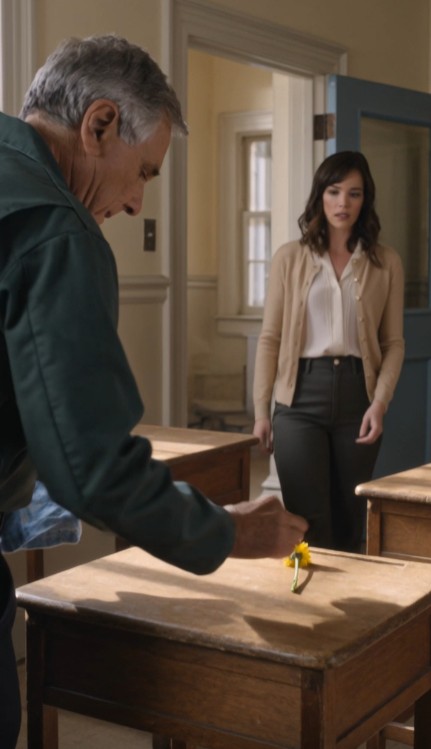
For twelve years, the school janitor refused to remove one old wooden desk from an empty classroom.
Teachers complained about it.
Students joked about it.
Administrators suggested throwing it away more than once.
But every Friday afternoon, Samuel cleaned that desk before anything else.
He wiped the surface.
Polished the metal legs.
Straightened the chair.
Then placed one fresh yellow flower on top.
Nobody understood why.
The classroom had not been used regularly in years.
Its windows faced the oldest part of the schoolyard.
Most of the other desks had already been removed.
Only one remained.
Always in the same place.
Third row.
Beside the window.
Whenever maintenance workers tried to move it, Samuel stopped them.
“Leave that one.”
That was all he ever said.
Samuel was sixty-eight years old.
He had worked at the school for almost thirty years.
Quiet.
Dependable.
The kind of person students greeted without really knowing anything about him.
He fixed broken door handles.
Changed lightbulbs.
Cleared snow from the steps before sunrise.
And every Friday, he bought one yellow flower from the grocery store near his apartment.
Then placed it on the old desk.
One September morning, a new teacher named Claire arrived.
She had been hired to teach literature.
The school was crowded that year, so administration temporarily assigned her the unused classroom while renovations were completed elsewhere.
Claire entered carrying books and folders.
She immediately noticed the single desk.
“Why is that still here?”
Another teacher laughed.
“Ask Samuel.”
Claire did not think much about it.
Until Friday.
She stayed late organizing shelves.
At around four o’clock, Samuel entered carrying a yellow flower.
Claire watched him clean the desk.
Then place the flower carefully on top.
“Is it someone’s memorial?”
Samuel looked at her.
For a moment, he seemed surprised she had asked.
Then he smiled.
“Something like that.”
He started walking away.
Claire looked at the desk again.
The wood was covered with old scratches.
Initials.
Tiny drawings.
Marks left by generations of students.
Then she noticed something beneath the front edge.
A name.
Small.
Carefully carved.
EMILY R.
Claire froze.
She ran her fingers across the letters.
Then looked toward Samuel.
“Where did you get this desk?”
Samuel stopped walking.
His expression changed completely.
For several seconds, he said nothing.
Then he whispered:
“I’ve been waiting twelve years for someone to ask me that.”
Claire frowned.
“Why?”
Samuel returned.
He looked beneath the desk.
Then toward Claire.
“You know that name?”
She nodded slowly.
“My mother’s name was Emily Reed.”
Samuel went still.
Claire’s mother had died when Claire was twelve.
She remembered her as warm.
Funny.
Always reading.
But Emily rarely spoke about her childhood.
Claire knew she had attended this school.
Nothing more.
Samuel pulled out the chair.
“You should sit down.”
Claire did.
Then Samuel went to an old storage cabinet.
He unlocked it.
Inside was a small wooden box.
He brought it to the desk.
On top was another yellow flower.
Pressed flat and dried.
Samuel opened the box.
Inside were photographs.
Letters.
A school badge.
An old library card.
And a thin blue notebook.
Claire stared.
“What is all this?”
Samuel sat opposite her.
“Your mother left it.”
Claire looked up sharply.
“My mother?”
Samuel nodded.
“She sat at this desk.”
Claire looked down at the carved name again.
Samuel began telling the story.
Thirty-one years earlier, Emily Reed had been a student at the school.
She was quiet.
Excellent at writing.
Terrible at mathematics.
She loved books so much that teachers sometimes had to tell her to stop reading during lessons.
Samuel had just started working at the school then.
He was twenty-seven.
A young maintenance assistant.
Most students barely noticed him.
Emily did.
Every afternoon, she stayed late in the library.
Then she waited near the entrance until her mother finished work and could pick her up.
Samuel often worked nearby.
Eventually, they started talking.
Nothing unusual.
Books.
School.
Weather.
The kind of conversations adults sometimes have with children they see every day.
Then one winter, Emily stopped staying in the library.
Samuel noticed she was leaving quickly.
Sometimes without a coat.
Sometimes upset.
One afternoon, he found her sitting alone in the empty classroom.
At this desk.
Crying.
Samuel did not ask invasive questions.
He simply sat several desks away and waited.
Eventually Emily explained that her mother had lost her job.
Money was tight.
They might have to move.
Emily believed she would have to leave school.
Samuel told her not to decide anything before speaking with the school counselor.
He helped connect the family with staff who knew about support programs.
The school arranged lunches.
Books.
Transport.
A local community group helped Emily’s mother find temporary work.
Within a few months, things stabilized.
Claire listened quietly.
“My mother never told me this.”
Samuel smiled.
“She hated people feeling sorry for her.”
That sounded exactly like Emily.
Then Samuel showed her the blue notebook.
Emily had started writing stories in it.
Short ones.
Most only a few pages.
One was about a girl living in a house made entirely of books.
Another about an old man who could repair memories.
One was titled:
THE YELLOW FLOWER.
Claire looked up.
Samuel nodded.
“That’s where the flowers came from.”
The story was about a girl who believed nobody noticed her.
Every Friday, someone secretly left one yellow flower on her desk.
She spent the entire story trying to discover who.
At the end, she learned it was not one person.
Different people had taken turns.
Teacher.
Friend.
Neighbor.
Librarian.
The point was simple.
Sometimes care is quiet.
Claire smiled through tears.
“She wrote this?”
“At fifteen.”
Samuel continued.
Years passed.
Emily graduated.
Went to university.
Became a journalist.
Later, an editor.
Then a mother.
She occasionally returned to the school.
Sometimes to speak with students.
Sometimes just to visit.
Every time, she sat at the same desk.
Then, twelve years earlier, Emily returned unexpectedly.
She was already ill.
Samuel knew she had been receiving treatment.
But he did not realize how serious it was.
Emily sat at the old desk for nearly an hour.
Then handed Samuel the wooden box.
“What did she say?”
Samuel looked toward the window.
“She asked me to keep it here.”
Claire’s eyes filled.
“Why?”
Samuel opened one of the letters.
It was addressed:
For Claire, if she ever finds her way here.
Claire covered her mouth.
Samuel handed it to her.
She unfolded it.
The handwriting was unmistakably her mother’s.
My Claire,
If you are reading this, Samuel finally broke his promise and showed you the box.
Samuel laughed softly.
“She knew me well.”
Claire continued.
I hope you did not come here because someone told you to.
I hope you arrived because life brought you through the door on its own.
Claire stopped.
“What does that mean?”
Samuel shrugged.
“Keep reading.”
Emily wrote that she had never wanted Claire to feel obligated to follow her life.
Not her career.
Not her school.
Not her love of writing.
So she made Samuel promise never to contact Claire about the box.
If Claire ever returned to the school herself, then he could show her.
If not, the box would eventually go to the school archive.
Claire stared.
“She knew I might become a teacher?”
Samuel shook his head.
“No.”
“She hoped you would choose your own life.”
That was why Samuel had waited.
Twelve years.
He kept the desk.
Kept the box.
Kept placing a yellow flower there every Friday.
Not because he believed Claire would necessarily come.
Because Emily had asked that the desk remain until the school finally needed the room permanently or Claire happened to notice it.
Then Samuel revealed something else.
The desk had not originally been stored there.
After Emily died, the school planned to replace all the old furniture.
Samuel rescued that one from disposal.
He recognized the carved name.
He moved it back to the classroom.
Then began the Friday flower routine.
Claire looked at him.
“You did that for twelve years?”
Samuel shrugged.
“Flowers aren’t expensive.”
“That’s not what I meant.”
He smiled.
“I know.”
Claire opened another envelope.
Inside was an old school photograph.
Emily at sixteen.
Sitting at the same desk.
A yellow flower rested beside her notebook.
Claire stared.
“Who gave her that?”
Samuel smiled.
“I did.”
Claire looked confused.
“But in the story, different people…”
“That came later.”
The first flower was Samuel’s.
He had found Emily crying one Friday after her family nearly lost their apartment.
The next week he placed a flower on her desk with a note:
You are still here.
That was all.
Emily never forgot it.
Years later, she turned the memory into the story.
Claire wiped her eyes.
Then noticed something beneath the photograph.
A second letter.
This one was addressed to Samuel.
He had never opened it.
Claire looked at him.
“You didn’t read this?”
“She told me not to unless you came.”
Samuel hesitated.
Then opened it.
The letter was short.
Samuel,
If Claire ever returns, the desk has done its job.
Stop buying flowers.
You have spent enough money on me.
Samuel laughed loudly.
Claire did too.
Then his expression softened as he continued.
You once made a frightened fifteen-year-old believe that being noticed could change a day.
It changed much more than that.
Thank you.
Samuel stopped reading.
He took off his glasses.
Wiped his eyes.
Claire reached across the desk and touched his hand.
“She remembered.”
Samuel nodded.
“That was enough.”
Over the next several weeks, Claire read everything in the box.
Her mother’s early stories.
Letters.
Old notes.
Teacher comments.
The pieces revealed a version of Emily Claire had never known.
Not just her mother.
A frightened teenager.
A stubborn student.
A young writer.
A girl who once believed she might have to give up school entirely.
Claire finally understood why her mother had always been so passionate about libraries and education.
Why she donated books every Christmas.
Why she never let Claire complain that school was “useless” without giving a ten-minute speech.
Those beliefs had roots.
The desk had witnessed them.
Claire continued teaching in the classroom.
She refused to remove it.
Instead, she placed it near the window.
Students began asking about the flower.
At first, Claire told only part of the story.
“It belonged to someone who once needed encouragement.”
Then she started a tradition.
Every Friday, one student could nominate someone in the school who deserved a small act of kindness.
Not an award.
Not money.
Something simple.
A note.
A book recommendation.
Help carrying equipment.
A seat beside someone who usually ate alone.
They called it the Yellow Flower Friday.
Samuel pretended to hate the name.
“You’re turning my grocery habit into a program.”
Claire smiled.
“You started it.”
“I absolutely did not.”
“You placed the first flower.”
“That was one flower.”
“Too late.”
The tradition spread.
Eventually, the desk became known as Emily’s Desk.
Not because students were told to mourn someone they had never met.
Because it became a place where they left anonymous notes of encouragement.
One read:
You helped me when I was new.
Another:
Thanks for sitting with me at lunch.
Another:
I know this week was hard. Don’t quit.
Claire kept every note.
Not forever.
Just long enough for the recipient to collect it.
Samuel still cleaned the desk every Friday.
But one day Claire noticed something.
There was no flower.
She found him in the hallway.
“Samuel.”
He looked innocent.
“What?”
“You forgot the flower.”
He smiled.
“No.”
Claire returned to the classroom.
A student had placed one there.
Then another the next week.
And another.
Samuel never had to buy one again.
Years later, when Samuel finally retired, the school held a small celebration.
He hated every minute of the attention.
At the end, Claire gave him a framed copy of Emily’s old story.
THE YELLOW FLOWER.
Inside the frame was the original note he had written all those years ago:
You are still here.
Samuel stared at it.
Then looked at Claire.
“You kept this?”
“My mother did.”
He nodded.
“Of course she did.”
Before leaving, he walked into the classroom one final time.
The desk was still there.
But it was no longer empty.
A student sat at it, reading.
A yellow flower rested beside her book.
Samuel smiled.
Claire stood beside him.
“You know what Mom wrote in the last page of the notebook?”
“What?”
Claire quoted it.
“Sometimes the person who changes your life doesn’t know they did.”
Samuel looked at the desk.
Then shook his head.
“Your mother always used too many words.”
Claire laughed.
“She was a writer.”
The old desk remained in the classroom.
Not because Samuel refused to let go of the past.
Not because the school was preserving a mysterious relic.
It stayed because one frightened teenager had once sat there believing her future was disappearing.
A janitor noticed.
He placed a flower beside her notebook.
And decades later, that same girl left behind a box for a daughter who had never known that part of her story.
For twelve years, everyone thought Samuel was protecting an empty desk.
He wasn’t.
He was keeping a promise.
Waiting for the day someone would notice the tiny name carved underneath.
And when Claire finally did, she learned the desk had never really been empty at all.
It had been holding a story for her the entire time.