
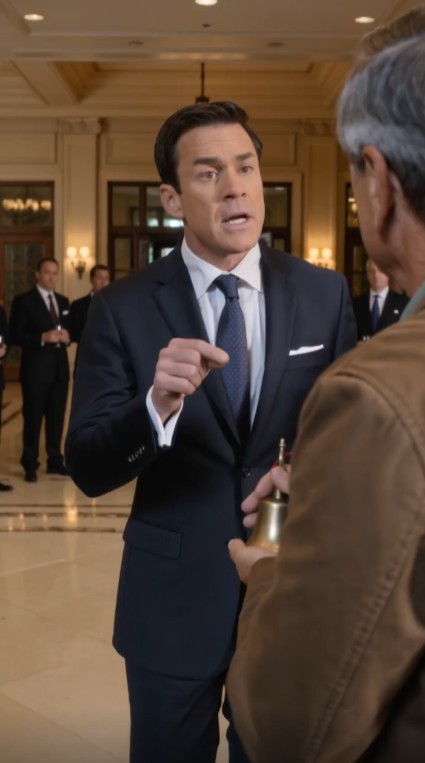
A millionaire ordered an elderly man out of his luxury hotel’s grand opening.
“This is a private event.”
His voice carried across the marble lobby.
Guests turned.
Champagne glasses paused in midair.
The elderly stranger stood near the entrance in a worn brown jacket.
He looked completely out of place among the suits, evening dresses, photographers, and polished stone.
His name was Samuel.
He was seventy-nine years old.
And in one hand, he held a tiny brass bell.
The hotel owner, Adrian Whitmore, stepped closer.
“Sir, you need to leave.”
Samuel nodded calmly.
“I will.”
Then he lifted the bell.
“But not before I ring this.”
Adrian frowned.
“What?”
Samuel raised the bell.
And rang it once.
The sound was small.
Clear.
Almost delicate.
Yet it traveled through the enormous lobby.
An elderly gentleman standing near the staircase suddenly froze.
His name was Thomas Whitmore.
Adrian’s father.
And the founder of the hotel company.
Thomas turned slowly.
His eyes went straight to the bell.
“Where did you get that?”
Samuel looked toward him.
Then smiled sadly.
“You remember it.”
Thomas began walking closer.
Adrian looked irritated.
“Dad, do you know this man?”
Thomas did not answer.
Instead, he stared at the bell.
A tiny piece of faded red thread was tied around the handle.
His hands began trembling.
“Samuel?”
The stranger nodded.
For several seconds, Thomas said nothing.
Then Samuel reached inside his jacket.
He removed an old photograph.
Two young men stood outside a tiny roadside hotel.
One was Thomas.
Much younger.
The other was Samuel.
Above them hung a hand-painted sign:
RIVER HOUSE INN.
Adrian stared at the photograph.
Then at Samuel.
“How do you know my father?”
Samuel looked directly at him.
“Your father made me a promise.”
Thomas closed his eyes.
Adrian turned toward him.
“What promise?”
Thomas looked around the lobby.
Then whispered:
“There’s something about this hotel I should have told you years ago.”
The celebration stopped.
Not officially.
Music was still playing softly.
Waiters still stood beside tables.
But everyone close enough to hear had gone quiet.
Thomas led Samuel, Adrian, and a few family members into a private sitting room beside the lobby.
Samuel placed the bell on the table.
Thomas sat across from him.
For a long moment, neither spoke.
Then Adrian said:
“Somebody needs to explain what is happening.”
Thomas nodded.
Nearly fifty years earlier, he and Samuel had been best friends.
They were both in their twenties.
Neither came from money.
Thomas worked nights at a gas station.
Samuel repaired furniture and did maintenance jobs.
One summer, they rented a failing eight-room roadside inn.
It was cheap because almost everything was broken.
Roof leaked.
Carpet was stained.
Two rooms had no working heat.
The front desk was an old wooden counter someone had salvaged from a train station.
There was no electronic reservation system.
No computer.
Just a paper ledger.
And one tiny brass bell.
Thomas smiled faintly.
“That bell.”
Samuel nodded.
They tied red thread around the handle because the wooden counter was dark and guests kept knocking it onto the floor.
The red thread made it easier to find.
Adrian stared at them.
“You owned a hotel together?”
Thomas looked embarrassed.
“For eighteen months.”
Samuel laughed.
“If you can call it a hotel.”
The River House Inn had almost no money.
But Thomas had ambition.
Samuel had patience.
And together they kept it running.
They repaired rooms themselves.
Washed sheets overnight.
Painted walls.
Cooked breakfast when the cook quit.
Sometimes guests paid late.
Sometimes they did not pay at all.
Thomas wanted to turn the inn into something bigger.
Samuel was less interested in expansion.
He liked the place as it was.
Small.
Personal.
Affordable.
The first serious conflict came when an investor offered to buy part of the property.
Thomas wanted to accept.
Samuel did not.
They argued.
Then Samuel’s life changed.
His younger sister became seriously ill.
She lived several states away and needed help.
Samuel left the inn temporarily.
At first, he planned to return.
Weeks became months.
Medical bills grew.
Thomas kept the River House operating alone.
Then another offer arrived.
This one was much larger.
Thomas took it.
He sold the property.
Not because he wanted to betray Samuel.
Because the inn was close to bankruptcy.
He used part of the money to settle debts.
The rest became his first real investment.
That money eventually helped Thomas open another hotel.
Then another.
Over decades, one small business became a successful hotel group.
Adrian interrupted.
“So this entire company started with money from a hotel you owned together?”
Thomas nodded.
“Partly.”
Adrian looked at Samuel.
“Then why weren’t you involved?”
Samuel answered quietly.
“Because I disappeared.”
He had been so overwhelmed with his sister’s illness that business stopped mattering.
He missed letters.
Changed addresses.
Then his sister died.
Afterward, Samuel fell into a difficult period.
He traveled for work.
Took maintenance jobs wherever he could.
Years passed.
When he finally tried contacting Thomas again, he learned the River House had been sold.
Thomas had moved.
There was no internet.
No easy way to find someone.
They simply lost each other.
Thomas shook his head.
“That’s not all.”
Before Samuel left the River House, Thomas made him a promise.
They had been standing behind the front desk.
Samuel had packed his things.
The little brass bell sat between them.
Thomas said:
“If this place ever becomes anything, half the story is yours.”
Samuel laughed at the time.
Then Thomas removed the red-threaded bell from the counter and handed it to him.
“Keep this.”
Samuel asked why.
Thomas said:
“When I build a real hotel someday, bring it back.”
“We’ll ring it in the lobby.”
Samuel smiled.
“And if you never build one?”
“Then you’ll own a very cheap bell.”
That was the promise.
Samuel kept it.
Through moves.
Through jobs.
Through years when almost everything else from his twenties disappeared.
The bell stayed in a box.
Then eventually in his desk.
He saw articles about Thomas from time to time.
The growing hotel company.
Awards.
New developments.
But by then, Thomas had become unreachable.
Samuel wrote twice.
Never received an answer.
Thomas looked shocked.
“You wrote?”
Samuel nodded.
Thomas shook his head.
“I never saw them.”
Adrian frowned.
The company had grown quickly during those years.
Assistants screened mail.
Offices changed.
Personal correspondence was often routed through staff.
The letters could have disappeared anywhere.
Samuel did not blame him.
“I figured life had moved on.”
Then, weeks earlier, Samuel saw a newspaper article.
The Whitmore Grand Hotel was opening.
A huge luxury property.
The article included a photograph of Thomas and Adrian.
Samuel recognized Thomas immediately.
He decided to come.
Not for money.
Not for ownership.
Not to embarrass anyone.
He wanted to do one thing.
Ring the bell.
Thomas stared at it.
“You kept it all this time?”
Samuel nodded.
“Forty-eight years.”
Adrian looked skeptical.
“If you were business partners, there should be records.”
Samuel nodded.
“There probably are.”
Thomas immediately agreed.
“There are.”
Adrian looked surprised.
Thomas had kept old River House documents in storage.
Not sentimental things only.
Contracts.
Bank records.
Partnership paperwork.
Tax documents.
The next morning, the company’s legal team reviewed them.
The facts were clear.
Samuel and Thomas had legally operated the River House together.
But there was no hidden half-ownership of the modern hotel empire.
When Samuel left, a proper agreement had eventually been prepared transferring his remaining business interest as part of the River House closure.
Samuel had signed it through an attorney while caring for his sister.
He had received a modest payment.
Legally, the matter had ended decades earlier.
Thomas’s promise had never been a contract for future wealth.
It had been personal.
That distinction mattered.
Samuel did not suddenly own half a billionaire-dollar company.
And he never claimed he did.
Adrian asked him directly:
“Then why come now?”
Samuel looked at him.
“I already told you.”
“The bell.”
Adrian frowned.
“That’s all?”
Samuel nodded.
“I’m old.”
“Your father is old.”
“I didn’t want one of us to die with a stupid promise unfinished.”
Thomas laughed through tears.
“That sounds like you.”
Then Samuel reached into his jacket again.
This time he pulled out another item.
A folded piece of paper.
Thomas recognized the handwriting.
It was his own.
A note he had written almost fifty years earlier.
Samuel,
If we ever make something better than this place, remember the best nights weren’t the full ones.
They were the nights somebody came in with nowhere else to go and we found them a room.
Thomas stopped reading.
Adrian looked at him.
“What does that mean?”
Samuel explained.
The River House had one informal rule.
If someone arrived late at night in genuine trouble and an empty room was available, Thomas and Samuel rarely turned them away.
A stranded family.
A traveler whose car broke down.
Someone waiting for a bus the next morning.
Sometimes they paid.
Sometimes they paid later.
Sometimes they never did.
It was terrible business.
Samuel laughed.
Thomas smiled.
“It was.”
“But it mattered.”
Samuel nodded.
One winter night, a woman with two small children arrived after her car broke down.
She had very little money.
Thomas wanted to give them a room.
Samuel worried they would not be able to cover heating costs that week.
They argued behind the desk.
Then Samuel looked at the children.
He rang the brass bell.
Thomas asked:
“What does that mean?”
Samuel answered:
“It means stop talking and give them the room.”
After that, the bell became a joke.
Whenever one of them started thinking only about money, the other rang it.
One ring meant:
Remember why we opened the door in the first place.
Adrian looked toward the enormous luxury hotel outside the sitting room.
Rooms there cost more per night than the River House once charged for a week.
For the first time, he understood why his father looked so shaken.
Thomas had built everything he once dreamed about.
But somewhere along the way, the little bell disappeared.
And so did part of the original idea.
Thomas turned toward Adrian.
“This is what I should have told you.”
“What?”
“This company did not begin with investors.”
“It began with two broke young men trying to keep eight rooms open.”
He pointed toward Samuel.
“And he was one of them.”
Adrian looked ashamed.
Less than an hour earlier, he had ordered Samuel removed from the building.
Not because Samuel had caused trouble.
Because he looked as though he did not belong.
That realization landed hard.
Adrian turned toward him.
“I owe you an apology.”
Samuel shrugged.
“You were protecting your event.”
“No.”
Adrian shook his head.
“I looked at your jacket and decided you didn’t belong here.”
“That’s different.”
Samuel said nothing.
Adrian continued.
“I was wrong.”
Samuel nodded.
“Then don’t do it again.”
It was not a dramatic forgiveness scene.
No hug.
No applause.
Just a clear apology.
And a clear answer.
That evening, Thomas asked Samuel to return to the lobby.
The grand opening had continued.
But before the ceremonial ribbon was cut, Thomas stepped onto the small stage.
He asked the guests for a moment.
“This hotel has a story that was missing a name.”
He invited Samuel forward.
Adrian joined them.
Thomas told the room about the River House.
Not every private detail.
Just enough.
Two partners.
Eight rooms.
A brass bell.
A promise.
Then he held up the old bell.
“This was the first bell from the first hotel I ever helped run.”
“And this man was standing beside me.”
The guests applauded.
Samuel looked uncomfortable.
He leaned toward Thomas.
“I came to ring it, not give a speech.”
Thomas smiled.
“Then ring it.”
Samuel took the bell.
For the second time that day, he rang it once.
The sound echoed beneath the huge chandeliers.
Thomas closed his eyes.
Then laughed.
“You took long enough.”
Samuel replied:
“You built a very difficult hotel to find.”
People laughed.
But Adrian had one more question.
“What promise are we fulfilling now?”
Thomas looked at Samuel.
Samuel pointed toward the old note.
“Maybe the same one.”
Over the following months, the hotel company created a small emergency-room fund.
Not free rooms for anyone who asked.
It was structured carefully with local charities and travel-assistance organizations.
A limited number of rooms each month could be made available to families facing documented emergencies.
Hospital travel.
Displacement after house fires.
Unexpected transportation breakdowns.
People who needed a safe place for a night but could not reasonably afford one.
Thomas insisted Samuel help design it.
Samuel refused to let them name it after him.
So Adrian suggested:
The Bell Room Fund.
Samuel approved.
“Less embarrassing.”
The old brass bell was placed in a glass display near the hotel’s front desk.
Beside it was the photograph of young Thomas and Samuel outside the River House Inn.
No exaggerated plaque.
No claim that Samuel secretly owned the hotel.
Just the truth.
The first hotel began with two friends.
This bell reminded them to keep a room for someone who needed one.
Samuel visited occasionally.
He and Thomas spent hours talking about things that had nothing to do with hotels.
Their families.
Friends they had lost.
Mistakes.
Years.
One afternoon, Adrian found them sitting together in the lobby.
Thomas pointed toward him.
“Samuel thinks your coffee is terrible.”
Samuel nodded.
“It is.”
Adrian laughed.
“You’re both banned.”
Samuel reached toward the display case.
“Careful. I know where the bell is.”
Thomas laughed so hard he began coughing.
For Adrian, Samuel’s return changed how he understood his father.
He had grown up believing the Whitmore hotel company started with Thomas alone.
A determined young entrepreneur.
That version was easier.
Cleaner.
But incomplete.
Success rarely begins as neatly as people later describe it.
There had been a partner.
A failing roadside inn.
A shared front desk.
And a small brass bell tied with red thread.
Years later, when Thomas died, Samuel attended the funeral.
This time, he did not stand at the back.
Adrian had saved him a seat in the front row.
Afterward, he handed Samuel a small box.
Inside was the brass bell.
Samuel shook his head.
“No.”
“Dad wanted you to have it.”
Samuel looked at Adrian.
“I brought it back.”
Adrian smiled.
“And he said you should keep it until somebody forgets what it means again.”
Samuel laughed softly.
He took it home.
By then, he understood something he had not understood at twenty-nine.
The promise had never really been:
We will own a hotel together someday.
Life had changed too much for that.
The real promise was simpler.
If they ever became successful, they would try not to forget who they had been before success.
Two young men behind a battered desk.
Listening for travelers at the door.
Trying to keep eight rooms warm.
And occasionally ringing a tiny bell when one of them needed reminding that a person mattered more than the price of a room.
Samuel kept that bell for nearly half a century because Thomas told him to bring it back someday.
He did.
And when it finally rang inside the marble lobby of one of the most luxurious hotels Thomas had ever built, the sound carried something no amount of money could buy.
A memory.
A friendship.
And a promise finally kept.